


Have you ever made a mistake that still bothers you years later?
Because Alex Anthopoulos has.
Back in 2015, the Toronto Blue Jays found themselves facing a trade deadline dilemma.
Rookie second baseman Devon Travis had been one of the best young players in the American League before a shoulder injury landed him on the injured list.
Toronto had a choice: trust that Travis would return shortly after the deadline, or complete a trade already taking shape with Oakland for veteran Ben Zobrist.
Anthopoulos chose patience. Eleven years later, he still thinks it was the wrong decision.
Travis never returned that season, eventually requiring shoulder surgery, and didn’t make it back to the majors until May of the following year.1 Zobrist, meanwhile, hit .284 with an .816 OPS after being traded to Kansas City before collecting 20 postseason hits as the Royals won the World Series.
“We thought Travis would come back, so we weren’t as willing to be as aggressive as we wanted to be... It’s one of those deals I regret.”
“Eleven years later, it’s still on my mind.”
That regret explains something important about how Anthopoulos will likely approach this season’s trade deadline.
More specifically, it explains why the Braves shouldn’t count on injured starters returning in time to save their season.
And why, if an impact starter becomes available over the next two weeks, Atlanta is likely to be one of the first teams in line.
Let’s talk about it.
A definition of “impact starter”
One of the interesting subplots over the winter was how Anthopoulos kept talking about adding an “impact starter”, but not only did he not acquire one, he didn’t even explain what that meant.
Well, we have a much better idea of what Anthopoulos considers an “impact starter” after he went on SiriusXM’s MLB Network Radio on Sunday morning to discuss the 2026 season so far and his trade deadline plans.
“(Spencer) Schwellenbach, to me, is a frontline starter. […] a playoff-caliber starter.”
That’s essentially what we expected from the “impact starter” terminology - someone that you’re willing to give the ball to in a playoff game without trepidation.
But Anthopoulos also discussed the injury concerns and that the eventual return of Schwellenbach, who is currently in Florida throwing bullpens but has yet to start a rehab assignment, is in no way a guarantee.
“Unless we have absolute certainty, I just think the prudent thing for us to do is to not count on those guys. If they come back, and they’re effective, and they’re throwing the ball well, fantastic. […] If guys come back and are back to the form that they’ve shown, that’ll just make the club stronger.”
Those unknowns mean that the Braves are positioning themselves to take advantage of an opportunity to make a deal for quality arms that can positively impact a playoff series. “If there’s a playoff-caliber starter out there, we would jump at that. If there’s a reliever, we would jump at that,” he told former MLB GM Jim Bowden.
Did you catch the “if” in that playoff-caliber starter quote? There’s an uncomfortable reality to address here.
How many impact arms will be available?
As of Sunday night, there are only four teams that are more than ten games out of a Wild Card spot, two in each league. And even a deficit that large might not be an obstacle if you’re hot enough; the Boston Red Sox went from 14 games below .500 and double-digit games back to over .500 and in a Wild Card spot over a three-week span. Going 18-2 over a 20-game span likely isn’t in the cards for everyone, but it’s a sign that nothing is decided at this point.
And that’s the point that Anthopoulos was making, telling Bowden that he’s talked to teams that are likely going to be sellers, but they won’t commit to making any deals just yet. “I had a few conversations with some clubs that clearly were going to sell. I had some clubs call me and say, ‘Look, we’re pretty sure we’re gonna sell. We’re not there yet, but just keep an eye on us, and let’s talk after the break.’ So I’d say three or four clubs.”
And even after the All-Star Break, the market hasn’t exactly thawed yet.
“Getting back from the break, I’d say yesterday afternoon, now that we’re past draft and all that kind of stuff and we’re past the break, now it’s starting up. I had some conversations late (Saturday) night just on some concepts and names and things like that. But, you know, the club, in fairness, said, ‘Look, I need to run the play out and talk to everybody and field offers,’ and it’s probably gonna be at least a week more.”
As if there wasn’t enough clouding the picture, game-to-game performance matters when looking at pitching options, because one bad - or good - outing can be enough to change how many teams are interested in adding that player.
“Both if you’re buying or selling, day-to-day performances can really change things. […] A guy goes out and throws three innings, gives up seven runs, that’s gonna change the price. And I know it sounds crazy that one outing, one big game, one awful game, but it will, and it’s really a day-to-day thing.”
Host Jim Bowden, who served as GM of both the Cincinnati Reds (1992-2003) and the Washington Nationals (2004-2009), agreed with Anthopoulos’ assessment.
“Players are just like the stock market, right? They, they just are. And people get emotional, and someone gets hot, value goes up. Someone gets cold, value goes down. 100%. It’s just like the stock market.”
Adding up all these factors means that the Braves are in a situation of being beholden to the timing of these deals. And while Anthopoulos is engaged with as many teams as possible, it means that getting a deal done is something that Anthopoulos characterized as a “challenge”.
Why the Braves Can't Afford to Lower the Bar
Last Friday, I wrote about the questions that the Braves should actually be asking at the trade deadline: Who starts Games 1, 2, and 3 of a postseason series?
We spent the rest of that article going over the internal options and evaluating whether or not they could get the ball in those scenarios. That’s not what I want to do here.
Let’s define what we’re looking for.
This isn’t intended to predict exactly who the Braves will acquire. It’s an attempt to think about pitching the way Anthopoulos just told us he does. If I were trying to reverse-engineer what Anthopoulos meant by “impact starter,” these are the four traits I’d start with.
Criterion No. 1: Miss bats
October is a game of tiny sample sizes. The outcome of an entire series can flip on one batted ball that slips through the defense.
The best starters don’t let it get that far - they can buckle down and get the strikeout when there’s a runner on 3rd and two outs, instead of letting the ball be put into play and relying on the defense to successfully convert the fielding opportunity.
And that’s why, to me, strikeout rate is arguably the most important indicator. Front offices aren’t just looking for pitchers who can navigate six innings in July; they’re looking for pitchers who can end an October inning themselves when the season is on the line.
This one’s sort of easy to define easy - we can look at whiff rates, if we’re being technical with the name of the criteria, but what I’m really trying to suss out here is the ability to bear down and get a strikeout when it’s needed, so let’s just go straight to that.
MLB average for strikeout rate this season is between 22% and 23%, while most of Atlanta’s non-Chris Sale starters are hovering in perilous territory, near (or below) 20%.
Of the 63 qualified starting pitchers this season, 23 of them are at 25% or above, with the true ace-level performances sitting at 28% or higher.
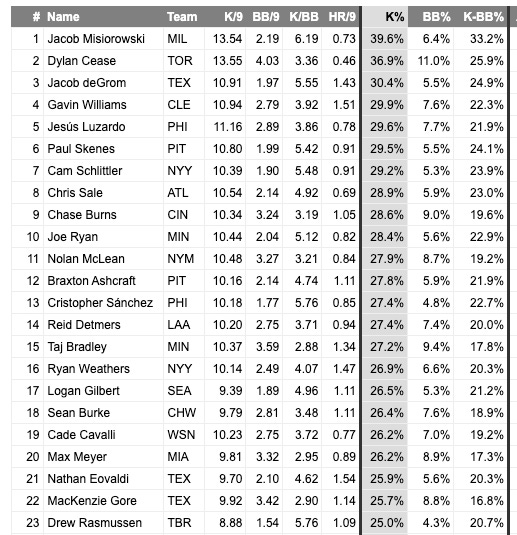
Let’s make that milestone #1: Strikeout rate of 25% or better
Keep in mind, it’s not a hard-and-fast rule - the first name missing from this list is Yoshinobu Yamamoto, who sits at 24.9% (and makes up for that slight underperformance against the frontline starter peer group with an exceptional walk rate of just 5.9%) and would be a fantastic addition to any team’s postseason group, but it’s a good guidestone as we search for answers.
Criterion No. 2: Survive the third trip
As Braves fans are all too aware recently, not being able to get into a lineup multiple times means overworking the bullpen. Atlanta’s starters have been dealing with this over the summer, with Chris Sale’s seven innings on Friday night representing the team’s first six-plus-inning outing since June 28th and the first to go seven innings since mid-May.
Length is the difference between a regular-season starter and a postseason one. October doesn’t reward pitchers who can dominate for four innings; it rewards the ones you trust to face Mookie Betts, Freddie Freeman, and Shohei Ohtani for a third time without immediately reaching for the bullpen.
But how do you quantify this, in an era of “Three Times through the Order” penalties and quick hooks? Fortunately, FanGraphs already tracks it. They offer wOBA for times through the order in their splits selections, so I threw together a quick leaderboard to give us a visual here, too. League average for wOBA is .317, so let’s look and see who is more than 10 points better (with a minimum of 20 innings pitched in those situations).
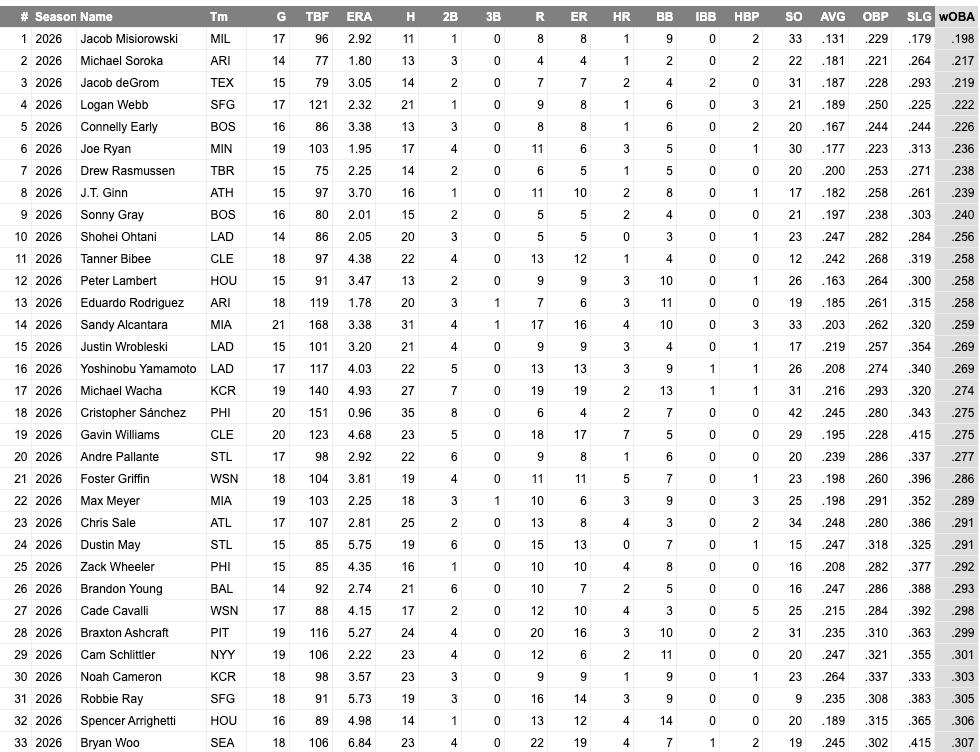
There’s some overlap with the first list here - flamethrower Jacob Misioriowski is likely going to show up every time, as he’s a Cy Young candidate in the NL if he can successfully come back from his current minor arm issue for tonight’s start versus former teammate Freddy Peralta and the New York Mets.
But there are also some names here that don’t show up on the first list, like Giants veteran (and expiring deal) Robbie Ray or old friend Michael Soroka, now of the Diamondbacks.
Criterion No. 3: Win with more than one weapon
This ties into the first two criteria - having multiple plus pitches both helps a pitcher turn over a lineup multiple times and miss bats while they do it. While there are some pitchers who survive based on one exemplary pitch - Cade Cavalli of the Nationals has a slider rated at a 119 Stuff+ and everything else is below average - for the most part, frontline guys have at least two, if not more plus pitches.
This is one of the easiest ways to separate "good" from "great." A lineup can eventually solve one dominant pitch. It's much harder to solve two or three, especially when the stakes are at their highest.
Let’s run the same samples of starters, but sort by overall Stuff+ and denote who has more than one pitch that is not only over 100, but gets to a full standard deviation over at 110 or better.
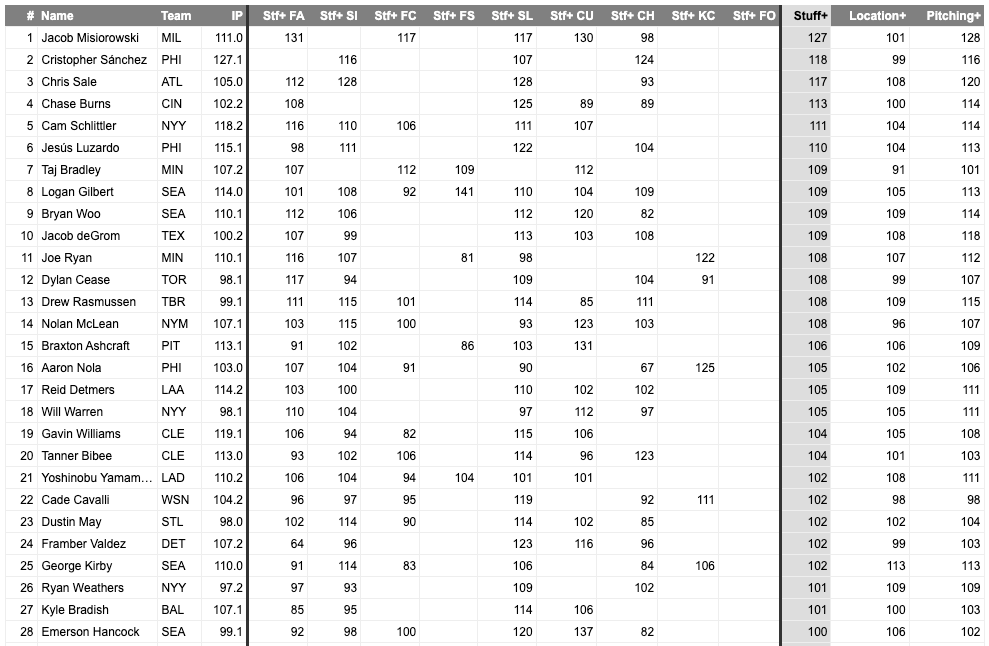
Again, this list isn’t the be-all end-all; the first pitcher missing is Marlins starter Sandy Alcantara and Pirates ace Paul Skenes has two 110+ pitches but an overall 98 Stuff+ as he works through a velo drop this season.
But it’s another example of how tough it’s going to be to find someone with truly great stuff at the trade deadline.
Criterion No. 4: No platoon weakness
Postseason lineups don’t let you hide from platoons. This ties in with the first three points, because generally if your stuff is good enough to turn over a lineup multiple times and rack up the strikeouts, it’s going to get hitters of both handedness out.
Rather than copy-and-paste multiple FanGraphs leaderboards, I went and identified guys in the top 60 of either chart, converted that into a combined score based on their league ranking, and dropped it into a table. The weightings are adjusted for the spread between the figures, with smaller spreads being given preference:
| Rank | Pitcher             | vs. LHB | vs. RHB | Combined |
| ---- | ------------------- | :-----: | :-----: | :------: |
| 1    | Brandon Woodruff    |    6    |    11   |  **17**  |
| 2    | Zack Wheeler        |    13   |    10   |  **23**  |
| 3    | Cam Schlittler      |    17   |    15   |  **32**  |
| 4    | Yoshinobu Yamamoto  |    11   |    20   |  **31**  |
| 5    | Dylan Cease         |    20   |    14   |  **34**  |
| 6    | Shohei Ohtani       |    21   |    1    |  **22*** |
| 7    | Bryce Miller        |    26   |    7    |  **33*** |
| 8    | Christopher Sánchez |    1    |    34   |  **35**  |
| 9    | Trevor Rogers       |    9    |    39   |  **48**  |
| 10   | Cade Cavalli        |    46   |    29   |  **75**  |
| 11   | Noah Cameron        |    44   |    41   |  **85**  |
| 12   | Peter Lambert       |    10   |    54   |  **64**  |
| 13   | J.T. Ginn           |    55   |    2    |  **57**  |
| 14   | Jesús Luzardo       |    3    |    55   |  **58**  |
| 15   | Edward Cabrera      |    52   |    33   |  **85**  |
A lot of overlap with the first few tables on guys like Zack Wheeler and Dylan Cease, but also some new names.
None of these benchmarks is a hard-and-fast rule, and no front office makes decisions from a spreadsheet alone. But when the same pitchers keep appearing across multiple categories, you start to see what Anthopoulos is actually talking about when he says “impact starter.”
So, Who Fits?
These aren't rankings of the best pitchers in baseball. They're rankings of how closely each pitcher matches the profile Anthopoulos described.
Let’s put this into tiers.
Perfect Match (4/4)
These are the pitchers that most closely match every characteristic we identified, being on all four lists. They would get the ball not only to start a postseason series, but you’d want them to have it in an elimination game.
Cam Schlittler
Those are the only two that cleared every filter.
Strong Match (3/4)
Missing one category doesn’t disqualify a pitcher. In fact, several of baseball’s best starters land here because they’re exceptional in every other area.
Jesús Luzardo
Dylan Cease
Yoshinobu Yamamoto
Cade Cavalli
Partial Match (2/4)
This is where the difficult conversations begin. These are very good pitchers, but each comes with tradeoffs.
Chris Sale
Zack Wheeler
Bryce Miller
Trevor Rogers
Peter Lambert
J.T. Ginn
Noah Cameron
Edward Cabrera
Caveats here
I honestly view only two pitchers being on every list (and Chris Sale being on only two of them) as a feature, not a bug. That’s actually encouraging, I think.
If a framework designed to identify profiles instead of greatness occasionally leaves out an obvious ace, it means we’re measuring something different than simply “best pitcher.”
No single metric is perfect, but this also illustrates the tradeoffs that the front office will need to address as they’re evaluating who is available. Do they take a guy with suboptimal stuff if he can get Philly’s lefties out? Do they accept that this guy historically can’t turn over a lineup a third time if he has exemplary stuff and can strike out nine in the five innings he’s actually in the game?
And let’s be clear, these aren’t the only factors front offices consider. Clubhouse fit, injury history, and yes, acquisition cost all matter here.
But taken together, they provide a much clearer picture of what Anthopoulos means when he says “impact starter.”
So who actually clears that bar?
Tomorrow, we’ll stop talking about the framework and start applying it.
Travis was never the same and, after two knee injuries, retired from baseball after the 2018 season at the age of 27.
WOW - great article!
1. I have gained some respect for AA with his admission of whiffing on Zobrist years ago.
2. It's amazing to me that Skubal did not make any of your lists (due to IL time?) It's NOT amazing that no Braves' SP, other than Sale, did not make any list.
3. Number 3 Phillie's SP Luzardo's name pops up more than Wheeler's or Sanchez's! The Phillies and Dombrowski have to be feeling really smug, both for the Division title and the post season.
4. My greatest fear remains: if Boston and Detroit continue to win, AA's options may shake out to Peralta, Wacha, and Detmers. Not good enough. I would rather resign the franchise to waiting 'til 2028 without Sale.
5. IF Detroit stumbles in the next week, Joe Ryan seems like the best guy to go all-in for. (Actually, Mike Soroka may be a real sleeper!😎)