


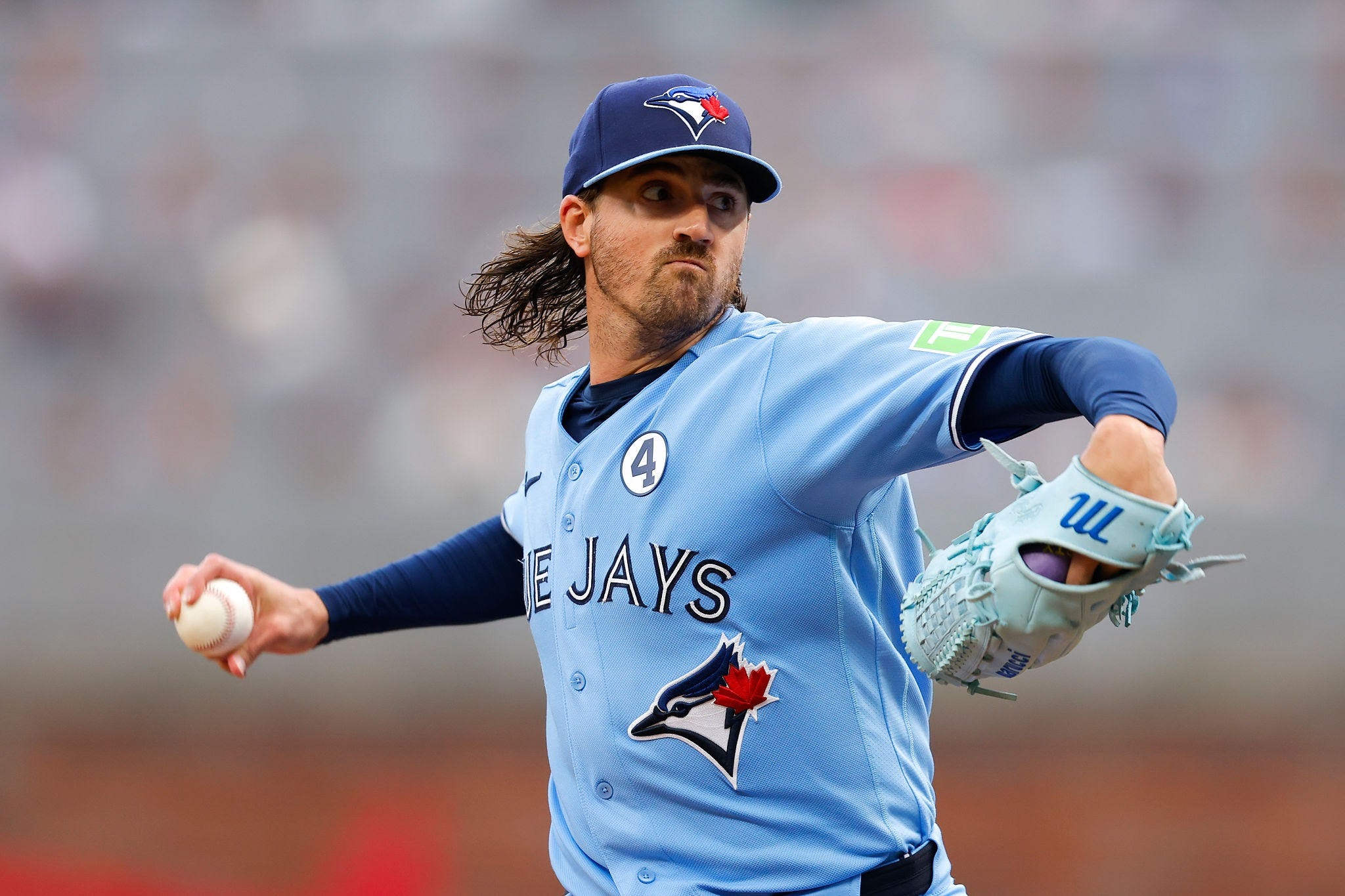
Kevin Gausman is one of those “what if” players for the Atlanta Braves.
Atlanta acquired the former #4 overall pick from the Baltimore Orioles in the summer of 2018 and immediately realized the promise that Baltimore never could - a 2.87 ERA down the stretch, after the right-hander gave the Orioles only a 4.22 ERA in his first six seasons.
But Atlanta got spooked by Gausman’s struggles in 2019, eventually trading him to Cincinnati after 16 dreadful starts - a 6.19 ERA and 1.488 WHIP, with 12 homers allowed.
Unlike the Devon Travis decision that Alex Anthopoulos still regrets, this one was understandable in the moment. The Braves just happened to move on immediately before Gausman discovered the version of himself they had hoped to unlock.
Once he got past the shoulder and foot injuries that hampered him in 2019, Gausman quickly established himself as one of MLB’s most durable and reliable veteran starters. Signing before the shortened 2020 season with the Giants and later moving to the Blue Jays, 2021 was the first of five consecutive 30+ start seasons for the righty, all with ERAs in the 3s (or better) and wth three Cy Young finishes and two All-Star selections.
Seven years later, this trade deadline could give Atlanta a chance to benefit from the version of Gausman it never got to see.
Let’s build the Trade Card.
The Player
Who is he?
Age: 35
How he entered the league: No. 4 overall pick in 2012 (LSU)
Contract: in the final year of a five-year, $110 million contract, earning $23M
Position: Toronto Blue Jays starting pitcher
Stats (conventional): 21 starts, 4-9 w/ 4.51 ERA. 115.2 IP w/ 117Ks, 34 BBs
Stats (advanced): 4.01 xERA, 3.67 FIP, 2.3 fWAR, +4 Run Value (64th percentile)
What kind of player is this?
Kevin Gausman is an aging veteran entering the final stage of his career, but the decline has been gradual rather than sudden. Since breaking out with San Francisco at age 30, he has made at least 30 starts in five consecutive seasons, never falling below 174.2 innings or finishing with an ERA above 4.00.
Despite a drop in his strikeout rate last season (a post-breakout low 24.4%), Gausman covered 30.2 innings last October with a 2.93 ERA as the Blue Jays won the AL pennant and took the eventual World Series champion Los Angeles Dodgers to extra innings in game seven.
He is no longer the Cy Young candidate Toronto signed, but he remains a durable mid-rotation starter with genuine postseason credentials.
Why Atlanta Would Want Him
Gausman can still miss bats.
Throwing a relatively limited three-pitch mix, consisting of a mid-90s fastball, one of the league’s best splitters, and the occasional slider, Gausman still has one of the better chase rates in the league (83rd percentile mark of 34%) and a 65th percentile whiff rate of 27.1%.
Similar to Casey Mize, a previous scouting target of ours, Gausman is a great study in visual styles to Atlanta ace Chris Sale. Gausman has a three-quarters slot (37°) from the right side that’s dropping splitters below the zone, a tough contrast and different sight picture for a hitter that just flailed against Chris Sale’s lefty sidearm sweeping sliders for seven innings.
Gausman’s veteran experience and ability to generate whiffs in a different way than Sale would add another dimension to Atlanta’s rotation in a postseason series. Absent another acquisition, Gausman would immediately become one of Atlanta’s leading candidates to start Game Two behind Sale. He would be a high-quality option that would compete with the rehabbing AJ Smith-Shawver, or injured Spencer Schwellenbach, or some other combination of existing pitchers for Game Three.
There could also be a developmental benefit. Few pitchers understand the splitter better than Gausman, making even a brief overlap with Hurston Waldrep potentially valuable, similar to the dynamic between Max Fried and veteran free agent Cole Hamels.
Why The Blue Jays Might Listen
The two reasons the Blue Jays might consider moving him are his expiring contract and the general disappointment of the season for Toronto.
Gausman’s in the final season of a five-year, $110M deal he signed with the Blue Jays after the 2021 season. It has been one of the rarer nine-figure contracts for a pitcher in his 30s to age well, with Gausman producing more than 20 fWAR for Toronto.
And despite the relative mediocrity of the American League, Toronto’s playoff chances are essentially nil. At 46-55, Toronto’s 12.5 games back in the AL East, 6.5 back in the AL Wild Card (and with five other teams ahead of them), and FanGraphs gives them just an 8.8% chance of making the postseason as of midday Wednesday.
Toronto has already started gauging interest in their expiring deals and are almost certain to move Gausman. Because Gausman has already received a qualifying offer once, Toronto cannot attach another one this winter, meaning if he leaves in free agency, the Blue Jays receive no draft compensation.
The Anthopoulogy Test
Let’s think about this as if we were Alex Anthopoulos.
The Braves are looking for a way to “map out 27 outs” in the postseason, and are open to multiple ways to figure that out. Getting a guy that can miss bats and is comfortable with the unique dynamics of the postseason can help accomplish that goal. Gausman’s 27.1% whiff rate (65th percentile) is better than all of Atlanta’s starters other than Chris Sale (80th percentile) and the injured Spencer Strider (86th percentile).
Additionally, as an aging player on an expiring deal, Gausman (theoretically) shouldn’t cost the same as some of the premier options thought to be available on the trade market in Tarik Skubal, Joe Ryan, and Casey Mize.
Player acquisition is rarely a perfectly rational market, especially in a deadline environment with limited supply and inflated demand.
Gausman also fits a familiar Anthopoulos pattern: a veteran with an established track record, a clearly defined postseason role, and a contract short enough to avoid creating a long-term payroll problem. The Braves would be buying two months of innings rather than assuming the risks attached to his late 30s.
The Obstacles
There are obstacles on both sides that may prevent a deal from coming together.
For the Braves, they may be concerned about the recent slide of Gausman. His season can really be divided into two separate chunks - the first ten games, and the rest of the season since then.
Gausman opened the year with a 3.45 ERA and only nine walks (opposite 53 strikeouts) in 57.1 innings. But something changed after the last outing in that stretch, a six-inning shutout in Detroit - walks.
Gausman’s next 11 starts saw him put up a 5.55 ERA while walking 25 in his 58.1 innings, an increase from 0.9 BB/9 to 2.3 BB/9. Not an egregious total for most pitchers, but a massive jump for Gausman. After allowing more than three runs in just two of his first ten starts, Gausman’s allowed four or more runs in six of the next eleven, including four earned in just 3.1 innings on Tuesday night.
Which version of Gausman would Atlanta be acquiring, the ageless veteran with the swing-and-miss stuff and postseason moxie, or the high-walk, command-challenged veteran he’s been over the last two months?
While for Gausman, there’s an unfortunate consideration we need to discuss: He was previously in Atlanta, and the organization traded him away.
The concern is not simply that Atlanta traded him. It is how his first tenure ended.
While there hasn’t been any published reports of “bad blood” between Gausman and the organization, there was a bit of acrimony towards the end of his tenure - amid an inflated ERA and the pending season debut of free agent signing Dallas Keuchel, Atlanta asked Gausman to move to the bullpen, and he refused. After being traded to Cincinnati, Gausman willingly joined the Reds bullpen and worked on refining his splitter, eventually turning his career around.
While Gausman has a limited no-trade clause, the Braves are reportedly not one of the eight teams he has the ability to block from acquiring him. That being said, many well-run organizations will solicit a tenured veteran’s input if they have roughly equivalent trade packages for the player, allowing them to decide their destination. It’s possible, although currently unknown, that Gausman would choose to finish the season somewhere else were all other factors being equal.
The Trade Card
Trade Card
Player: Kevin Gausman
Position(s): Starting pitcher
Age: 35
Years of Control: Free agent after 2026
Remaining Contract: Approximately $8.2 million remaining (prorated)
Atlanta Fit: ★★★
Acquisition Cost: ★★
Likelihood: ★★★
Anthopoulogy Score: 7/10
Best Argument For:
He’s an experienced veteran who can still miss bats on the strength of his splitter.
Biggest Concern:
A spike in his walk rate is partially to blame for underwhelming performance over the final two months.
Verdict:
Gausman should not be Atlanta’s first call if true frontline starters become available. But if the market never produces that caliber of arm, he offers a credible compromise: durable innings, real postseason experience, and a splitter that still misses enough bats to matter in October.
Final Grade
Pursue at the right price.
FCL Braves season about to end.
There's only one player who deserves consideration to Augusta. Shortstop Manuel Campos.
But Lodise currently has a lock on Shortstop,
Of course they could promote Gil to Columbus and Lodise to Rome.
Good analysis of a truly suboptimal choice......but Gausman is still probably better than any option we currently have after Sale. The Dodgers and Phillies would smile if the Braves decided to make Gausman their 'big' move.