


(Anthopoulogy is Braves Today’s running series in which we step into the shoes of President of Baseball Operations Alex Anthopoulos and evaluate one roster-construction question at a time.)
Reliability is inherently backward-looking: Something is dependable…right up until the moment it isn’t.
Raisel Iglesias made the ninth inning feel boring. It’s one of the highest compliments you can give a closer - in a sport built on uncertainty, the Atlanta Braves could hand Iglesias a lead and reasonably expect it to survive contact with the enemy.
But bringing Iglesias back for his age-37 season wouldn’t mean paying him for the certainty he’s provided during his time in Atlanta; it’s paying him for the possibility that it continues.
And that’s where this becomes uncomfortable. Relief pitching is volatile, Father Time is undefeated, and a “safe” contract for a proven reliever can suddenly turn bad the moment the aging curve bends.
Atlanta’s bullpen would unquestionably be better in 2027 with the version of Iglesias it had in 2026. But how much should the Braves bet that the same version returns?
Welcome back to Anthopoulogy. Let’s talk about it.
The Question
Raisel Iglesias is a free agent, but Atlanta isn’t deciding whether it wants an established closer. It already has one.
Robert Suarez will make $16 million in 2027, and the structure of his contract always suggested he could succeed Iglesias in the ninth inning.
No, the real question is this: What is late-inning redundancy worth? How much should the Braves pay to ensure they have more than one pitcher capable of finishing games?
Because in his Braves tenure, Raisel Iglesias has been really good at it. From August 2022 through the end of the 2026 regular season, Iglesias recorded 131 saves. Only Emmanuel Clase, who missed all of 2026 while suspended, had more with 134. Iglesias has not been perfect - no closer is - but his 17 blown saves are tied for the 3rd-lowest mark among any of the 10 closers with 100 or more saves during that time period.
In a vacuum, it’s a no-brainer to bring back Iglesias for his fifth full season in a Braves uniform; the underlying peripherals were good, and he’s one of the team’s leaders in both the clubhouse and the bullpen.
But we’re not in a vacuum, and it’s possible that his money would be of better use to reinforce a struggling offense or add a starter to a rotation that’s struggling with injuries.
The Current Reality
Iglesias was good in 2026, tying his career-high with 34 saves and putting up his second-best Atlanta ERA at 2.55. He was able to bring back his slider, which was the Achilles heel of his 2025 campaign, and balanced his pitch mix, throwing his devastating changeup practically even with his four-seam fastball’s usage.
But that pitch mix rebalance coincided with a slight drop in velo on the four-seamer, with the pitch losing half a mph. Whether it was the velo or other factors, Iglesias threw it slightly less than the changeup after he returned from a minimum-length stint on the IL in late April for shoulder inflammation.
Despite the two-week break, he still managed to break 60 innings this season and maintained his high-20% strikeout rate, even if he did see a slight tick up in his walk rate from 6% to 7.1%.
It’s hard to argue that a one-year deal for Raisel Iglesias would age that poorly, given the persistence in his underlying fundamentals. But they didn’t survive completely intact - Iglesias saw slight deteoriation in several of his fundamentals, including strikeout rate (-0.5%), whiff rate (-0.9%), hard-hit rate (+2.7%), and barrel rate (+0.9%).
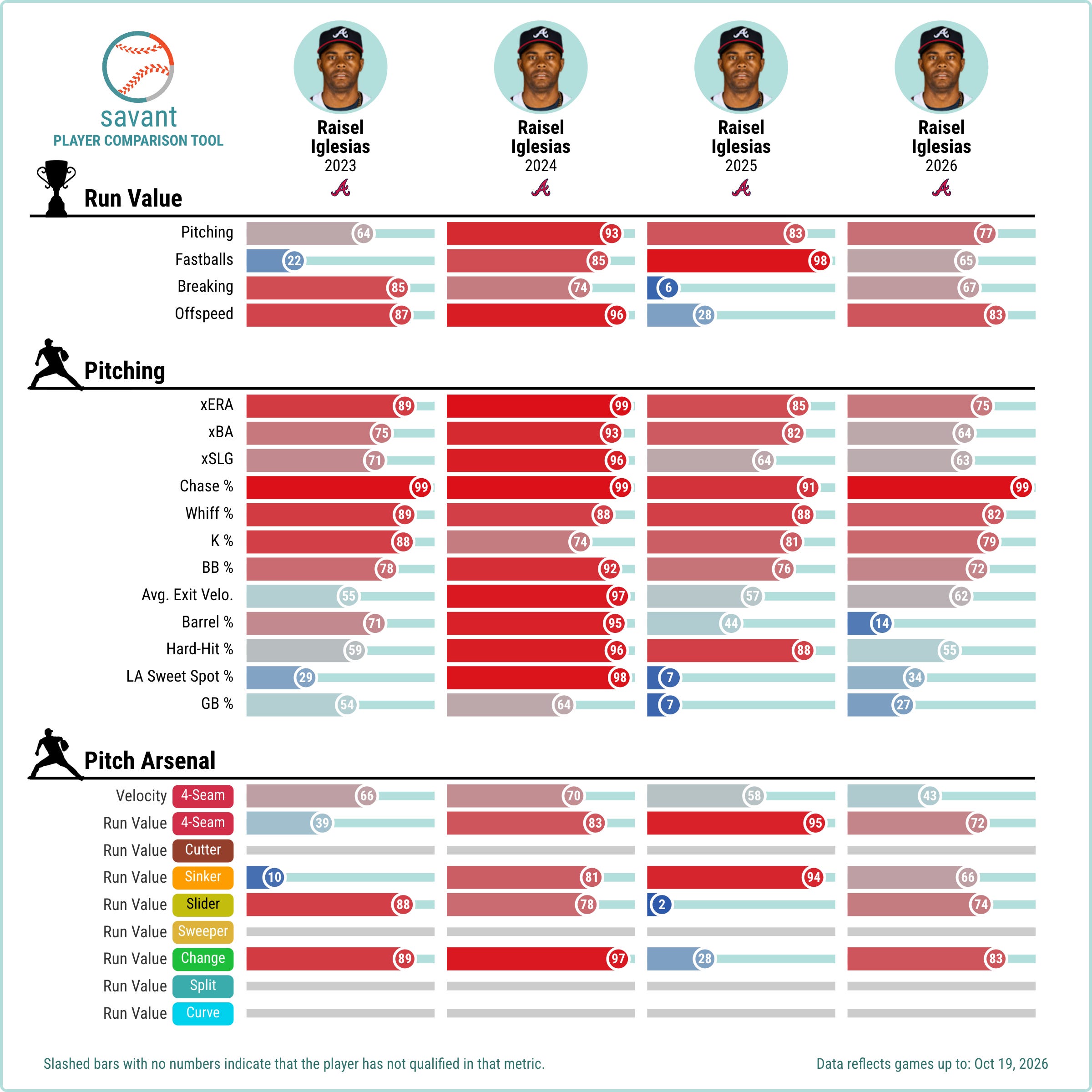
None of these changes in a vacuum signal an imminent collapse…but they probably widen the error bars on either side for a 37-year-old reliever who also spent time on the injured list with shoulder inflammation. Iglesias remained an excellent closer in 2026, but how much confidence can Atlanta place in that remaining true for another season?
Internal Options
If Atlanta were to let Iglesias walk in free agency, his replacement’s already in-house - setup man Robert Suarez. The righty led the National League in saves in 2025 and then signed to be Iglesias’ understudy for a year, but everyone knew what the eventual plan was - Suarez’s three-year contract was backloaded, with his $13M salary for 2026 jumping to $16M once Iglesias hit free agency.
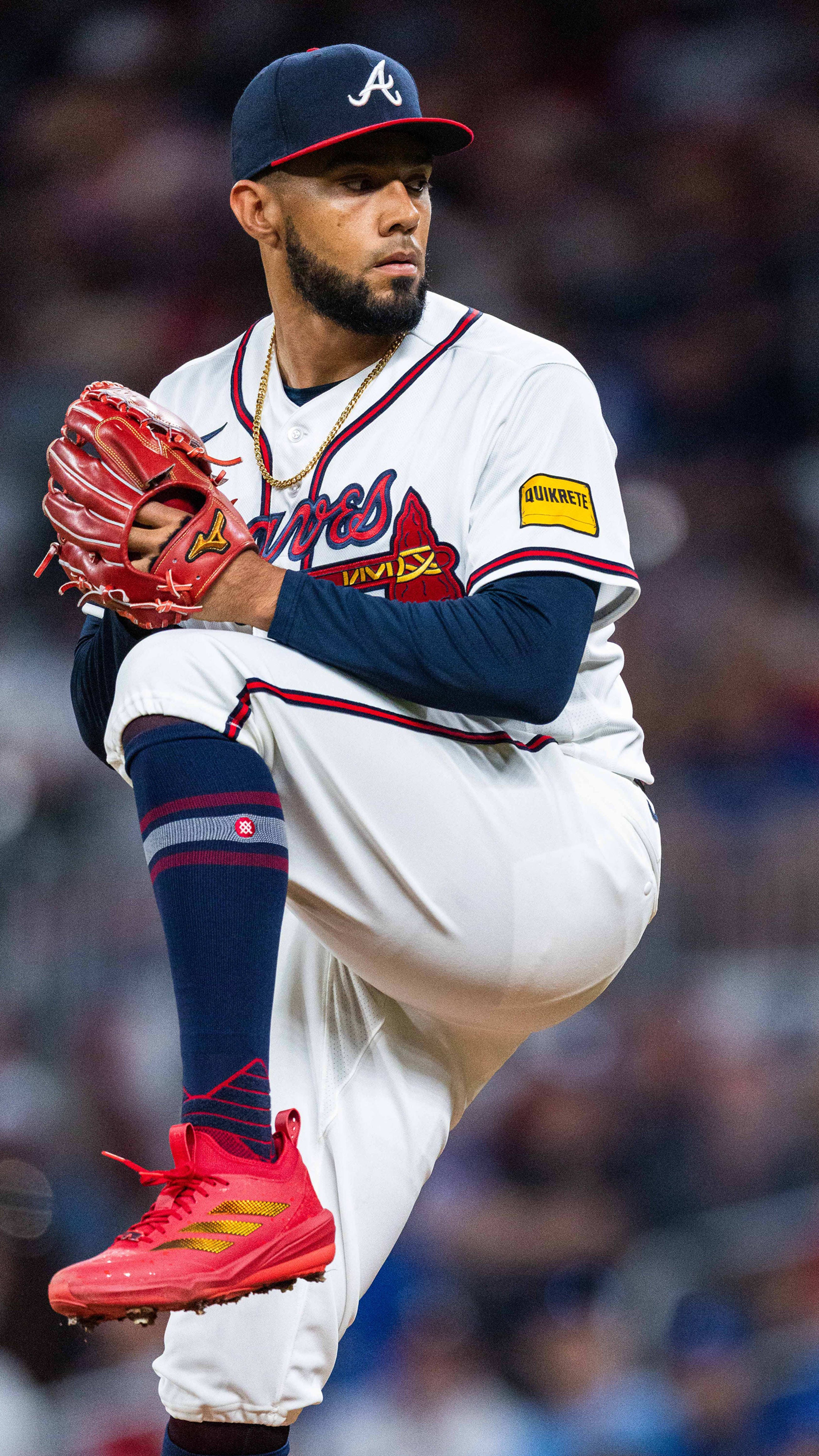
He’s the closer-in-waiting, and filled that role during Iggy’s two-week injured list stint.
But the problem here is two-fold: Who sets up for Suarez, and who covers for him if he suffers another injury? Lefty Dylan Lee had a nightmare second half, allowing a 6.00 ERA. If he can figure out what went wrong (or if it was just small sample size shenanigans, similar to Iglesias’ homer-prone slider in 2025), Lee can step into the now vacated 8th-inning role that Suarez was handling. Dylan Dodd, Atlanta’s own Diet Josh Hader, can likely step into a bigger role, as can postseason hero Ray Kerr.
If Suarez has another injured list stint like this year, where he missed three full months with elbow inflammation, who would step into the closing role? Young flamethrower Didier Fuentes, one of Atlanta’s biggest surprises in 2026 and the arm most trusted to back up Iglesias during the Suarez absence, will enter camp as a starter next year. No one else on staff has the combination of stuff and experience to profile as a backup closer, so Atlanta would need to either go without (which did NOT work in 2025) or spend some more money to find that veteran setup man with the requisite Capital-S Stuff and experience to cover if Suarez misses time.
The Braves could also look to supplement the bullpen with one of their young pitching prospects, hoping to replicate the Didier Fuentes lightning in a bottle. Blake Burkhalter and Owen Murphy both debuted down the stretch, while Luke Sinnard flashed the pure stuff in Double-A to step into a relief role for a year before returning to starting. Cedric De Grandpre is closer to the majors, and his velo bump into the mid-to-upper-90s in Gwinnett this season could allow his 4S/slider combo to eat in a relief role.
External Options
I’m pretty convinced that the Braves would be content to give the closer job to Suarez, so depending on what salary Iglesias was looking for, signing a new setup man could end up being cheaper than bringing Iggy back for his age 37 season.
Adrian Morejon is likely going to be the coveted reliever on the market, as he’s a lefty that’s throwing 99 mph. But he’ll likely get a closer role somewhere, so Atlanta would be stepping into the second tier of relief options - Evan Phillips, Jason Adam, and Gregory Soto. Spotrac’s projections currently have them making between $8M and $13M AAV on a multi-year deal, allowing Atlanta to get marginally younger and cheaper in the bullpen at the same time.
It’s also possible that the Braves lean into Stuff over pedigree, finding affordable relievers with excellent velocity and movement and auditioning them for roles in the 2027 pen. There’s a school of thought that paying relievers is dumb and teams shouldn’t do it, so it’s possible Atlanta focuses on Stuff on some marginal adds and look to see who steps up, allowing them to prioritize spending elsewhere.
As an amateur pitching nerd, I also worry about the overexposure of the same type of reliever; retaining Iglesias would provide role redundancy, but not necessarily repertoire diversity. Both he and Suarez are right-handed relievers built primarily around four-seamers and changeups, creating meaningful overlap in the looks Atlanta would present during consecutive leverage innings.


That doesn’t make either pitcher less effective individually. But it strengthens the case for targeting a left-hander or a reliever with a meaningfully different pitch-shape profile if the Braves look elsewhere.
The Verdict
It’s hard to see the Braves settling their bullpen’s back end in 2027 after subtracting both Iglesias while simultaneously preparing Fuentes for a return to the rotation.
But if the Braves want the comfort of knowing they have multiple options to put out a fire or finish off a win, bringing Iglesias back as a second late-inning option at a lower salary would go a long way towards providing that peace of mind.
Another one-year deal for Iglesias, but at $12-14M as compared to this season’s $16M, would make sense for Atlanta as they work on building some bullpen options in their farm system. But if they do that, it likely requires compromise somewhere else on the roster - If retaining Iglesias prevents Atlanta from adding a starter or diversifying the lineup, is the bullpen certainty worth the sacrifice elsewhere?
It’s also important to acknowledge the agency of Iglesias here, as well. He’s reportedly indicated that he’s been mulling retirement the last offseason or two, and will likely have that same conversation this winter, as well. But just assuming he’ll take a smaller salary and a demotion in role is folly; It may take either a legitimate opportunity to retain the closer role or a salary comparable to this year’s $16 million to bring him back.
The Braves shouldn’t evaluate Iglesias against the cost of doing nothing. They should compare him with the roughly $9 million it may take to acquire a less familiar setup reliever. At the end of the day, the Braves will likely pay a modest one-year premium to make the ninth inning boring. Hopefully, Father Time doesn’t make it interesting again.
If i were gonna convert Fuentes to Starter, I would look to resign Iglesias or add another Reliever.
Could have brought De Grandpre up in September and looked at him as a Starter or Reliever. But they're not that Smart.
Agree 100%. Signing a premium reliever, that can cover 50+ leverage innings and likely wants a one-year deal is a great move. Braves have experience with multi-year reliever deals bringing significant risk.