


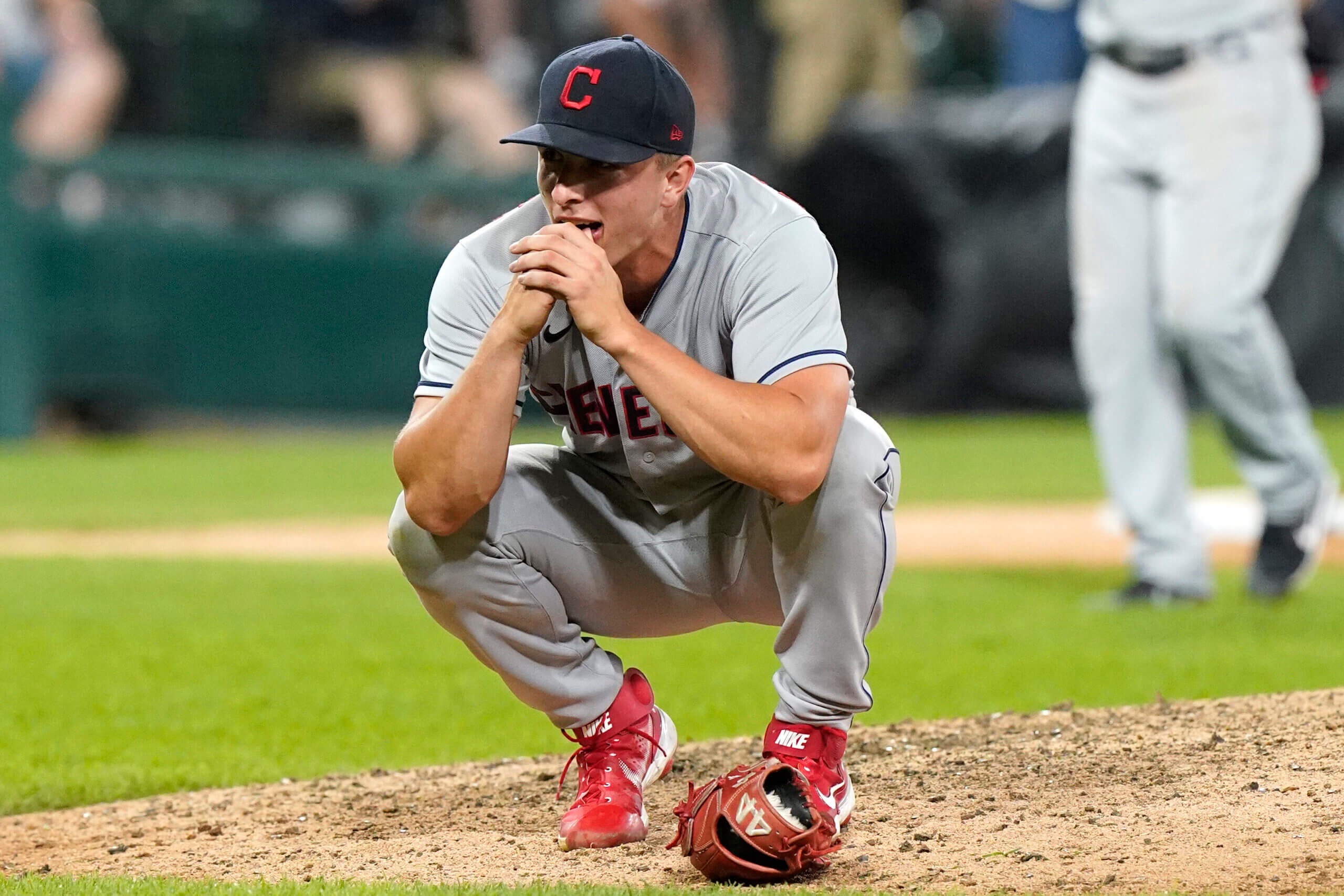
Often, it takes some time to return from a severe injury as a professional athlete.
Atlanta Braves fans saw that firsthand in 2025, with strikeout artist Spencer Strider forced to paint with a smaller canvas as he returned from injury and his stuff wasn’t fully back.
There’s a chance that one of Atlanta’s offseason acquisitions might be able to defeat his own injury-induced woes. The Braves signed free-agent reliever James Karinchak, a former Cleveland Guardian, to a minor league deal last week, and he’s presumably being invited to spring training. If he makes the Opening Day roster, it’ll be his first time in the majors since September of 2023.
It takes time and concentrated effort to get back to peak form after a catastrophic injury. A weekend thread from New Jersey-based baseball lab Baseball Performance Center gave hope that Karinchak might have already done so.
Let’s talk about it.
Dominance, interrupted
Karinchak debuted in late 2019 and quickly became one of MLB’s more underrated late-inning relievers. In 174 games from 2019 through 2023, he had a 3.10 ERA and 253 strikeouts in just 165.2 innings, sporting an impressive 36.3% strikeout rate. His crowning achievement was the 2022 season; predominantly pitching the 8th inning ahead of now-suspended and indicted Emmanuel Clase, Karinchak went 2-0 with a 2.08 ERA, striking out 62 in just 39 innings, an eye-popping 38.8% strikeout rate.
But injuries quickly felled the setup man, with both a teres muscle strain and right shoulder inflammation and fatigue combining to wipe out a significant portion of his mid-20s. After being released by Cleveland late in 2024, he was on a minor-league deal with the Chicago White Sox, but they released him from their Triple-A affiliate’s roster in June.
After the shoulder issues, his stuff just wasn’t the same. During his prime with Cleveland, Karinchak was a two-pitch guy, pairing a mid-90s fastball with elite Induced Vertical Break (20.8 inches) with a deadly 12-to-6 curveball that sported whiff rates near 50%.
Last year in Charlotte, he was throwing just 92.7 with a curveball that whiffed only 33.8% of minor leaguers he faced.
But “The Northeast’s Top Baseball Facility”, as the Baseball Performance Center bills itself, may have fixed the once dominant New York-born Karinchak.
‘We can rebuild him. We have the technology’
Having not spoken with BPC specifically, but generally understanding how these things work, let’s talk about the intake process for a player to come into a pitching lab.
It all starts with collecting information. A typical process, after discussing the situation and what you’re hoping to achieve, is getting you plugged in to various pieces of equipment to understand the way your body moves:
Force plates, either single-axis or tri-axial, embedded in the ground to understand how much force your pitching motion is generating
A biomechanical analysis, either with markered (through placing dots on the body) or markerless motion capture, is turned into a wire model of the human body.
Wearable sensors, to track everything from effort/exertion to oxygen capacity, blood flow, and even brain waves.
The goal of all of this information is to understand how your body moves now, both good and bad, so it can be adjusted to optimize your movements and generate the best possible results from the mound.
And with Karinchak, it uncovered quite a few things he had started doing wrong as his body tried to adjust to the various injuries.
For starters, Karinchak’s release point had drifted up over the last few seasons, from under 78 inches to over 81 (as measured from the pitching rubber). That might not sound like much, but increasing the arm angle like that means that the pitches both come out of the hand on a slightly different spin axis and end up moving differently during the flight to the plate.
A lot of Chris Sale’s early-season struggles in 2025, which we wrote about in April, came down to mechanical issues that resulted in his sidearm angle dropping. This negatively impacted both the movement of his pitches, with the sinker in particular being notably worse from a movement perspective, as well as his accuracy and ability to land the pitches in the zone.
Another easily observable issue plaguing Karinchak was his diminished velocity. After averaging 95 mph and maxing out at 99 in 2021 & 2022, he was averaging under 93 and not breaking 95 in the minors this last season. Some of this will naturally return the farther he gets away from the injuries, which gives me hope for Spencer Strider to return to form, but some of the problems for Karinchak were also related to the balance of his weight from the back foot to the plant leg as he was going through the pitching motion.
BPC set out to rebuild Karinchak’s delivery, focusing on better alignment of the body early in the delivery, how and when in that delivery he shifted his center of gravity and weight, and rotating his body to the target (the catcher) instead of through and towards the left-hand batters box.
The result? His first post-adjustment bullpen had him averaging 95 mph throughout, significantly closer to the old velocity.
Is Karinchak completely back? Not in the slightest. He still needs to do it against live hitters, as well as in competitive/game situations and on back-to-back days. But those are all things he’s done before, and it’s a matter of getting back there, which will come.
And in the meantime, he’s on a minor league deal, set to make roughly the league minimum if he’s selected for the Opening Day roster…and with just over four years of service time, he’d be controllable for 2027, as well.
It might not be a flashy move, but if it works, it will be seen as an insanely good move.
Merrill Kelly just got $40 million/2 years. Braves aren' gonna get a Starter in this Pitcher's Market.
Go ahead and get Kim, if possible.