


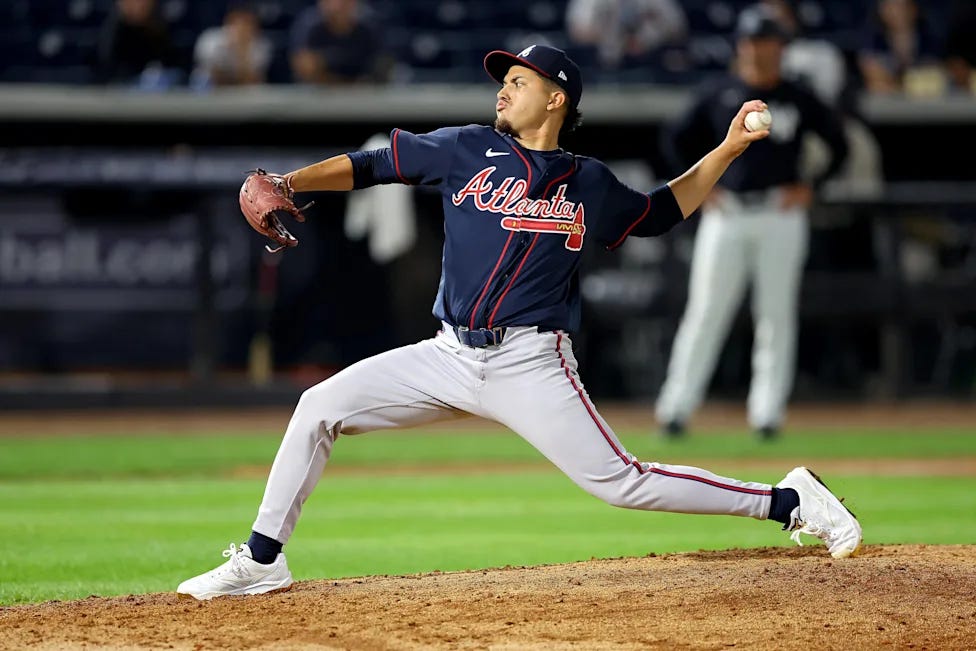
Herick Hernandez is the most unhittable pitcher in Atlanta’s farm system. He’s also the most unfinished.
He got the ball for Gwinnett against the Norfolk Tides on Wednesday and was dominant - eleven strikeouts in 6.1 innings, allowing just two runs on two hits. He had a Triple-A-leading 22 whiffs on Wednesday (56%) and an absurd 40% CSW.
He also walked four batters and threw three wild pitches, being in the zone just 37% of the time.
Herick Hernandez can already miss major-league caliber bats. Now he has to prove he can consistently find them.
Let’s talk about it.
This Isn’t Really a Surprise
The Herick Hernandez backstory bringing him to Atlanta shouldn’t surprise anyone who has paid attention to the way the Braves run their drafts: graduating from high school as a centerfielder, he didn’t start pitching until college. After sitting 86 during a brief stop at Barry University his freshman year, he transferred to Miami Dade and quickly became their ace, going 8-3 with a 2.86 ERA and 90 strikeouts in 78.2 innings as a sophomore.
That was enough to get the attention of some MLB teams, but just barely. Cincinnati took him as a draft-eligible sophomore in the 19th round, but he declined to sign and instead transferred to the University of Miami. His move to the ACC was…messy. He went 3-7 with a 6.14 ERA, but he did strike out 95 in just 70.1 innings. Atlanta looked past the ERA, selected him 129th overall in 2024 and signed him for $472,500.
And he’s already in Triple-A, having gone from an 86-mph converted outfielder to a Gwinnett starter who touches 97 in about five years. That lack of pitching experience prior to college is why Atlanta was so high on him in the first place, as one of their scouting lodestars is finding players who have more development ahead of them than their cohort, whether through injury, a multi-sport background, or a late position change.
What The Braves Have Built
What’s that, an undersized ACC pitcher with a great IVB fastball and gyro slider pairing that has questionable secondaries? There’s a reason he’s been called the “Spencer Strider Starter Kit” throughout his time in Atlanta.
But unlike Strider, the Braves had more work to do here.
Atlanta wasn’t taking an established college pitcher, sanding down the rough edges, and applying some polish. They identified the fastball’s shape, created a plus slider, and are attempting to add enough pitches and command around the pair of weapons to “Build-a-Bear” themselves a starter.
The four-seam fastball averages roughly 93, but he can run it up to 97 and it carries about 19 inches of induced vertical break.
The slider is a classic mid-80s gyro, pretty solidly considered a plus pitch by all evaluators. It’s produced a whiff rate of 50.7% in Triple-A so far this year, out of 142 thrown.
The split-change sits in the mid-80s and is still developing, but its ability to be a weapon that moves down and away from right-handed hitters means that they’re going to keep working on this until it’s there.
And the curveball, thrown in the upper-70s, might be the biggest thing keeping him in the rotation instead of the bullpen.
The Curveball Changes the Conversation
Most 5-10, fastball-and-some-other-stuff college pitchers end up as relievers at the next level. An undersized pitcher with a fastball-slider foundation and questionable command usually gets moved to shorter outings, where the arsenal can be narrowed and the velocity can play up.
Not Herick Hernandez, and it’s because of the emergence of the curveball.
Since he entered the system, Atlanta tweaked his arm slot, dropping it a bit, and refined his old college curveball into an actual weapon.
You saw it in action on Wednesday night.
In the outing vs Norfolk, Hernandez threw 90 pitches: 34 four-seamers, 28 sliders, 24 curveballs, and four offspeeds. Nineteen of his 22 whiffs came on secondary pitches, with the slider and curveball accounting for 17, a 58% CSW, and nine of his eleven strikeouts ended on one of the two pitches.
SIDEBAR: I’m sticking with “offspeed” here because while Hernandez has been throwing a splitter as his primary offspeed pitch per all the public scouting reports, Wednesday’s movement profile—14 inches of arm-side run and 11 inches of induced vertical break—looked more like a firm changeup than a traditional splitter to me. ¯\_(ツ)_/¯
And then the third time through the order, the curveball was the primary weapon, being used at a 43% rate.

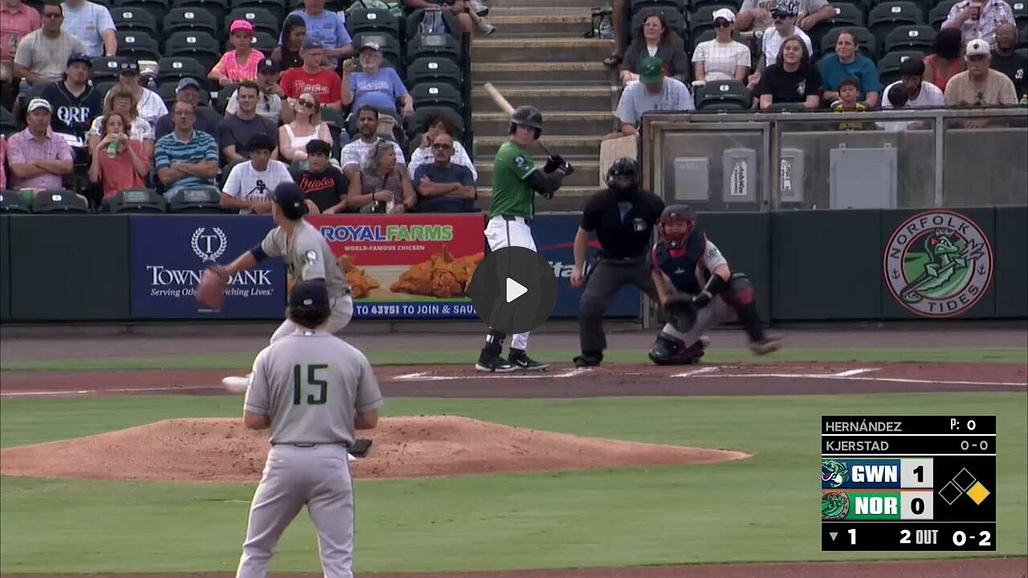
And unlike its reputation, the fastball was merely an accessory player, filling out the company, rather than the top-billed star. Averaging 92.7 and topping out at 94.3, it picked up only three whiffs and a 12% CSW. The direct contribution of the fastball was soft contact, with one hit on nine batted balls and an average exit velocity allowed of only 83.6 mph. The other ‘glorious purpose’ of the heater was as visual contrast and to establish the top of the zone, being thrown upper rail to establish that part of the zone as a target to guard against and to keep hitters from committing entirely to spin.
Hernandez wasn’t surviving because Triple-A hitters couldn’t catch up to premium velocity. This was a breaking-out prospect thriving by overwhelming hitters with dramatically different vertical looks from the same general release area.
The slider’s dominance was…pretty much what we all expected at this point. The way Hernandez used his curveball was the meaningful development.
The curveball is roughly 4.5 mph slower than the slider, 79.3 mph to 83.8 mph, and features 14 additional inches of drop. Consequently, Hernandez used them differently.
The slider was the chase pitch (58%), used to finish plate appearances.
The curveball was thrown in the zone more frequently (46%), stealing eight called strikes and changing the eye level of hitters.
And Hernandez sequenced them well, too:
First time through: 57% fastball, 29% slider, 14% curve.
Second time through: 38% fastball, 38% slider, 22% curve.
Third time through: 20% fastball, 27% slider, 43% curve.
That’s a real sign of maturity and confidence for a young pitcher. Hernandez didn’t just stick with the same fastball-slider combination and hope it remained unhittable. He altered the shape, eye levels, and speed of the matchup each time they saw him, and that’s the type of sequencing a starter needs to navigate a lineup repeatedly.
Not So Fast, My Friend
Despite the dominance and polish of the outing on Wednesday, some of the same problems remained for Hernandez.
He walked four in his 6.1 innings, a combination of being in the zone only 37% of the time and throwing only 56% first-pitch strikes. So many breaking pitches down below the zone meant he was charged with three wild pitches as well.
The outing really only worked because he got a 37% chase rate, which is partly a credit to him and his ability to induce that chase, but also something that likely takes a small step back in the majors, where the skill level is higher.
And this wasn’t just warning signs in one start, either; these are all known issues that have followed him throughout his minor league career.
He walked 68 hitters in 103.1 innings last season, and gave out 31 free passes in 45 innings for the Double-A Clingstones earlier this year. His second-half surge in 2025, one that saw him put up a 1.50 ERA after June 24th for High-A Rome, was mostly due to better batted-ball outcomes instead of fewer walks. He gave out 41 free passes in his 48 innings during that stretch (a .322 OBP), but held opponents to a .252 slug thanks to just nine total extra-base hits.
In 2026, his walk rate is hovering around 16% to both righties and lefties, and first innings have been particularly brutal from a command perspective - 16 walks to 27 strikeouts in 84 batters faced.
Wednesday was evidence that his stuff can absolutely overwhelm Triple-A hitters despite below-average control. It did not demonstrate that the control problem has been corrected.
And make no mistake, a 15% walk rate has to be corrected for Hernandez to be a viable major-league starter.
Major league hitters will be less willing to chase the slider, forcing more fastballs in the zone in predictable counts. His fastball shape can produce soft contact, but with only modest velocity, there’s a much smaller margin for error when it comes into the heart of the plate.
92 mph fastballs with 19 inches of IVB in the heart of the zone have allowed a .304 average and .594 slug, getting whiffs only 15.5% of the time and putting up a -2.57 RV/100.
Change that to middle-middle and it becomes a .357 average and .705 slug.
Can He Stick As a Starter?
There’s a case to be made either way here, and they both make a ton of sense.
The Case for Continuing to Start Him
He throws four distinct pitches, which include two legitimate whiff options in the breaking balls. He doesn’t have significant platoon issues, either. Lefties have a .684 OPS against him this season, while righties are at .662. The walks are essentially identical against both sides, while Hernandez has actually struck out righties more frequently.
He was able to handle 100 innings in his first full season, including both multiple outings of six or seven innings and the ability to hold his velocity through the seventh on Wednesday.
And most importantly, he showed he’s willing and able to change his pitching plan the third time through the order.
The Case for Relief
His walk rate consistently remains around that six per nine innings mark, and it’s not a Blake Snell-like “I’m not giving you anything to hit” walk rate. Being 5-10, 205 creates both workload and repeatability concerns. Most significantly, the fastball/slider pairing gives him an immediate high floor in shorter appearances, minimizing his need to focus on locating the curveball and changeup over six innings. Plus, the reliever velo bump might allow him to throw that heater at 95, instead of 93, and touch 98 or 99 instead of 97.
What To Do Here
Atlanta should keep developing him as a starter. His breaking ball depth and ability to hold the stuff deep into games remove any immediate need to kick him into the bullpen for developmental reasons. If the Braves need him in the majors soon-ish, the bullpen’s still his likely entry point, but that should be viewed as the path of least resistance rather than a predetermined ending point for him.
At the end of the day, Herick Hernandez no longer looks like a two-pitch reliever that Atlanta’s trotting out there as a starter every fifth day. He’s beaten the bullpen allegations…to an extent. He looks like a starting-pitching prospect who happens to be carrying substantial bullpen risk. The curveball keeps the potential rotation outcome alive. The command will decide if he ever reaches it.
Excellent prospect write-up, plus my wife was impressed with the shrugging smiley macro.
Nice to hear about a big arm down on the Farm. Other than Fuentes and maybe AJSS, we don't see many high velocity guys like Philadelphia and San Diego keep rolling out. Velo isn't everything but 'it ain't nothing, either'.