


The Atlanta Braves are 22-10 with a 6.5 game lead in the NL East with no shortage of positive stories - great contributions from role players like Mauricio Dubón (.275, 15 RBI) and Dominic Smith (.338 and 17 RBI), a potential breakout starter in Bryce Elder (3-1, 1.88 ERA), and a young catcher in Drake Baldwin who is blossoming into one of baseball’s best hitters before our eyes, hitting .308 with seven homers and 25 RBI.
So why are we talking about third baseman Austin Riley?
Because he’s been downright bad this season, and it’s becoming a problem. Let’s talk about it.
Quantifying how bad it’s been
Austin Riley is hitting .190/.274/.314 with three homers and 17 RBI. And to be clear, Riley’s not the only Braves player that hasn’t yet gotten going in 2026. Fellow ‘aircraft carrier’ Ronald Acuña Jr. is hitting .240 this season. But Ronald’s also riding an eighteen-game on-base streak and is carrying a .375 OBP, showing that he’s still capable of contributing to the offense.
Riley isn’t doing any of that. He just wrapped up the team’s series against the Detroit Tigers with no hits in 11 at-bats and struck out eight times. In the last ten games, he has just two hits (both doubles), with 14 strikeouts and three walks.
It’s only the second time in Riley’s career that he’s recorded two or fewer hits across a ten-game stretch, per Stathead. That was in his debut season of 2019, where he went 2-21 in the majors but also was injured in the middle of that stretch; this span started in late July and ended in early September, with an injured list placement and a minor league rehab stint in the middle.
He’s not seeing the ball well, is what I’m saying.
What is wrong with Riley?
According to him, it’s a problem of where he’s making contact with the ball. He went on 680 The Fan on Monday morning from his charity golf tournament and explained his struggles:
”You know, I think it just comes down to, you know, it’s kind of been it’s been a little weird because like I said, the strikeouts aren’t there. It’s like the walks are up a little bit. It’s like, you know, I’m putting the ball in play. It’s just not hard contact. And I think that’s just a contact point (problem).”
And it’s amazing how quickly things can change - Riley had just four strikeouts in his previous six games, but he added eight strikeouts in three matchups against the Tigers this week.
But back to Riley’s claim: that he’s not getting hard contact and struggling with the intercept point. Is he on to something here?
On the hard contact idea, Riley’s got a point. This season, Riley sits at just a 43.7% hard-hit rate, which is defined as a batted ball of 95 mph or harder. He’s averaged between 49% and 53% in each of the past four seasons, so there is a noticeable and measurable slip in his batted ball quality.
And on the contact point problem, Riley’s got the right idea, but the wrong timeframe. Thanks to Statcast’s bat tracking data, we can quantify where the slugger is making contact, called the “intercept point”. It’s slightly deeper in the zone versus last season, now sitting at six inches in front of the plate. Last year, this figure was 6.7 inches in front of the plate, so he was actually even earlier to the ball last season.
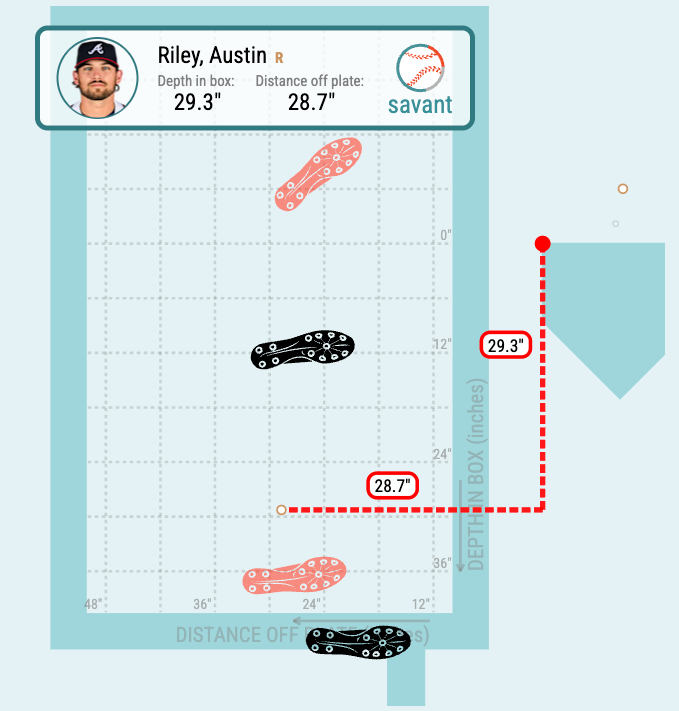
But in 2023, the last of his monster offensive seasons so far, that intercept was only four inches from the front of the plate. This season’s six inches actually matches 2024’s figure exactly.
This isn’t a 2026 problem; it’s a ‘the entire last three years’ problem.
I’ve got a different theory.
Is the sports hernia still bothering him?
Riley went down last August for what the team termed “core muscle surgery”, which was to fix a soft tissue tear in the lower abdomen. It was an issue that plagued him for much of the season, with the infielder first experiencing discomfort in early June. After an IL stint that spanned the All-Star Break, he re-aggravated the injury in Bristol at the Speedway Classic and had season-ending surgery in mid-August.
It’s a surgery with a high rate of success - Baylor University Medical Center has quantified a 98% success rate of the procedure among an elite athlete population, focused on professional and collegiate competitors.
But just because players can return to competition within three months and usually no more than six does not mean there are no lingering performance impacts, both in the short term and for the player’s career. A 2017 study published in the Orthopedic Journal of Sports Medicine, examining NFL players who had surgery for sports hernias, showed that those players who received surgery would play fewer games nd have shorter careers post-surgery than matched controls.
Similarly, a 2013 study of NHL players focused specifically on measuring performance levels before and after surgery found that veterans of the sport, which they defined as players with seven years in professional hockey, exhibited significant decreases in their overall performance levels versus early-career surgery recipients and control groups of both demographics.
Austin Riley was drafted in 2015 and is entering his tenth full season in professional baseball and eighth in the majors.
The most common long-term effects on performance from a sports hernia repair are reduced core strength, scar tissue formation, and psychological barriers in the athlete.
On the note of reduced core strength, Riley is exhibiting the lowest bat speed of his career since the advent of Statcast bat tracking at the midpoint of the 2023 season. Riley’s 74.8 mph average bat speed, while still well-above the MLB average of 71.7 mph, is about 1.5 mph slower than in his 2023 season’s second half and down over one full mph from last year. His ‘fast swing rate’, or the percentage of his swings that exceed 75 mph, has collapsed from last year’s 60.5% to just 48% in 2026.
What’s the big takeaway here?
The easiest and most reassuring explanation for Riley’s struggles, assuming there isn’t another underlying issue, is a small but noticeable drop in performance as he continues working his way back from last year’s abdominal surgery.
A minute drop in bat speed, combined with approach issues as he’s pressing to get out of an extended slump that has now reached 32 games, could be mostly to blame for his significant struggles.
And lingering performance effects after a player returns to competition shouldn’t be a surprise at this point to Braves fans. Ronald Acuña Jr. famously struggled in 2022 after returning from his ACL tear, one that impacted the length and intensity of his rehab leading into his 2025 return to play. Ozzie Albies, who broke his wrist late in the 2024 season, saw a notable increase in his bat speed in the second half of the 2025 season, peaking at 69.9 mph after being a mile and a half lower early in the campaign.
Is it possible Riley’s in for a performance upswing in the second half? It’s possible, but there’s more to fix than just Riley’s swing speed. Hitting coach Tim Hyers and hitting consultant Chipper Jones have their work cut out for them over the next few weeks.
There are also reasons to believe that this is more pitch recognition and approach-driven than mechanical. For instance, Riley’s struggles seem to only be against right-handed pitching. With the caveat of small sample sizes, Riley’s hitting .310/.396/.452 with a sub-20% strikeout rate versus left-handed pitching, but .190/.274/.314 with a nearly 30% strikeout rate against right-handed pitching.
He’s not seeing right-handed pitching well, specifically breaking balls. Riley is currently outperforming last year’s rate stats against fastballs, which would make sense if he were severely impacted by the abdominal injury last year. But sliders, sweepers, and curveballs are all giving the slugger fits, with whiff rates nearing or surpassing 40% on the entire pitch group.
So what’s actually going on here?
This isn’t just one thing.
It’s not purely mechanical, even if the bat speed dip is real. And it’s not purely approach, even if the pitch recognition issues against right-handed spin are obvious.
It’s both.
A slight drop in bat speed narrows Riley’s margin for error. When that’s paired with chasing more breaking balls and struggling to pick them up early, the result is what we’re seeing now: more swing-and-miss, weaker contact, and fewer balls driven in the air.
That’s how a small change turns into a big problem.
What does Atlanta do in the meantime?
The hard part here is that the Braves are a bit limited in their options while Riley works to figure it out, both from a core-strength and a hitting-approach standpoint.
With centerfielder Michael Harris II limited to designated hitter duties during the pending three-city road trip, Atlanta will need to deploy infielder Mauricio Dubón on the outfield grass as Atlanta faces lefty starters and strong-side platoon bat Mike Yastrzemski is relegated to the bench.
Thursday’s loss to Detroit was the first time that Atlanta has given experienced third baseman Kyle Farmer a start, putting him at designated hitter. The veteran has just three defensive innings at third base this year as he’s been mostly relegated to the final spot on the bench. Additionally, Farmer’s core value lies in his ability to hit lefties, which is something that Riley’s not struggled with to this point in the season.
The solution may end up being to leave Riley in the lower third of the lineup, especially against right-handed pitching, and wait for him to figure it out. It does appear that more of this is mental than mechanical, so it should theoretically be fixable with enough reps, coaching, and guidance.
The Bigger Picture
The good news for the Braves is that none of this looks permanent.
Riley is still producing elite exit velocities. He’s still capable of handling velocity. And against left-handed pitching, he’s been exactly the hitter you’d expect him to be.
The foundation is still there.
But until the swing decisions against right-handed pitching improve (and until the bat speed fully returns), this version of Riley is going to be inconsistent at best.
That puts Atlanta in a difficult spot.
Because there isn’t a real replacement, and there isn’t a shortcut.
The only path forward is time, reps, and Riley figuring it out.
And based on his track record, that’s a bet worth making.
But right now, it’s still a bet.
Austin Riley is under contract with the Atlanta Braves through the 2032 season, with a guaranteed 10-year, $212 million extension signed in August 2022.
Can this turn around? Yes. Will it turn around? IDK.
If it doesn't this contract will be an albatross going forward. Nobody is trading for him at his current level of non-performance. He needs to get it figured out. And the sooner the better.
The one thing I believe the Braves held their hat on was that Riley would make the adjustments. When he finished his 1st year the Braves asked him to change his body. He did the thing they did not expect. He reconfigured his weight and his flexibility. In every level he would struggle and then take over. It is simply crazy he has not found a way to adjust due to his injuries. I miss him.