



When Atlanta’s first pick of the 2025 MLB Draft was announced, plenty of Braves fans were surprised. Not only did they pass on a pitcher, which many expected them to target based on recent history, but they selected a prep position player who most public draft boards ranked outside the top 30 prospects in the class.
With the 22nd overall pick, Atlanta selected Nevada prep shortstop Tate Southisene out of Basic High School. Just one year earlier, his older brother Ty had signed an over-slot deal with the Chicago Cubs in the fourth round.
At the time, Southisene’s selection left many scratching their heads. He was not one of the marquee prep names in the class, nor did he fit the profile many expected Atlanta to target. In hindsight, it may have been the first glimpse into a draft strategy that could become a trend under Ronit Shah and Alex Anthopoulos in future drafts. With another draft just weeks away, we may soon find out.
After signing, Southisene was assigned directly to Single-A Augusta, but the results were rough. Across 15 games, he hit just .219 with a .539 OPS. Even more concerning was the approach. He walked at only a 1.5% rate while striking out in 40.9% of his plate appearances.
Fast forward to 2026, and the conversation around Southisene looks completely different. In 51 games with Augusta this season, the 19-year-old slashed .297/.429/.500 with a .929 OPS, a 154 wRC+, and 36 stolen bases. Just as impressive, he raised his walk rate to 15.4% while cutting his strikeout rate nearly in half to 21.3%.
That performance earned him a promotion to High-A Rome less than two weeks ago. Through his first seven games, he has collected five hits, including three doubles, while drawing five walks.
At just 19 years old, Southisene is already putting himself on a timeline that could make him one of the organization’s fastest-rising position-player prospects.
Now the questions surrounding Southisene are much different. Can he stick at shortstop? Will the bat continue to develop? And just how high is the ceiling?
Let’s dig into it. (stats as of 6/15/26)
Is He Actually A Shortstop?
There is an old saying in baseball, one that comes up a lot at draft time, that if a player can handle shortstop, he can probably handle just about anywhere else on the field. Shortstop is typically reserved for some of the most athletic and instinctive players in the game. You can typically move a shortstop around the diamond and into the outfield with relative ease. The reverse is usually much harder.
Southisene played shortstop in high school, but he also bounced around the diamond before officially taking over the position full-time after his brother was drafted.
When Atlanta selected him, there was immediate speculation that his long-term future might be somewhere other than shortstop. The Braves' usage has only fueled that discussion. In 73 professional games so far, Southisene has started only 20 times at shortstop. He has started 45 games at second base and spent another eight games serving as a designated hitter. He has yet to play the outfield, but some speculate he may end up there in the future.
Last season, Atlanta gave fellow 2025 draftee Alex Lodise the bulk of the shortstop reps in Augusta. This year in Rome, John Gil has received much of that opportunity.
That does not mean Southisene cannot play the position. The tools are there. He has plus speed, a 60-grade arm, and enough athleticism to make the routine and difficult plays alike. There have been stretches where the errors have been an issue, but that is not uncommon for a young infielder still refining his game.
Personally, I can see the appeal of second base or even centerfield. His speed and arm strength could play up even more in those roles.
What has been interesting lately is that Atlanta appears to be giving him more opportunities at shortstop than they had earlier in his professional career. Whether that is coincidental or intentional, it feels like the organization is taking a longer look at whether he can stick there. And frankly, they should.
With Gil, Lodise, three top 50 picks in the upcoming draft, and potentially top international prospect Alfredo Sena joining the system next year, the competition for infield playing time is only going to increase.
Ultimately, the bat may determine everything.
That’s part of what makes Southisene’s first full professional season so encouraging. Rather than relying solely on raw athleticism, he’s showing measurable improvement in the areas teams value most: plate discipline, swing decisions, and quality of contact. Those are the kinds of developmental gains that tend to translate as players climb the ladder.
Will The Bat Play?
Speaking of the bat, this is where things get exciting.
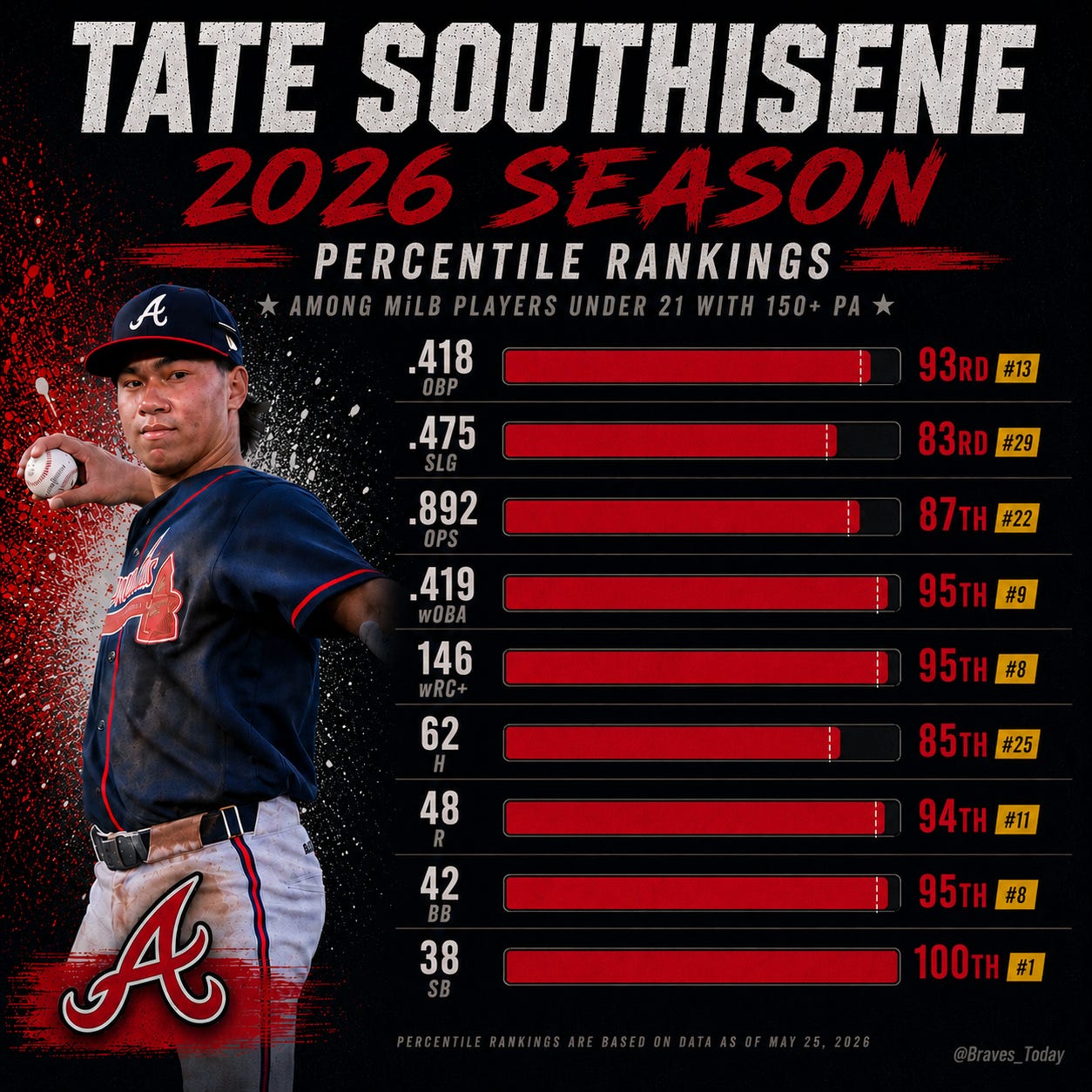
The improvements in Southisene’s stat line jump off the page, but the underlying data may be even more encouraging. Alongside fellow breakout prospect Eric Hartman, Southisene has become one of the fastest-rising hitters in the Braves organization.
A major reason for that growth has been his improved plate discipline.
After posting a 53.5% swing rate during his brief debut in 2025, Southisene has lowered that figure to 40.0% this season. At the same time, his contact rate has jumped from 61.3% to 75.1%. In simple terms, he is chasing less and swinging at better pitches, and allowing him to make far more contact when he pulls the trigger.
That combination is exactly what teams want to see from a young hitter. His 10.0% swinging strike rate further supports the idea that the improvements are real.
The quality of contact has also taken a step forward.
Southisene has lowered his ground ball rate from 51.4% to 47.5%, allowing more of his hard contact to get into the air where it can do optimal damage. Last season, four of his 14 hits went for extra bases in his 66 plate appearances (28.6%). This year, across 273 plate appearances, 23 of his 62 hits have gone for extra bases (37.1%).
That jump is significant, especially considering he is still one of the youngest players at every level he has played.
For me, this is what stands out most. The production is impressive, but the process behind it is even more impressive. When a player is improving his plate discipline, contact skills, and quality of contact all at the same time, it becomes much easier to believe the breakout is sustainable.
How High Is His Ceiling?
Coming out of the draft, most evaluators viewed Southisene as roughly a 50 future value prospect. Solid, possible top 100 prospect eventually, but most likely not a superstar.
Today, however, there is a lot more reason for optimism.
The bat-to-ball skills are evident. If he continues progressing at his current pace, a .300/.400/.500 offensive profile is not an unreasonable outcome.
Remember, Southisene produced a .297/.429/.500 slash line in Augusta while being 1.4 years younger than the average player in the league. Now in Rome, he is 3.1 years younger than the average player.
The strikeout rate has ticked up slightly since the promotion, and his swinging strike rate has climbed as well. However, that is perfectly normal. He is facing the most advanced competition of his career and adjusting on the fly.
More importantly, the underlying improvements that fueled his breakout in Augusta have remained visible after the promotion.
At roughly 180 pounds, Southisene still has plenty of room to add strength. If that happens, it is not difficult to envision 50 to 55 grade power developing alongside his already 60-grade speed.
If everything clicks, the player archetype starts looking awfully interesting.
Stylistically, Southisene shares some traits with players like Trea Turner: speed, athleticism, contact ability and room to grow into more power, but those comparisons should be viewed as archetypes rather than expectations.
Turner has built a career around hitting for average, getting on base, stealing bags, and providing defensive flexibility. If Southisene develops into even a version of that type of player, the Braves will have found themselves an outstanding piece for the future.
As always, prospect development is not linear. There are still plenty of hurdles ahead. But when you compare Southisene’s production to other highly regarded young prospects at similar ages and levels, the results are eye-opening.
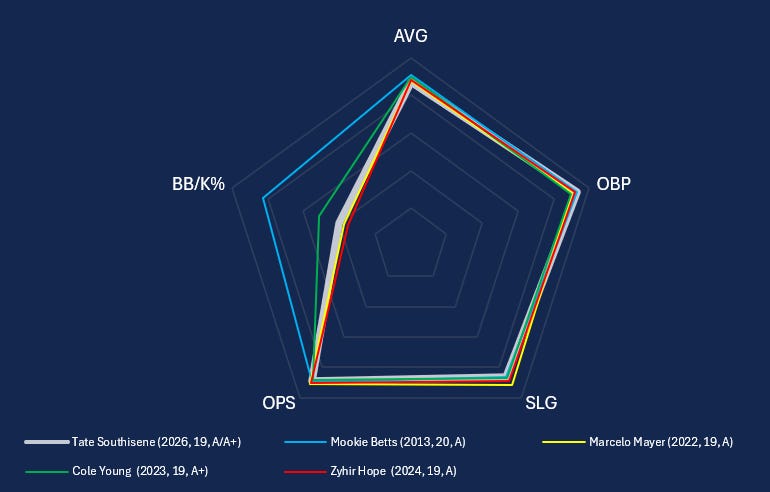
Comparisons always come with plenty of caveats. Mookie Betts is obviously a future Hall of Famer and probably an unfair comparison for anyone. But when you look at recent top prospects such as Marcelo Mayer, Cole Young, and Zyhir Hope, Southisene's numbers stack up surprisingly well in a similar age-to-level range.
In 2022, Mayer climbed to number 14 overall on MLB Pipeline's rankings. After Cole Young’s 2023 season, he reached number 37 overall the following year. Zyhir Hope rose to number 75 the year after his impressive 2024 season as well.
Southisene has already broken onto some Top 100 lists, and I would be surprised if that trend does not continue by season’s end.
More importantly, what prospects like he and Eric Hartman have done has completely changed the conversation around Atlanta’s position player pipeline. For years, the Braves farm system has been viewed as pitching-heavy with a lack of impact bats behind the major league roster.
That outlook suddenly looks very different. And if Southisene keeps developing the way he has over the last year, Braves fans may soon be talking about him as much more than just a Top 100 prospect.
And if Atlanta follows a similar approach in the 2026 draft, betting on athletic prep position players with room to grow, Southisene may wind up being remembered as the player who introduced Braves fans to the organization’s new drafting philosophy.
Tate was an elite power/speed prospect entering the 2025 draft. I believe he was the only recorded prospect in the 98th percentile for both max exit velo and 60 yard dash. Arm was in the 99th percentile. His selection could signal a growing emphasis on athleticism .
Looking for a similar profile this year one name that stands out is Luke Williams SS/OF from PA.
A hyper quick twitch athlete with 5 tool potential. Elite arm, high end bat speed, raw power and plus plus speed. Vandy commit. Player development may lean more tools over production.
Exciting prospect and kudos to the Braves scouting group. As we head towards the trade deadline, it’s best not to get too attached to our up and coming prospects. And, we shouldn’t over-estimate the value our prospects have to other teams.