


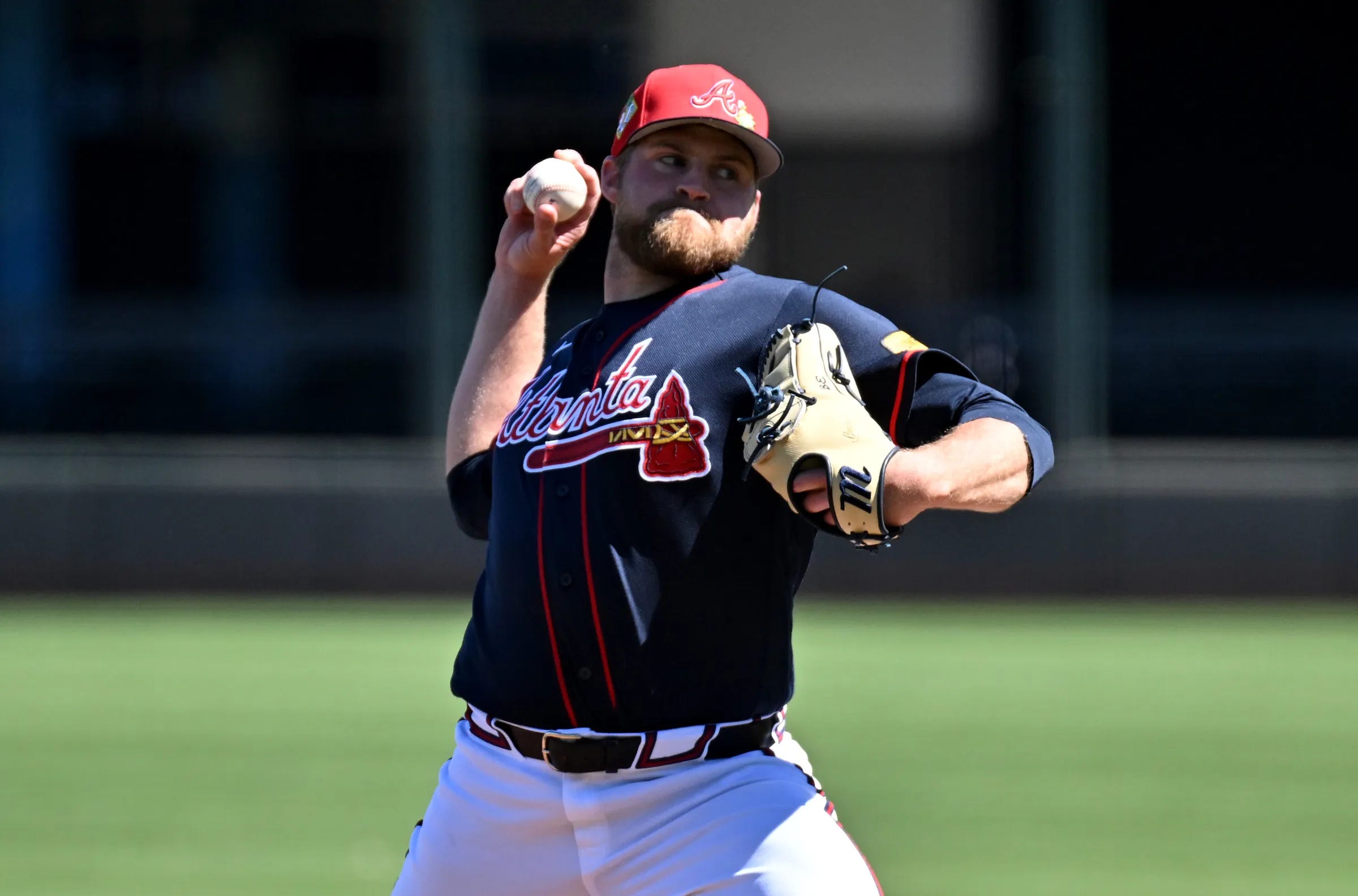
The day has finally come: Bryce Elder is adding a cutter.
On Saturday against the Boston Red Sox, the sinkerballer threw six cutters among his 78 pitches. Hyperbolic as it may sound, this one pitch could dramatically change his fortunes at the major league level.
It’s also part of a much larger shift in how the Braves are developing their pitchers.
Let’s talk about it.
Not technically the first time
Saturday’s cutters from Elder were not the very first cutters the righty has thrown in competition. Out of the 7,100 pitches he’s thrown at the MLB level in his career, exactly one was a cutter:
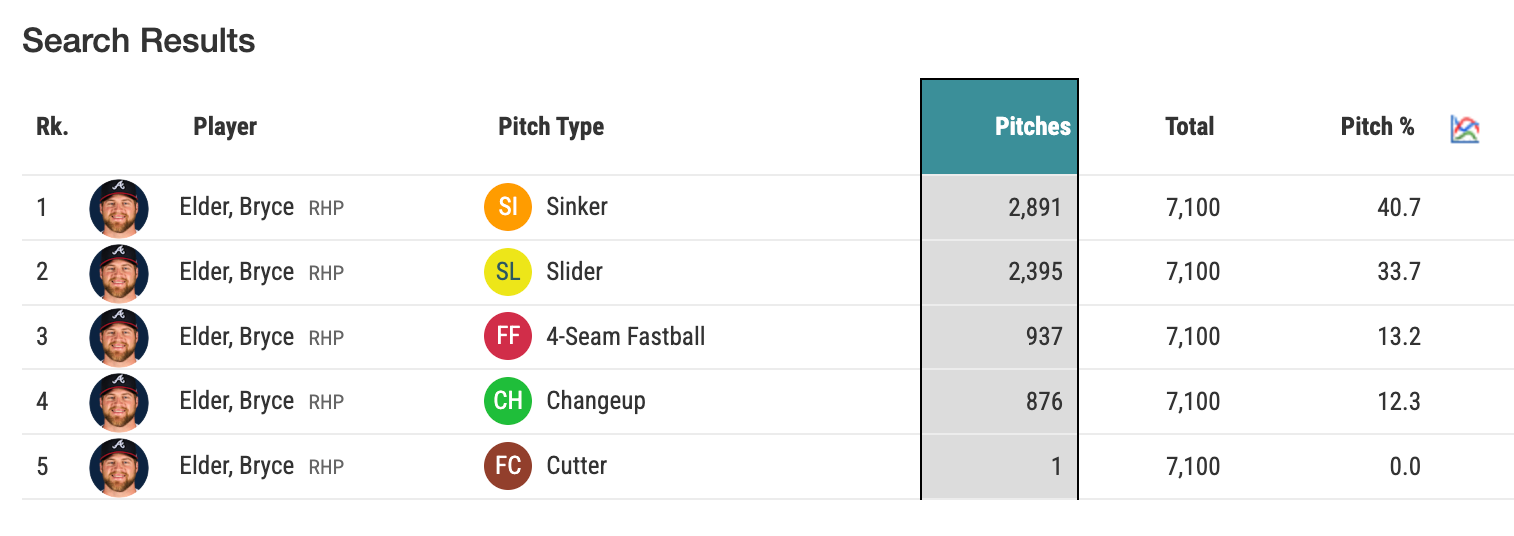
On July 30, 2024, against the Milwaukee Brewers, Elder threw an 0-1 cutter to get former Braves catcher William Contreras to ground out in the 6th inning of an eventual 5-1 Atlanta win.
It’s the last one he threw in a game until this weekend. But the 2024 version and these from the weekend share a lot of similarities.
What type of cutter is it?
The cutter is typically described as a hybrid between a four-seam fastball and a slider, offering the glove-side movement of a slider while maintaining the velocity of a standard fastball. It usually sits three to six mph below a four-seam fastball, but still close enough in velocity to avoid being classified as a true breaking or offspeed pitch.
Elder’s cutter hits that criteria, coming in about five mph less than his four-seamer on Sunday (87.2 mph to 92.6 mph).
But there are multiple types of cutters that pitchers can throw, and it’s important to understand which variety is Elder’s.
The first type, the ‘true’ cutter, is characterized by roughly 10 inches of vertical break and between three and six inches of horizontal movement towards the pitcher’s glove hand. Less vertical break than a four-seam fastball, but more horizontal movement, albeit less than a purpose-built breaking pitch. The movement is often late, which can end up breaking bats - think Mariano Rivera here.
Another common version of the cutter is the cut-fastball, which features a vertical break closer to a traditional four-seamer, but with some glove-side break and exceptional velocity. Think Corbin Burnes, who uses a 94 mph cut-fastball as his primary pitch.
There can also be slow cutters or breaking-ball style cutters, which I call "baby sliders’, that tend to lean into different aspects of the pitch’s characteristic. This version blurs the line between a slider and a cutter, featuring more drop and horizontal movement than a typical cutter. Think Yu Darvish here.
Bryce’s pitches from Saturday appeared to be more of a slider-ish cutter, featuring the horizontal movement of a slider while bringing high-80s velocity. He induced two swings, getting a foul ball on one and a foul tip on the other (which does count as a whiff, if you were keeping score at home).
What does this do for Bryce?
One of the reasons I’m such a propagandist when it comes to pitchers adding cutters is how it bridges several different pitch types and provides for sequencing opportunities, and I think that’s the biggest gain here for Elder.
As a sinker/slider-reliant arm, Elder’s standard game plan is to throw sinkers down in the zone for ground balls and supplement them with sliders below the zone for chase and whiffs.
He’s ramped up that slider usage as well, going from below 27% his debut season to over 35% last year. But if his location slips on either pitch, especially the slider, the result has often been extra-base hits.
The cutter bridges these two pitches well, looking like a fastball out of the hand but sitting in the middle of a pitch plot between the sinker and the slider, both from a horizontal and a vertical perspective.
But throwing more sliders is not the only change he’s made. We’ve seen Elder ramp up his four-seam fastball velocity recently, with last year’s average of 92.8 being a career high and 48 of his 51 hardest career four-seamers coming in the last three months of last season. The cutter works well here, too, bridging the vertical difference between the four-seamer and the slider. Try to sit on either one and Elder has more than one option to keep the ball off the barrel of the bat now that the cutter disguises well with both.
You can see this ‘bridge’ action visually on a pitch plot. Here’s last year’s pitch plot, showing the locations of his different pitches, with my estimation of where the cutter will land (brown circle):
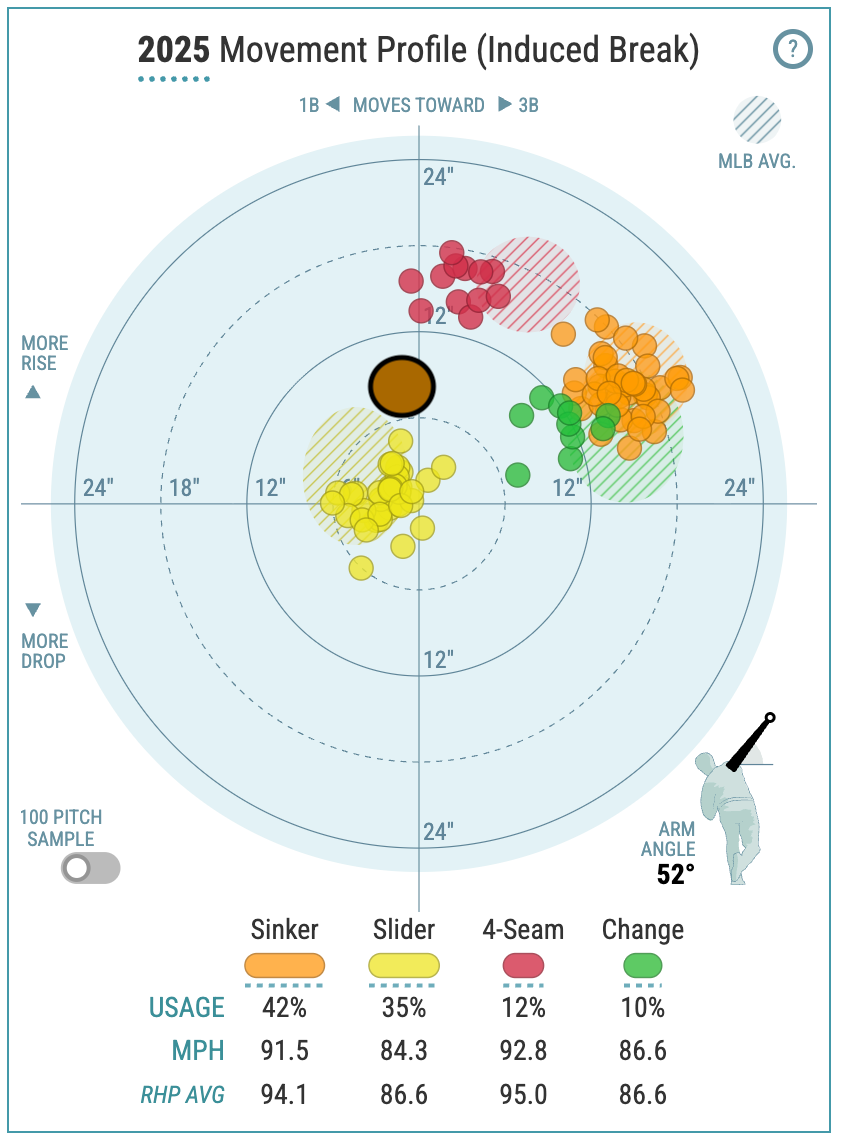
It’s honestly a better vertical bridge on the four-seamer/slider pairing (red and yellow dots) than it is as a horizontal sinker/slider bridge (orange and yellow), but my hope is that it’s something else he can command if the slider’s not there that day.
The other place this comes in handy, other than with sequencing, is in matchups against right-handed hitters. Elder’s usual course of attack there is almost entirely sinker/slider, with those two pitches accounting for 90% of his pitch usage (53% sinker, 37% slider). Last season, that wasn’t good enough. Righties hit .301 with a .498 slugging percentage against him, roughly 62 points higher in average and 107 points higher in slugging than lefties managed.
While sinkers are the correct primary pitch in those situations, since it’s going to run in on the hands of a righty, the ability to throw a cutter inside and have it end up as a front-door strike is a useful tool to have in your bag. Unfortunately, that’s not how Elder used it on Saturday, with all five being thrown against lefties.
But Elder’s new cutter isn’t happening in a vacuum. It’s part of a much larger shift in how the Braves are developing their pitchers.
What does this all mean?
On the micro level, this is another tool to help Elder find that ever-elusive consistency. Last season, 50% of his outings were quality starts. While the bare minimum of a quality start is three runs across six innings, good for a 4.50 ERA, that’s not what Elder did. His quality starts produced a 2.23 ERA last season, averaging 6.2 innings and 1.6 earned runs per.
When he’s good, he’s really good.
His non-quality starts, however, were collectively worth a 9.75 ERA, with Elder allowing 69 runs in 63.2 innings. That’s 4.2 innings and nearly 5 runs per start.
The goal here, on the individual level, is for Elder to be able to mitigate the damage when things aren’t working.
But I think this says something more about Atlanta’s pitching development. We’ve seen two significant personnel changes in recent years, with the organization moving on from minor league pitching development coordinator Paul Davis after the 2024 season and then major league pitching coach Rick Kranitz after 2025. While the Braves haven’t announced who is currently the minor league pitching development coordinator (I believe it’s Bo Henning, but that’s not confirmed right now), a data-driven coach in Jeremy Hefner took over for Kranitz this season.
Over the last calendar year, the Braves have quietly entered their most aggressive “arsenal expansion” phase in recent memory. In the minors last year, Hurston Waldrep added both a cutter and a sinker, as did JR Ritchie, while in the majors, this spring has seen Ritchie also add a “Vulcan split”, Joey Wentz add a two-seamer, and several other pitchers add or tweak existing pitches to either fix existing deficiencies (Grant Holmes and his terrible, horrible, no good, very bad fastball) or just make them more reliable (Reynaldo López and his changeup) and useful.
If you’re not going to add to the rotation, make the guys you have better, I guess.
Now we get to see if those changes translate once the games start counting.
Wow, that's a ton of amazing info! I think we all hope for Elder's success - he seems to be one of the few Atlanta pitchers who is always ready to go for any assignment they have for him.