


The Concorde’s four engines maintained a cruising speed of Mach 2, but they couldn’t get there alone. To get the plane up to and through the sound barrier, each engine had afterburners, known as “reheats”, for the initial climb after takeoff.
Those reheats powered the supersonic airliner’s takeoff and push through the sound barrier. But once the Concorde reached Mach 1.7, the reheats were switched off out of necessity - they were immensely powerful, but consumed too much fuel to be used throughout the entire flight. Besides, at cruising speed, the Concorde didn’t need them; the hard part was reaching that extraordinary speed, not maintaining it.
That was the engineering challenge: not merely generating enormous power, but sustaining enough of it efficiently to make it through the entire flight.
Ray Kerr has already shown the Atlanta Braves his afterburner. In relief, he can reach back for an upper-90s fastball and pair it with his devastating curveball.
But as Atlanta considers stretching him out as a starter this winter, the question isn’t if he has starter-quality stuff in the first inning. The Phillies and the Dodgers can testify that he does.
No, it’s whether he can switch off the reheats and still cruise.
Can he preserve his velocity and command, supplementing the fastball/curveball pairing with enough variety to turn over a lineup, all while maintaining his delivery as the pitch count climbs? Or is the highest and best use of Ray Kerr what we saw in October - a multi-inning weapon out of the bullpen that’s suited for no more than one time through the order?
The Braves know that Ray Kerr can generate thrust. This winter is about whether he can maintain cruising speed.
Let’s talk about it.
We don’t know they’re doing this…
…But it’s pretty easy to guess, based on their public comments.
Alex Anthopoulos discussed whether or not to stretch out a reliever in his end-of-season press conference, in the context of Didier Fuentes. Atlanta’s relief ace is entering the offseason preparing to start next year, because Alex explained it’s a lot easier to undo this decision than to try and make it midseason.
“It's always easy to shorten a guy up. […] Depending on how the off-season goes, how he looks, how it goes, we can always say, ‘All right, we're gonna shorten you up. You're gonna go one or two innings,’ and so on.”
Between that comment and Atlanta’s usage of Kerr when they first acquired him from the Padres entering the 2024 season, it’s pretty safe to assume that he’ll get an opportunity to prepare as a starter. When you look at the state of Atlanta’s rotation entering the offseason, it’s easy to see why the Braves would want to find themselves another option in Kerr for spring training:
Chris Sale: Excellent, but almost always on additional rest
Spencer Schwellenbach: Injury and workload concerns
Spencer Strider: Injury, workload, and quality concerns
Bryce Elder: Quality concerns
Didier Fuentes: Workload and quality concerns
AJ Smith-Shawver: Workload and quality concerns
JR Ritchie and Owen Murphy: Workload and quality concerns
I feel pretty confident as of now in assuming Kerr’s going to be reporting to camp as a starter this spring, based on how the Braves operate and the current state of the rotation.
Atlanta has already conducted a smaller (and considerably less successful) version of this experiment.
Kerr made two emergency starts in 2024, allowing eight earned runs across 7⅔ innings. But even within his 9.39 ERA was the flashes that Atlanta is hoping to unearth: He struck out 13 and walked only three. The stuff produced misses, but it also produced far too much damaging contact. In his first start, the seven fastballs Pittsburgh put into play averaged 98.8 mph off the bat.
His October heroics were not the first time anyone imagined Ray Kerr as a starter. It likely was the reason Atlanta would reconsider an experiment that failed the first time.
What he needs to work on
But despite the October dominance, it’s not as simple as “stick him in the #5 spot and profit.” There are four major questions that Kerr will need to answer if he wants to work out as a starter at the major league level.
Can he recover the curveball as a genuine finishing pitch?
We usually think of Tommy John surgery having the biggest impact on a pitcher’s command, with several recently returned starters having issues throwing strikes.
For Kerr, the biggest post-TJ issue has been the effectiveness of his curveball.
In 2023 & 2024, he had a whiff rate greater than 50% on the curveball, putting up 53.8% and 50.6% whiff rates. Opposing hitters had xBAs of .178 and .157 on the pitch, combining for more strikeouts (39) than balls put into play (38).
This year? A .32.4% whiff rate and expected stats of a .307 batting average and .526 slug.
(Disclaimer: This is separating the slow curve from the standard curveball; that slow curve was thrown only 14 times this season and it was the first time that Statcast has separated the pitches.)
How much of the curveball’s struggles was Kerr trying to reacclimate to major league hitters? In October, on an incredibly small sample size of 33 pitches, he allowed just one hit (a Miguel Rojas double) on the pitch while picking up seven whiffs, good for a 46.7% whiff rate.
How much of this was location? Kerr was guilty of hanging the curveball this season, giving up a home run, a double, and two singles on pitches across the middle of the zone horizontally.
Three of those four batted balls were over 100 mph, as well, including a middle-middle double by Bryce Harper at 107.2 mph and a 103.3 mph home run by Miami’s Jonah Cox.
I’m inclined to think that this could be small sample size noise, although nothing’s conclusive at this point.
Can the fastballs get outs without becoming predictable?
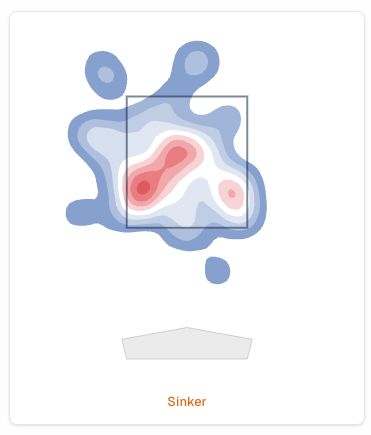
The unspoken third pitch for Kerr, one that he hadn’t thrown for Atlanta until this season, was a sinker. Last used in any meaningful capacity in 2022, Kerr broke it out after returning from TJ and allowed just a single on fourteen balls in play with it.
The movement profile’s below average, getting four inches less drop and one inch less armside run with it than the typical sinker. Despite that, though, hitters weren’t making great contact on it (average EV of 78.6 mph) and weren't lifting it, with an average launch angle of 0°.
The sinker actually ended up being Kerr’s primary pitch against lefties, with the curveball ending up at 29% usage and the four-seamer at 19%.
Here’s the thing, though: 3.7% whiff. He picked up plenty of called strikes, mind you, but wasn’t exactly racking up the swings-and-misses.
Can Kerr ramp up his sinker usage without becoming predictable? Being able to get a ground ball on command is an important part of being a starter and making it through a start, but how much room does Kerr have to ramp up the sinker usage without sacrificing effectiveness?
And on the four-seamer, it’s also pretty dead-zone as well, so diversifying the fastball mix is likely an important adjustment for Kerr to make either way. As a reminder, a ‘dead zone’ fastball has a predictable ball flight for a hitter based on how the majority of fastballs from that release point and arm angle will typically travel. These tend to get hit…hard.
He averaged 94.9 mph on it, although he did break 97 with it a few times this year. The results were excellent, despite the dead zone profile: .130 average, .261 slug, but that was only 76 pitches.
What does the pitch look like at the 70 or 80-pitch mark when he can no longer reach back for 97?
Does he need a different look against righties?
If you just look at the performance stats in platoon situations for the regular season, this doesn’t look like it needs to be a conversation:
vs RH hitters: .135/.175/.297
vs LH hitters: .174/.240/.217
But all of these stats were compiled in one pass through the order, and Kerr’s usage patterns vs. righties leads to a natural question of sustainability when you try to do it two or three times:
46% four-seam fastball
43% curveball
6% sinker
6% cutter
His current 4S/CB mix against righties might work once, but we have no evidence it’ll work a second or third time. The good news is that Kerr was previously more well-rounded than this; back in 2024, he had a splitter that he used primarily against righties, although his cutter’s never really been a big part of the arsenal.
There’s potentially a path to broaden to a 4S/CB/splitter/cutter arsenal vs. righties, with the cutter being able to bust right-handed hitters inside, the curveball and splitter occupying different velocity bands and movement patterns, and the combo of the sinker and four-seamer combining to establish velocity while avoiding being predictable.
The problem here is that Kerr’s very clearly a natural pronator and struggles to generate spin, so it’s hard to assume he could just pick up a slider or some other breaking ball to diversify the arsenal. Ramping up the cutter, which behaves more like an incredibly hard gyro slider at zero inches of horizontal break but an additional 1.5 IVB versus a traditional cutter, might be the way forward for Kerr.
The largest obstacle is innings
If you’re concerned about the ability of Didier Fuentes to take a full season of starts after throwing just 97 innings between Triple-A and MLB this season, have I got some bad news for you about Kerr.
He threw 18⅓ MLB innings and 11⅔ minor-league innings in the 2026 regular season, plus six postseason innings. 36 innings is in no shape or form a valid base of work to assume a jump to even 100 innings, never mind the 130-150 or so that a converted reliever usually manages to put up in their first season as a starter.
The last time Kerr was a full-time starter was 2018, when he was pitching for Single-A Clinton.1 He put up a 4.28 ERA across 111.1 innings, still his highest innings total for any single season of his career.
Even reaching 100 effective innings is an aggressive increase from his recent workload and would require active, deliberate management to reach.
Most likely path here
IF the best-case scenario were to come to fruition here, Kerr would follow a starter’s throwing routine this offseason, followed by a spring build-up and progressively longer scheduled outings once the season begins. If he can handle his velocity and strike-throwing, the Braves are likely looking at him as a starter for the first half of the season before looking to transition him to the pen as the Spencers, Schwellenbach and Strider, are (hopefully) coming off the injured list and showing they’re ready for effective starts every five or six days.
If Kerr can’t exceed more than two or three effective innings, the decision to make him a flex arm, moving between leverage and bulk innings, is an easy one to make.
How do you turn six brilliant October innings into 100 useful innings the following season? I’m not sure Atlanta can. But the flexibility of the starter-to-reliever transition means the Braves owe it to Kerr, and themselves, to try.
What they cannot do is treat the experiment as an offseason acquisition.
Ray Kerr can be part of Atlanta’s rotation depth without being counted among its five dependable starters. Let him spend the winter learning whether he can switch off the reheats and still cruise. But build the rotation as though the answer will be NO.
Atlanta should ask whether Ray Kerr can start. It cannot construct an offseason that requires the answer to be yes.
Mariners affiliate. This was his first full-season affiliate assignment after Seattle signed him as an undrafted free agent in 2017. Even I had to look this up, so don’t feel bad if it didn’t immediately ring a bell.