


“Sinkerballers are best when they’re a little bit tired. Don’t want them to have too much giddyup in their fastball.”
Braves broadcaster Joe Simpson said that to me back in 2024, in the Truist Park press box, when we were discussing Bryce Elder.
It’s a common adage in baseball - here’s Trevor Cahill saying it back in 2011, and he wasn’t the first to coin the phrase.
But is it true?
Bryce Elder just got blown up for eight runs in a single inning against the Milwaukee Brewers on Sunday, although he rebounded to finish six innings. He was on additional rest, too, fueling the theory.
Let’s talk about it.
Is this a thing?
Maybe!
Looking at this season, of Elder’s three ‘blow-up’ starts - five earned runs in Boston on May 27th, six runs in New York on June 14th, and Sunday’s eight runs vs Milwaukee - two of them came on extra rest.
Elder was on the standard four days between starts in Boston, but then was on six days of rest for both the New York and Milwaukee outings. Atlanta was aggressive about shuffling the rotation to keep Elder on regular rest earlier in the season, but of late, both some accumulated fatigue and weather impacts caused him to have additional rest for both New York and Milwaukee.
On the season, here are some of Elder’s pertinent statistics based on days of rest:
4 days = 2.70 ERA, .543 OPS, 1.050 WHIP
5 days = 3.20 ERA, .651 OPS, 1.066 WHIP
6+ days = 7.88 ERA, .946 OPS, 2.000 WHIP
It’s important to clarify that there might be sample size issues with the 2026 numbers - these are nine, four, and three starts, respectively. Let’s look at the career numbers for Elder:
4 days (37 GS, 216 IP) = 3.58 ERA, .653 OPS, 1.213 WHIP
5 days (27 GS, 154 IP) = 4.21 ERA, .719 OPS, 1.279 WHIP
6+ days (30 GS, 157 IP) = 5.68 ERA, .825 OPS, 1.529 WHIP
To recap, Elder has a lower ERA, opposing OPS, and WHIP allowed on regular rest than he has on either one additional day of rest or two or more additional days.
At the very least, it’s more than just baseball folklore. But why?
If extra rest really changes Elder’s performance, we’d expect to see it somewhere in the underlying data, not just the box score. Let’s look.
It’s all about the locations
While Bryce Elder’s sequencing and pitch usage have changed this year, with the right-hander making his four-seam fastball his primary pitch against left-handed hitters for the first time in his career, he’s still a sinkerballer at heart. Simpson’s conventional wisdom was about sinkerballers, too, so let’s look at it.
I went into Baseball Savant and searched across Bryce Elder’s career for the performances of each of his pitches based on a few factors: xwOBA, Whiff rate, and barrels per batted ball event and plate appearance (both expressed as percentages).
Here’s the baseline for four days of rest for Elder:
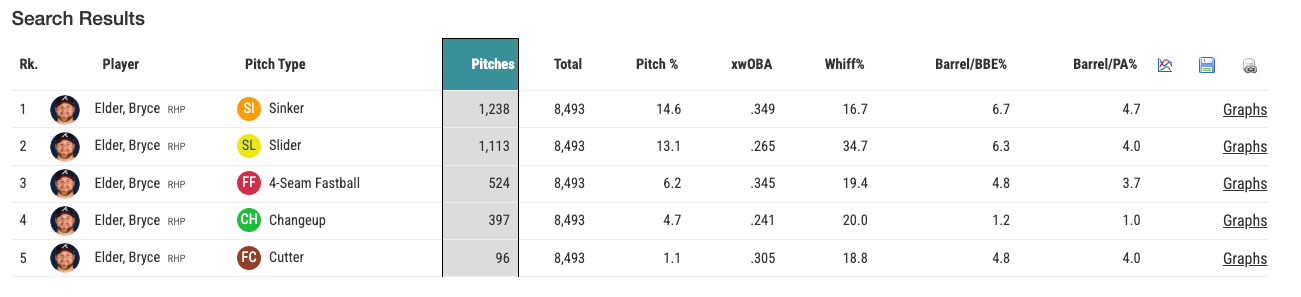
And for the sinker locations, you can see that regular rest Bryce is pretty decent at keeping the ball either down or inside to righties, albeit with some pop-up middle-middle locations.
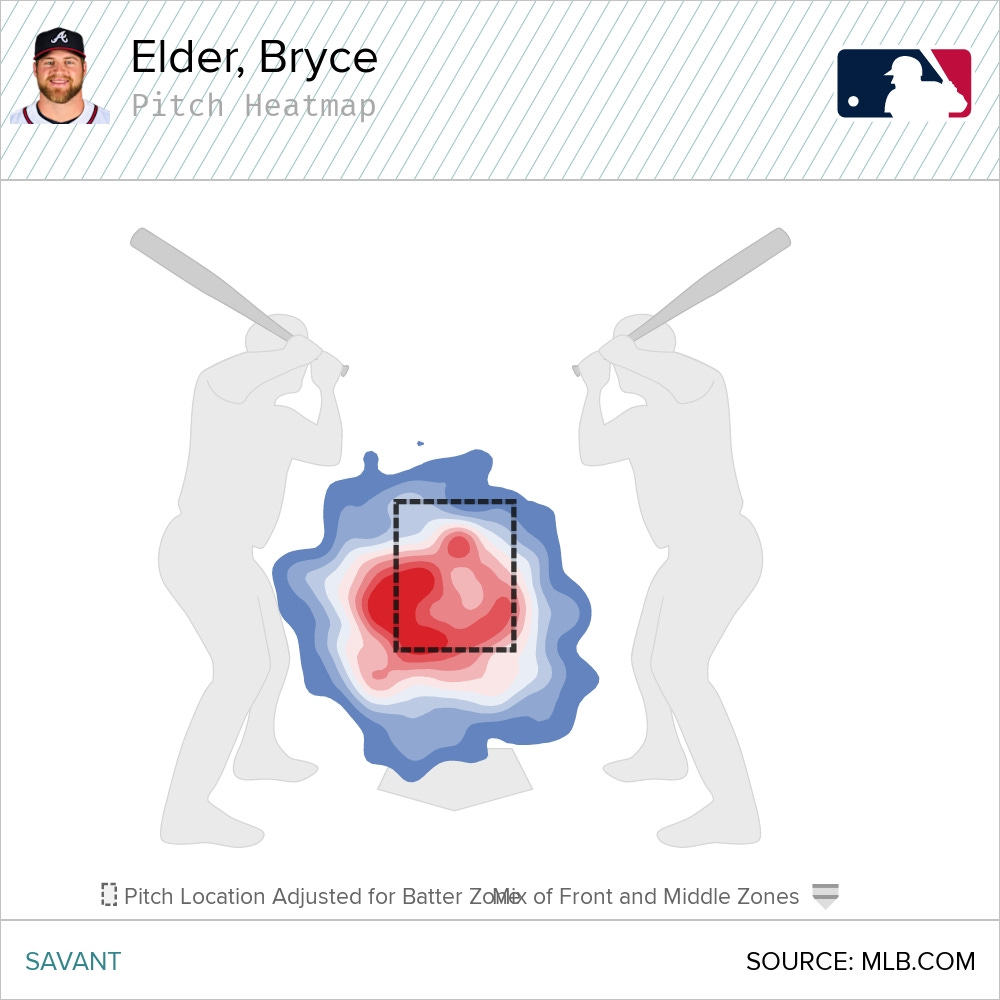
Going to five days of rest, you can see some degradation in whiff rates, although the xwOBA floats between better and worse, depending on the pitch.
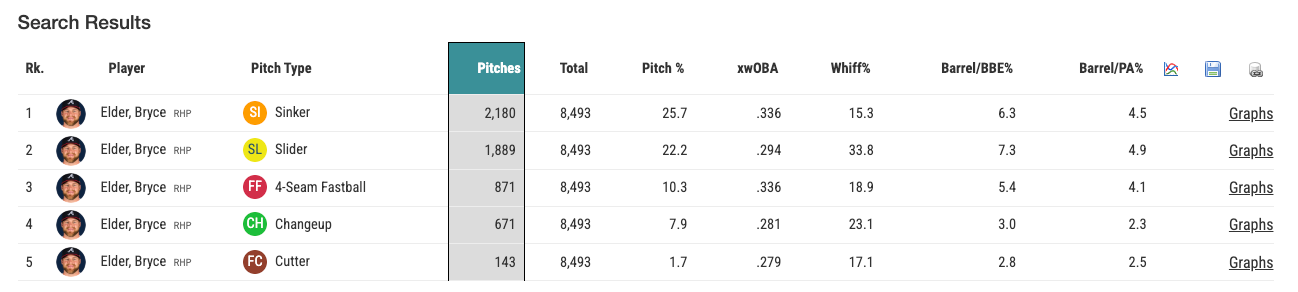
And on the locations, it’s a pretty similar heat map - keeping the ball down and inside to righties.
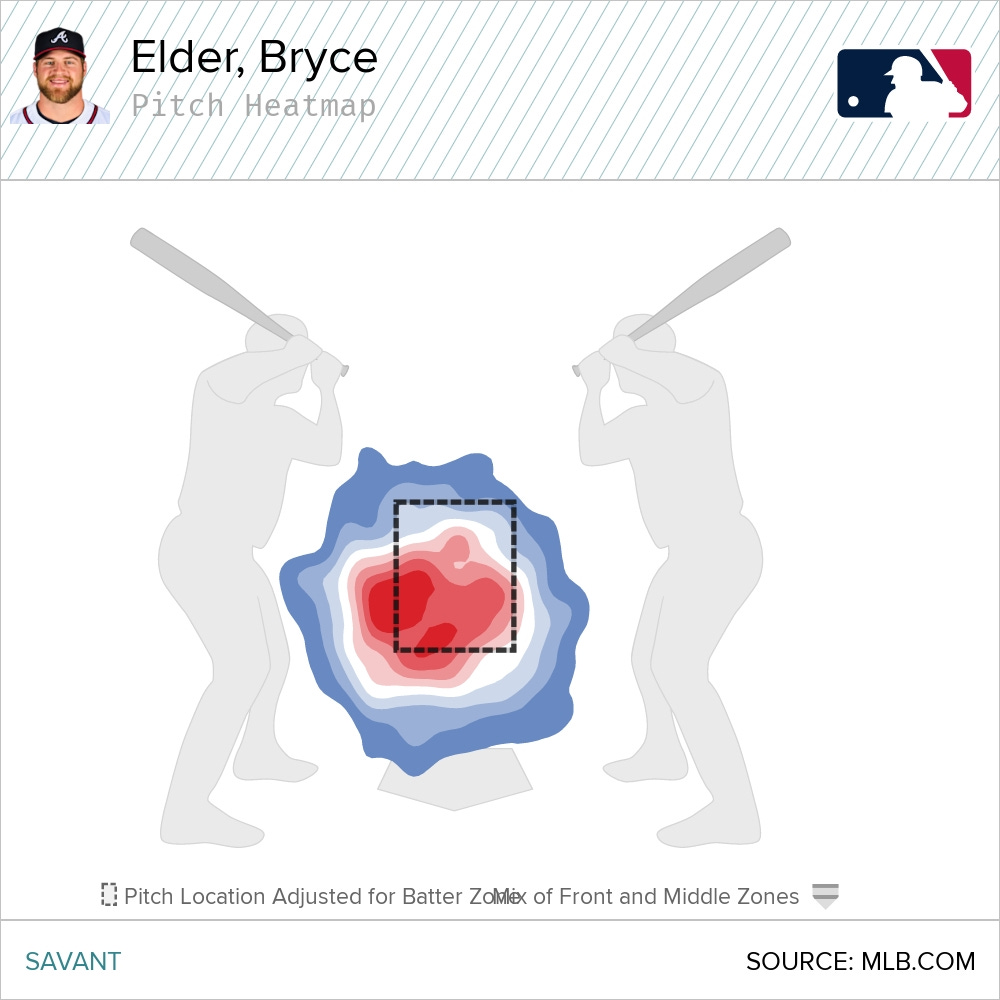
But six or more days of rest? That’s a significant drop in quality when it comes to the sinker, with the xwOBA going from .336 to .379 and the barrels per BBE going from 6.3% to 8.7%.
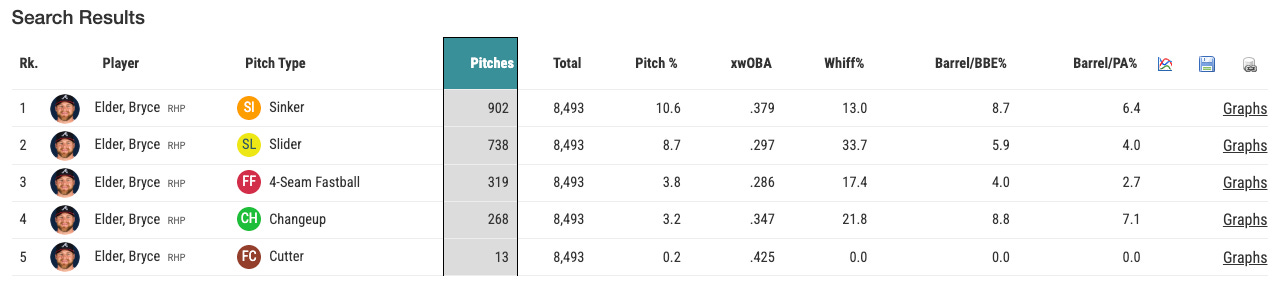
Interestingly, the changeup is also a big problem in 6+ days-rest situations, going from a .281 to a .347 xwOBA and jumping from 3.0% Barrel/BBE to 8.8%.
Arguably, the changeup is a bigger problem than the sinker is with extra rest.
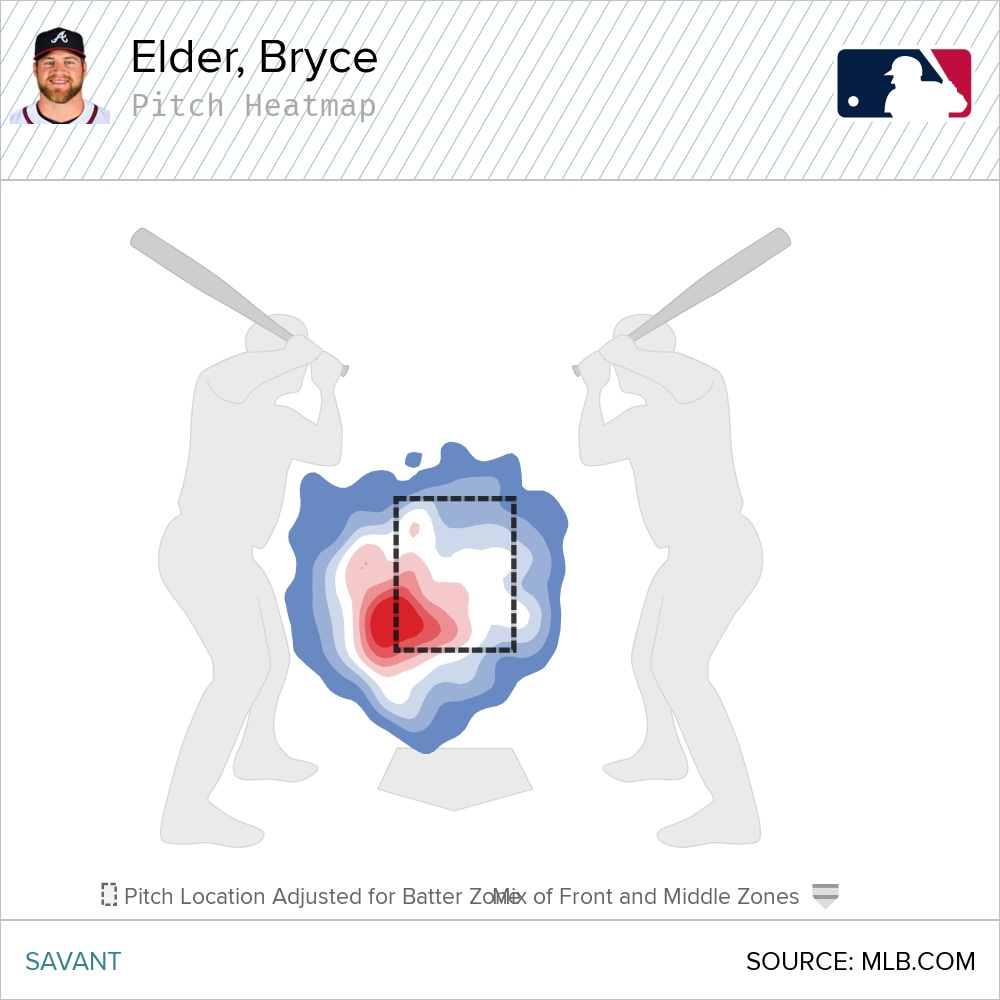
When you look at the heatmaps, you can see how the sinker isn’t as reliably in the zone at with normal rest, although it’s also not left blatantly up in the zone as you’d think if a rested Elder had a little more “giddyup” in his arm, to paraphrase Simpson.
Baseball wisdom meets the data
Does Joe Simpson’s old saying hold up?
For Bryce Elder, maybe more than you’d expect.
Across nearly 600 career innings, Elder’s results have consistently worsened the farther he gets from a regular four-day schedule. That’s true in the traditional numbers, and there are hints of it in the underlying metrics as well. The sinker loses some effectiveness, but perhaps more importantly, so does the changeup, suggesting the issue isn’t simply velocity: it’s the entire movement profile that makes Elder successful.
That doesn’t necessarily prove Simpson’s theory. There are countless variables that come with extra rest: changes in routine, differences in opponents, mechanical timing, even randomness. Baseball rarely gives us clean experiments.
But it does raise an interesting possibility. Maybe some sinkerballers really are at their best when they’re on a regular schedule, relying on feel, movement, and rhythm more than maximum stuff.
Joe Simpson probably wasn’t thinking about xwOBA or Barrel/BBE when he said sinkerballers don’t want too much “giddyup.” He was describing something pitchers have felt for decades. The numbers don’t prove he was right. But in Bryce Elder’s case, they suggest there may have been more truth in that old baseball wisdom than most of us realized.
If nothing else, it’s another reminder that when the Braves have the opportunity to keep Elder on a regular cadence, history suggests it’s probably in everyone’s best interest to do so.
Hapless DSL Braves win their 4th game. Now 4-13
Today they bang out 20 hits and win 15 to 2.
In all the years i've followed the DSL Braves i've never seen a collection of 1st year (age 17) hitters this team has.
The centerfielder Cruz $1.2 million
The Shortstop Manon $1.5 million
The Shortstop/ 2nd baseman Cabral $600,000
The CATCHER Pulido $350,000 best hitting catcher Braves have anywhere. And basestealer.
The corner outfielder Da Costa Gomez
$250,00 a real slugger. 6'3" 210lb.
The Bonus money always goes to hitters.
Excellent assessment. Why not put him out there every fifth day - he doesn't seem to ever have arm problems and that would give the others more rest. But it will still always come down to command. Last night Holmes , to his credit, managed to allow only one run but he was usually behind in the count, walked four or five, and was generally one pitch away from disaster. That sort of pitching won't work in the post season.
Again, I vote for going all-in and acquiring Skubal, DeGrom, or Webb with whatever it takes. Otherwise we're looking at the Dodgers winning their third WS in a row (or the Phillies hoisting the trophy) and an owners' lockout for the next season with Sale approaching 39y/o. But, hey, there might be some great retail office space to be had!