


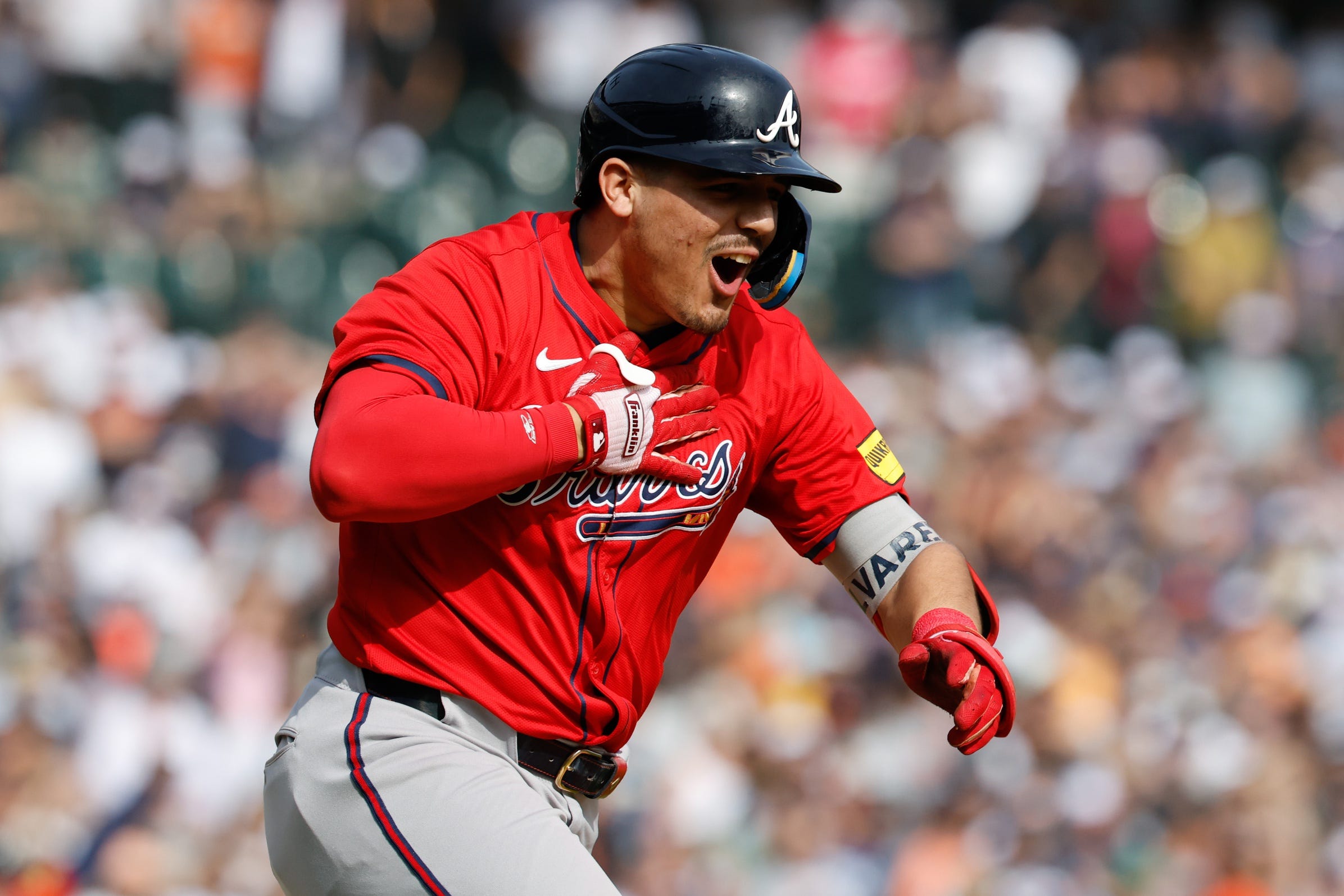
Back when I hosted the Locked On MLB Prospects podcast, one concept came up constantly: prospect fatigue. It’s what happens when fans hear about a player for years before seeing sustained major league success, eventually deciding they already know what that player is.
Nacho Alvarez Jr. may already be experiencing it.
After debuting in July of 2024, the infielder exhausted his prospect eligibility with a modest early major league line and a move off shortstop, developments that have quietly cooled expectations. But context matters here. Alvarez is still just 22 years old, with limited upper-level experience and underlying indicators that suggest far more development ahead than most realize.
But graduation from prospect lists often says more about service time than finished development. The book on him isn’t closed. It may still be in the early chapters.
Let’s talk about it.
The defensive move was always a long shot
Nacho Alvarez played third base for Riverside Community College prior to the Braves taking him in the 5th-round in 2022, but they announced him as a shortstop. This is a common practice for MLB teams, looking for additional defensive value from a mid-round pick.1
It just didn’t work out. Despite 187 minor league games and 1,562.1 innings at the position, the Braves moved him back to his original third base last season. The scouting reports predicted this, with MLB Pipeline saying that he “likely fits best at third base” after the draft and Baseball America predicting he could be an “above-average third baseman” while merely noting that he played some shortstop in his pro debut.
The ultimate issue, as BA pointed out the next season, was his range. The infielder was a “below-average runner”, which Statcast data confirmed by his 32nd percentile sprint speed of 26.8 ft/sec last year. Pair that with middling arm strength and the move back down the defensive spectrum becomes inevitable.
But the other issue, one that the Braves wanted to fix last year, was which defensive position he was playing. After abandoning the shortstop experiment, the Braves deployed him at second base in Gwinnett when he returned to the level in July. Having played one game at the position prior to last season and with second baseman Ozzie Albies having missed 180 games in the last four seasons, the cross-training would have prepared him to be the ‘next man up’ were Albies to miss more time.
But instead, Austin Riley missed the rest of the season for an abdominal issue, with Alvarez playing just seven games at second base for Gwinnett prior to his call-up and installation as the Major League third baseman for the rest of the year.
The offensive numbers were…underwhelming
In his most recent big league stint, Alvarez hit .241/.305/.348, good for an 84 wRC+. His two home runs came not only in the final week of the season, but actually in the same game - September 20th in Detroit versus the Tigers.
Alvarez didn’t qualify for a full Statcast profile, but the underlying data still paints a rough picture. Several of his offensive inputs, from bat speed (67.7 mph) to average exit velocity (84.9 mph) and barrel rate (1.4%), suggest he is a low-impact hitter. The problem is that he also wasn’t fulfilling the other side of the equation, running roughly league-average strikeout (23.6%) and below-average walk (5.8%) rates. While he didn’t have a chase problem, coming in at a better-than-average 25.2%, he did whiff roughly an average amount overall and slightly more than average in the strike zone.
But despite the poor inputs, there is reason to be hopeful.
Here’s what the experts said
I brought Max and Owen from the Down on the Farm substack onto the Braves Today podcast this week, and one of the players we discussed was Nacho. Much to my surprise, they were high on his offensive potential for a few reasons.
The first was his age. Not turning 23 for over a month from now, Alvarez has been one of the younger players in his minor league stops and when you normalize his results for age-to-level, he actually comes out looking pretty good. “Even though we’ve seen him play really for parts of two seasons already,” said Max, “He’s gonna be entering his age 23 season. He’s a super young 23. He’s younger than JJ Wetherholt. He’s younger than Travis Bazzana, so he has a lot left in the tank.”
Max explained that even though we’re suffering from prospect fatigue with Alvarez, his age indicates more development is on the way. “ His age indicates that he’s got some runway left. So if he wants to add strength, be more patient, figure out ways to do that? He’s in an age where that’s still something that’s absolutely possible.”
Owen then jumped in with the next point - that while we’ve watched Alvarez underperform from a power perspective in the majors last season, he’s not too far removed from surprising minor league power production. “ In AAA in 2024, right, which feels like ages ago now, but there’s only one season, he had 10 home runs in 64 games. So this is a guy that, when he is clicking, it’s not like he’s incapable of hitting the ball over the fence. There’s some potential for power there. And I think that’s something that, for a guy who’s going into this year at (only) 23, is something that you shouldn’t quite give up on yet.”
It’s worth pointing out that part of the reason Alvarez didn’t debut until mid-June in Gwinnett is that he was sidelined since spring training with a wrist injury, suffered on a defensive play early in Grapefruit League play. As we saw with Ozzie Albies in the first half of last season, wrist injuries can have lingering ramifications on a player’s swing speed and power production even after they return to play.
What’s the ceiling for Nacho?
It’s well within the realm of possibility that Alvarez ends up as an MLB regular. As Max and Owen pointed out, his time in the minor leagues was characterized by ever-improving walk rates, including over 13% in Triple-A in 2024, as well as solid contact rates. And even when he struggled in the majors last year, it wasn’t characterized by poor swing decisions (chase), it was mostly suboptimal contact as he adjusted to MLB-caliber Stuff. Those are adjustment issues, not skill limitations.
I do still think that his lower-power, higher on-base profile, while both atypical for third base and currently blocked by Austin Riley, can play at second base with more experience at the position. Atlanta added significant experience to compete for the final bench spot, much of it with greater defensive versatility than Alvarez. As a result, he’s likely destined to open his final option year in Gwinnett with the Stripers.
If they play him at second base and he can rediscover the blend of contact and power that he flashed upon arriving in Gwinnett in 2024, he can carve out a role as the short-term successor to Ozzie Albies whenever the organization finally moves on from the second baseman. Offensively, he profiles as a bottom-half-of-the-lineup, lighter version of Drake Baldwin - contact-driven with modest power and limited swing-and-miss.
And with defensive versatility becoming increasingly valuable, even Alvarez’s recent experimentation behind the plate speaks to an organization still searching for ways to get his bat in the lineup.
Here’s the full Nacho segment with Max and Owen. The entire podcast, which is worth the 30 minutes and also discusses John Gil, Drake Baldwin, and Owen Carey, is available on the Braves Today YouTube channel.
The Braves also tried this a round earlier with college first baseman David McCabe, announcing him as a third baseman. They eventually moved him back to first base last season.