


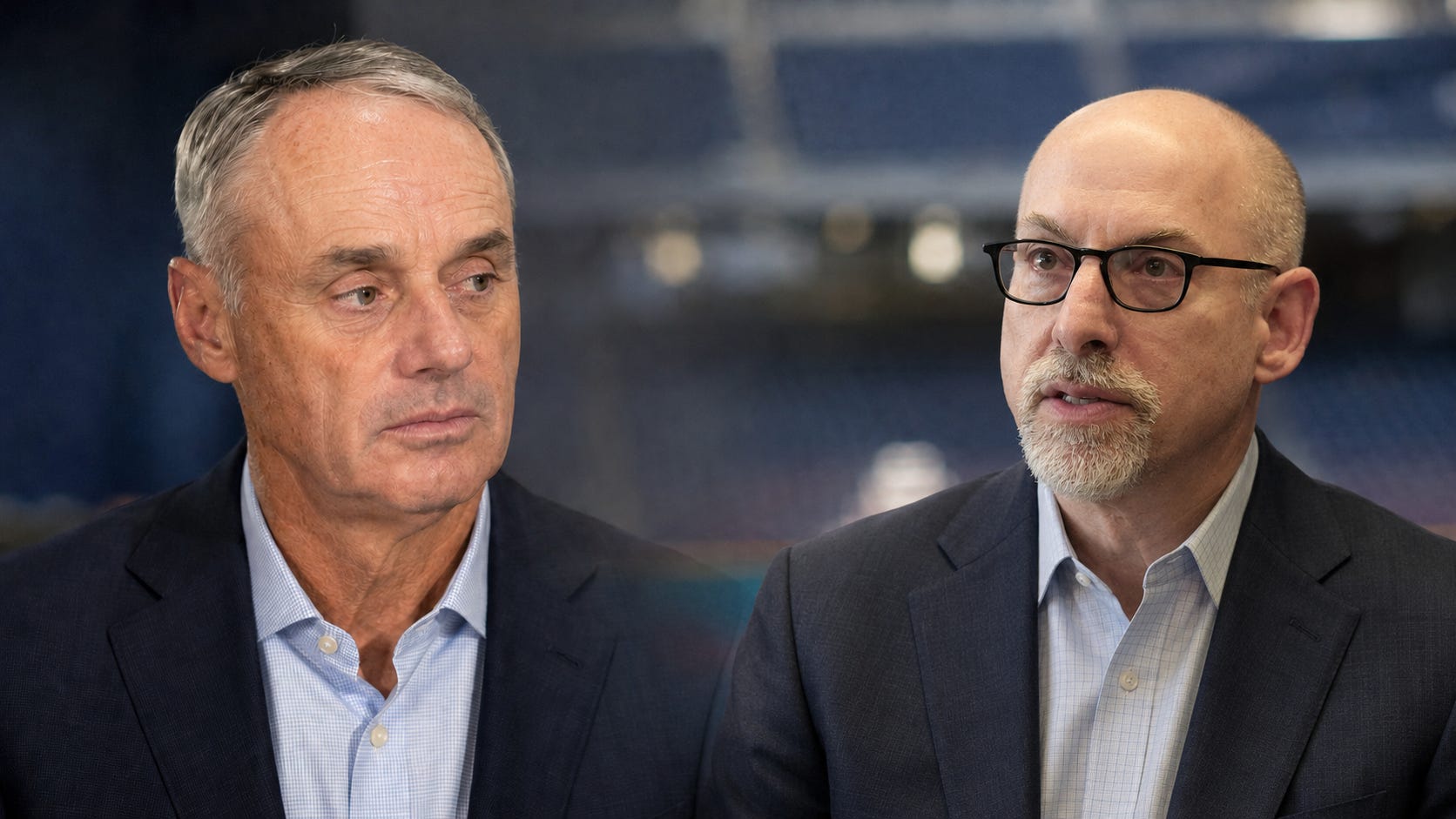
Lost in the discourse of whether or not a salary cap would fix baseball’s ‘parity’ problem is one major flaw:
The owners don’t seem to be interested in presenting a good-faith offer the players would even consider accepting.
Representatives of the Players Association have explained on the record that not only are they not inclined to even consider the latest owners’ proposal, both because it includes a salary cap - the union’s central guiding principle since its inception has been opposing one - and because the proposal’s supporting details are heavily slanted toward ownership.
“The cap system they proposed is not just bad for all the reasons that we believe cap systems are always bad,” MLBPA interim executive director Bruce Meyer told The Athletic. “They’ve effectively managed to cobble together the worst system for players in any of the major sports, and (it’s) not even close.”
The common response when I point that out is that the owners’ proposal is just a starting point, and the players can negotiate the proposal to be more neutral. But to me, if you want the players to abandon their fight against a cap, why not make the rest of the offer attractive enough that the rank-and-file players are intrigued enough to actually engage with the proposal? Negotiate in good faith, y’know?
So that’s what I’ve done here.
If I were appointed baseball czar for a day and given the ability to unilaterally design the new CBA, tasked with giving the owners the salary cap they so desperately yearn for while making it worthwhile for the players to drop that fight, acknowledging that there is a middle ground that would give both sides what they want is the road we’d take to have a full season in 2027.
Let’s talk about it.
A valid player complaint
One of the issues with the latest owners’ proposal to split baseball revenues “50/50” is that it’s not actually 50/50.
Per the union (and verified by The Athletic’s Evan Drellich, using the text of the actual proposal), there are a significant number of deductions from the total revenue number before the split is instituted, including:
17% of local revenues and 22% of national revenues as “expenses”
Unlimited (uncapped) deductions for:
Construction and renovation costs for ballparks
Construction and renovation costs for spring training facilities
Expenses for MLB Network costs
“New ventures” from the league
Additionally, baseball-adjacent revenues like expansion fees, mixed-use development, etc. are all excluded from the baseball revenue definition.
So it’s not actually a true 50/50 split; it’s a split of what’s left after the league deducts however much they want from the total pot.
The other issue with the owners’ proposal is that the 50/50 split isn’t just establishing the pool for payroll and related expenses; it’s for every single dollar spent on players, from benefits and medical expenses to amateur-signing bonuses, interpreters, and even meals in the clubhouse. These additional expenses severely cut down the amount left for payroll, with just the $23M in benefits per team in the league’s proposal establishing an effective salary floor of closer to $148M from the original $171M.
The players already estimate they receive 54% of all baseball revenues under the current system, so cutting that down to a skimmed-over 50% is a non-starter for the MLBPA.
This is just one example of several areas where the players feel that the surrounding details - like restrictions on both free-agent contract length and amount, limiting the length and eligibility for the amateur draft, etc. - are slanted heavily in favor of the owners.
Let’s fix it under a cap system, making sure that both sides get meaningful improvements over the current system.
My Proposal
1. A revenue-linked cap and floor
We’re going to set a hard cap and hard floor, subject to an audit of 2026 revenue, of $280M and $180M, respectively. These amounts are solely for payroll, not the related figures of benefits, pensions, and centrally funded bonus pools or other ancillary spending like translators.
After 2027, both of these figures will move automatically with baseball-related revenue, based on a percentage of the reference payroll (league-wide payroll allocation divided by 30): 125% for the cap and 80% for the floor.
That gives us a maximum-to-minimum ratio of roughly 1.56-to-1, being a conservative compromise between the league’s proposed $245.3M/$171.2M spread (1.43-to-1) and the union’s ‘soft cap’ of $300M/$150M (2-to-1). This leans toward the owners while making the minimum high enough to meaningfully improve spending levels and being the rising tide that raises all boats, if you will.
2. The revenue split is going to tilt slightly towards the players
Not to rehash the intro, but the league’s proposed 50/50 split isn’t actually a 50/50 split once you account for all the deductions coming off the top. Under the owners’ proposed revenue definition and the associated escrow system, the players would lose more than $500M relative to 2026, according to SportsNet.
So my plan does two things. The first is to establish a slight edge to players, a 52/48 split, because their acceptance of a cap is itself an enormous concession and we’re attempting to reward both parties here.
The second thing is to establish a three-year rolling window to future cap and floor figures, to smooth any single-season fluctuations in the figures, while classifying applicable revenue via an externally audited process.
Eligible for the 52/48 split: Media and streaming rights, MLB-controlled digital businesses (including MLB Network and MLB.TV), sponsorships, licensing, gambling and data revenue, tickets, concessions, parking, and baseball-related affiliate transactions. (Independent auditors would determine fair-market value when a club sells rights or services to an affiliated company).
Not eligible for the 52/48 split: standalone real-estate revenue (subject to restrictions on shifting baseball revenue into a neighboring development just to keep it outside the calculation)
There will be billable hours for those auditors, jointly paid by the union and MLB.
3. Aggressive revenue sharing between clubs
This one’s not hard, because there’s already some agreement here in the competing proposals.
We are pooling and dividing 100% of local television and streaming revenue equally, with continued equal sharing of national media and central revenue. Sharing of ticket, concession, and other game-day revenue will be capped at just 30%, allowing teams to be rewarded for putting a winning product on the field by keeping 70% of their home game revenue.
Every lower-than-median-revenue team will be guaranteed the greater of $240M or 85% of average club revenue, with an additional performance pool for lower-revenue teams that either finish above .500 or reach the postseason.
One requirement here is that revenue-sharing recipients are required to spend their new distribution on major-league payroll and associated costs - medical care and player development, for instance - with a required percentage of 85% going directly towards payroll. If you don’t hit that 85% target, you lose revenue sharing funds at a 150% penalty rate, with those penalties being reinvested in the revenue sharing pool. So if you miss the 85% target by $10M, you’re sacrificing $15M in revenue sharing funds.
4. The floor is going to contain anti-evasion provisions
We want to make sure the floor is going toward current player salaries, so let’s set some guardrails here. Clubs must be at 90% of the floor on Opening Day and at or above 100% by the end of the season.
If a team is not at the floor, they are assessed a penalty of 150% of the difference. 100% goes to that club’s players, paid in an inverse proportion to the size of the contract (the lower your salary, the more you get). The remaining 50% goes into the league’s pre-arbitration pool.
To prevent a team from acquiring a player on an unwanted contract and immediately cutting them as a floor circumvention measure, the trio of dead money, retained trade salary, and buried salaries (MLB contracts for players in the minors) count against the cap but not the floor.
5. The early-career player compensation will be a compromise
We’re setting the minimum salary at $1.25M, the midpoint between the two suggested $1M and $1.5M salaries. The minimum will increase annually at the greater of 5% or the YOY growth rate of baseball revenues. The pre-arbitration pool will be $120M- roughly the midpoint between the two current proposals of $65M and $180M - and will also be indexed to baseball revenue. From that pool, any rookie who earns a full season of service time will automatically receive a $100,000 bonus. The remainder will be divided similarly to the current system, based on award voting and independent performance metrics such as fWAR.
We’re expanding Super Two eligibility from 22% to 35%, guaranteeing the salaries awarded in arbitration, and establishing a minimum arb award of $2.5M that increases at either 5% per year or double the minimum salary, whichever is higher.
6. Preserve Free Agency
There’s a lot of overlap here already: Free agency after five years for players who are at least 30 years old on the cutoff date, with six years for everyone else. No qualifying offer at all, and increased service time manipulation protections. Keeping all of that, since they already agree on it.
But we’re also rejecting the owners’ proposals to cap free-agent contracts at five years and establish individual salary limits. You already got a cap, and the market will take care of the rest - if you want to spend 40% of your cap on a long-term deal for Juan Soto, have at it. A team should be able to spend $70 million annually on one player or spread it among five. That’s a baseball decision, not something we’re going to legislate.
7. Adjusting the Cornerstone Player Provision
I loved this idea when it was first proposed, but we’re removing the free-market restrictions. Let’s incentivize lower-revenue teams to do the behavior we want, not restrict higher-revenue teams.
Each club can designate one homegrown or tenured player as the cornerstone player, provided that player has spent at least five consecutive seasons with the organization. Up to $10M of his annual salary would be excluded from the team’s cap at the top end, although the entire amount will still count as player compensation and towards the payroll floor at the bottom. Additionally, revenue-sharing recipients can receive up to an additional $10M per season toward that player’s contract, with no limits on contract length, annual or total salary, or external offers.
(This $10M will come from the general revenue-sharing pool in the form of additional revenue sharing to the subject club.)
If you want to draft, develop, debut and eventually retain a superstar, we’ll provide incentives to help you do that. It’s an actual retention benefit, not a market restriction masquerading as a benefit.
8. Allow deferrals, within reason
A lot of fans get emotional about deferred money, like it’s some sort of circumvention of the luxury tax instead of it really being a tax-planning (players) and cash-flow-smoothing (team) mechanism. So we’re going to establish some realistic guardrails:
No deferring more than 50% of the contract’s total value
All deferrals require an interest rate within 1.5% of the Imputed Loan Interest Rate in the CBA, and will be charged at its stated value in salary cap calculations
A current rule, XXIII(E)(6)(b), states that if your deferral’s interest rate is within that 1.5% range, your CBT value is the stated contract amount, not the net present value with the deferrals calculated. We’re making all new deferrals meet this standard.
Contract terms and present value must be publicly disclosed when the contract is officially announced by the club
All deferred compensation must be fully funded within nine months of the conclusion of the season in which they are earned
The current standard is the 2nd June 1st after the season they’re earned, so 2026 money must be funded by June 1st, 2028. We’re shortening that by a year.
9. Enhanced competitive-integrity safeguards
We’re pulling some of these enhanced anti-tanking provisions from the union’s proposals, because they’re legitimately good ideas.
The MLB Draft lottery will expand from six clubs to eight, with revenue-sharing recipients being prevented from receiving a top-six selection in three consecutive years. We’re also going to award additional bonus pool space to revenue-sharing recipients that have a winning record and/or meaningfully improve their winning percentage year over year.
The 20-round draft will remain, and it will not have hard slots, meaning draftees will still be able to negotiate bonuses. All current draft eligibilities will remain in place, with no changes. An international draft will also be instituted, with a minimum age of 17 years old, the same bonus total as the domestic draft, but with hard slots and more rounds (to allow teams to completely fill out their Dominican Summer League teams). In the two seasons prior to being drafted, eligible players will play organized games as part of a new youth baseball initiative to be implemented in Latin America and paid for in part by the clubs, while being scouted at those games and through an MLB-run combine process.
The owners proposed reducing the domestic draft to 12 rounds, prohibiting preps from taking part, and instituting a fixed bonus system (hard slots) at a $200M total bonus pool. You already got the salary cap, so we’re giving concessions to the players and further incentivizing lower-revenue teams to win instead of further narrowing and restricting the draft.
Final Verdict
Both sides have wins in this system.
The owners finally get their long-awaited cap, but the players are compensated with a $280M/$180M cap and floor spent almost entirely on salaries, supported by enhanced revenue sharing (which will raise overall payroll spending). The baseball revenue split is both clean, without amounts skimmed off the top, and slanted slightly towards the players, to compensate them for accepting a salary cap in the first place. Contract freedom is still there, with no restrictions on contract length or salary amount other than what the market naturally settles on.
Again, while I can see the argument that a salary cap and floor help the rank-and-file of the MLBPA, the owners’ current proposal asks players to accept a team cap, individual salary restrictions, maximum contract lengths, and escrow while receiving a league minimum far below the union’s request. That is not a good-faith offer, to insist on a maximalist position both on the existence of the cap and the details that go into it. At the same time, the current system the players have proposed, merely tweaking it, makes it too easy for the biggest clubs to continue separating themselves through ever-increasing revenue disparity, and the mild incentives at the bottom do not impose a true spending obligation on the lowest clubs.
This, to me, is a workable grand bargain: The owners get certainty at the top, both in their team salary and the league’s maximum payroll spending, while the players get more money in the middle and low end of the player pool while retaining personal freedom of choice and a path to unrestricted free agency.
Complicated to the max.
Dayn Perry at CBS Fantasy Sports recently had a very good article on this topic. I was shocked at how the Dodgers, who were in bankruptcy proceedings at the time, when then owner Frank McCourt sold them to the Guggenheim Group. After working a deal with the NL, the Dodgers, after signing an $8.35BILLION deal with Time Warner, were allowed to share a much SMALLER percentage of their local broadcast revenues than other teams were. The Dodgers, on average, take in $334 million per year in local broadcast revenues, and that figure grows each year since the contract is backloaded. By contrast, the Marlins make less that $50million each year and even the Yankees take in less than half of what the Dodgers do in terms of local broadcasting revenues. This is known as the 'Dodger Exception' and runs through 2038!