


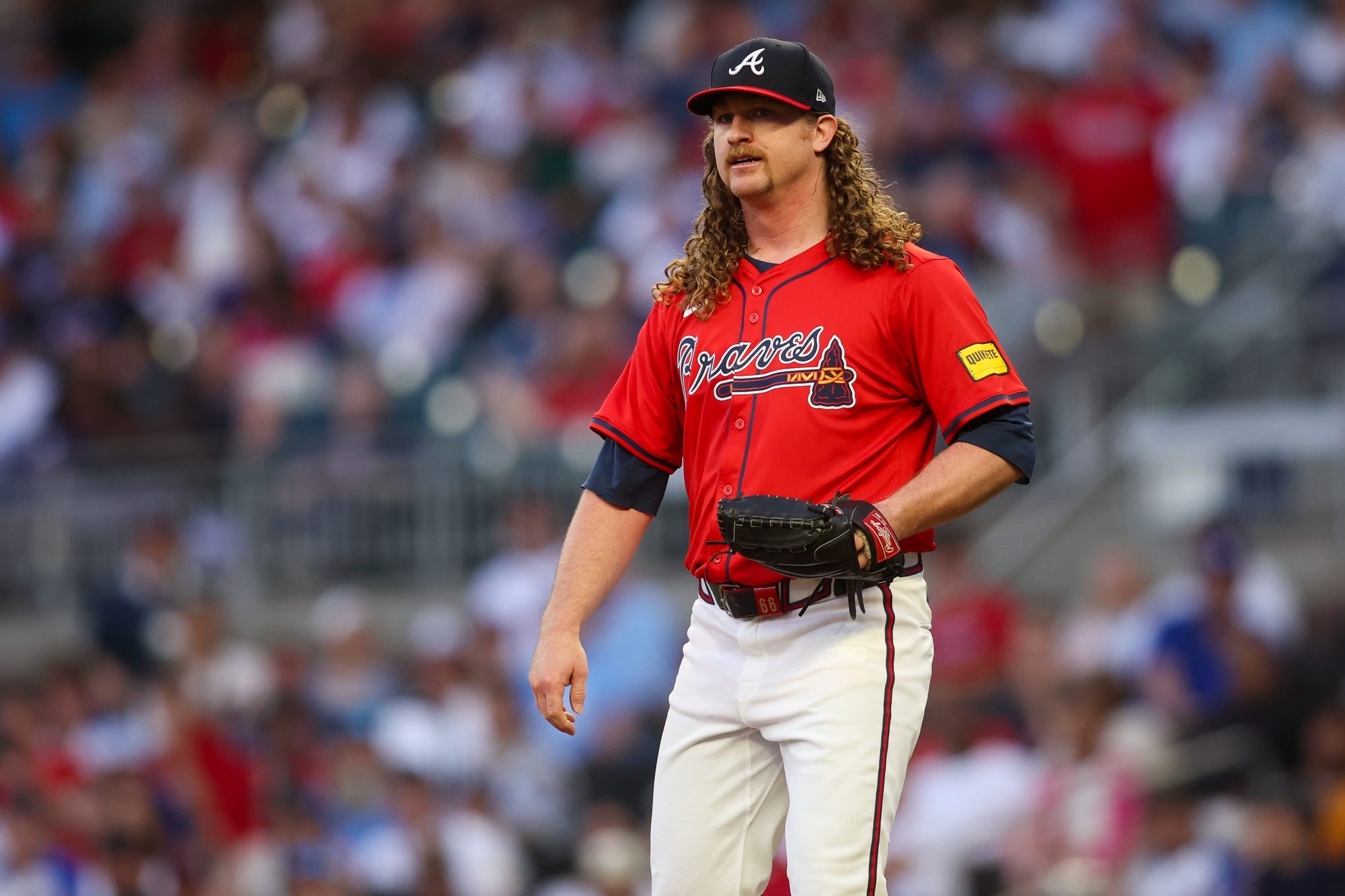
The Atlanta Braves are, publicly at least, not worried about their rotation in 2026.
Manager Walt Weiss said as much in North Port this weekend, telling MLB.com that one of the top positives in camp has been “how our starting pitchers look,” adding that it “makes me sleep a little easier at night, for sure.”
And despite the losses of both Spencer Schwellenbach and Hurston Waldrep for at least the first half of the 2026 season, the Braves have declined to add a free agent to their rotation, instead relying on internal options to cover the lost innings.
Is this the right move, or will not bringing in outside reinforcements be their undoing? The answer largely comes down to how much the Braves should trust their internal pitching depth. Let’s talk about it.
There are a lot of options
As we’ve previously discussed, Atlanta has a lot of starting pitcher options in the organization, even when you remove the injured arms from the equation. That depth is the reason the Braves feel comfortable standing pat. Instead of bringing in an outside starter, they’re betting their internal options can absorb the missing innings. Assuming that lefty Joey Wentz is healthy after his Sunday injury scare, Atlanta’s Opening Day rotation appears likely to look like this:
SP1: Chris Sale
SP2: Spencer Stride
SP3: Reynaldo López
SP4: Grant Holmes
SP5: Bryce Elder
Top depth options include Joey Wentz, who will be the 6th starter for at least the first few times through the order before heading back to the bullpen as a swingman, as well as veterans Carlos Carrasco and Martín Perez, both on minor league deals.
Behind those veterans are some promising prospect options in Gwinnett, led by JR Ritchie, Didier Fuentes, and Lucas Braun. Looking behind them to Double-A, it’s possible the Braves get any of a handful of arms to Atlanta, led by spring training NRIs Owen Murphy and Garrett Baumann and including 2024 college draftee Herick Hernandez. Luke Sinnard, who finished last season in High-A, is my pick to be that breakout “fast-rising” prospect, but 2024 1st-rounder Cam Caminiti could potentially join him if the glowing scouting reports reflect his true talent level.
In other words, the Braves aren’t short on options. They’re short on certainty.
If even one of those arms emerges as a credible major league starter, Atlanta’s decision not to add outside pitching looks far more reasonable.
But will any of them be any good, though? What’s the realistic ceiling and floor for this rotation in 2026?
The most realistic positive scenario
It’s easy to see how this could go right for Atlanta. Wentz’s Sunday injury scare notwithstanding, the best-case scenario is simple: no more injuries, and several pitchers merely hit their projections.
Chris Sale is projected to be in the running for a Cy Young, putting up the NL’s 2nd-best strikeout rate at 32.4%. He’s only down at no. 9 due to an expected injury absence, being projected for only 125.2 innings, but a full season would put him right in the thick of the running, as when he won in 2024. A resurgent Spencer Strider behind him would give Atlanta one of the NL’s best top-of-the-rotation pairings, especially if he can beat his projected 3.87 ERA/3.51 FIP on a full season worth of starts. Reynaldo López and Grant Holmes being available for the full season would already be a win, given their reduced workloads in 2025, but in this scenario, they might not need to. If both Schwellenbach and Waldrep are able to return and regain form quickly, then the Braves have a lot of options for how they configure the rotation for the stretch run.
SP1: Sale
SP2: Strider
SP3: Schwellenbach
SP4: Waldrep
SP5: López or Holmes
And having that #5 spot be one of Holmes or López is assuming that this positive scenario doesn’t include the emergence of either JR Ritchie or Fuentes as a viable major league starter. Similar to how Spencer Schwellenbach figured it out after only six starts in 2024, going from a 5.68 ERA during that span to a 2.54 down the stretch, the breadth of Ritchie’s six-pitch arsenal or the sheer quality of Fuentes’ pitches (a 103 Stuff+ on Saturday and a 110 last season, when he was throwing the entire arsenal) could could give either one the tools to settle in quickly..
In a best-case scenario, Atlanta can move both Holmes and López to the bullpen for the postseason, allowing López to work in high leverage and using Holmes in that famed “utility pitcher” role he excelled in back in 2024.
The emergence of one of those prospect starters could even allow the Braves to trade an out-of-options Bryce Elder at the deadline, with the ideal return being an additional Comp Pick. As much as a pick in Compensation Round A, sitting somewhere between 29 & 37, would be useful in what projects to be an exceptionally deep draft, a more realistic target might be Comp Round B and its picks at 67-74.
Of course, that’s the version of the plan where everything works.
The most realistic negative scenario
The problem with that scenario is simple: Not much has gone right for the Braves on the injury front in the last few seasons. Even in 2024, when they had one of the best rotations in baseball, a slumping offense and a poorly timed back issue for Chris Sale resulted in Atlanta being out of pitching for the postseason. Starters AJ Smith-Shawver and Max Fried combined for eight runs on 3.1 innings, giving up twelve hits while striking out only three, as the Braves got swept by the San Diego Padres in the NL Wild Card round.
It’s easy to see how those injury issues could continue this year, as well. If Schwellenbach and Waldrep don’t make it back this year, the Braves are banking on a return to form from Strider and rare health from Chris Sale to maintain a competitive top of the rotation. Add in the persistent shakiness from Bryce Elder and it’s a recipe for disaster.
The Braves normally use between ten and thirteen ‘true’ starters (i.e. not relievers working as openers) every season. Last year’s sixteen is unlikely to repeat, but does Atlanta trust numbers nine through twelve? Most teams don’t. But it’s also a question of exposure: Anybody can give you a spot start or two, but it’s when you need to rely on them for five or six that things get hairy.
The 2026 season looks very different if Carlos Carrasco is asked to make one start in May versus making seven consecutive starts heading into the All-Star Break. That’s the difference between depth and reliance. Bryce Elder leading your team in innings and starts (like he did in 2025) versus being 6th in starts and 13th in innings (like he was in 2024) could be the difference between being one of the best rotations in baseball and scratching to be in the middle of the pack.
How I think it’s going to go
Somewhere between the best and worst-case scenarios lies reality. The main question is, which direction does it lean?
Maybe this is the perpetual optimist in me, but I’m inclined to think things will end on the more positive side of the middle.
Chris Sale’s injuries in Atlanta have mostly been fluky, not related to the myriad of issues that sidelined him for much of his Boston tenure. Spencer Strider’s already showing good improvement in his fastball shape through just two appearances in spring, and even if he doesn’t return to 2023’s heights of velocity, he’s shown the development in his secondaries to be more of a traditional pitcher than his previous reliever-esque profile.
Behind them, I expect one of Waldrep or Schwellenbach to be available in the back half of the schedule, partnering with an improved Reynaldo López to be a formidable top four in the rotation. It’s entirely likely that between Holmes, Elder, and the top prospects, Atlanta can piece together enough starts in the #5 spot to ‘hold serve’ and turn the rotation over. When October comes, the Braves should be able to pare down their starting pitching options and prioritize both velocity and swing-and-miss.
This clearly requires most of Atlanta’s health-related absences to already be accounted for this season, which feels like the biggest weakness of this scenario.
But that’s the bet the Braves appear to be making.
Rather than spending prospect capital or committing money to an external starter, Atlanta is trusting the pitching depth the organization has spent the last several years building through the draft and development pipeline. Between veterans like Holmes and López, a handful of credible spot-start options, and a wave of upper-minors prospects, the organization believes it can cover the innings until the rotation is whole again.
It’s a defensible strategy. It’s also one that leaves very little margin for error.
If the health cooperates and one or two young arms emerge, the Braves could once again finish with one of the better rotations in the National League. If the injuries continue, though, Atlanta may find itself testing the limits of that depth sooner than expected.
Not much
"Maybe this is the perpetual optimist in me, but I’m inclined to think things will end on the more positive side of the middle"
Lindsay, obviously this newsletter was put to bed before you knew Wentz tore his ACL and is out for the year. With this knowledge, do you still believe "things will end on the more positive side of the middle." Or are you now of a mind that Alex needs to sign Giolito today?
Thanks! Great analysis, as always!!