


When we were looking for our first house, right before our wedding fourteen years ago, we found a starter house that we loved - end of the street on a cul-de-sac, with that rare combination of a yard that was both ready for entertaining and low-maintenance, and with a new roof and HVAC system.
There was just one problem: These awful green Formica countertops in the kitchen and both bathrooms.
I know, we could have just had them replaced, but this was a starter house, and we were already at the max of our budget. I was starting grad school at Auburn, and my wife had just gotten her master’s degree from UGA and was starting at the bottom in her (underpaid) teaching job.
If we bought the house, we’d be stuck with those. I knew it.
So we passed. We found a townhouse that was under our max budget, so we had the funds to do some small work on it, and it all worked out in the end.
The Braves have been stuck with the green Formica countertops at shortstop for a few years now. This winter, they need to replace them, but the free-agent market doesn’t offer much they’d want to install.
Let’s talk about it.
This has been a problem for four seasons
In retrospect, maybe the Atlanta Braves should have met the asking price for Dansby Swanson.
In a fleece right up there with getting Chris Sale (and his 2024 salary) for Vaughn Grissom, the Braves acquired Swanson, the summer’s #1 overall pick, along with outfielder Ender Inciarte and starter Aaron Blair for starter Shelby Miller and reliever Gabe Speier back in 2015.
Miller’s ERA in Arizona was 5.44 across the three seasons and 28 starts he made for the Diamondbacks, while Inciarte won three Gold Gloves and had a 200-hit season for the Braves.
Oh, and Swanson turned out okay, missing only two games across his final three seasons for the Braves, twice getting down-ballot MVP votes, and winning his first career Gold Glove in his walk year.
But Atlanta was hesitant to meet the Cubs’ offer of seven years and $177M in free agency after the 2022 season, holding firm on the “Atlanta Max” of $22M AAV across six years. Swanson departed to Chicago, joining wife Mallory, a soccer player for the local Stars, on the Northside.
Eleven different players have received meaningful time at shortstop for Atlanta since Swanson left:
Orlando Arcia: 304G, 84 wRC+
Nick Allen: 127G, 52 wRC+
Ha-Seong Kim: 68G, 41 wRC+
Mauricio Dubón: 61G, 115 wRC+
Jorge Mateo: 40G, 71 wRC+
Jim Jarvis: 38G, 58 wRC+
Vaughn Grissom: 18G, 71 wRC+
Luke Williams: 15G, 4 wRC+
Vidal Bruján: 10G, 36 wRC+
Zack Short: 7G, 31 wRC+
Nicky Lopez: 5G, 168 wRC+
That’s a 73 wRC+, coming from a .231/.287/.338 line.
In that same time span, by the way, Dansby Swanson has a 100 wRC+ for Chicago while making $96M.
So what can Atlanta actually do this winter?
The good news is that Atlanta may not need to solve shortstop for the next seven years. John Gil, Alex Lodise and Tate Southisene all give the organization legitimate long-term possibilities. None of them, however, should be expected to open 2027 in the majors.
What the Braves really need is a bridge: someone good enough to stabilize the position for a year or two without blocking the prospects when one of them proves ready.
It’s slim pickings in free agency
As we discussed on Friday, it’s a small list of available options, headlined by current Braves Dubón and Kim, joined by former Seattle Mariners infielder J.P. Crawford and a lot of veterans and/or utility-types.
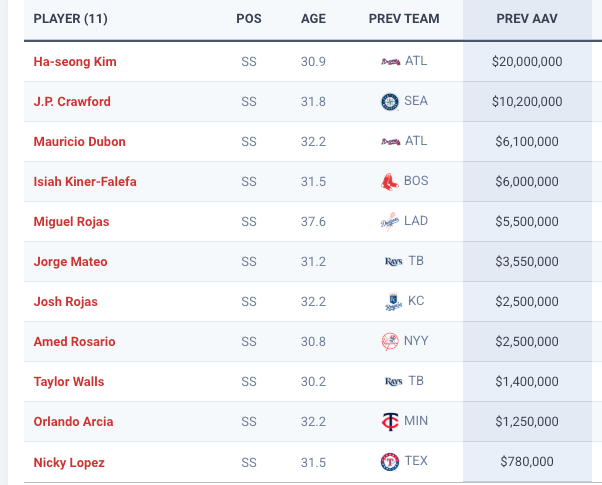
And in a sign of how desperate the Braves have been for a shortstop in recent seasons, five of these players have spent time in Atlanta already.
Let’s break down the possible routes here:
Re-sign Dubón to a multi-year deal
This is the path that makes the most sense - we’ve seen him hold down the position both offensively (115 wRC+) and defensively (+1 DRS, +3 FRV). Alex Anthopoulos was asked about the possibility on Sunday, admitting that he’s “comfortable” with Dubón at shortstop and praising his “really good year” for Atlanta.
On his side, Dubón’s previously said he’d be open to returning to Atlanta, telling Friend of the Show™ Gabe Burns of the AJC back in June that he’s open to an extension that would keep him in Atlanta.
“I waited six years for this (opportunity with the Braves),” he said. “If they come and offer something, and it makes sense for me and my family, we’re open to hear it. […] I’d love to stay here, man.”
Anthopoulos said that the team plans to use the exclusive negotiating window they’re currently in, which lasts until five days after the World Series, to work on their own free agents and have the conversations about those players returning.
(If they can’t reach a free agent deal, Atlanta could always issue a Qualifying Offer to Dubón, which would pay him $23.15M for 2027 if he accepted. Were he to leave in free agency, Atlanta would receive draft pick compensation.)
I personally think Dubón’s free agency is going to be the one that surprises us, and I wouldn’t be shocked to see the 32-year-old sign for $10M or more a year on a multi-year deal. Given that he made $6.1M this year, his final of arbitration eligibility, my guess would be something around three years and $32M, although 2/$25M with a $10M club option as a third year might get it done, as well.
The irony is that making Dubón the everyday shortstop might take away the very thing that maximizes Dubón’s usefulness.
Does locking Dubón into the everyday shortstop job hamper manager Walt Weiss's ability to make pinch-hit decisions without having to consider the defensive fit? His usual go-to was to deploy the best pinch-hitter, knowing that Dubón could cover any position but catcher at the drop of a hat (and swap of a glove). As Anthopoulos explained on Sunday, “As a manager, knowing you could plug him anywhere you want? How many times in the middle of a game did Walt shift him from outfield to infield, infield to outfield? We haven’t had that here in a long time.”
There may be a solution there, however:
Re-sign Dubón and Kim
Kim’s had a terrible run of injury luck in recent seasons, and it’s prevented him from getting the long-term deal at shortstop1 that the Scott Boras client has been looking for since the end of 2024.
His recovery from a 2024 shoulder injury, plus back and hamstring issues that popped up during his rehab, didn’t allow Kim to debut with the Tampa Bay Rays until July of 2025. He got in just 24 games over two months with Tampa before being waived, joining the Braves for the final month of a lost 2025 season. His performance picked up somewhat after joining Atlanta, with Kim hitting .253/.316/.368 over the final month of the season before declining his player option and entering free agency.
But Kim then tore a finger ligament in an accident back home in Korea last January, which delayed his 2026 debut until mid-May. And he was clearly not fully healthy when he did return, hitting just .068/.171/.068 across his first 82 PAs before the Braves put him back on the injured list for the finger. He performed more respectably when he returned to the majors in August, but .179/.281/.232 was still well below both his and the team’s expectations when they committed $20M to him for 2026.
Could the Braves bring Kim back on a relatively small deal? He’s likely going to be offered guaranteed money by someone, so a minor league deal with a non-roster invite to spring training likely won’t get it done, but a commitment of a few million could allow the player to rebuild some value while also giving the Braves much-needed roster insurance for 2027.
And depending on the size of the guarantee, moving on from Kim if he’s still not producing like he did when healthy (.250/.336/.385 from 2022-2024, stealing 72 bags with an 11% walk rate and a 106 wRC+), they could always either eat the money or make a minor trade to unload him to another team.
At the right guarantee, Kim becomes a lottery ticket Atlanta can afford to lose.
But if they decide not to bring back a struggling shortstop in Kim, they can instead choose to rehabilitate a struggling shortstop from the AL West:
Sign J.P. Crawford to a short-term deal
Former Seattle Mariners shortstop J.P. Crawford was moved off the position mid-season for top prospect Colt Emerson, but regained his job after Emerson went down with a wrist injury in August.
There is a laundry list of pros and cons here, so let’s discuss it.
Pro: He’s got the on-base ability Alex Anthopoulos is looking for.
Crawford has a career walk rate of 11.5% and a strikeout rate under 20%, thanks to his virtual refusal to chase (98th percentile mark of 19.7% this season). His 13.1% walk rate this season, a 92nd percentile mark in all of baseball, would have led the entire Braves roster, easily outpacing Ronald Acuña Jr. (11.3%) and Kim (10.9%).
Con: He struggled to pick up hits
Crawford’s .221 average was the second-lowest of his career, and it’s not like he was especially unlucky; his xBA, per Statcast, was still just .234.
A big issue there was his uncharacteristic jump in his pop-ups, reaching 9.1% after sitting at 5.3% last year and 7.9% for his career. Is this something that Atlanta feels is fixable, or is this a deterioration in bat speed or approach that comes with the aging curve?
Pro: He’s reportedly fantastic in the clubhouse
Crawford was a leader in Seattle, being described as the “heart and soul” of the team. He joined the Mariners via trade from Philadelphia in 2018, as Seattle was tearing it down, and became the franchise leader in starts at shortstop…until he voluntarily offered to move to third base mid-season to clear a spot for Emerson.
The move by the team’s de facto captain was well-received in the clubhouse, as were some of the little things he’s done over the years: taking young players out to dinner, or buying them their first suits, or being the first player to speak up in the clubhouse to address issues.
For a Braves team that’s doubled down on the chemistry in recent years, there’s not much clubhouse downside to adding Crawford to the group that Atlanta’s assembled.
Con: He’s been dreadful defensively
A cynical observer could claim that it’s not hard to give up playing shortstop when you’re not good at it, but trying to give the organization an out from needing to bench you.
No matter which defensive metric you choose to believe in, it wasn’t kind to John Paul.
Crawford put up -13 Outs Above Average, -10 Fielding Run Value, and -12 Defensive Runs Saved at shortstop for Seattle this year. Only two shortstops had a lower FRV than Crawford, and both of them had 300-400 more innings at short than Crawford’s 720.
The problem appears to be his range, which was a 1st-percentile mark this season, combined with well-below-average arm strength (20th percentile at 80.2 mph) that doesn’t give him a way to make up for being late to the ball.
Is it possible that playing next to a sound defensive third baseman in Austin Riley (82nd percentile in range) could allow him to mitigate his range issues enough to cover the position for a year? Of course, but the Braves have always prioritized defense up the middle at catcher, shortstop, and centerfield.
You’d need either a strong defender to swap in for Crawford late in games (maybe bumping Crawford over to second base for Ozzie?) or to see some offseason improvements in Crawford’s glovework to see this happening, but everything else lines up outside of that (admittedly big) aspect.
And if none of those bridge options are appealing enough, then Anthopoulos has to decide whether shortstop is worth spending real prospect capital to solve.
Make some sort of trade
Without knowing who is available via trade this winter, which Anthopoulos told us over the winter he was working on ahead of the GM Meetings, it’s hard to know where the Braves would find a shortstop.
But the deal would likely take one of two forms: Taking on additional money, or a team trading a young player ahead of free agency. Let’s look at each option and speculate on who would make sense in that scenario.
A high-priced vet: The first name that comes to mind here is Corey Seager, who Atlanta reportedly called Texas on last winter. He’s close to average defensively at this point in his career, but is clearly there as an offensive option. There’s injury concerns to deal with - he’s currently rehabbing from postseason elbow surgery - and he’s incredibly expensive, being owed $31.5M for each of the next five seasons, but Atlanta could give him time at designated hitter and move him in to second (or out to third base, if Austin Riley can’t rebound) once the prospects are ready for shortstop.
(It’s worth pointing out that the Braves had a deal in place with Texas for Jacob deGrom at the deadline before the pitcher nixed the deal by exercising his no-trade clause. They could always attempt to revisit that, making it a package deal.)
Other options here: Willy Adames, Trevor Story, Dansby Swanson, Ezeuqiel Tovar (who isn’t expensive yet, but will be as his long-term deal continues to age)
A young player heading to free agency: Depending on how early the team wants to sell, I’m looking at either Houston’s Jeremy Peña (one year away) or LA’s Zach Neto (three years of control) in this scenario.
Peña’s hired Scott Boras as his agent and is likely to walk in free agency, and Houston has done this before, trading away Kyle Tucker ahead of his final year of control (2025), sending him to the Cubs. Neto’s a harder trade to make, given his multiple years of control, but a new general manager coming in could face a mandate from new owner Stan Kroenke to finally execute the tear-down that the Angels have been refusing to commit to for the last decade.
Both teams have top-of-rotation arms, like LA’s Reid Detmers and Houston’s Hunter Brown, if Atlanta wanted to attempt to kill two birds with one stone on their deal. Both deal would be incredibly expensive, with both pitchers having two years of control remaining, but Atlanta could always target a higher-salaried pitcher like LA’s Yusei Kikuchi or Houston’s Tatsuya Imai or Cristian Javier instead of trying to get the ace if they wanted to mitigate the prospect cost.
The Braves don’t necessarily need to find their next Dansby Swanson this winter.
They have three young shortstops in Gil, Lodise and Southisene who might eventually provide the long-term answer. What Atlanta cannot afford is another season of waiting for that answer while getting a 73 wRC+ from one of the most important defensive positions on the field.
Maybe the bridge is Dubón. Maybe it’s Dubón and Kim. Maybe Crawford’s on-base skills are tempting enough to live with the glove for a year, or Anthopoulos decides this is finally the position worth spending serious prospect capital to solve.
But the Braves have spent four years finding different ways to live with the same problem.
At some point, you have to replace the green Formica countertops.
He was reportedly offered a four-year, $48M deal by the Athletics last winter to play second base, among other multi-year deals, but took Atlanta’s $20M offer so that he could remain at shortstop.