


If you are reading this piece, odds are you are hoping the Braves can take care of business in the first two games and we do not even have to worry about a potential win-or-go-home Game Three. Those types of games are electric when you are watching someone else play in them. But when it’s your team, they can take years off your life. Put the Phillies on the other side and somehow the stress level gets cranked up even higher.
Facing a division rival in the playoffs is already difficult enough. Then you add in all of those images and videos from the 2022 and 2023 postseason, when Philadelphia sent Atlanta home in October. Now add that a Game Three would likely feature Zack Wheeler on the mound, albeit on short rest, against whoever Atlanta decides is its third starter.
We all know how good Wheeler is. Yes, he is on the tail end of his career, but he just completed yet another season with an ERA of 3.00 or lower and has historically given his hometown team fits.
So I do not think Atlanta should approach Game Three like a normal baseball game. The goal should not necessarily be finding one pitcher capable of matching Wheeler inning for inning. The goal should be figuring out the best way to get 27 outs with the collection of arms Atlanta has available.
And to me, that plan starts with Kyle Schwarber and Bryce Harper.
Those are by far the two most dangerous bats on Philadelphia’s lineup card, with Bryson Stott recording the only other above-league-average offensive season this year. Notice the pattern? All three are lefties, and all three should hit near the top of the order.
Trea Turner, Alec Bohm, and Edmundo Sosa will likely find themselves mixed in there as well, but the goal for Atlanta should be simple: do not let Schwarber and Harper be the reason you go home.
That puts a lot of responsibility on the bullpen, but more specifically, it puts a lot of responsibility on how Walt Weiss deploys it. With the flexibility this pitching staff has, finding 27 outs might not be as daunting as it initially sounds.
First Time Through
This is going to be a hot take, and I can already predict what many of you are thinking, but I am starting Brent Suter in a Game Three scenario. Walk with me here.
Since being traded to Atlanta, Suter has faced 41 lefties this season. He has allowed just seven hits, including two doubles, one triple, and one home run. He has walked four and struck out seven, while left-handed batters have hit just .189 against him in that span. That includes Schwarber, who went 0-1 with a walk and a strikeout against Suter. Harper did not face him this season.
At its simplest, the goal here is to do everything possible to prevent either Schwarber or Harper from hitting a baseball over the fence. Obviously there is more nuance to pitching than that, but when you boil this entire strategy down, that is what we are trying to prevent.
Suter throws his sinker 40% of the time to lefties and his slider another 27% of the time.
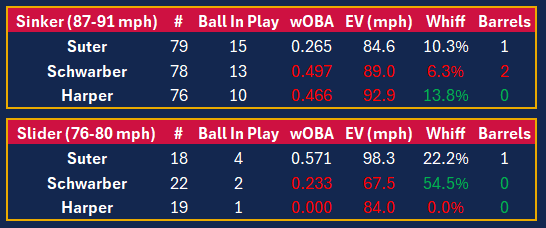
Using a five mph range around Suter’s averages, we can see that he does a relatively good job of limiting damage. Schwarber and Harper have both performed better than Suter’s averages against similar pitches, so there is certainly some danger involved in handing him the baseball in the first inning.
But there is going to be danger with just about anyone Atlanta puts out there against these two. The other logical left-handed option is Ray Kerr. The problem is that both Harper and Schwarber have better numbers against the harder sinker-and-curveball combination that Kerr deploys.
I could absolutely see Weiss giving the ball to either pitcher, but if I am making the decision, I am going with Suter based on what Schwarber and Harper have done against similar pitches.
BRIDGE: From there, the next one or two innings can belong to Grant Holmes. Holmes has pitched well for Atlanta this season and has experience both out of the bullpen and as a starter, which makes him almost perfect for this type of role. Yes, you could simply start Holmes in the first inning and let him work through the order once. I would understand that decision. But both Schwarber and Harper have had success against him this season, and if I can control when they see him, I would rather avoid that matchup the first time through.
Second Time Through
Whether it comes in the third or fourth inning, this is when I would start deploying some of my biggest bullpen arms.
Yes, it is early. I also do not care.
In a winner-take-all Game Three, every Schwarber and Harper plate appearance is a high-leverage situation. Saving your best relievers for some theoretical situation in the eighth inning does you no good if one of these guys changes the game in the fourth.
Assuming the game is close or Atlanta has a lead, I would bring in Dylan Lee for their second time around.
For the last three seasons, Lee has been one of the best relievers in baseball, period. He has struggled a bit over the last few months, and whether that came from his high usage, tipping pitches, simple regression, or some combination of everything, we really do not know. What we do know is that he is still an effective pitcher, has looked better as of late, and I am willing to trust him in this spot.
Schwarber is 6-18 against Lee, including two doubles, a home run, three walks, and four strikeouts. This season, he is 2-5 with a triple and a walk. Harper has also had success against him, going 4-14 with two doubles, a home run, and three strikeouts. This season, he is 2-5 with two doubles and a strikeout.
So why Lee? Similar to Suter, Lee will primarily deploy a two-pitch mix against lefties. He throws his slider 64% of the time and his four-seam fastball the other 36%.
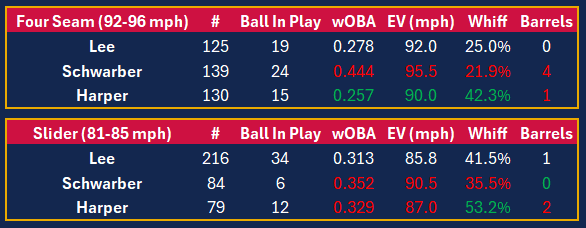
Again, both Schwarber and Harper have produced relatively well against these pitches. But let’s be fair here. It’s Kyle Schwarber and Bryce Harper. They have produced against most pitches thrown by most pitchers in this league.
What interests me is how the matchup works. Lee has yet to allow a home run on his slider this year. Schwarber and Harper have each hit just one against similar sliders while posting extremely high whiff rates.
It follows the same general philosophy as using Suter the first time through. Keep them off balance, make them chase, and create opportunities for swings and misses.
Lee also brings better pure stuff. His four-seam fastball has a 116 Stuff+ with as much as six additional miles per hour of velocity compared to Suter, while his slider carries a 118 Stuff+ compared to Suter’s 111 Stuff+.
Now, if Holmes gets the bulk innings after the first and is absolutely rolling, Weiss may decide to let him face the top of the order again. I would not hate that.
This is where managing a postseason game becomes different from planning one on paper. If Holmes is cruising, you have to read the game in front of you rather than blindly following a script.
BRIDGE: This portion obviously depends on how the game is going and which relievers have already pitched in Games One and Two, making it difficult to precisely determine who should get these outs. As of today, I would be comfortable going to either Dylan Dodd or Victor Mederos. Dodd has been great all season, while Mederos has allowed a hit in just three of his last 10 outings. One of those was admittedly a four-hit, three-run outing against these same Phillies, but both give Atlanta options for getting from one major matchup to the next without burning another premium reliever.
Third Time Through
Now, we are hopefully reaching the third trip through the order somewhere around the sixth or seventh inning. Assuming the game is close or Atlanta is winning, this is where I deploy my team MVP: Didier Fuentes.
Fuentes has been one of the best relievers in baseball this season and deserves far more consideration for both Reliever of the Year and Rookie of the Year than he will likely receive.
It really has not mattered which side of the plate opposing hitters stand on. Against lefties this year, Fuentes has allowed just a .228 batting average and .396 slugging percentage while posting a 33.9% strikeout rate across 165 left-handed batters faced.
Because this is his first full season, Harper and Schwarber have only faced him twice apiece. Both are 1-2, with Harper recording a double and Schwarber hitting a home run.
Didier Fuentes uses three pitches against lefties: a four-seam fastball 68% of the time, a slider 20%, and a split-finger fastball 12%.
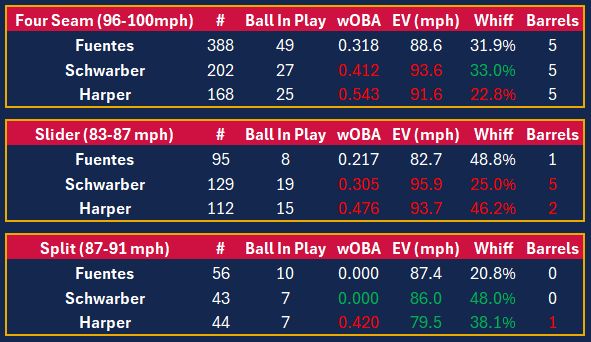
Both Schwarber and Harper have been just okay against the high heat, slider, and split combination Fuentes brings to the table. More importantly, these are some of the higher whiff-rate pitches you will see from these two superstars.
Of course, there is still essentially no margin for error. If Fuentes makes a mistake, both are more than capable of making him pay for it. And both have done so this year.
One major advantage here is that Fuentes has worked multiple innings plenty of times recently. If he has to enter as a pseudo-fireman at the end of the sixth inning, there is no reason he cannot come back out for the seventh. This all depends on how much he was needed in the previous two games, of course, but his ability to cover more than three outs gives Weiss another level of flexibility.
BRIDGE: Fuentes might be able to serve as his own bridge. If he is well rested, he is capable of giving Atlanta two innings and potentially even three if the situation calls for it. If not, the equation becomes pretty simple. Give the ball to either Robert Suárez or Raisel Iglesias.
Fourth Time Through
The final trip through the lineup will hopefully not arrive until the eighth or ninth inning. This is Robert Suárez and Raisel Iglesias time.
Until he landed on the IL, Suárez was a top-five reliever in baseball. He returned during the final week of the season and allowed one run in each outing, but both felt a little more fluky than concerning. More importantly, his velocity was back into the high 90s.
Iglesias started the year strong before hitting a rough patch in the middle of the season. He recovered down the stretch, finishing September with a .205 batting average against and a 1.05 WHIP while allowing just four hits and one earned run across nine outings.
I want to look at both here because I genuinely do not know which pitcher would end up getting Schwarber and Harper for the fourth time through. Suárez deploys his high-velocity fastball 46% of the time and his changeup 40% of the time against left-handed hitters. Iglesias follows a similar formula, throwing his changeup 44% of the time and his four-seam fastball 42% against lefties.

What stands out to me when looking at this relatively basic set of numbers is that both Schwarber and Harper have struggled against the fastball and changeup combination that Suárez and Iglesias possess.
That lines up with the recent head-to-head matchups as well.
Schwarber vs. Suárez : 0-2, 2 K, including 0-1 with a K this season.
Harper vs. Suárez : 1-3, 1B, K, including 0-1 with a K this season.
Schwarber vs. Iglesias: 4-18, 2B, HR, BB, 8 K. He is 0-2 with a BB, K this year.
Harper vs. Iglesias: 6-12, 3 HR, 3 K. He is 0-1 with a K this year.
I want to note that for Iglesias, both batters’ damage was done before the 2024 season. Schwarber is 0-4 with two strikeouts, and Harper is 0-3 with two walks and two strikeouts over the last two seasons.
At the end of the day, these are your two horses at the back end of the bullpen. They are earning top dollar to close out games exactly like this, and that is what they have done. At some point, you have to trust your best players to beat their best players. I trust these two to do that.
Between Fuentes, Suárez, and Iglesias, the backend of Atlanta’s bullpen is among the best in baseball. Depending on usage, those three can cover anywhere from three to five innings on their own.
In a winner-take-all game, I am riding that group as far as it can take me.
Final Thoughts
Of course, baseball rarely cooperates enough for something like this to work perfectly.
Walt Weiss will inevitably have to make in-game adjustments. Schwarber and Harper are not always going to conveniently step to the plate at the beginning of an inning. There could be runners on base. Someone could get hurt. A pitcher could simply not have it that day.
Those moments will create the biggest decisions Weiss has to make. But that is also why I like this approach.
In my eyes, the biggest advantage Atlanta has over Philadelphia in this series is its bullpen. The Braves have the depth, flexibility, and variety of arms to deploy a strategy like this without asking one pitcher to do everything.
I do not need Suter to throw five innings. I do not need Holmes to turn into Chris Sale. I do not need Lee, Fuentes, Suárez, or Iglesias to record six outs apiece.
I need this collection of pitchers to get 27 outs while doing everything possible to prevent Schwarber and Harper from being the guys who end Atlanta’s season. If other players beat you, you simply tip your cap to them.
That is the puzzle.
Suter gets the first crack. Holmes provides a little length. Lee gets an early high-leverage opportunity. Fuentes gets the heart of the game. Suárez and Iglesias finish it.
Will it unfold exactly like that? Almost certainly not. But the philosophy should remain the same.
Do not manage Game Three like it’s a random Wednesday night in June. Do not save your best reliever for the ninth inning while Harper is standing at the plate with two runners on in the sixth. Sometimes a game’s highest leverage spot ends up being in the sixth inning, and Atlanta has to be willing to deploy its pitching that way. Identify the plate appearances most likely to decide the game and use your best weapons to win them.
And, of course, I think I speak for all of us when I say I hope I wrote this entire piece for absolutely nothing. Hopefully Atlanta goes 2-0, we turn our attention toward the Dodgers, and none of us ever have to find out whether this plan would work.
But until then, enjoy it.
Enjoy October baseball, and let’s cheer on a team that, on paper, has a real chance to win the World Series.