


Just over 400 days ago, the Atlanta Braves surprised many by selecting shortstops with each of their first three picks in the 2025 MLB Draft. Sandwiched between prep Tate Southisene and fellow college bat Cody Miller was Golden Spikes Award finalist and Florida State Seminole Alex Lodise.
After posting a .976 OPS during his freshman season at North Florida, Lodise transferred to the ACC powerhouse, where he would spend the next two seasons as Florida State's starting shortstop.
As a sophomore, Lodise experienced some growing pains with the jump in competition. Still, he batted .281 with an .833 OPS and nine home runs.
The breakout would come the following year.
In 2025, Lodise exploded during his junior campaign, slashing .394/.462/.705 with a 1.167 OPS and 17 home runs. Despite the massive production, legitimate questions remained about his hit tool as he entered the 2025 MLB Draft. Lodise had struck out at least 20% of the time in each of his two seasons at Florida State while posting a walk rate below 10%.
Those concerns remained when Atlanta selected him in the second round, taking him with the 60th overall pick and signing him to a $1.3 million bonus.
Immediately, many penciled him in as the potential starting shortstop for the Atlanta Braves as early as 2028. He was assigned directly to High-A Rome after the draft, but almost immediately ran into trouble at the plate. Whether that was the result of a long college season, an aggressive assignment, or simply a young player adjusting to professional baseball, the numbers were alarming.
Now, almost a full year later, Alex Lodise is starting to show why so many people were excited when his name was called last summer. Myself included.
The Red Flags Were Hard To Ignore
In my inaugural Top 50 Braves prospect rankings, I placed Alex Lodise at number 19 overall. To many, that was probably a surprise.
MLB Pipeline currently ranks him as Atlanta’s number five prospect. FanGraphs also opened the year with him at number five, while Baseball America had him at number nine entering the season. Most outlets had Lodise comfortably inside Atlanta’s top ten. Even with my placement of 19th dragging down his overall, Lodise came in as Atlanta’s 12th-rated prospect with a composite score of 13.26 on the Braves Today Prospect Composite.
So why was I so much lower on him?
For me, a college bat of Lodise's caliber should, at minimum, hold his own against Single-A and High-A pitching. He spent two seasons playing in one of the best conferences in college baseball and was one of the best hitters in the country during his final year at Florida State. The pitching he would face at the lower levels of the minor leagues should not be completely foreign to him.
Yet, in 25 games with High-A Rome last year, Lodise slashed just .252/.294/.398 with a .692 OPS. Those numbers by themselves were not disastrous. What concerned me was how he got there.
Many of the problems scouts worried about before the draft immediately showed up. Lodise struck out at a 38.5% clip, posted a 32.8% whiff rate, and walked just 4.6% of the time. That is a pretty difficult offensive profile to make work, and the reasons why we wrote before the season that Lodise might require a longer developmental runway than his college résumé suggested.
Instead of sending him back to Rome to begin 2026, the Braves assigned the now 22-year-old to Single-A Augusta to continue working through those issues.
Through his first 50 games, Lodise showed improvement, but not quite at the level I wanted to see. His slash line still sat at just .251/.338/.399 with a .737 OPS. His strikeout rate dropped considerably to 27.3%, while his walk rate improved to 9.5%.
Better? Absolutely. Good enough for someone many considered one of Atlanta’s best prospects? I still wasn’t sold.
So when I put together my rankings, I wanted to compare Lodise's profile to other recent prospects and see what players with similar numbers eventually became. The results were concerning, to say the least.
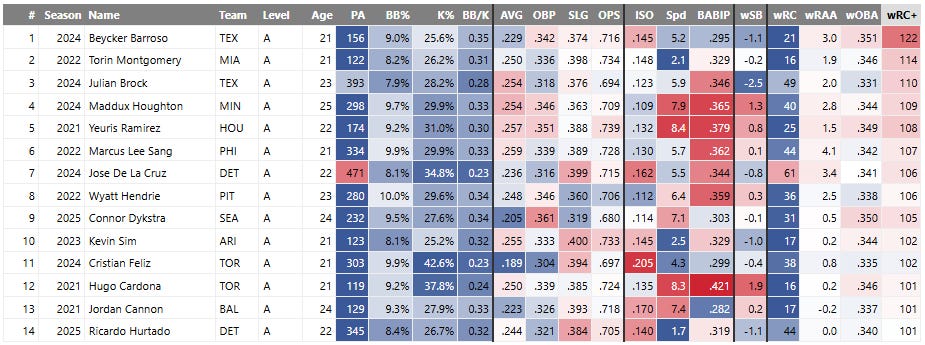
Since 2021, there have been just 14 prospects who were at least 21 years old, hit below .260, slugged below .400, struck out more than 25% of the time, walked less than 10% of the time, and still managed at least a 100 wRC+.
Yes, those are very specific parameters. That is also kind of the point.
Lodise was putting together a very unusual profile for a player of his age and pedigree. There was enough production to remain above league average, but the way he was producing raised legitimate questions about how his bat would translate as he climbed the ladder.
Thankfully, that version of Alex Lodise has slowly started to disappear.
Since the beginning of June, Lodise has slashed .263/.354/.587 with a .940 OPS. More importantly for me, his strikeout rate dropped to 24.1% while his walk rate climbed to 10.1%.
After 435 plate appearances with Augusta, Lodise earned his promotion back to High-A Rome with an .826 OPS and 117 wRC+ on the season. This time, he looks much more prepared for the challenge.
Lodise Is Finally Answering The Questions
As I mentioned before, since the calendar turned to June, Alex Lodise has looked much closer to the player we all hoped he would become.
Before returning to High-A on July 28, Lodise posted a .920 OPS during his final month with Augusta. His strikeout rate continued trending in the right direction as well, dropping to 23.6%.
For me, his return to Rome represented the first major test of Lodise's future in the organization.
If he struggled again, especially in the same ways he did last season, it would become increasingly difficult to overlook. At some point, a highly regarded college hitter has to show he can handle lower-level minor league pitching. And well, Lodise seems to be playing like he knew that.
Through 17 games since his promotion, Lodise has posted a ridiculous .343/.434/.571 slash line with a 1.005 OPS and 163 wRC+. Even more encouraging, he has struck out just 7.2% of the time. Yes, you read that correctly. No, that is not a typo.
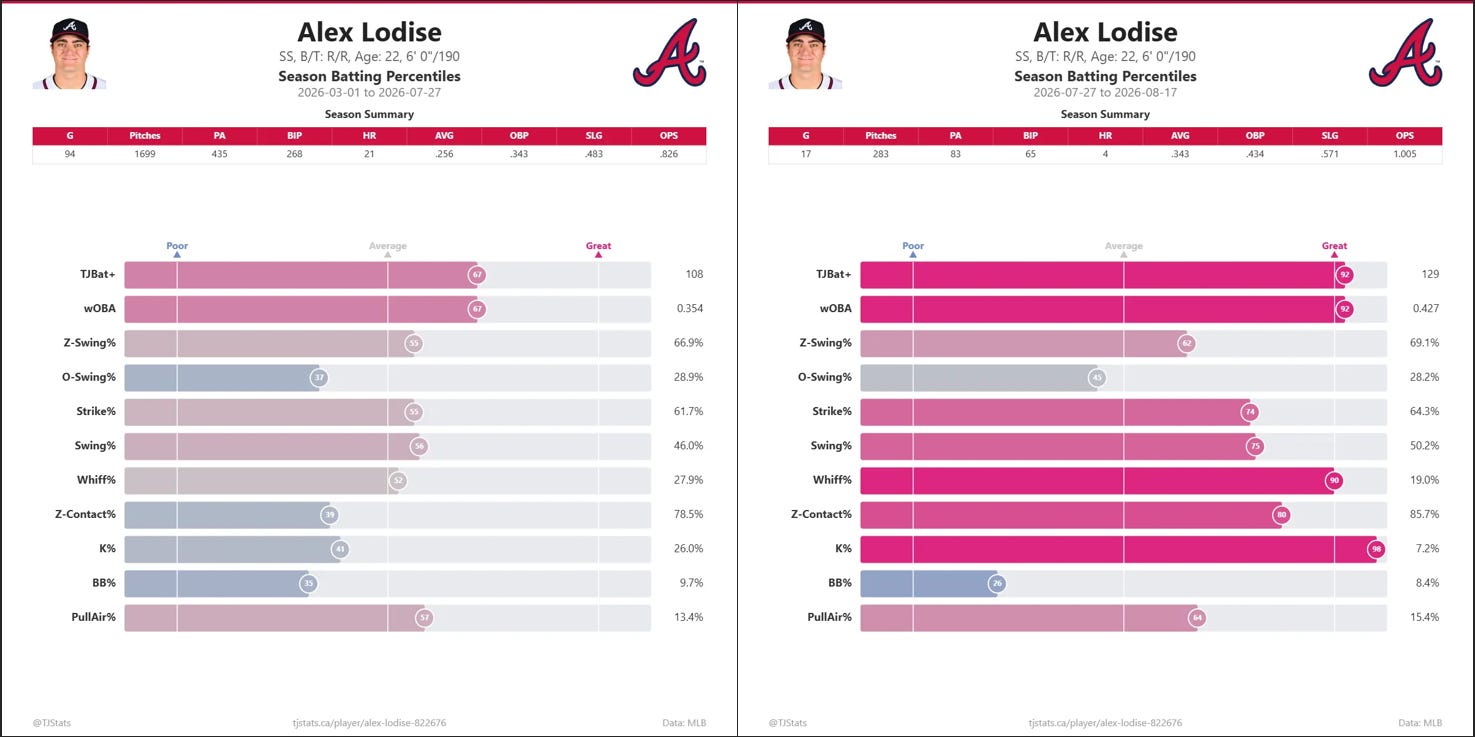
Realistically, a roughly 20% reduction in strikeout rate is not going to be sustainable. I am not suddenly expecting Lodise to become Luis Arraez at the plate. But that really isn't the point.
What matters is that the underlying improvements we needed to see are showing up. Lodise has lowered his whiff rate to just 18.6% while increasing his zone contact rate to 86.9%. His walk rate still sits at a fairly pedestrian 8.4%, but he is making significantly more contact without sacrificing the damage that made him such an intriguing hitter in college.
Lower swing-and-miss. More contact. Higher damage. That is the version of Alex Lodise we have all been waiting to see.
The Next Test For Lodise
At 22 years and five months old, Alex Lodise is almost exactly the average age of a player at the High-A level. For me, however, that does not automatically mean he is right back on track to become the shortstop of the future for the Atlanta Braves.
Context matters.
Before getting hurt, Tate Southisene had already proven himself at High-A and earned a promotion to Double-A at just 19 years old. John Gil has also reached Double-A at only 20, although he returned to High-A to start this season before an early-August promotion back to Columbus.
Other shortstops selected in 2025, such as Eli Willits, JoJo Parker, and Kayson Cunningham, are already playing at the same level despite coming out of high school. Fellow college shortstops such as Aiva Arquette, Marek Houston, and Wehiwa Aloy have already reached Double-A.
That does not mean Lodise is behind schedule or suddenly a failed prospect. Development is not linear, and comparing every player directly by age and level can get dangerous pretty quickly.
Still, for a polished college hitter who was one of the best players in the country just over a year ago, I think it is fair to expect a little more.
I would really like to see Lodise continue this hot streak and earn at least a small cup of coffee at Double-A before the season ends. That would give us another data point against more advanced pitching and, more importantly, another opportunity to see if these improvements in his contact ability are real.
Because that is ultimately what this comes down to for me. The power was never really the concern. The athleticism was never really the concern. There is a reason Lodise was viewed as a potential everyday shortstop almost immediately after Atlanta drafted him.
It was always about whether he would make enough contact for everything else to matter. Over the past few months, he has started answering that question.
Those red flags from late last season and early this year have not completely disappeared from my mind. I am sure I am not alone there. 17 great games at High-A cannot completely erase what we saw beforehand. But it can change the conversation.
What Alex Lodise has done over the past few months has been awesome to watch, and I can already tell you he will not be sitting anywhere near number 19 when I put together my end-of-season prospect rankings.
I still want to see more. If these contact gains continue as Lodise faces better pitching, though, we might look back at the first few months of 2026 as nothing more than a young player figuring things out.
And if that is the case, Alex Lodise has a chance to do more than just prove skeptics like myself wrong. He could very quickly put himself right back at the front of the conversation to become the next everyday shortstop for the Atlanta Braves.
Thanks for the recognition mr Harrelson !!!
I'm retired witth time to follow sporrts
I think 21st best farm system is about right. Don't forget there are about 15 revenue RECEIVING teams getting extra draft picks, extra International bonus pool money. Every year
Makes me SICK.
I just wonder if Lodise "corrected" his vision with contacts ?
Or is it all about his Swing Mechanics ?
MLB Lineup rated the Braves #21 out of 30 for farm systems. Is this due to the GM who got kicked out for cheating? Are we still ailing due to that? Also, I cannot believe William Nichols has not responded to this!! That man follows the farm!!