


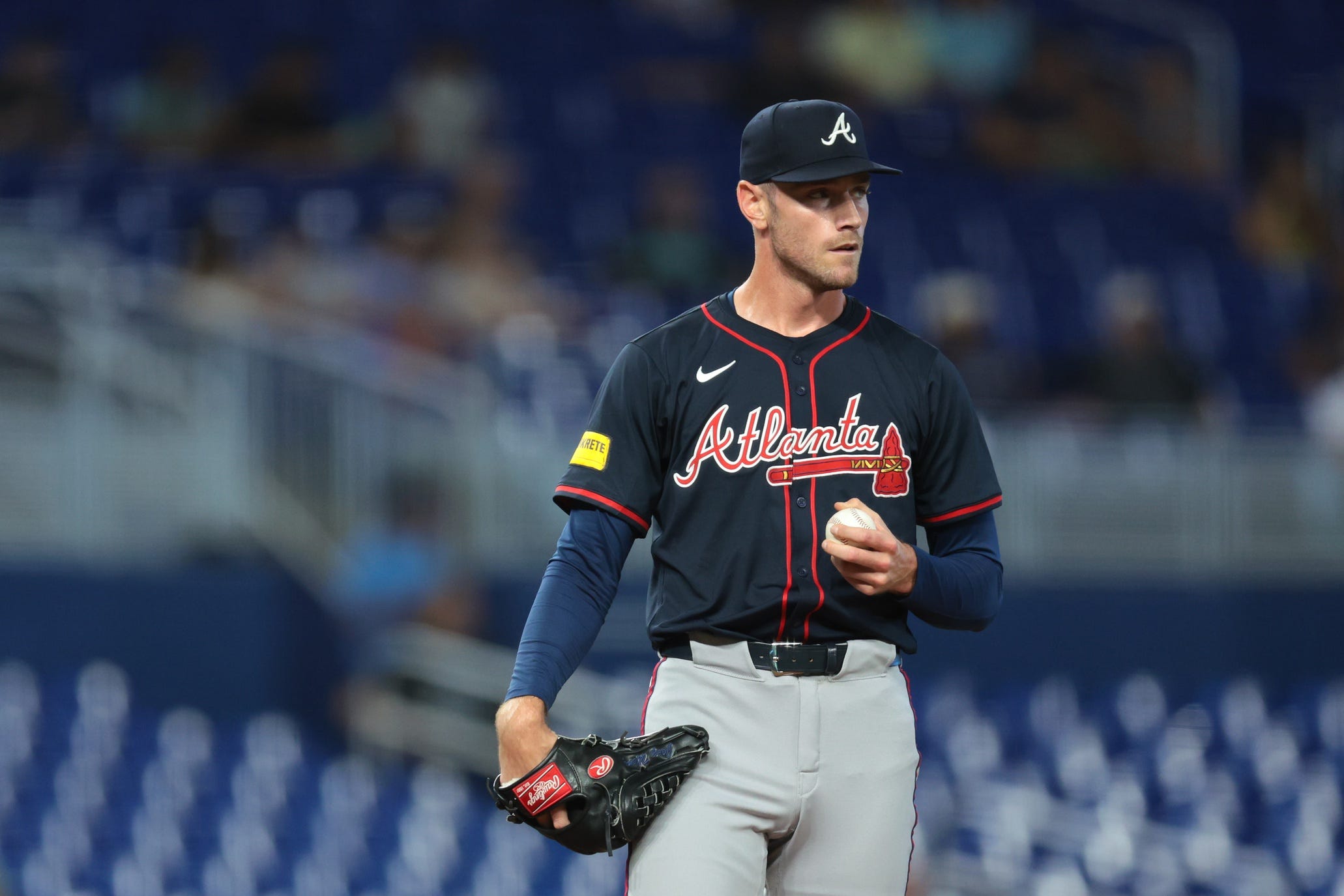
Stop me if you’ve heard this before, but the Atlanta Braves are once again dealing with an injury to their starting rotation.
This one isn’t an arm injury but rather a torn ACL, suffered by lefty Joey Wentz on Sunday while trying to cover first base versus the Rays. The Braves beat in North Port collectively reported Monday afternoon that Wentz will miss the entire 2026 season, adding to Atlanta’s growing injury woes.
Wentz is the third starting pitcher to go down during spring training, following the elbow surgeries of Spencer Schwellenbach and Hurston Waldrep for bone spurs and loose bodies in their throwing elbows. When Wentz is placed on the injured list, he will become the ninth Braves starting pitcher to miss time over the last two seasons, eight of whom eventually landed on the 60-day IL and missed multiple months.
Where do the Braves turn from here? Let’s talk about it.
What are you trying to replace here?
It depends on who you ask.
The public-facing projection systems, led by ZiPS over at FanGraphs, had Wentz expected to throw roughly 90 innings of 4.54 ERA/4.08 FIP baseball, making 12 starts and 33 total appearances. That doesn’t sound especially difficult to replace, although the Braves struggled to do exactly that late last season as injuries mounted in the rotation.
But in-house, the team was optimistic about Wentz having a full offseason to prepare as a starter and for the changes he made over the winter. Adding a two-seamer was one of the adjustments Wentz made to address the .295/.380/.446 line lefties posted against him last season, while also giving him another option to attack the left side of the plate early in counts.
It was entirely reasonable to see a path to outperforming the swingman projection for Wentz.
But more than the on-field production, losing Joey Wentz the person in the clubhouse is a tough pill to swallow.
“I didn’t think anybody expected — even Joey, I don’t think he was expecting that news from the MRI. I don’t think it felt like it was torn. But it was. Terrible for the kid,” said Walt Weiss on Monday in North Port, shortly after relaying the news of the injury to the media in North Port.
Weiss expressed regret for Wentz the player, who was producing well in spring. “Feel terrible for the kid,” said Weiss. “Pitched well for us last year. Really turning some corners in his career last year, and throwing the ball good this spring.”
So, if the Braves are looking at another pitcher to take Wentz’s place as the swingman, where can they turn?
Internal options
The immediate beneficiary of Wentz going down, as uncomfortable as it sounds to phrase it that way, is José Suarez. A reliever by trade at this stage in his career, he threw to a 1.86 ERA in 19.1 innings for the Braves last year. Most importantly for this conversation, he has 62 career starts to his name, meaning he can credibly flex into the rotation if needed.
The Braves know about his ability to make starts firsthand; he made eight of them for Triple-A Gwinnett last year and was called up late in the year for a spot start. Against Washington on the road, he gave Atlanta seven innings of two-run ball, striking out nine opposite six hits and two walks.
Suarez is a lefty with a five-pitch mix, although he doesn’t always use all of them. Righties see almost exclusively four-seam fastballs (2025 avg = 93.4 mph) and changeups in about equal parts, paired with about 14% sliders and occasional curveballs. Lefties, by comparison, get all five pitches, with the slider becoming his second-most thrown pitch to same-handed batters, followed by the sinker, changeup, and finally the curveball.
His ability to cover multiple innings as a long-reliever and experience as a starter mean that Suarez is the first and most logical option to step into the vacant shoes of Joey Wentz at the back end of the bullpen.
But there are other options, mostly among starting pitcher candidates.
Prospect JR Ritchie and veteran NRI Martín Perez are both still in camp, and there’s a real opportunity here for one of them. Ritchie has looked impressive this spring, running his four-seamer up into the high-90s and flashing a complete six-pitch mix. Perez, by contrast, isn’t overpowering but brings experience and roster flexibility. A non-roster invitee to spring training, Perez has 279 career MLB starts and over 1630 innings under his belt. While he’s not the same pitcher at age 35 as he was in his All-Star year of 2022, he throws a complete five-pitch mix to both sides of the plate and knows how to minimize hard contact.
I’d characterize Suarez as the favorite, owing to already being on the 40-man roster, but this is going to be a fascinating battle to watch over the next two weeks. There are several permutations of how the staff could be configured with these three, depending on how aggressively the team wants to balance the talent vs depth tradeoff.
If the goal is to prioritize depth, keeping Suarez in the majors and sending both Perez and Ritchie to the minors to begin the season is the way to go. Suarez has been designated for assignment three times in his career, including once by Atlanta this offseason, and has been put on waivers at least twice. That likely makes him the most ‘disposable’ arm in this group, if that makes sense. Martín Perez is not an XX(B) free agent, so he does not automatically have an opt-out in his deal1 that would allow him to head to free agency if the team does not select him for the Opening Day roster.
In this case, Suarez would need to be DFA’d whenever the team was ready to replace him with Perez, with Ritchie being held as more of a long-term rotation option. While this doesn’t give you the absolute best 13-man pitching staff on Opening Day, it’s the option that preserves the most depth, as Suarez is out of options and so isn’t a lock to be retained if he is DFA’d in favor or Perez or Ritchie for Opening Day.
What about an external add?
Let’s talk about Lucas Giolito.
The surface stats for the former Red Sox hurler are appealing, at first glance: 10-4, 3.14 ERA in 26 starts with 145 innings pitched, 121 strikeouts, and 56 walks
But once you dig into the underlying metrics, the picture looks far less convincing. He put up a 4.17 FIP and a 5.06 xERA, combined with a 19.7% strikeout rate and a 9.1% walk rate.
In case it wasn’t obvious, those numbers aren’t especially encouraging. Here’s the same stats for Bryce Elder last season:
4.55 FIP, 4.73 xERA, 19.3% strikeout rate, 7.5% walk rate.
That’s right, Bryce Elder and Lucas Giolito had roughly equivalent strikeout rates last year. And Elder actually outperformed him on walk rate and expected ERA. There’s a reason the two have strikingly similar 2026 projections on FanGraphs:
Elder = 4.38 ERA, 4.10 FIP in 152 innings w/ 19.7% K rate, 7.7% BB rate
Giolito = 4.65 ERA, 4.58 FIP in 138 innings w/ 20.6% K rate, 8.9% BB rate
When you combine his overperformance last year (which was fueled by an outlier 9.3% HR/FB rate and 76.7% Left On Base rate), combined with missing the end of the season with an elbow issue, it makes sense that he’s still unsigned three weeks before Opening Day. This isn’t some sort of obvious miss by Alex Anthopoulos; no team has wanted to bring in Giolito, either for financial reasons (his salary ask), injury reasons (the surgically-repaired elbow), or the fact that they don’t believe he’ll be better than their internal options.
If the Braves sign him, it’s a sign not that they believe that last year’s ERA is legit, but rather a sign that he represents an upgrade over their remaining internal depth.
He’s not the only option left in free agency, but none of the remaining options are especially appealing: Patrick Corbin, who had a 4.40 ERA/4.25 FIP for the Texas Rangers last year, Wade Miley, who opted out of his minor league deal with the Cincinnati Reds at midseason, and Marcus Stroman, who was released by the New York Yankees last August and is still unsigned.
Is a trade possible?
Yes, technically? But it seems rather unlikely that a significant one will happen in the next week or so. The solution here is likely the same as it is for Atlanta’s vacant designated hitter spot - continue to evaluate the options that become available in the week leading into Opening Day, as teams inform veterans with opt-outs that they’re not going to make the roster or out-of-options players get placed on waivers.
In other words, the Braves are likely to do what they usually do in situations like this: wait.
Between Suarez, Perez, Ritchie, and the rest of their upper-level pitching depth, Atlanta still has enough internal options to cover the innings Wentz was expected to provide, albeit at a lower level of production. None of those fill-in arms is a perfect solution, but the reality of modern pitching staffs is that teams rarely get perfect solutions this time of year.
Instead, the Braves will spend the next few weeks evaluating what they already have while keeping an eye on the waiver wire and late spring opt-outs around the league.
If a clear upgrade becomes available, Alex Anthopoulos has never been shy about making a small move.
If not, Atlanta will do what it has done for much of the past two seasons - lean on its pitching depth and hope it’s enough to get them through another round of injuries. Is this the time it works?
That doesn’t mean that Perez doesn’t have an opt-out, just that one was not automatically in the deal. He may have been given one by the team, but we don’t have any official confirmation one way or the other.
One sentence in your article says it all: "...Alex Anthopoulas has never been shy about making a SMALL move". It's the BIG moves (or lack thereof - think Freeman, Swanson) - that show weakness. Whether this is due to McGuirk's restrictions or not is not clear. At this point I don't think turning to poor quality FA's is going to help and I hope AA's faith in "internal options" pays off in spades but I get queezie just thinking about the first DFA move we see to 'strengthen the rotation'.
Lindsay, great article was great, as always.
I'd like to push back a little at something you said yesterday on the podcast or at least get you to expound on your thoughts. Yesterday on the podcast when discussing the Wentz injury you said something to the effect that "you shouldn't bunt in spring training."
I *hear* you...but what if you're Maury Wills (before your time) or former Brave Brett Butler and bunting is a large part of your offensive arsenal? Why is it not OK for those guys to work on a major part of their game in Spring Training? As always, thanks! I'll hang up and listen...