


The next installment in my MLB Draft Primer series takes us to pick number 48. The further down the board we go, the more difficult it becomes to project exactly who will still be available. On top of that, signability starts playing an even bigger role than pure talent.
That said, we can still get a good feel for the type of players likely to be available in this range by looking at consensus mock drafts and prospect rankings. Some of these names could come off the board earlier if a team wants to cut an underslot deal, while others could slide because of bonus demands. Regardless, each of these prospects fits the profile Atlanta has targeted in recent years to some capacity.
It's also worth keeping the draft trends we covered earlier in this series in mind. The extra first-round pick and bonus pool money certainly change the equation with those patterns, but in the best way possible. Even with the added flexibility, I still expect at least three of Atlanta’s top five selections to come in under slot to help maximize the overall draft class.
So let’s get into it.
2026 Braves Today Draft Guide
Connor Comeau, SS, Anderson

Historically, this is a range where Atlanta leans heavily toward the college ranks, so I’ve only included one prep player. If the Braves decide to get aggressive thanks to the extra bonus pool money, though, Connor Comeau is someone I could absolutely see them taking a chance on.
The Austin, Texas native is committed to Texas A&M and is one of the youngest players in the entire draft class. At first glance, his frame looks unfinished. Standing 6’4” and roughly 180 pounds, there is plenty of room left for physical development. This is exactly the type of project professional organizations love to get their hands on.
Comeau has a simple, repeatable swing that already generates impressive bat speed. As he continues to mature physically and learns to elevate the ball more consistently, there is legitimate power upside waiting to be unlocked. He also controls the strike zone well and doesn’t expand it often, giving him a solid offensive foundation.
The biggest question revolves around his defensive home. He played shortstop in high school, but his size likely pushes him to third base or potentially a corner outfield spot as he climbs the professional ranks. Wherever he ultimately lands defensively, the bat is what makes this profile intriguing.
Jack Radel, RHP, Notre Dame
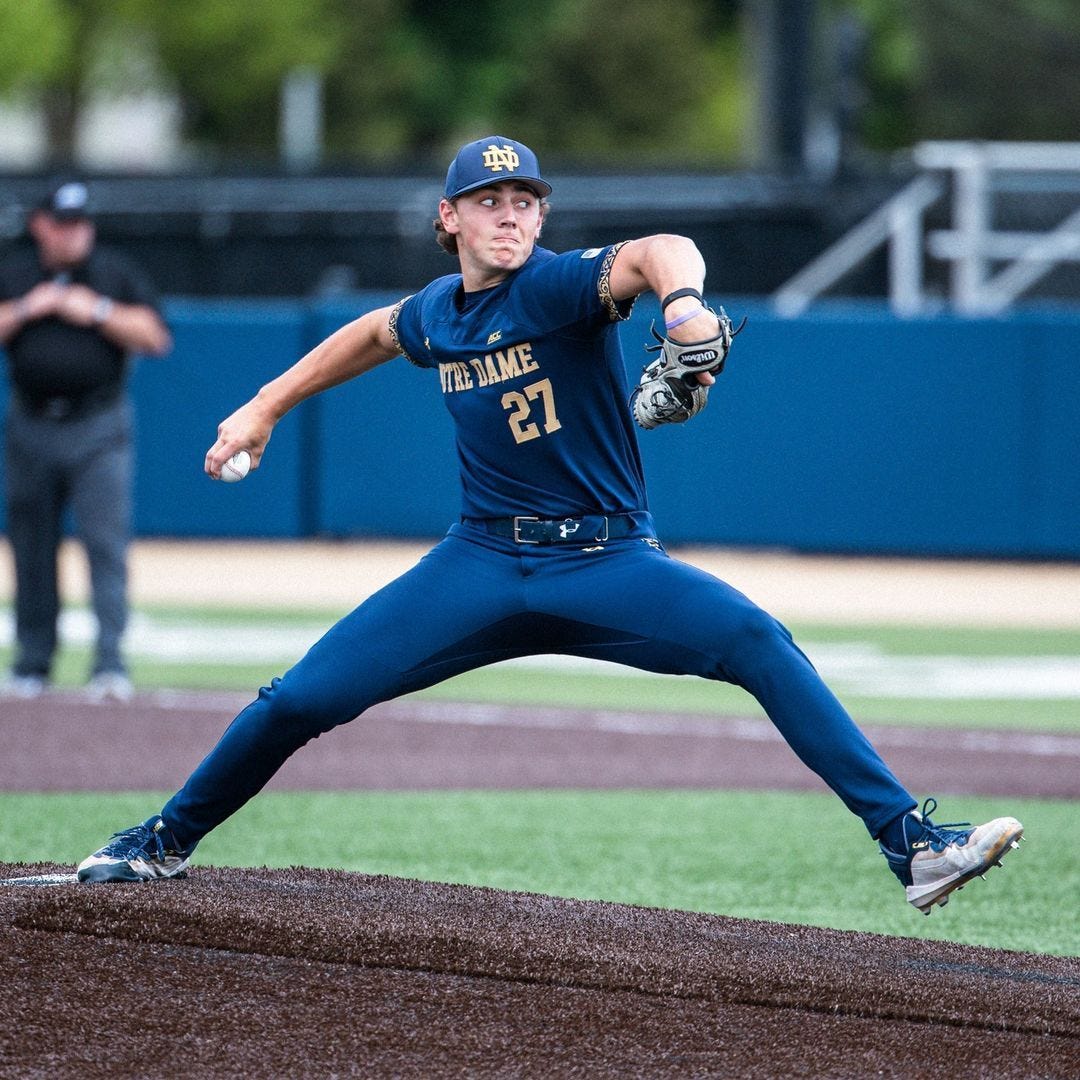
Jack Radel has one of the more unique paths in this draft class. Originally from South Dakota, not exactly a baseball hotbed, he quietly developed into one of the better college arms available while pitching at Notre Dame.
The junior was a three-year starter for the Fighting Irish, finishing his career with a 3.71 ERA and 1.12 WHIP. His biggest jump came this season. After posting strikeout rates below 21% during his first two years, Radel exploded for a 32.5% strikeout rate in 2026 while maintaining an elite 6.2% walk rate. He also finished with career-best marks in ERA (3.29) and FIP (3.22).
Standing 6’5” and over 210 pounds, Radel has the frame every organization looks for in a starter. His roughly seven feet of extension makes a mid-to-upper 90s fastball play even better than the radar gun suggests. He complements it with a cutter, breaking ball, and a developing changeup.
This feels like one of those pitchers Atlanta would love to get its hands on. The raw ingredients are already there, and few organizations have a better recent track record of maximizing profiles like this than Atlanta.
Aiden Robbins, OF, Texas
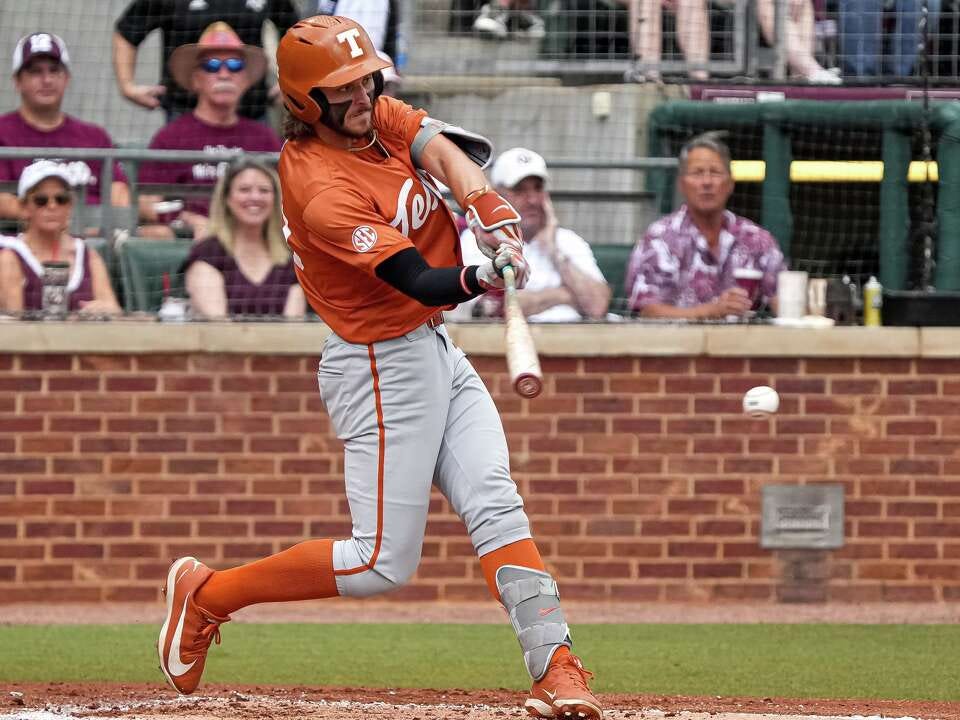
Before transferring to Texas, Aiden Robbins had already established himself as one of the best mid-major hitters in college baseball. The jump to the SEC is never easy, but Robbins handled it about as well as anyone could have hoped.
After slashing .422/.537/.652 with a 1.189 OPS during his sophomore season at Seton Hall, Robbins followed it up by slashing .333/.426/.696 with a 1.122 OPS with the step up in competition. His strikeout rate did climb to 22.9%, which is hardly surprising given the massive jump in pitching quality, but he still paired it with a healthy 13.7% walk rate.
The biggest development was the power. After hitting six home runs in each of his previous two seasons, Robbins launched 24 this year for the Longhorns. He has consistently produced exit velocities north of 110 mph, showing the type of raw power scouts dream about. He does a good job laying off fastballs outside the zone, although advanced breaking balls can still give him trouble. If a professional organization can tighten that up, there is a lot to like about this offensive profile.
Caden Sorrell, OF, Texas A&M
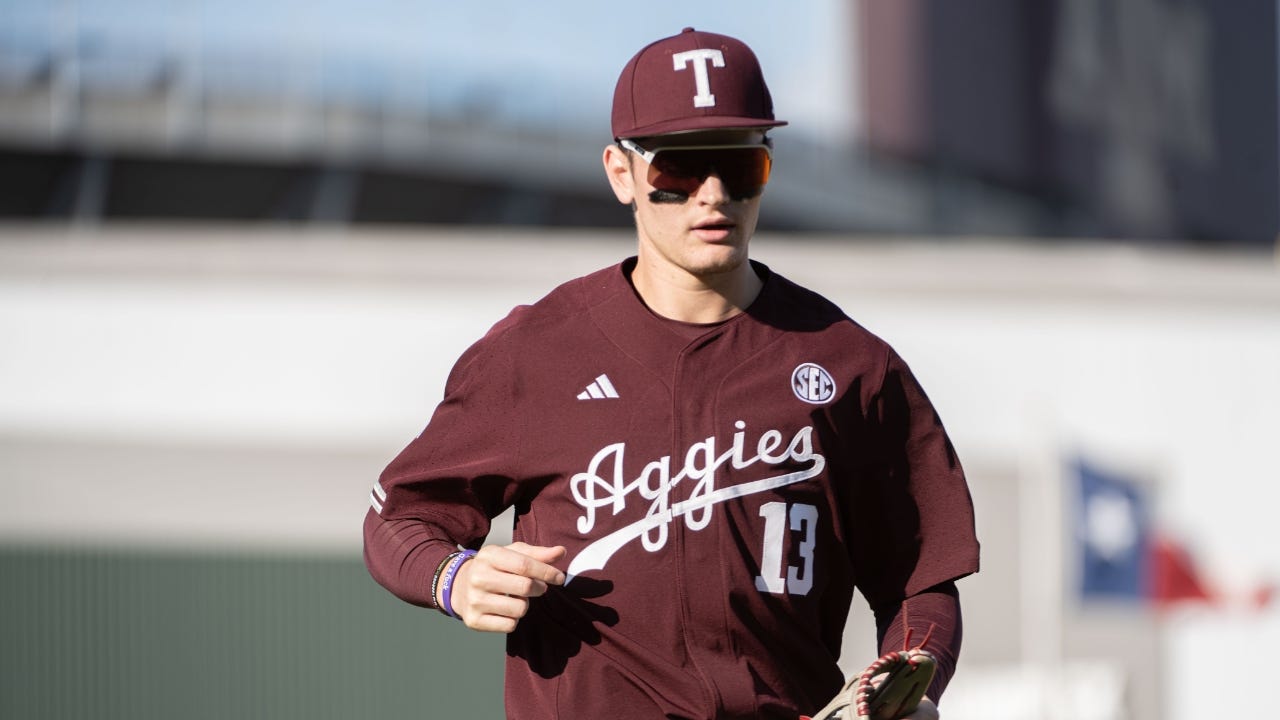
Caden Sorrell has been on draft radars for years. After earning Freshman All-SEC honors in 2024, injuries derailed much of his 2025 season. This spring, he reminded everyone why he entered the year as a Golden Spikes Award candidate.
Sorrell put together an outstanding season, slashing .341/.434/.743 with a 1.177 OPS while collecting 23 home runs, 76 RBIs, and 67 runs scored. However, there are still some questions. High fastballs and quality spin have given him trouble at times, contributing to a 23.0% strikeout rate. The encouraging part is those struggles became less noticeable as the season progressed, suggesting he was already making adjustments.
Defensively, Sorrell has spent most of his career in the corners but has shown enough athleticism to handle center field when needed. At the plate, the bat speed is obvious, and the power should continue to play as he develops. If he can become just a little more selective early in counts, I think he has a chance to move through the Braves system in a hurry.
Carson Tinney, C, Texas
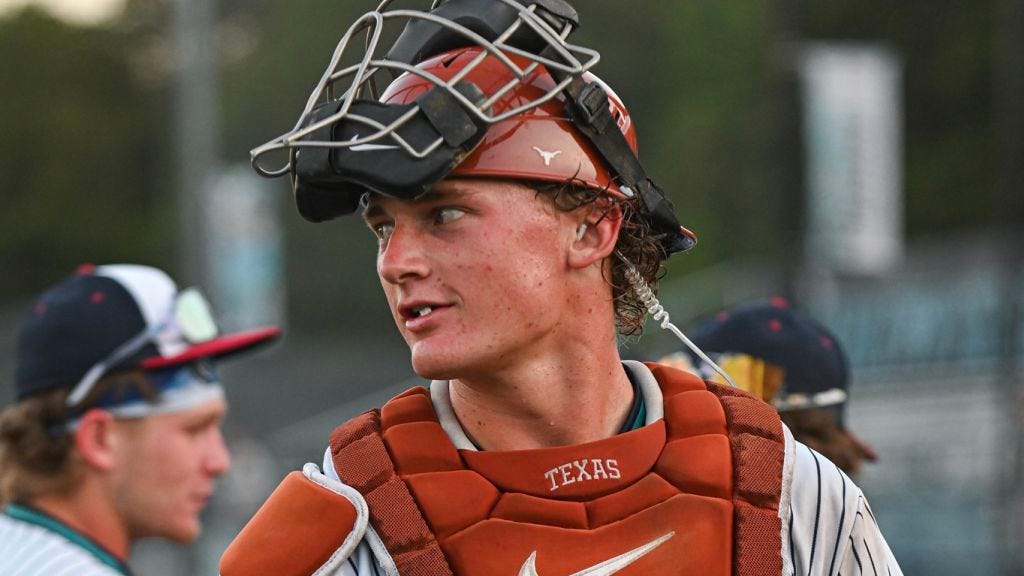
Carson Tinney may honestly be one of my favorite fits for Atlanta in this range. After beginning his career at Notre Dame, the Colorado native transferred to Texas looking to compete for a national championship, and his production translated immediately.
Following an ACL injury that shortened his freshman season, Tinney returned in 2025 and posted a ridiculous .348/.498/.753 slash line with 17 home runs. Many hitters see their numbers take a step back after moving into the SEC. Tinney did not follow that trend, finishing with a 1.171 OPS while blasting 22 home runs. Even more impressive was his combination of patience and power, walking at a 19.2% clip while striking out just 23.1% of the time.
The raw power is among the best in this draft class. His 6’3”, 220-pound frame generates easy juice, and while there are still questions about how consistently he’ll handle quality spin, the upside is obvious. Behind the plate, Tinney owns a strong throwing arm and projects as at least an average defensive catcher. Atlanta has done a tremendous job developing catchers over the years, and this feels like another profile that fits their strengths exceptionally well.
Wes Mendes, LHP, Florida State
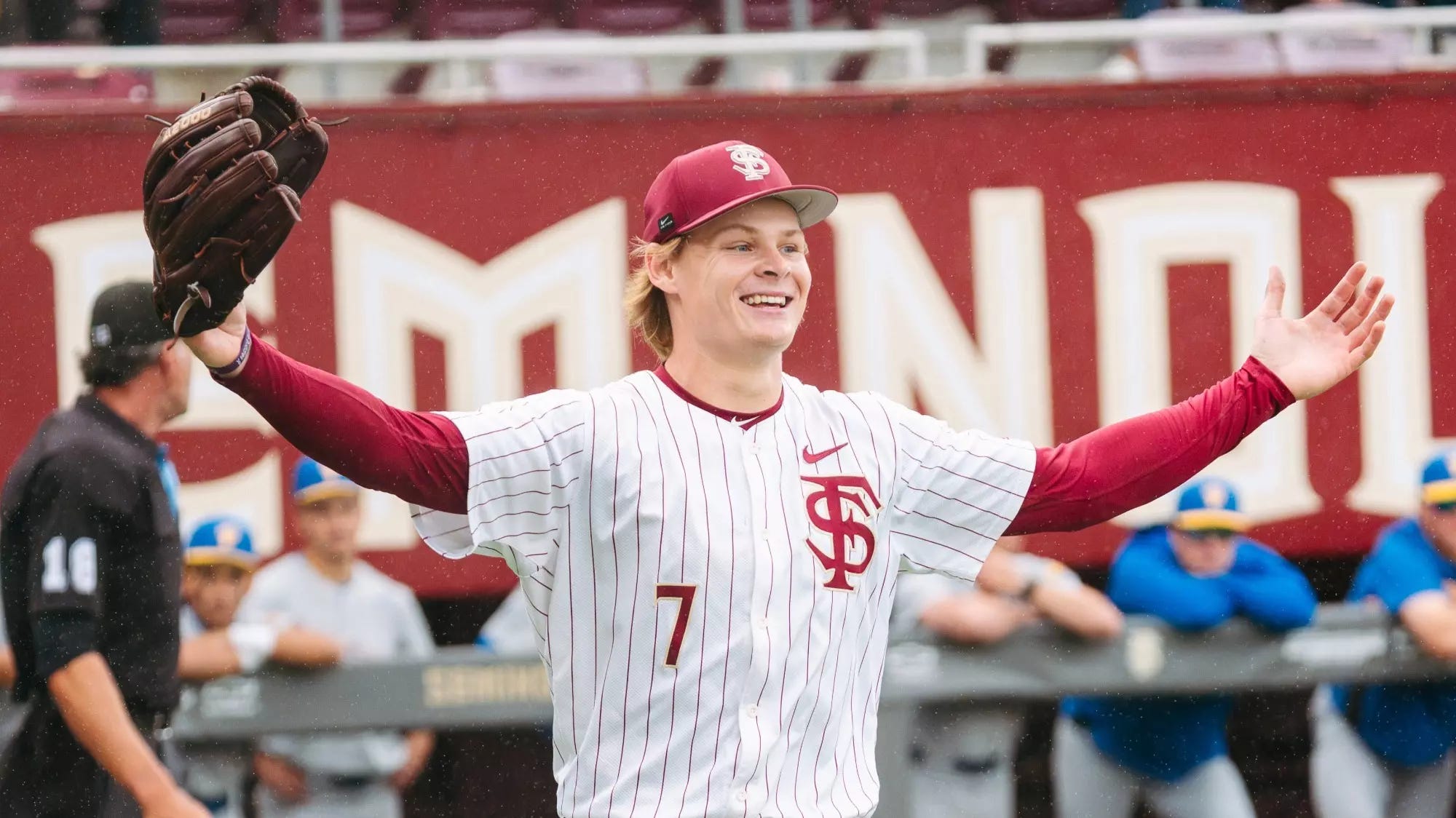
The final player on this list is Florida State left-hander Wes Mendes. After beginning his career at Ole Miss primarily as a reliever, Mendes transitioned into a full-time starter with the Seminoles over the last two seasons. This spring, he stepped into the role of staff ace and delivered across the board.
In 16 starts, Mendes posted a 2.81 ERA, 3.10 FIP, 1.02 WHIP, a 32.6% strikeout rate, and just a 6.5% walk rate, all career-best marks. His fastball typically sits in the low-to-mid 90s, but he has touched 96 mph. While it isn’t an overpowering offering by today’s standards, it plays well because of his command and sequencing. His best secondary pitch is a plus changeup that tunnels beautifully off the fastball, and he also mixes both a slider and curveball.
There’s still room to dream. Improving the fastball and sharpening the breaking balls could unlock another level, but the foundation already resembles that of a polished college starter. It would not surprise me one bit if Atlanta viewed him as another pitcher capable of outperforming where he is drafted.
Prediction: Carson Tinney, C, Texas
Catchers with this combination of power, patience, and defensive upside rarely last this long, and Tinney feels like the type of college bat Atlanta has consistently valued.
Overslots might be hard this year. Teams will be drafting 4 rounds day one. The overnight negotiations after round 3 will be diluted with nearly half the slotted picks already completed.
Perhaps earlier deals are cut Teams with bigger pools will have an edge and we could see more preps early or teams just playing the board straight up.
Example: Rojas, Wachsmann, Shelar and Lascelles. Then all college prospects straight down the line.