


The Rosetta Stone was not the creation of Egyptian hieroglyphs. But it was the thing that helped us read them.
The same decree from King Ptolemy V Epiphanes was inscribed on the stone three separate times - once in Ancient Greek, and then again in both hieroglyphic and Demotic versions of Ancient Egyptian. Because scholars of the time already understood Ancient Greek, the trilingual inscription became our basis for understanding the characters and structure of the two Egyptian scripts.
If Atlanta’s lucky, Pete Crow-Armstrong’s 2026 can serve a similar purpose for Michael Harris II.
Crow-Armstrong didn’t invent the idea of an elite defensive center fielder with both speed and power becoming one of baseball’s Most Valuable Players. But he successfully translated his abundant tools to a full season of production - and, in doing so, made Harris’ own path to the award easier to read.
It’s not a perfect comparison, and the outcome isn’t exactly a guarantee. But PCA’s season shows that Harris doesn’t need to become an entirely different player to make better use of his gifts and talents. What he does need to do is improve the portions of his game that continue to suppress his value.
What’s the PCA-like path for Michael Harris II?
Let’s talk about it.
The center fielder Atlanta already knows
Pete Crow-Armstrong’s MVP award was unanimous, and deservedly so: He put up 10.6 fWAR while logging baseball’s 7th-ever 40-home-run and 40-stolen-base season. He finished with 45 long balls and 41 steals, hitting .280/.372/.570. That slug was the best in the National League, while his 119 runs and 45 home runs led all of baseball this season, as did his 357 total bases. He also, to add one more feather in his cap, won his 2nd consecutive Gold Glove in center field as one of the game’s best overall defenders.
But he wasn’t always playing at an MVP level. Just a few seasons ago, both PCA and Michael Harris were elite defensive outfielders with legitimate power and speed…and too many swings at pitches outside of the zone.
Here’s the new Baseball Savant Player Comparison Tool, looking at the percentile rankings for PCA and Harris in both 2024 and 2025.
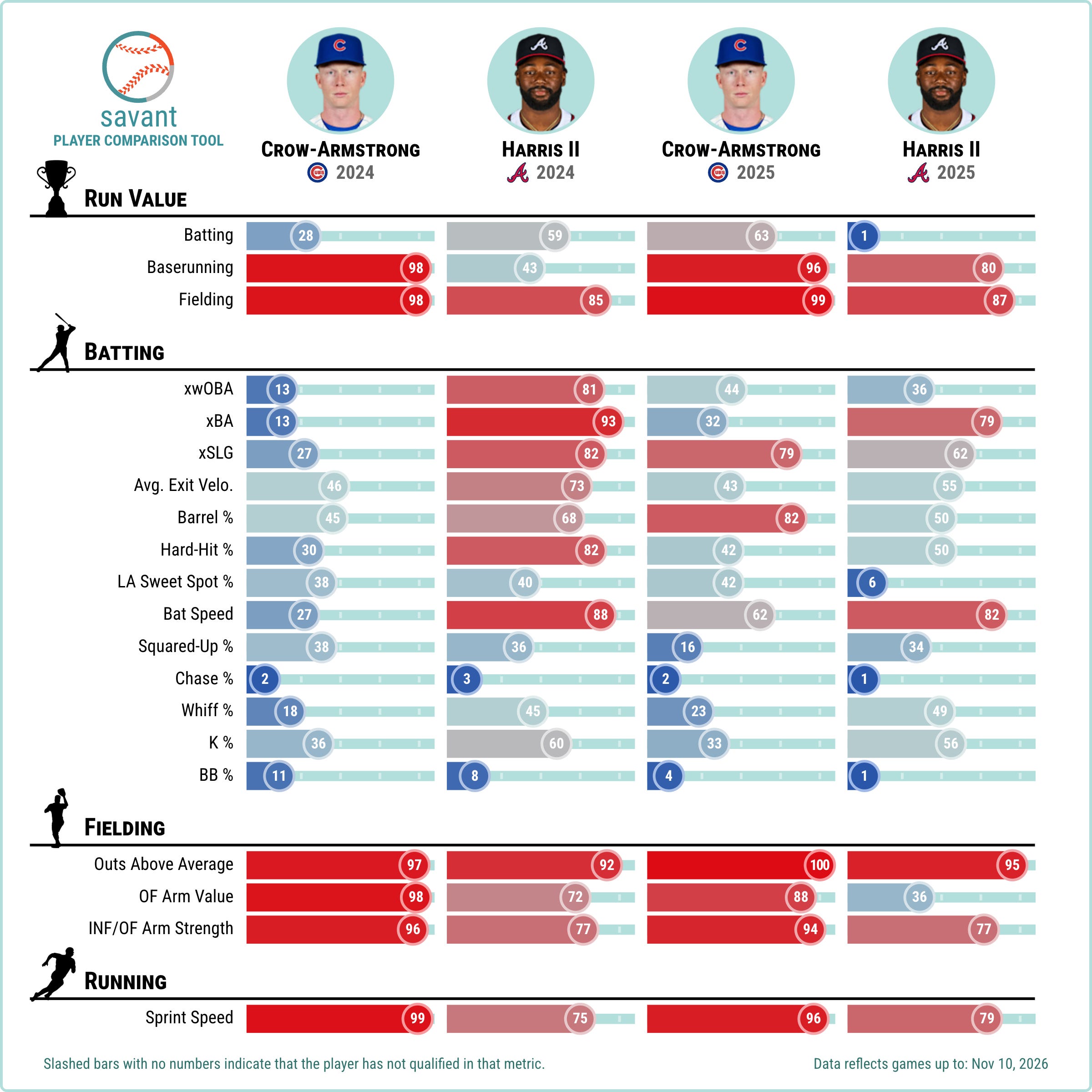
The plate discipline metrics towards the bottom of the “batting” section were remarkably similar, most notably the high chase and the low walks. From 2023-2025, the first three seasons of his career, PCA’s chase rate was 41.2% entering 2026, the seventh-highest rate among the 300+ hitters that saw 1500 or more pitches outside of the strike zone in that time frame. Mike’s? 40.46%, just 0.7 percentage points less frequently than PCA.
And then something changed for PCA in 2026: his ability to draw a walk.
PCA went from walk rates of 5.1% and 4.5% his first two full seasons in the majors to an absurd 11.4% this last year; that’s easily more walks in 2026 (83) than he had in the entirety of his major league career before 2026 (53).
Obviously, adding the walks is the missing element for Harris. His first three years in the league saw him with walk rates nearing 5% before falling to 2.5% and 3.7% in the last two seasons.
Here’s how PCA did it, and if it’s something that Michael Harris could replicate:
PCA stopped giving away so many pitches
Improving your swing decisions can do a lot for your offense, and we saw it with PCA’s 2026 season. He had fewer swings at pitches outside of the zone he could not drive, which meant more walks, sure, but also more favorable counts and more opportunities against hittable pitches in the zone.
His chase rate fell from 41.7% to 34.2%. Now, just because he chased less doesn’t mean he struck out less - his strikeout rate actually went up nearly two percentage points, to 25.8%, but the batted-ball outcomes were much better with more swings in the zone.
FanGraphs calculated a 5% increase in the number of pitches he saw while ahead in the count, with the measure sitting at 25% in early September.
Harris, meanwhile, saw his chase rate go up (somehow,) to a 1st-percentile 45.1%, an increase of over two percentage points from his already poor 2025 mark. And unfortunately, it wasn’t a notable problem with sliders like PCA fixed; Harris struggled against nearly everything. Fastballs outside the zone were his “best” pitch, with just a 37.3% chase rate, but he also had a 53.5% chase rate on breaking balls outside the zone and 50.9% on the various offspeed pitches (changeups, splitters and forkballs).
Curveballs were actually his biggest culprit, though, chasing at a 54.4% rate and hitting only .157 with a .294 slug against the pitch in total, striking out 45.3% of the time.
In shades of PCA, though, Harris saw 23.7% of his pitches when he was ahead in the count, so some of the end result of what chasing less gets you is already manifesting in Mike’s higher-contact profile.
He changed his setup without surrendering his power
Pete narrowed his stance this season, standing more upright and closer to the plate. His stride was shorter, with his swing being able to get into the zone quicker as a result of all of those changes.
To be clear, I’m not saying Harris needs to change his stance; I think what that stance change allowed PCA to do is more important.
What it unlocked was a better ability to lift the ball in the air to the pull side - his barrel rate was virtually identical, but hitting 34 pull-air% means that more of those batted balls were either falling for extra-base hits or clearing the outfield fence. When you combine the stance change’s downstream effects with his ~2 mph increase in bat speed, he was able to better apply that power to the baseball more consistently this season.
This is an area where Harris already compares quite well, with PCA’s new career-high of a 75.1 mph bat speed being just ahead of Harris’s 74.9 mph.
The steals followed the on-base surge
The additional walks for PCA resulted in an on-base jump from .287 to .372, while the offensive surge kept him in the leadoff spot enough to get a career-high 726 plate appearances (79 more than 2025).
His speed was virtually the exact same, an elite-ish 29.5 ft/sec. But he had more opportunities to use it, jumping from 35 stolen bases in 2025 to 41 in 2026.
For Harris, his quad injury that lingered through the early summer really put a damper on his baserunning this season, with the Atlanta center fielder only stealing 12 bags and actually grading as a negative baserunner per Statcast’s Baserunning Run Value. His sprint speed is nominally higher than the listed 27.7 ft/sec (55th percentile), though, with some of that being impacted by him playing through the quad injury.
Harris was better, but took a different route
Harris had a really good 2026 on the aggregate, hitting a career-high 26 homers and finishing with a .297/.321/.491 line. He was both getting more quality contact and more balls in the air, pushing his hard-hit rate to 47.6% and lowering his ground-ball rate to a career-best 43.6%.
But let’s also recognize that 2026 wasn’t built entirely out of steps forward. He also walked just 3.7%, an increase over 2025’s 2.5% in name only, since he virtually had almost nowhere to go but up. And as we already mentioned, his chase rate actually went up to 45.1%, the highest rate of his career and over 6% higher than his ROTY campaign in 2022.
The key to Michael reaching PCA’s level in 2027 isn’t a change to his batting stance; it’s pairing his improved contact quality with better pitch selection.
The question for 2027
Michael Harris II shouldn’t try and become PCA. For one, Mike probably wouldn’t look great with baby blue hair.

And there are parts of PCA’s breakout that Harris doesn’t need to try and copy - replicating his exact stance or swing isn’t really how it works in baseball.
But PCA’s MVP season gives us a way to read what Harris is missing.
He’s got the power, the bat speed, and (when not dealing with a quad injury) the foot speed. Harris has the defensive chops to make an impact, although I’d argue that we haven’t seen a center fielder defender quite at PCA’s level since the days of Andruw Jones - I scouted PCA in the minors quite a bit, and it’s generationally great defense.
But what Michael hasn’t done is force pitchers to consistently feed him pitches he can destroy.
That’s the next missing step: Chase less, get ahead more often, and take the walk when pitchers refuse to come into the zone. And then, similar to PCA this season, the things you normally do well, like stealing and running the bases, become more valuable when you have more opportunities to do it.
The Rosetta Stone didn’t create the language, but it showed us how to understand it.
PCA didn’t create Money Mike’s path to an MVP-caliber season, either. But he made it a little easier to read.
PCA gained close to 90 points in OBP and SLG while maintaining his BA. Money is very capable of making a similar jump.