


For several years now, pitchers have held the technological edge in Major League Baseball.
Every offseason, a familiar storyline emerges: pitchers heading “to the lab,” working with facilities like Driveline or Maven Baseball Lab and returning in spring training with added velocity, reshaped arsenals, and lab-designed pitches that look dominant on paper and even better on the mound.
Hitters, by comparison, have largely been left to more traditional preparation. High-speed cameras and swing-analysis tools help refine mechanics, but the core of offseason work has remained largely unchanged: see ball, hit ball.
That gap may finally be narrowing.
The Trajekt Arc pitching simulator can replicate real pitchers, real pitch shapes, and real release visuals with near-game accuracy. The Atlanta Braves now have two units installed, one in the cages at Truist Park and another at their spring complex in North Port, giving hitters access to a level of pitch preparation that was difficult to imagine even a few years ago.

And for hitters with a specific vulnerability, the impact could be enormous.
Let’s talk about it.
What’s so special about this thing?
Pitching machines have been around for a long time - what’s so special about this one?
Well, most pitching machines throw only fastballs. Some of the fancier ones, colloquially called “spinball” machines, can throw a rudimentary breaking ball, too.
But not the Trajekt. Between the advanced pitching mechanism and the visual screen, you can recreate any pitcher you have data for, both the shape of the pitches and the way they look coming out of the hand.
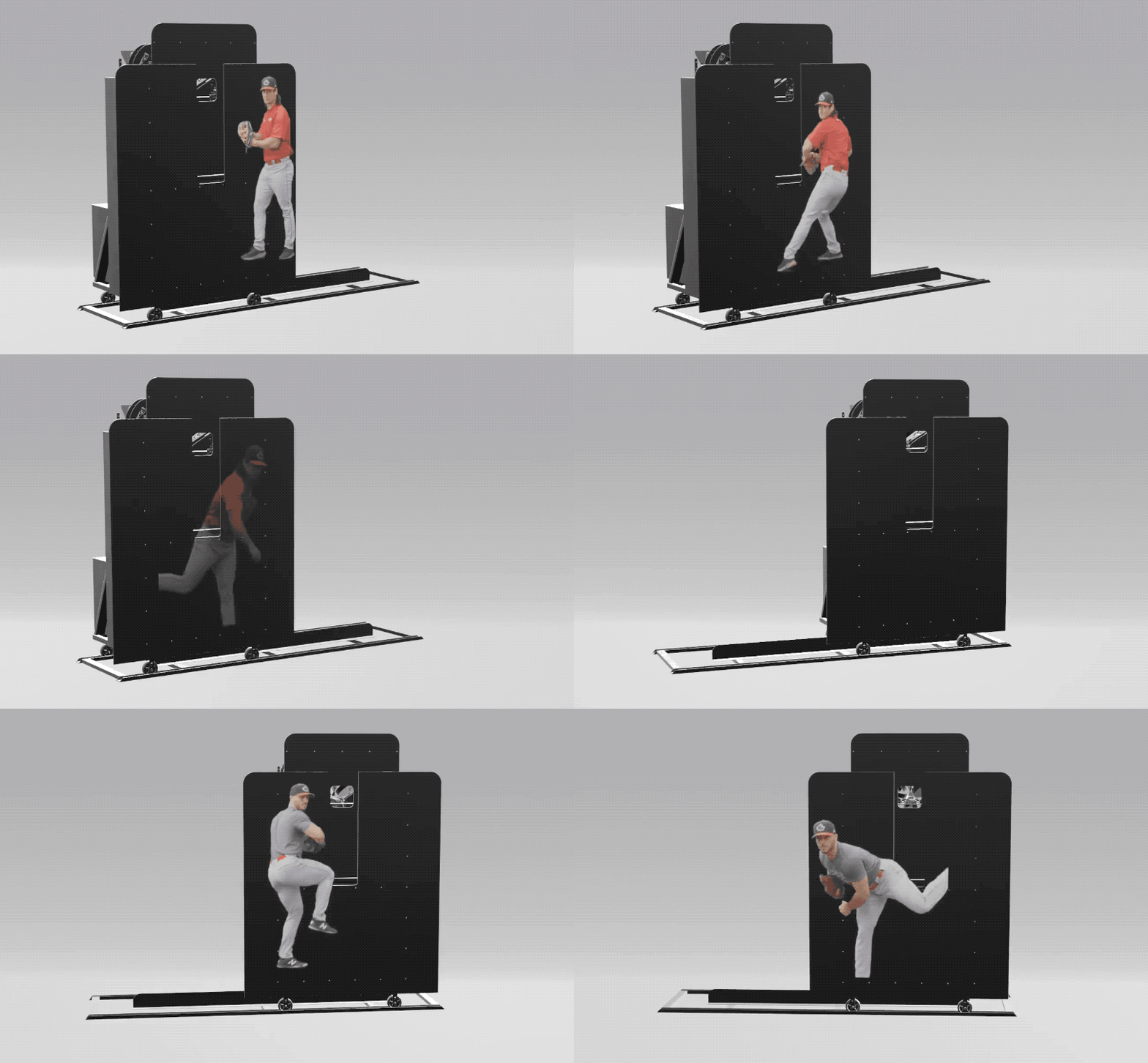
The Trajekt Arc is a pitching machine with a built-in display - not only can you program in a specific pitcher’s entire arsenal, but the adjustability of the machine means that it can deliver the ball from the same slot and release height as the real pitcher. And the actual pitch is timed with the visual of the pitcher that’s displayed on the front of the machine.
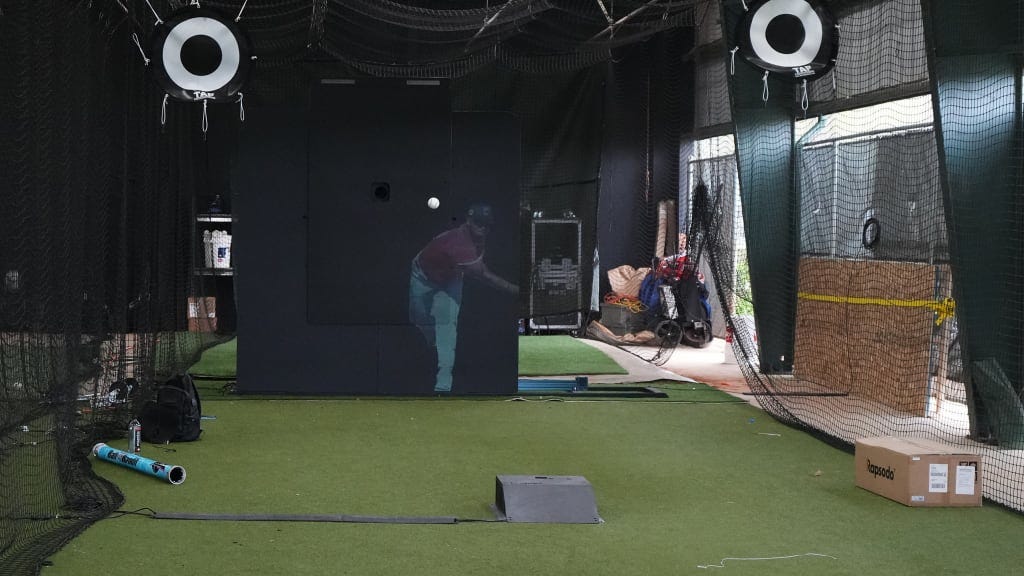
Essentially, you can take live BP against any pitcher, on demand.
It’s a newer device, only created in 2021 and quickly adopted across the league. Nineteen teams were known to be using them by 2024, meaning the Braves are actually behind the curve here - they added theirs midseason last year, behind both the Rockies and Marlins, who installed theirs ahead of the 2025 season.
It’s quite a commitment - the machine needs more room than most pitching machines, measuring four feet deep, six feet tall, and weighing 1500 pounds. It also needs additional space from side to side, as the machine slides across a track that allows it to mimic releasing the ball from different sides of the pitching rubber. It can slide all the way towards the first base side, to mimic a Chris Sale lefty sidearm slot, before moving to the 3rd-base side and all the way up to mimic a high-slot, Trey Yesavage-type release.
The machines are also costly, requiring a monthly commitment of roughly $15,000 on a three-year contract. Despite the cost, several teams maintain multiple machines, with a few unnamed MLB organizations having one stationed at every single full-season minor league affiliate, along with the usual home-park-and-spring-training deployment.
Who has already benefited from the installation?
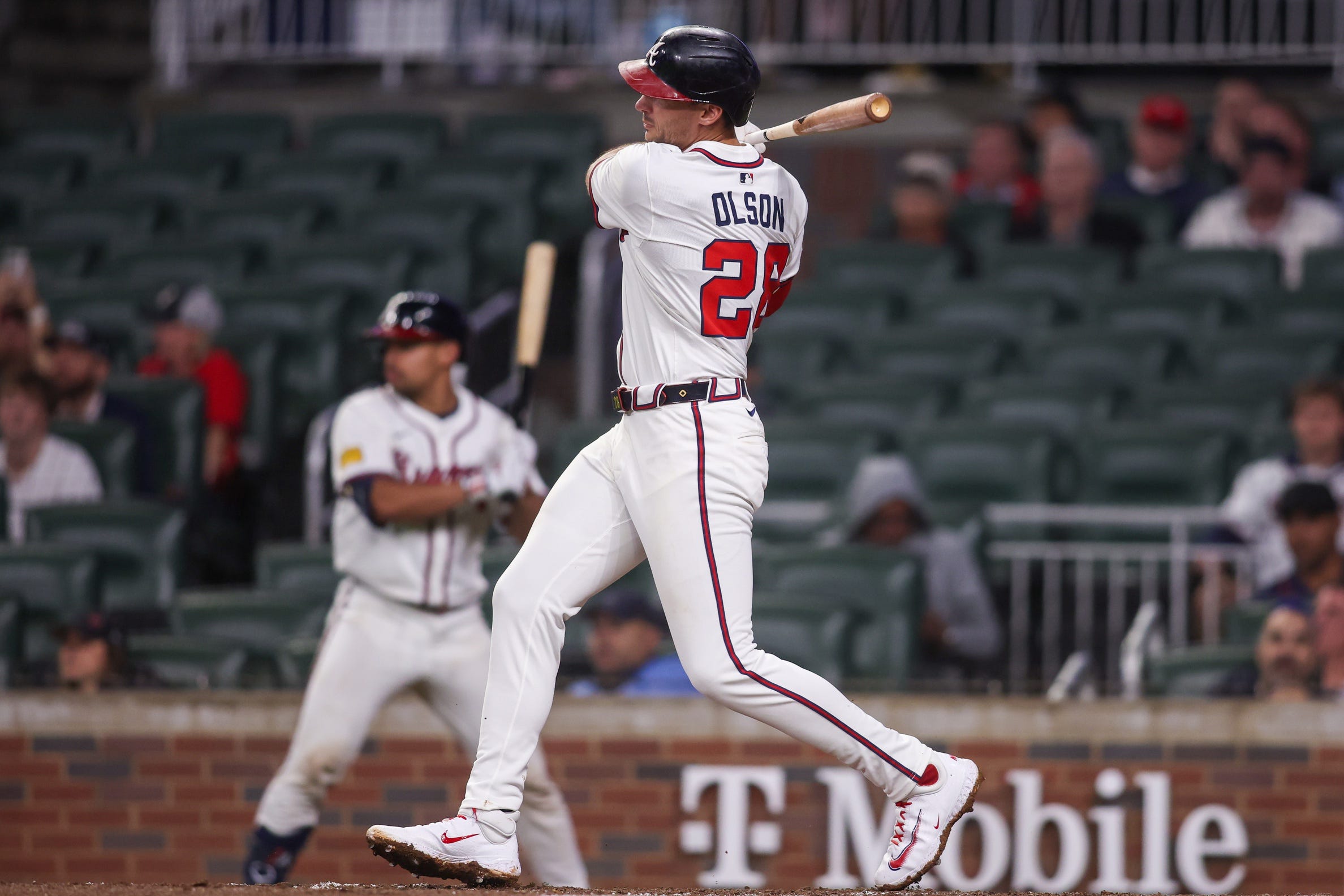
While we don’t have detailed information about the team’s usage of the machines, there’s a clear answer for who saw a significant improvement midseason: Matt Olson.
Atlanta’s first baseman had a surge in the second half, improving both on the whole and against specific pitch types.
It’s not like Olson was bad in the first half of the season, mind you: .262/.362/.468, good for a 131 wRC+. But he turned the jets on in the second half, putting up a .287/.372/.506 line that was good for a 146 wRC+.
And not only was he better on the whole, he specifically improved against breaking balls, the most obvious application of the Trajekt machine. From the first half to the second, Olson’s chase rate dropped and his hard-hit rate against breaking balls climbed to their best marks of the season, with Olson cutting his chase on breaking stuff down to 19% in September while boosting his hard-hit rate to 65%. The only month that featured a higher hard-hit rate was Olson’s performance against offspeed pitches in May, where he crushed them at a 66.7% rate.
Breaking it down even further from pitch types to individual pitches, September saw Olson put up his best hard-hit performance of the season against sliders (71.4%), splitters (66.7%), and curveballs (62.5%).
Who can benefit the most?
There are two main advantages to Trajekt machines over a conventional pitching machine. The first is getting comfortable with a specific pitcher, usually one that you’re preparing to face. Now that Trajekt has included an “offline” mode, one that prevents the device from being connected to the internet, MLB has approved the device to be used during games. Potential pinch hitters can go down into the tunnel and get live ABs against the potential relievers they’ll be called on to face in a few innings, which is a boost.
But the other is fixing a known weakness against spin. And I have two names in mind here: Austin Riley and Michael Harris II.
Riley hasn’t fully fixed his tendency to chase sliders down and away, but he has significantly mitigated it. In his debut season of 2019, Riley chased the breaking ball away more than 45% of the time. He’s gradually improved, plateauing at about 30% the last five seasons.
But while he’s not chasing as much against that slider, he’s still not doing much with it. When he does chase, he misses 72.3% of the time, and he’s still at a .176 batting average and .250 slug against sliders, pretty consistently his worst performance against any specific pitch type.
My hope is that he can improve the recognition against that specific pitch type by practicing against the good sliders leading up to those matchups.
The other utility of Trajekt is with overall pitch recognition and discipline, and I’m thinking about Michael Harris here.
Atlanta’s young centerfielder posted a 43.1% chase rate last year - 1st percentile in MLB. It resulted in an MLB-worst 2.5% walk rate, with just 16 free passes in 641 plate appearances.
While his worst statistical performance was against sinkers, with a -17 Run Value and -3.7 RV/100, Harris was an egregious chaser against all pitch types. Among all pitch variants where he saw at least 125 pitches, he chased more than 40% of the time against everything but four-seam fastballs (35.5%) and sinkers (38.8%).
It’s not a perfect comparison, but the Chicago Cubs were the first team to adopt the Trajekt Arc in the majors. Despite having a free-swinger like Pete Crow-Armstrong (41.7%), they chased just 26.6% as a roster.
What does this mean?
If the Braves were simply adding a fancy pitching machine, this wouldn’t matter much. But that’s not what this is.
This is a tool designed to attack known weaknesses. Olson’s vulnerability to spin. Riley’s chase-and-miss tendency against sliders. Harris’ overall pitch discipline. These aren’t mysteries. They’re documented, measurable problems.
The difference now is that hitters don’t have to wait for the game to fix them.
They can see Chris Sale’s slot without facing Chris Sale. They can rehearse elite sliders before they count. They can train recognition, not just mechanics.
The Braves were behind the curve in adopting Trajekt. They may not be for long.
And if even one or two hitters turn a known weakness into a neutral matchup, the ripple effects across a lineup this deep could be enormous.
That’s how technology flips from novelty to advantage.
Good article. Trajekt Arc represents real advancement in technological innovation to improve athletic performance. I'm glad the Braves finally added the upgrade to their franchise. But it only underscores my concern that the Atlanta Braves have an over-inflated view of themselves, using their gleaming, modern ball park and its surrounding glamorous retail development to convince themselves that they are "the envy of all of baseball" (McGuirk) and yet when it comes improving the quality of play on the field they turn their backs on franchise icons like Freeman over one year's worth of contract, invest money in retail office space instead of players, and wait two years to invest in technology that other teams have already been using to the disadvantage of the Braves. That's why I would like to see someone like Lindsay delve into an evaluation of the Braves' scouting system. With decisions like Kelenic and Laureano and the depleted minor league system, I wouldn't be surprised to learn that the Braves do not invest in scouting as wisely or completely as many other consistently good teams. Without great scouting reports (think Dodgers) AA has to work with one hand tied behind his back.