


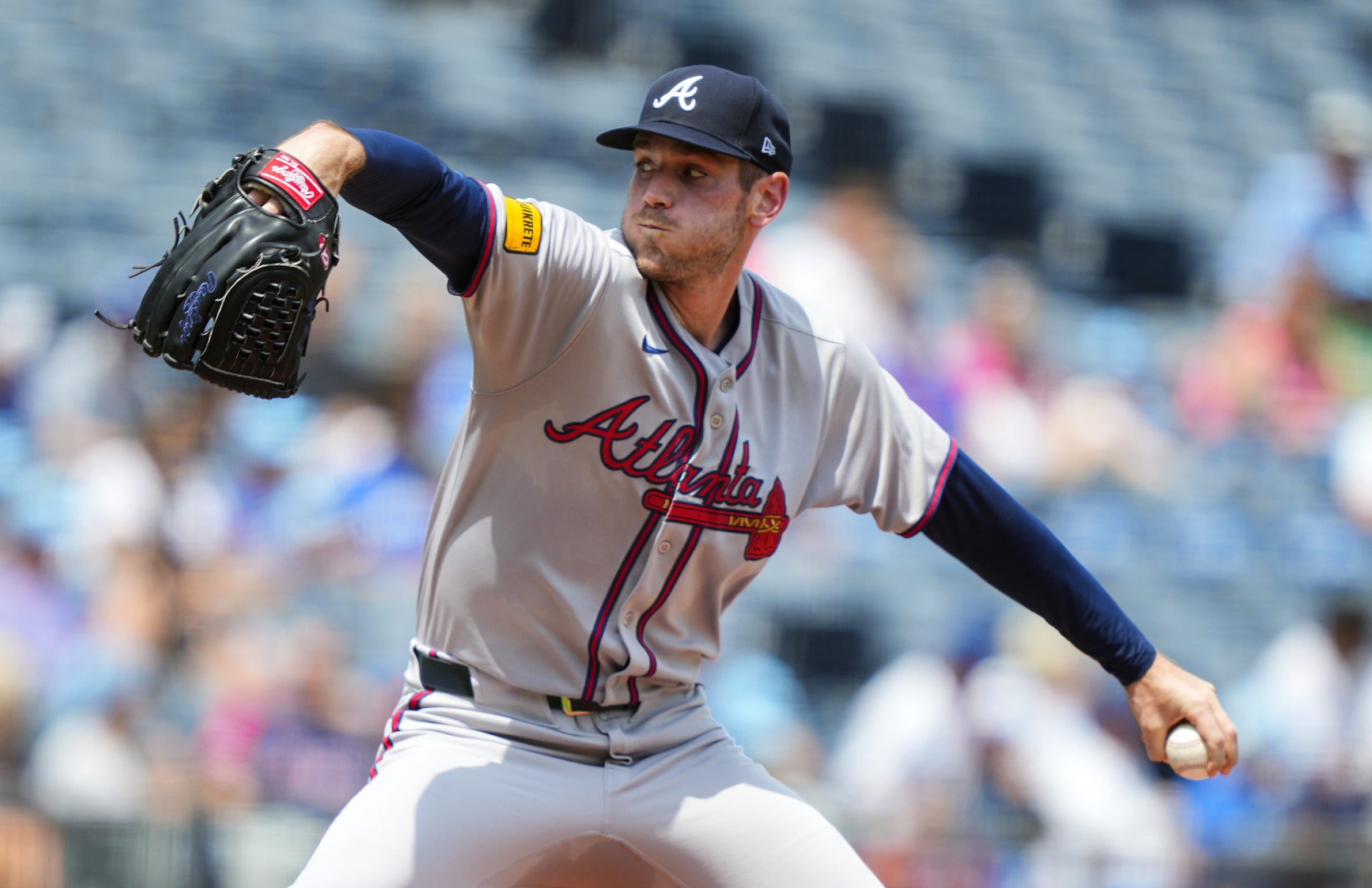
In mid-July, with the rotation reeling from injuries to Chris Sale, AJ Smith-Shawver, and Spencer Schwellenbach, the Braves went back to familiar territory. They claimed former 2016 first-round pick Joey Wentz off waivers from the Minnesota Twins, looking for stability more than upside.
The final line wasn’t pretty — a 4.92 ERA across 64 innings in Atlanta — but that surface number misses the part that mattered most.
In his first seven starts, Wentz delivered exactly what the Braves needed: competitive innings, a 2.70 ERA, and a 3.13 FIP while the rotation was in survival mode. For a few weeks, he stopped the bleeding.
That stretch is why the organization views him differently than the national analysts and why, even amid renewed concerns about rotation depth following spring injuries to Schwellenbach and Hurston Waldrep, Atlanta is comfortable penciling Wentz in as both a swingman and sixth starter.
Let’s talk about it.
Was that seven-game stretch real?
It’s easy to see a 34.2-inning stretch with a 2.60 ERA from a pitcher who’s been waived three times and assume it was smoke, not signal.
And it didn’t last - in his final seven starts, Wentz had an awful 7.67 ERA and took four losses.
But let’s look at those two halves in turn.
In the first seven starts, the underlying metrics suggest mild overperformance, but nothing outrageous. His 2.60 ERA sat close to a 3.14 FIP. He generated groundballs at nearly a 45% clip and posted a 14.3% strikeout-to-walk ratio. A .216 BABIP helped1, but he still stranded 72.8% of runners.
Atlanta largely shelved his cutter and changeup, leaning heavily on the slider and curveball. In his first start, he threw the slider more than the four-seam, a very Braves-style adjustment.
And it worked. For the first month of Wentz’s Braves tenure, he held opposing hitters to a .175 average and a 32.2% hard-hit rate.
But the tide turned over the next seven starts…or did it?
The back-half wasn’t bad under the hood
It’s easy to look at the final seven starts and conclude that the 7.67 ERA was the correction.
I mean, he allowed opposing hitters to put up a .356/.400/.508 line, a 1.98 WHIP, and registering a .390 wOBA.
Underneath, the damage was less dramatic: a 3.78 FIP paired with a .443 BABIP.
Some of this may be related to fatigue. Wentz hadn’t started regularly since September 2023. Even with Atlanta easing him in, his pitch counts quickly climbed into the 90s without extra rest. The workload spike appears to have caught up with him.
His fastball velocity dipped to just over 92 mph in early September before the Braves found him additional rest late, another sign fatigue was setting in. His locations crept up in the zone late, dropping his groundball rate to 34.7% and replacing it with line drives, the most damaging contact type in baseball.
Here are the outcomes for the different batted ball types across all of MLB last season:
Fly ball: .261 average, .805 slug
Pop-up: .013 average, .014 slug
Line drive: .628 average, .870 slug
Ground ball: .249 average, .272 slug
What does Atlanta do with him now?
One complication this offseason: few Braves pitchers have minor league options remaining. Wentz doesn’t. Any multi-million dollar addition would require a guaranteed rotation spot and force a bullpen reshuffle.
That move makes sense for an impact starter, as Anthopoulos has said. It doesn’t for a mid-tier arm likely to replicate Wentz’s 3.43 FIP and 4.24 xERA from last season.
But that doesn’t mean Atlanta’s completely stuck here. Wentz has plenty of experience in a major league bullpen, having thrown 125.2 innings in relief in his career. And that’s why it makes sense to start him in the pen on Opening Day.
But it’s not likely to last long. With Atlanta having thirteen games in thirteen days to open the season, a sixth starter is likely. While Alex Anthopoulos told me back in November that a six-man rotation isn’t feasible long-term, it’s something that the Braves can swing for the first two weeks until the schedule spaces out a bit in mid-April.
Wentz doesn’t need to be an ace. He doesn’t even need to be a full-time starter.
He needs to give Atlanta competitive innings — the kind he provided immediately after the waiver claim — while the rest of the rotation stabilizes.
The glass slipper didn’t shatter at midnight. The clock just ran long on a workload he hadn’t carried in years.
If the Braves manage that workload better this time, there’s reason to believe the version they saw first is closer to the truth than the one the final ERA suggests.
MLB average BABIP was .292 last year
Watching every game last year, I think Wentz and Elder have very common traits - not similar 'stuff' but they are both highly dependent on being almost perfect at hitting their 'spots'. If Elder can spot his slider low-and-in to LH hitters or low-and-away to RH hitters and keep his sinker at or just below the bottom of the strike zone, he is quite effective. If Wentz can spot his slider in on the hands of RH'ers and low-and-away to LH'ers he can be effective. But for guys who don't have much velo and few other options, it's asking a lot to go 5+ innings and not miss a target by more than a few inches. I hope they both have great years but I don't see why we are not in for more consecutive 3 run innings and above 5.00 ERA's.
Ahhh, these are the kinds of articles that remind me I’m a full-on Braves sicko. I can’t help it — I want this to work so badly. If they really have found something in him, and he can turn his career around here? That would be special. There’d be something poetic about the team that drafted him picking him back up off waivers and helping set him on the right path.