



There are times when we accept certain things as truths without completely understanding why they happen - Why the Chorioactis geaster mushroom grows only in Texas and Japan but no place else, or why humans dream, or how the feeling of being alive arises from physical brain matter.
Dylan Lee’s in this bucket.
MLB.com’s Jason Foster wrote recently about the lefty reliever, extolling how he’s been one of the best lefty relievers since the start of 2024, but without being able to explain why. Lee’s fastball is only 93 mph, with a slider that has below-average movement versus comparable righty sliders.
So I asked some people in baseball. Let’s talk about it.
How good has Lee been?
Oh, pretty good. Foster put it well:
“Since the start of the 2024 season (135 appearances), no qualified lefty reliever has 1) caused batters to chase pitches out of the zone at a higher rate; and 2) caused a higher rate of overall whiffs than Lee.
His 34.7 percent chase rate during that time is the best among his lefty peers with at least 130 innings pitched. Meanwhile, his 35.6 percent whiff rate is easily the highest among that group. So, it makes sense that Lee also leads the group with a 5.00 strikeout-to-walk ratio during that span.”
Foster then included a helpful chart showing where Lee ranks among all lefty relievers who have thrown 130 innings since the start of 2024 (22 total pitchers, per Baseball Reference):
Chase rate: 34.7% (best in MLB)
Whiff rate: 35.6% (best in MLB)
K/BB ratio: 5.00 (best in MLB)
Strikeout rate: 29.9% (second-best)
Percentage of batters retired: 73.9% (third-best)
Hard-hit rate: 33.4 percent (fourth-best)
WHIP: 1.02 (fourth-best)
Average exit velocity against: 86.3 mph (fifth-best)
Percentage of inherited runners stranded: 78.8% (fifth-best)
Overall opponents' average: .214 (sixth-best)
All amazing stats, and absolutely help Foster’s case that Dylan Lee is elite.
But it doesn’t explain why, just that he is.
What is Lee doing differently?
Let me disappoint you up front: We don’t know for sure.
But I talked to some folks who work in professional baseball, all folks smarter than me with more information than I have, and there are some theories I gathered from those conversations.
The first is the interactions between his fastball and his slider. Let’s talk about tunneling.
If you’re a follower of MLB analyst Rob Friedman, better known as Pitching Ninja, then you’re already familiar with this concept: two pitches that look almost identical out of the hand…until they’re not. The goal is for that divergence point to be after the hitter has been forced to commit to one or the other.
I’m going to simplify this a bit, but that decision point for the hitter - let’s call it the “Tunnel Point” - occurs roughly 175 milliseconds before the pitch crosses the plate. That’s around 23.4 feet in front of the plate, with obvious differences in the exact point between fastballs and breaking/offspeed stuff.
(These calculations come from Yale physicist Robert Adair in his 1990 book “The Physics of Baseball”, calculated off of a 90 mph fastball, so it’s likely a bit closer than 23.4 feet in 2026.)
Dylan Lee’s fastball and slider tunnel very well together. Here are both pitches in an at-bat to Kyle Schwarber on NBC’s Sunday Night Baseball.
First, the fastball:
Now the slider:
And my crude attempt to overlay these two, foiled by wind pushing the centerfield camera slightly askew:
At the decision point, occurring just over Lee’s shoulder from our angle, there’s not much of a difference from Schwarber’s viewpoint:
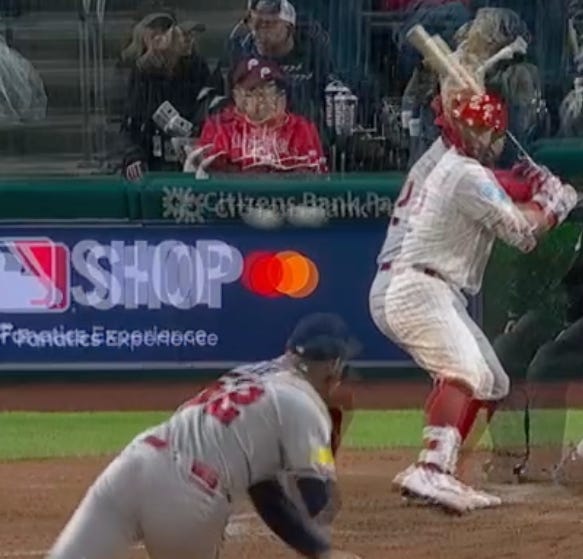
When you adjust for the camera being slightly off between the two shots, those are likely nearly perfectly overlaid - look at the difference between the ‘S’ in “SHOP” and the two pitches.
One of these pitches stayed up in the top of the zone and one dropped all the way to the bottom, coming in about nine mph slower.
One team employee I spoke with, who works in player development for a non-Braves organization, told me that their internal data has Lee’s tunneling as some of the best in the game.
But we can look at more than that.
Deception plays a part, too
One of the hardest things for the public baseball analysis space to quantify has been deception, which can be characterized by how well a pitcher hides the baseball from the batter’s view during the delivery.
(The other ‘white whale’ of modern analytics, to my knowledge, is quantifying the catcher’s full impact, including game calling and managing a pitching staff.)
The two public approaches I’ve seen so far are to either use machine learning to measure the time a baseball is obscured on a slow-motion video of the delivery or by creating some sort of stat that incorporates release point, velocity variance, spin axis, etc. to determine how different the pitch’s flight is from what the batter would ‘expect’ based on their mental muscle memory of the standard way all of those things normally work.
We don’t have the ability to do either here at Braves Today, but we can show you a slow-motion of his delivery. Here’s that same fastball to Schwarber, this time slowed down to 10% of normal speed and from the front:
(Remember, this camera is higher than Schwarber’s viewpoint, so that brief flash we get of the ball over Lee’s head would be obscured to the batter.)
Here’s the first frame the pitch becomes visible from the hitter’s perspective - when it’s leaving his hand.
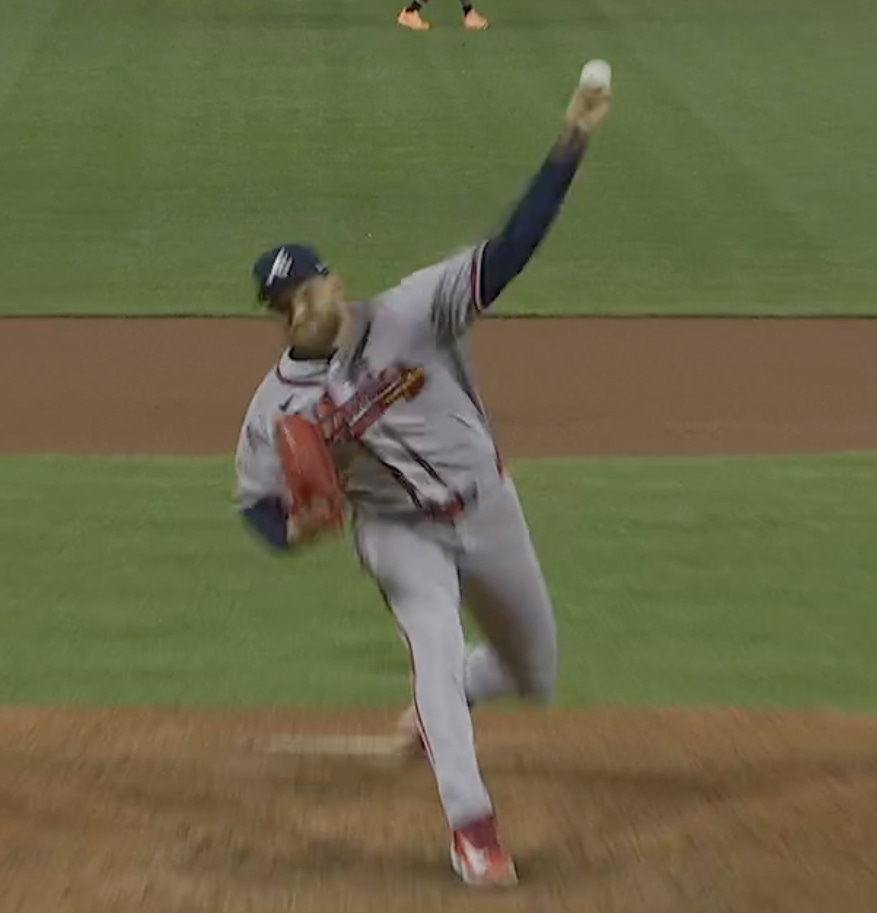
The advantage of a deceptive delivery like Lee’s means that a hitter isn’t able to begin tracking the pitch until it’s out of the hand, shortening the time to make a decision before the baseball hits the “tunnel point” we referenced earlier.
It forces a hard decision to be made even more quickly.
This is still a bit of a mystery
Tunneling and deception explain the chase and whiff numbers. But Lee also commands both pitches well enough to make hitters pay even when they do make contact, which is why the hard-hit and exit velocity numbers are as good as the swing-and-miss ones. In that same sample of lefty relievers (2024 to now, minimum 130 innings), Dylan Lee’s Pitching+ score is a 111, the 5th-highest, owing to his 108 Stuff+ and his 104 Location+.
There isn’t one thing Dylan Lee does that makes him elite. There are four or five things, all working together, that nobody has quite figured out yet. He’s the rare pitcher where the more you dig into the numbers, the more impressed you get, and the more you study the mechanics, the more questions you’re left with.
Some things just…work. Dylan Lee is one of them.
High time someone gave DL some praise. He has been a bargain for AA.