


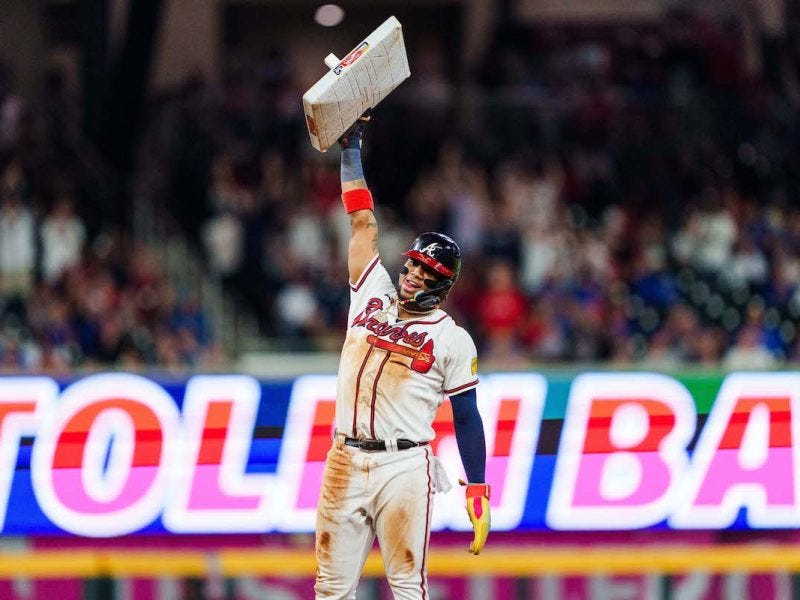
The enduring images of the 2023 Atlanta Braves are of offensive dominance: Ronald Acuña Jr. swiping 73 bases on his way to an MVP award. Matt Olson launching 54 home runs and driving in 139. A team slugging percentage over .500. Three hundred and seven home runs, tied for the all-time MLB single-season record.
That team won 104 games.
And yet, for all the historic offense, the rotation itself was not some untouchable, generational unit. It was fine. It was steady. But it was not the sole engine of that season.
That matters now.
Because if the 2026 rotation simply performs at a level comparable to 2023 - even with inevitable injuries - the formula for winning is still there. The difference won’t be the pitching.
It will be whether the offense can be meaningfully better than what we’ve seen the past two seasons.
Let’s talk about it.
There’s an obvious parallel here
While there were outstanding performances from the 2023 rotation, on the whole, it was a decidedly average unit.
Spencer Strider was the ace, with his twenty wins, .800 winning percentage, and 281 strikeouts all leading MLB. Bryce Elder was named an All-Star for the first (and only) time in his career with a 2.97 first-half ERA, although a back-half collapse left him with a 3.81 on the season.
But without Max Fried for multiple months, on the IL with elbow neuritis, and with prospect Jared Shuster acclimating to the majors, Atlanta’s rotation put up a 4.35 ERA, 17th in baseball. The peripheral numbers told the same story: a 1.34 WHIP, 19th in baseball, and a 2.71 strikeout-to-walk ratio, 18th overall.
The Braves used thirteen different true starters and three different relievers as ‘openers’, giving seven starts to Dylan Dodd (7.60 ERA), Kyle Wright (6.97), six to Allan Winans (5.29 ERA) and Michael Soroka (6.40). While AJ Smith-Shawver’s five starts produced a respectable 4.26 ERA and Darius Vines contributed a 3.00 in two, Yonny Chirinos (9.27) and Kolby Allard (6.57) were far less successful.
It’s interesting to look and see where the 2026 Braves are projected to come in with this injury-impacted version of their rotation, as there are clear parallels in both overall performance projections and individual roles.
Chris Sale projects as the ticket-punching ace, mimicking Strider’s 2023. Max Fried’s partial season (14 starts, 2.55 ERA/3.14 FIP) as of now is projected to be largely replicated by Spencer Schwellenbach (15 starts, 3.52 ERA/3.49 FIP) with the combo of 2026 Spencer Strider and Reynaldo López getting a high-3s projection similar to the actual results from 2023 Bryce Elder and Charlie Morton. The role of struggling Jared Shuster (5.81 ERA in 11 starts) is bettered by Grant Holmes (4.19 ERA in 19 starts) and Bryce Elder’s projected 19 starts and 4.43 ERA this upcoming season would easily outpace Dylan Dodd’s actual 7.60 ERA across seven outings.
On the whole, the actual 2023 and the projected 2026 output are strikingly similar:
2023: 4.36 ERA, 16.3 fWAR, 852 innings
2026: 3.89 ERA, 14.1 fWAR, 926 innings.
So, what’s the difference here?
How will the offense support?
The 2023 Atlanta Braves offense was generational - 947 total runs, an average of 5.85 per game, and it had a way of making things easy on Braves starters. Atlanta’s hitters scored 146 first-inning runs, meaning the rotation was usually staked with an early lead and asked only to hold it.
I’m not, in any way, suggesting that the 2023 Atlanta Braves offense is about to walk through that door. It’s clear that there was something going on with the baseballs, despite MLB’s denials, and the fan theory that Atlanta somehow hacked the league’s PitchCom system is entertaining, even if it’s rooted in nothing but conspiracy.
But if the 2026 Atlanta Braves offense can outperform the injury and slump-impacted 2024-2025 squad, it’s possible for this rotation to be more than good enough for Atlanta to not only be competitive in the NL East but also make the playoffs and potentially even win the division outright.
FanGraphs has the Braves offense projected for a .256/.331/.435 line, good for 28.9 fWAR. The models have Atlanta hitting 226 home runs and scoring 803 runs, an average of 4.96 per game.
If the 2023 rotation, backed by 5.85 runs per game, won 104 games, what can a similar or better staff do with roughly one run per game less?
As luck would have it, even after the injuries, Atlanta is projected for 89 wins, the second-best mark in baseball behind only the Los Angeles Dodgers and their absurd 97-win projection.
So, why the catastrophizing?
The skepticism is understandable.
The last two seasons have trained Braves fans to expect the other shoe to drop. Injuries pile up. The offense underperforms. The rotation feels thinner than it looks on paper. And compared to the 2023 juggernaut, this roster can feel like a step down before a pitch is even thrown.
But that memory may be distorting the comparison.
The 2023 team did not win 104 games because the rotation was untouchable. It won because the offense created a margin. The staff only had to be good, not historic.
The 2026 projections suggest the pitching can clear that same bar again, even with the early absences. The difference is whether the lineup rebounds from two injury-impacted seasons and plays closer to its underlying talent.
If it does, the math changes quickly.
An 89-win projection is not a ceiling. It’s a midpoint that assumes health uncertainty and some positive offensive regression baked in. If the lineup outperforms that expectation, and if even one or two of those injured arms return midseason as contributors, this roster starts to look far less fragile.
It starts to look deep. It starts to look dangerous.
Maybe not 2023-level historic, sure. But more than capable of being one of the best teams in baseball.
The rotation doesn’t have to be perfect. The offense doesn’t have to be generational.
They just have to be better than we’re allowing ourselves to believe right now.
Really appreciate the continued insight. You’re the only Braves commentator that I watch or read that hasn’t gone full panic mode because we don’t have 5 SPs that have never been injured and are projected to throw 170 innings at a sub-4.00 ERA. SP is still extremely important, but it is no longer the top determinitayive factor for team success. I’ve lshared a number of metrics that demonstrate this. Here’s one more: In 2025, 8 of the top 10 teams in runs scored made the playoffs. Five (5) of the teams with the lowest team ERA did not make the playoffs. The team needs to score runs! Full stop. And they also need to go through ST with the mindset that non-starters will throw 45% the innings and they will need 8-9 starters (hopefully, not more). They need to build and manage the roster and team accordingly. A lot went wrong last year and my sense is one of the issues is the manager had not fully embraced this reality.
This is what i love about Braves baseball :
Tomahawk Take reports Braves have a $1,5 million "handshake agreement" with a 12 year old defensive whiz shortstop. He is related to Ronald Acuna.
He would be a Class of 2030 player.