


In retrospect, Alex Anthopoulos should probably be credited for his honesty.
It would have been really easy to offer the familiar offseason reassurances about struggling third baseman Austin Riley: He’s working hard. He’s immensely talented. They’re just one tweak away from getting the MVP finalist who hit .286 and averaged 36 home runs from 2021 through 2023.
But that’s not what he said to the media last Sunday when breaking down the 2026 Braves season and laying out their offseason plan. Instead, Atlanta’s President of Baseball Operations admitted something far more revealing:
“We haven’t been able to solve it, and he hasn’t been able to solve it.”
That matters because for the first time in three seasons, Riley was healthy. He played in 159 games after two consecutive seasons of 110 or fewer, due to injuries. And while his bat speed was still elite, and the defense was arguably better than it ever has been, the offensive production still disappeared.
What does Atlanta do now? Let’s talk about it.
It’s a three-year decline, but different declines
Riley hasn’t been able to replicate his 2023 season, an impressive campaign that was his third consecutive season with an OPS in the high-8s, 30+ homers and nearly 100 RBI, and a top-seven MVP finish.
In reality, the process deterioration came after the results started to fall off.
|Season| OPS  | K%    | xwOBA|
|------|------|-------|------|
| 2023 | .861 | 24.1% | .366 |
| 2024 | .783 | 25.2% | .367 |
| 2025 | .737 | 28.6% | .330 |
| 2026 | .654 | 31.9% | .299 |
In 2024, the results weren’t there, but the quality of contact was essentially the same as his 2023 season, with his xwOBA climbing from .366 to .367.
In 2025, that’s when the underlying process started to deteriorate, as Riley was playing through a core muscle injury that ultimately ended his season.
And in 2026, he was healthy…but both his underlying process and his results got worse.
His physical tools have not disappeared
One of the major concerns with any sort of abdominal/core injury to a hitter is how it will impact their ability to swing a bat. This is doubly important for power-focused hitters, who are relying on bat speed to generate exit velocity and put balls over the wall.
The good news is that Riley’s average bat speed this season was roughly as good as it’s ever been, sitting at a 91st percentile mark of 75.8 mph. And the other measurable parts of his swing, like the 7.6 ft swing length, were mostly unchanged from the previous three seasons, as well. While his average exit velocity declined to 91.3 mph, that is still above-average and explainable by drops in his ability to square up pitches in the sweet spot for production.
Essentially, nothing measurable about his swing changed. Yes, some of the outputs are down - his maximum exit velocity, hard-hit rate and barrel rate all declined. But there is no obvious loss of strength or swing speed sufficient to explain a 207-point OPS decline from 2023.
Besides, he seemed physically fine in the postseason, when he turned around a 100-mph fastball from Phillies closer Jhoan Duran and deposited it into the Truist Park seats.
It isn’t a velocity problem
When researching this newsletter, one of my first thoughts was “well, he’s still swinging as hard, but is he just late on fastballs?”
Not really? He wasn’t good against fastballs, mind you, but it’s not like he’s only struggling with velocity.
Per Statcast, Riley was worth:
-8runs against four-seamers-4against sinkers-4against sliders-3against changeups-1against sweepers
He’s not being beaten by one exploitable weakness. He’s not reliably hitting anything.
So, I dove into different velocity bands. Maybe it was premium velocity that was messing him up?
Nope. Against fastballs over 95 mph, he hit .182/.289/.313 with a .296 xwOBA. But against fastballs below 95 mph, it’s not like he was Vishnu, Destroyer of Worlds. He hit .226/.316/.333 against subprime velocity, putting up a .334 xwOBA and still whiffing 34.1% of the time.
Yikes.
The most revealing number may be -39
Long-time readers will remember us talking about Attack Zones, the segmentation of the strike zone, and how the best hitters make their hay absolutely destroying baseballs in the Heart of the zone while holding their own on pitches in the Shadow.
Riley’s…not done that in recent years.
| Season | Heart | Shadow | Chase | Waste | Total |
|--------|-------|--------|-------|-------|-------|
| 2023   |  +7   |   -8   |  +15  |  +12  | +26   |
| 2024   |  +5   |   -8   |  +9   |  +7   | +13   |
| 2025   |  +1   |   -8   |  +5   |  +6   | +4    |
| 2026   |  -2   |   -39  |  +9   |  +14  | -17   |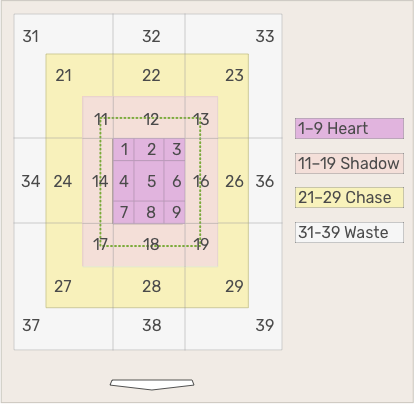
Sure, his production on pitches over the heart of the plate declined - but that’s not the biggest decline in value here. Riley’s ability to navigate the edges of the strike zone has absolutely disappeared. That encompasses more than what happens when he makes contact: It includes which borderline pitches he attacks, which ones he takes, and what happens when he does swing.
And again, there’s no obvious loss of physical capacity that explains it. That points more toward pitch recognition, swing decisions, timing or barrel control, but the public data cannot tell us which.
The bat remained fast. The barrel became less accurate
The one thing that isn’t being measured by the swing, but is visible in the outputs, is Riley’s efficiency at making quality contact.
We touched on it earlier, but Riley really struggled at squaring up baseballs at contact. There are two ways to measure this in Statcast: Squared-Up percentage and Sweet Spot, and they measure different things.
Squared-Up rate compares the exit velocity a hitter produced with the maximum exit velocity theoretically available from that combination of bat speed and pitch speed. Statcast considers a swing squared up when the hitter obtains at least 80% of that potential exit velocity.
The difference in hitting a ball flush (on the sweet spot of the barrel) and getting jammed or off the end of the bat is enormous when it comes to production. MLB illustrated the value of the metric with these results from the first month of the 2024 season:
Squared up
.371 BA // .656 SLG // .438 wOBA // 60% hard-hit rate // +11.4 run value per 100
Not squared up
.126 BA // .142 SLG // .119 wOBA // 1% hard-hit rate // -6.7 run value per 100
Confusingly, Sweet-Spot percentage measures something entirely different: how frequently a hitter produces a launch angle between 8 and 32 degrees. (Barrels are determined through exit velocity and launch angle, although their qualifying launch-angle window changes with exit velocity.)
I wanted to bring these two up for Riley because they’re both underwhelming. Riley’s 34.3% Sweet-Spot% is roughly league average, so he’s doing a good enough job of managing his launch angles, but that’s down from his usual top quartile marks (75th percentile to 87th percentile) over the last few seasons.
But on the Squared Up calculation, he’s been terrible. Riley’s 18.9% mark is 7th percentile in baseball, ahead of just 15 batters in baseball. Eleven of those fifteen have strikeout rates over 30%.
Riley had two related problems: He whiffed on 31.9% of his swings, and only 18.9% of all swings produced squared-up contact. Even among the swings on which he made contact, his Squared-Up rate was only 27%. He generated plenty of force but applied it correctly far too infrequently.
It’s a terrible combination.
From 2025 to 2026, his popup rate climbed three percentage points to 9.2%, his barrel rate fell 2.8 points to 12.4%, and his hard-hit rate dropped 5.9 points to 44.3%.
Now unpacking why is the harder part - is he struggling to physically command the barrel? Or is this to do with late/wrong swing decisions (a 32.3% chase rate, his highest percentage since his debut season in 2019)? I don’t know.
I wondered whether contact point was involved, but the directional batted-ball data doesn’t resolve it. Riley’s pulled-air rate has fluctuated seemingly at random between 16.6% and 24.2% over the last few seasons, without mapping neatly onto his production. Determining whether his contact point changed would require the newer Statcast intercept data for previous years and, ideally, a side-by-side video comparison.
My working theory is that this is a pitch recognition issue: Riley is frequently caught between fastballs and breaking balls. But that remains exactly that, a theory.
We’re almost 1300 words into the article, and I haven’t figured out what’s wrong.
Why haven’t Riley or the Braves solved it?
Part of me wonders if the brief flashes that Riley has shown over the last few seasons, including a hot 2026 spring training (.351/.451/.786 w/ 5 HRs) and his April heater that saw him with a .988 OPS across two weeks of games, make it difficult to commit to deconstructing and rebuilding his swing. The defense and physical indicators look good; he can have the moments (like the Duran homer), so the belief is that he’s “so close” to being back that the urge to tear him down and rebuild him is suppressed.
Every flash makes the old Riley appear close, but they’re just that - flashes. None have lasted. He’ll make a mechanical tweak, have a few good games, and then it’s right back to more of the same.
It’s probably not fair to argue that Atlanta’s ignored the problem…but it is fair to point out that a healthy season for Riley ended without the player or the coaching staff finding an adjustment that worked more than a short stretch.
So, what does an actual fix look like? It isn’t another good spring training, that’s for sure.
The Braves also cannot treat a Riley rebound as one of their offseason offensive additions. He will enter 2027 as their third baseman, but the rest of the lineup must be constructed to survive another season in which he is merely average, or worse. That means adding offense elsewhere rather than assuming a healthy winter will automatically restore the middle-of-the-order hitter they once possessed.
Let’s talk about some measurables that we can watch for:
Improved swing/contact outcomes in the Shadow region
Fewer whiffs against four-seamers and in-zone breaking balls
More squared-up contact without sacrificing bat speed
Fewer popups
Better damage on pulled air
A more consistent contact point
A strikeout rate moving back toward his 2021–23 range
The Braves don’t need a winter of reassurances that Riley’s healthy and getting back to his old self at the plate. They need to understand why one of MLB’s fastest bats so rarely arrived with the barrel in the proper place.
They also need to be prepared for the possibility that the old Austin Riley never returns.
Admitting they haven’t solved Austin Riley was the honest first step. Now the Braves must prove they know which problem they are trying to solve, and prepare for the possibility that they can’t.
Great analysis!
Great article, thanks for all your hard work!!👍