


Didier Fuentes was never going to win the National League Rookie of the Year award.
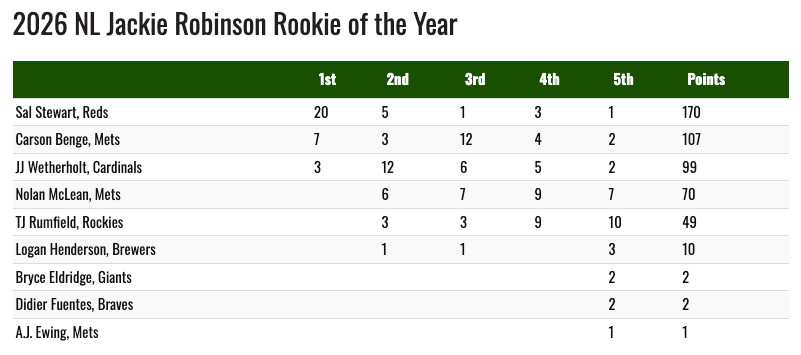
But two voters remembered what he did this season. Fuentes received two fifth-place votes on Monday, leaving him tied for seventh after a season in which he rebounded from an atrocious debut to become one of Atlanta’s most trusted relievers.
To be clear, it’s very difficult for a reliever to take home ROTY. The last time a reliever won the award in a full-length season1 was actually a member of the Braves: Craig Kimbrel in 2011, after leading the National League in saves with 46 and pitching 77 innings with a 2.10 ERA.
The 2026 season for Fuentes wasn’t enough to bring home a trophy to Atlanta. But it was enough to raise an interesting question: Who could make a case for Atlanta next year?
Let’s talk about it.
Readiness versus opportunity
Take a look at the vote breakdowns and tell me what you notice. Let’s start with the National League, as it is the senior circuit:
And here’s the American League:
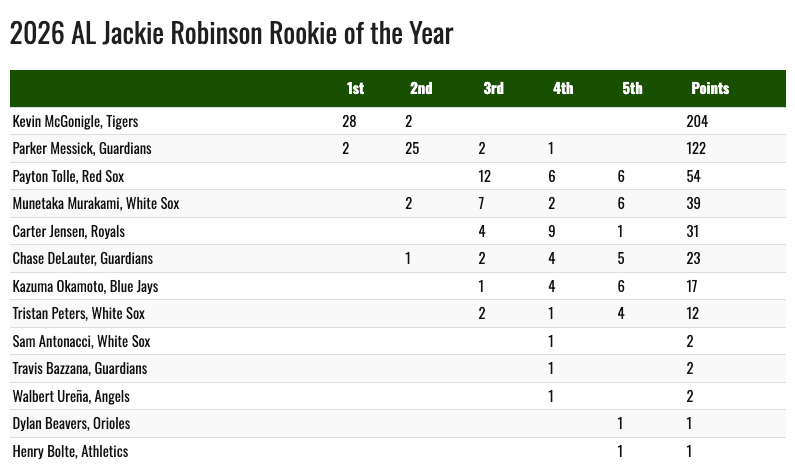
Five of the six finalists - including both winners - made their teams’ Opening Day rosters.
To go deeper, 15 of the 22 players who received votes were on their team’s Opening Day roster. In the NL, three of the bottom four didn’t break camp with their teams, with Fuentes being the exception. In the AL, Payton Tolle’s the outlier here - he finished third despite not being with the Red Sox when they left Florida (he made three starts with AAA Worcester before they called him up), with the others coming in T-9th (Sam Antonacci and Travis Bazzana) and 12th (Henry Bolte).
Not only did everyone else start the season with the big league club, but they also played prominent roles this season.
Now obviously, playing a prominent role requires them to be effective and productive, but they all took advantage of a roster opening to seize playing time and never let it go. The hitters were getting everyday plate appearances, while the pitchers were almost all starters who seized a rotation spot early and got the ball every fifth or sixth day for the entirety of the regular season.
That’s why we can’t just look at “who is the best prospect” when trying to figure out which Braves player might contend for the award next year. “Best prospect” ≠ “best candidate”, because opportunity matters too.
The clearest position-player candidate
Let’s talk about Patrick Clohisy.
MLB Pipeline already beat me to this, because they dropped their article the same time the award was announced, while I didn’t have this newsletter idea until the morning after the award was announced.2
The reason that Pipeline cited is that Clohisy has a combination of a carrying tool and an opportunity to use it, having stolen 141 bases over the last two seasons and being more than capable of holding down left field, a spot where Atlanta’s used twenty-one different guys over the last three seasons.
He hit .290/.372/.457 with 62 steals in a season divided between Double- and Triple-A, but saved his best work for Gwinnett: .340/.420/.483, stealing 25 bases in his 42 games.
It’s elite speed, and it’s coming from a guy who’s run walk rates at or over 10% in every season of his career so far. The Braves need speed and athleticism from guys that can reach base on their own, and if Clohisy’s game quickly translates to the majors in that rotating left field spot, he can provide it in a hurry.
The problem is that his power’s somewhat limited, meaning he’ll need regular playing time to accumulate the value through his OBP, speed, and defense. And as of right now, the Braves have four outfielders tabbed for spots in Michael Harris and Ronald Acuña Jr. (written in pen), Mike Yastrzemski (penciled in), and Jurickson Profar (lightly traced in the sand ahead of an incoming wave during low tide).
Clohisy’s never debuted in the majors and isn’t even on the 40-man roster at the moment, so he’s not likely the most major-league-ready rookie hitter…but he’s the likeliest award candidate if injuries (or a suspension) create an everyday role.
The immediate pitching candidate
Owen Murphy made his debut this season, but threw only 12 major-league innings, so he’s retained his rookie eligibility. Having been promoted to Gwinnett after just five starts for Columbus, Murphy finished his Triple-A season with a 3.07 ERA, 1.07 WHIP and a .198 opponent average across 96⅔ innings.
It’s a metric-driven fastball, sitting just 93 mph but with a well-above-average 19 inches of induced vertical break. He pairs it with a sinker, using both a curveball and a slider off of it, as well as a changeup to lefties.
He’s already on the 40-man roster and has debuted, so there’s not a logistical problem with getting him to the bigs, while he has the Triple-A workload to meaningfully project a full season of starts with some moderate protection in his usage and rest. And besides, we all know that Atlanta’s continuous rotation injuries mean that he’ll eventually get another opportunity, even if it’s not immediately on Opening Day.
The risk here is that the first exposure to big league hitters was rough, with a whiff rate below 20% and struggles with mitigating hard contact. He needs the stuff to continue to grow as he gets further away from his Tommy John surgery - even Joe Ryan, the current patron saint of the low-velo-but-high-IVB fastball, is throwing closer to 94 and has the exceptional extension (6.9 ft, 89th percentile) to let that velo play up. Any offseason rotation additions are likely going to start ahead of Murphy on the pecking order for playing time, and it’s likely both JR Ritchie and AJ Smith-Shawver will as well.
It’s incredibly likely that the Braves won’t even enter camp with a rookie planned to fill one of their five rotation spots. But the reason we’ve gotta address Murphy here is that their rotation’s health history makes it hard to believe that Atlanta can make it through 2027 without needing a rookie to step up and take starts.
The dark horse arm
We’ve gotta talk about Davis Polo.
I don’t want to call him a co-favorite with Murphy, because of the longer road ahead of him to make the majors, but he could surprise us all.
He did this year, returning from missing all of 2025 to an unknown injury to post a 3.00 ERA with 140 strikeouts in 129 innings. He did that while pitching at every single full-season affiliate this year, starting in Single-A and finishing the year with a scoreless six-inning Triple-A debut.
Organizations don’t accidentally race a guy through every level of the minors; that’s usually reserved for a player they know is good and they’re trying to get more looks to figure out how good he is so they can find a true competition level for him. He throws all three fastballs, sitting about 93-95, along with a changeup and a slider, and can locate them all for strikes or take them out of the zone for chase.
He’s not currently on the 40-man roster, but that might change soon: MLB has indicated to teams that they need to proceed as if the Rule 5 draft will happen in some way, so protection decisions will come soon and they’ll likely add him. It’ll be a shame for the league to push teams to protect their players, only to cancel the Rule 5 draft (as they did during the last lockout), and now those newly protected players will be ineligible to play in the minors during the lockout, but…when has anyone ever accused Rob Manfred of being super-insightful and forward-thinking?
But he still remains a long shot. Sure he appeared in Triple-A, but it was one start. He’s still just 21 and is behind both Ritchie and Murphy in the young pitcher hierarchy, so his opportunity might come too late to impact a ROTY race. And I’m not a fan of the four-seamer’s shape, with the caveat that it was one start in Triple-A at the end of a long season, so we need to have a bit of grace and understand that the adjustment to a different ball or fatigue over a long season could have impacted that.
Could a shortstop force the issue?
In case you haven’t glanced at the team’s depth chart recently, it’s…grim at shortstop. And by “grim”, I mean “the Braves don’t even list the position on the online depth chart because there’s nobody to play it.”
If the Braves can’t figure it out this winter, either via making a blockbuster trade or re-signing Mauricio Dubón, either Alex Lodise or John Gil could theoretically force an accelerated promotion.
Lodise, who started in Augusta as the Braves worked on some of his approach issues, figured it out in June and quickly rose to Rome and then Columbus. From June 9th through the end of the Double-A season in early September, Lodise hit .292/.373/.559 with 20 homers and 58 RBI in 79 games.
His mid-August promotion caught him up to fellow shortstop prospect John Gil, who made the transition two weeks earlier. He finished the season hitting .262/.357/.392, hitting just 14 home runs to Lodise’s full-season mark of 28 but stealing 60 bags to Lodise’s 17.
They’re different types of players, but with styles which complement each other. If Atlanta can’t find a high-end solution this winter and is stuck with a temporary and/or underperforming option at short, one of those guys could potentially be rushed to the majors to attempt to salvage the position.
Tate Southisene is the third of the team’s three top shortstop prospects, but the path to his ROTY candidacy feels longer. He was actually the first of the three to reach Double-A, being promoted in late July, but broke his right wrist on a HBP in his first game with Columbus and missed the rest of the regular season. He’s since made up for some of that lost time with a few weeks in the Arizona Fall League, earning “Fall Stars” honors, but 16 games in the offense-friendly desert environment doesn’t make up for missing two months of regular season development.
The highest-ceiling long shot
But there’s one more name we need to discuss, and it’s because he may have the highest ceiling of all: Cam Caminiti.
He joined the shortstops in Columbus for the final month-plus of the regular season, now fully cemented into the “Diet Chris Sale” mechanical adjustments that Atlanta gave him. Despite being only 19 when he hit the level, he still pitched to a 2.01 ERA in his six starts for the Clingstones, finishing the season with a cumulative 3.38 ERA and 125 strikeouts over 114.2 innings.
He’ll likely return to Double-A to start 2027, but the potential and pure athleticism in the lefty mean that he’s a threat to be given a quick car ride up I-85 to Atlanta at any time.

Why not a reliever?
I know, I know, I just said that it’s very hard for a reliever to win Rookie of the Year in a full-length season. But we did just see Didier Fuentes get downballot votes, so we should probably acknowledge that there is a chance there.
And if I’m looking at relief prospects in Atlanta, the two names that stand out are Blake Burkhalter and Rolddy Muñoz.
Both men are on the 40-man roster, with Muñoz debuting in 2025 and Burkhalter in 2026. Muñoz has the better stuff, with a fastball capable of pumping 100, while Burkhalter has the much better idea of where his is going.
It’s a long shot that either man can get into a high-enough leverage role to produce the Kimbrel-like numbers required to win ROTY, but they’re the two with the best combination of proximity and favorable logistics to have an opportunity.
Verdict
I don’t feel comfortable ranking each of these players against one another, since everyone’s situation is so different. Let’s break them all into categories to illustrate the scenario that would have that guy being a candidate to get votes from the BBWAA.
Best combination of readiness and opportunity: Owen Murphy
Best position-player candidate: Patrick Clohisy
Breakout pitching candidate: Davis Polo
Highest ceiling, hardest timeline: Cam Caminiti
Opportunity-dependent shortstop candidates: Alex Lodise and John Gil
Relief long shot: Blake Burkhalter
It’s easy to see where the Braves could have a few Rookie of the Year candidates. But whether or not they have a Rookie of the Year winner depends on what Alex Anthopoulos does this winter. Every veteran addition likely narrows the path a bit, while every unresolved or under-addressed lineup question leaves the door open just a skosh.
We’ll likely know a lot about Atlanta’s 2027 Rookie of the Year chances by the end of spring training, and it’ll come from looking at the depth chart, not the prospect rankings.
Milwaukee Brewers closer Devin Williams won it in 2020 without recording a single save, pitching 27 innings with a 0.33 ERA. That was a weird year.
I knew Fuentes would get down-ballot votes, but I also knew he wouldn’t win, so this wasn’t really on my radar.
Interesting, thorough and thought-provoking analysis. Well done! Also, enjoyed your podcast that included this discussion. The broader point for the Braves is they need a couple of these players to contribute significantly at the big league level in 2027. In the last 2 seasons my biggest fustration has been the approach they’ve taken to promoting guys to the big league. But that doesn’t make sense because if you look at the last decade, no team has done a better job at introducing promoting impact players. Looking forward to your continued discussion of this topic.
Since the team is now rewarded for a ROTY award, each league should have a pitcher and a position player award. Messick had a tremendous season and I think Cleveland has a real case that he should’ve won the award.