


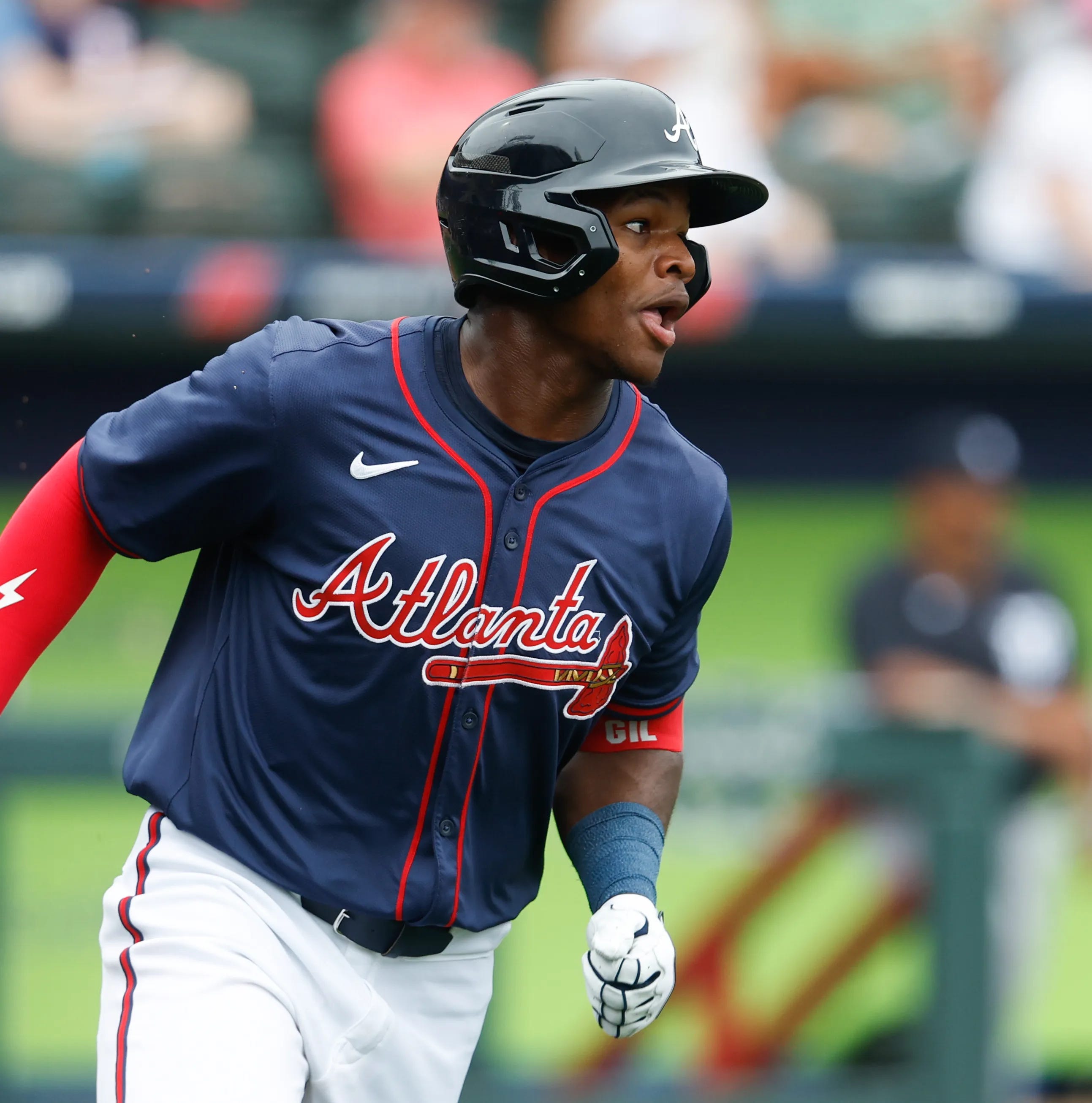
After going 0-2 in Spring Breakout, the Atlanta Braves are trying something new.
Atlanta’s prospect squad dropped their 2024 matchup to the Boston Red Sox 7-2, followed by a 6-3 loss to the Detroit Tigers last year.
It clearly didn’t work, so they pivoted. This year’s roster is out, and the changes the Braves made are fascinating. Let’s talk about it.
Talent versus roles
In their two previous iterations of the Spring Breakout roster, Atlanta attempted to build a more traditional, role-based roster.
In 2024, 3B Sebin Ceballos and 1B Cade Bunnell were selected specifically to play the corner infield spots, with Owen Murphy getting the start and relievers taking the middle innings before Spencer Schwellenbach finished things off.
2025 was similar, with David McCabe and Drew Compton manning the corner infield and Luke Waddell getting the start at second base for a second consecutive year.
(EDITOR: An earlier version of this article referred to Will Compton, the former NFL linebacker, instead of Drew Compton. We regret the error.)
Not this year. The Braves went with the best talent, regardless of position. It’s an idea stolen from college football, where the common refrain “it isn’t about the Xs and Os, it’s about the Jims and Joes” is used to discuss the idea of amassing the most talent possible and figuring it out later.
Here are the infield options for the Braves. See if you can figure out what’s odd here:
SS John Gil
SS Jim Jarvis
SS Alex Lodise
SS Cody Miller
SS Jose Perdomo
SS Tate Southisene
2B Dixon Williams
If your answer was “they’re building the entire plane out of shortstops”, congratulations, you nailed it. For the most part, just about every professional right-handed infielder was a shortstop at some point of their baseball life. It may have been college, high school, or even younger, but they played it.
It’s that same idea here, but in professional baseball.
We’ve seen teams do this at the MLB level, by the way - the 2024 San Diego Padres, famously, was composed of almost entirely current or former shortstops:
1B Jake Cronenworth
2B Xander Bogaerts
SS Ha-Seong Kim
3B Manny Machado
LF Jurickson Profar
CF Jackson Merrill
RF Fernando Tatis Jr.
DH Luis Arráez
Every single player in that lineup was a former shortstop in professional baseball. Even Luis Arráez has logged innings at shortstop in his career.
If I had to guess an initial configuration of this lineup, I’d go with this setup:
SS Alex Lodise
3B John Gil
2B Cody Miller
1B Jim Jarvis
Jarvis is the closest thing to a utility player here, while Gil has 50 games at third. Lodise has barely played the position, so keeping him at short makes the most sense. Miller’s played all three non-first positions in the pros, with Dixon Williams likely coming off the bench to replace him.
So they’re covered, the catching group is the weakest spot on the roster, made up of lower-level prospects in Archer Brookman, Colin Burgess, and Manuel Dos Passos. All three were in the lower minors last year and this is the team’s weakest position, although I’ve heard good things about the Venezuelan-born Dos Passos.
The outfield tools!
For as exciting as the almost-all-shortstop infield is, the outfield features the best collection of sheer talent the Braves have rolled out on the grass in a while.
Here’s the list of outfielders on the roster:
Owen Carey
Patrick Clohisy
Isaiah Drake
Conor Essenburg
Eric Hartman
Diego Tornes
All six are exciting players and together constitute six of the team’s seven top outfield prospects, with only Luis Guanipa not represented.
Tornes and Essenburg (who has yet to play in full-season ball) profile as the power hitters of the group, while Hartman, Drake, and Tornes (again) bring the speed. Owen Carey and Patrick Clohisy are the ‘floor over ceiling’ picks that can do everything well, as jacks of all trades, while not specializing or featuring any one specific tool.
Who debuts this year?
There’s been a trend of Atlanta’s final Spring Breakout pitcher debuting later that season. Spencer Schwellenbach struck out three Boston prospects in the final three innings of 2024’s game before making his MLB debut on May 29th, while Didier Fuentes punched out a Breakout-high seven Tigers last year ahead of his June 20th debut.
The two starters on this year’s team are Owen Murphy and Garrett Baumann, both of whom were invited to spring training and showed promise, albeit with fewer whiffs than ideal. If the pattern holds, one will start and the other will finish the game, with both getting two or three innings.
Sandwiched between them are a septet of true relievers, including alliterative lefties Hayden Harris and Herick Hernandez. They’re supplemented by five righties, including Blane Abeyta, Isaac Gallegos, Luis Vargas, and the flamethrowing duo of Jhancarlos Lara and Rolddy Muñoz.
Can they actually win the game this year?
The Braves prospects are 0-2 in this game, but this year’s as good a chance as any. They’re matched up with the New York Yankees this weekend, an organization that has a farm system built on starting pitching…that they aren’t bringing to the Spring Breakout.
Of New York’s 21 pitching prospects in their Top 30, the highest rated that made the roster are #10 Pico Kohn and #11 Kyle Carr. They’re both lefties; Kohn was a 2025 4th-round pick out of Mississippi State who has yet to debut in professional baseball. Throwing in the low to mid-90s out of a three-quarters slot, he’s a fastball/slider guy with a nascent changeup. Carr, a 3rd-rounder in 2023, was the South Atlantic League pitcher of the year in 2025 despite a low-90s fastball that maxes out at 95, a high-70s slurve, and both a two-seamer and a firm changeup to get groundballs.
On the position player side, organizational #1 prospect George Lombard Jr. is likely to start at shortstop, but power machine Spencer Jones was not included on the roster. Lombard’s the only top ten prospect of New York’s to make the roster, and there are only four top-twenty prospects at all on their side.
It’s a winnable game - the Yankees simply aren’t bringing their best pitching.
What’s with the lack of stars?
The Braves are missing a lot of potential star power from the pitching ranks in this game. While it makes sense that both JR Ritchie and Didier Fuentes, who are competing for MLB roles, wouldn’t make the roster, the Braves could have included any of Cam Caminiti, Luke Sinnard, Briggs McKenzie, or even newly-converted reliever Blake Burkhalter to this year’s squad.
It’s a trend across the league, not just Atlanta. Per an analysis from Baseball America, only 52 of the league’s top 100 prospects are in this year’s Spring Breakout series, down from 67 last year. Of those, only 11 of the 37 T100 pitchers will participate, with only two top-10 pitchers (Kade Anderson, Liam Doyle) and four top-50.
I have a few theories on this.
The first is the World Baseball Classic. While the tournament is now wrapped up, several prospects got opportunities for prolonged run in major league camp to replace departed veterans. With the finalists not due back in camps on Thursday, it’s likely that there wasn’t time to get those prospects shifted to minor league camp for a Spring Breakout exhibition on Friday, Saturday, or Sunday.
The second is anecdotal, but it feels like many prospects are battling for rotation spots to open this season. Off the top of my head, just in the NL East alone, I can think of six or seven prospects that have (or just recently had) legitimate chances to break camp with a rotation spot: Jonah Tong and Nolan McLean (Mets), Andrew Painter (Phillies), Dax Fulton (Marlins), Luis Perales (Nationals), and both Fuentes and Ritchie in Atlanta.
So yes, the Braves are doing something different this year.
Instead of trying to simulate a “real” roster with clean positional fits and defined roles, they’re leaning into what actually matters at this stage: talent. Stack as many interesting players as possible, let them move around, and trust that the athleticism and instincts will sort the rest out.
It’s a small shift, but an important one. Spring Breakout isn’t about winning a single exhibition game - even if going 0-2 probably didn’t sit great internally. It’s about showcasing what’s coming next.
And this roster does exactly that.
It’s toolsy. It’s crowded. It’s a little chaotic. And it’s probably a more honest reflection of the organization than the previous versions.
If nothing else, it should be a lot more fun to watch.
Good to see Perdomo on the Futures roster. There are many players who signed for less than his $5 million in 2024 kmocking on the Major Leagues.⁰
I still haven't seen any National Publications assess this year's International Signees.
I know Fangraphs.said they signed 3 top 50 prospects, led by Edelson Cabral. In their view.
5 guys signed for at least $350,000 so these would be the ones to watch out for.
2 shortstops
1 centerfielder
1 right hander
1 catcher. Mr Romero said he could hit and hit for power
There's still money ( $1 million) and time (December)to add more players
The only source for all who signed and their bonus is Mr Francys Romero. He has his own Substack Newsletter.
Beisbol something or other