


Atlanta Braves Holdings released its latest annual revenue report on Wednesday, and the headline number jumps off the page: overall revenue increased by 11% year over year.
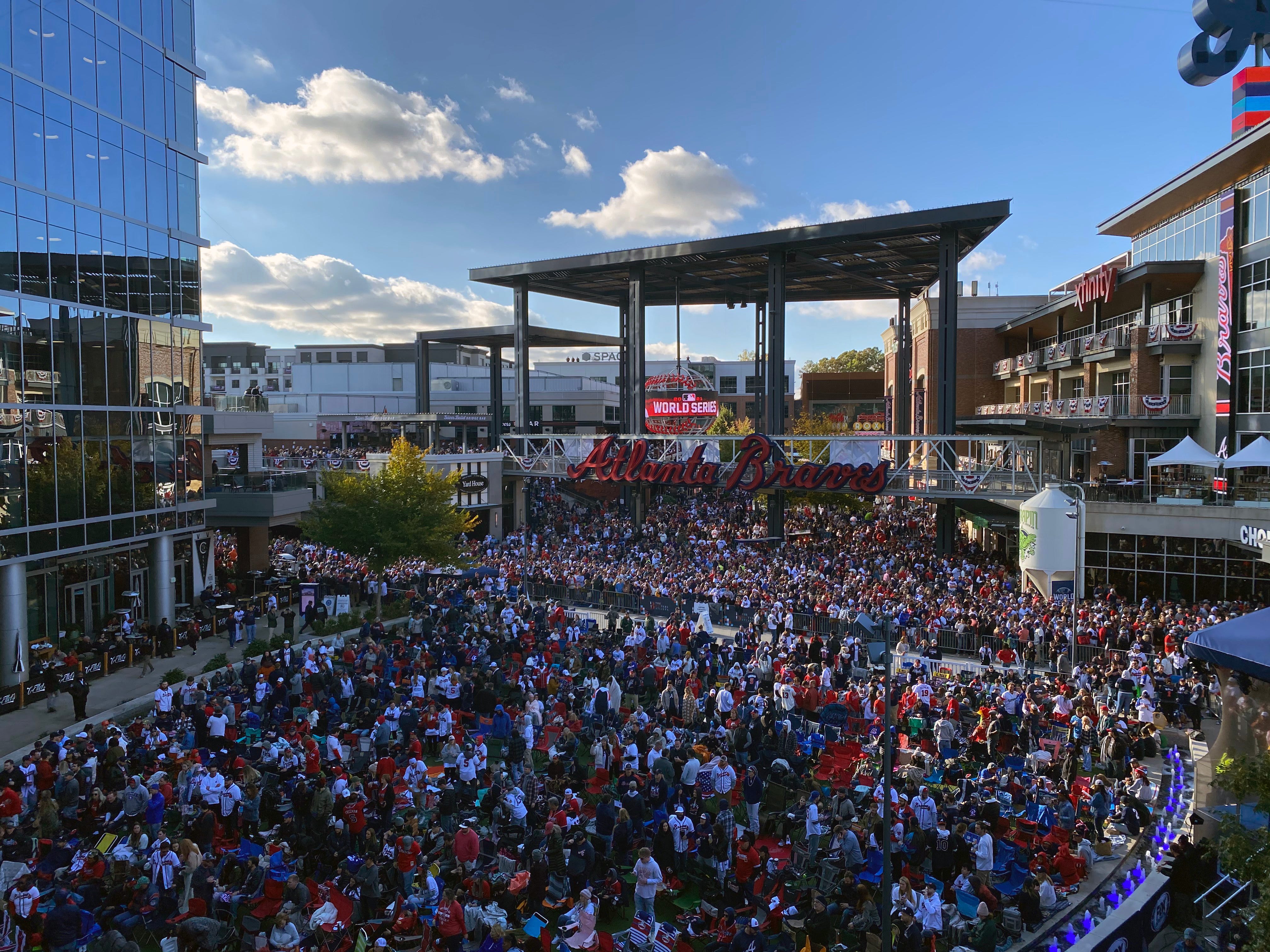
Dig a little deeper and the most aggressive growth isn’t coming from ticket sales or traditional baseball operations, but from The Battery Atlanta and the organization’s expanding mixed-use development portfolio, which surged by 45%. At the same time, the Braves are preparing for one of the biggest structural changes in franchise history, transitioning away from their recently exited regional sports network agreement toward a team-controlled broadcasting model.
In other words, this isn’t just a good financial report. It’s a glimpse at what the Braves believe the next era of team revenue will look like.
Let’s talk about it.
The highlights from the financials
Let’s start with some numbers.
The Braves saw an 11% increase in total revenues, to $732.5M, but the growth wasn’t equal among all sectors of the business. Baseball revenue, which includes game-related revenue (ticket sales, merchandise, concessions, etc.) and broadcast revenue (both local and national), grew a modest 7% to $635M.
Mixed-use development revenue, which is the activity from The Battery Atlanta and consists largely of rental revenue, was up a staggering 45% YOY.
But just as the growth wasn’t equal, neither was the revenue mix. $635M of that revenue was from baseball activities, or 87%. The remaining $97M was the mixed-use development, a much smaller percentage at just 13%.
That additional $97M does matter, though, for two reasons.
First, mixed-use development revenue is not subject to league revenue sharing. While the Braves are forced to contribute 48% of their local revenues into a central pool (and they do receive funds back from this, but not as much as they’re contributing), they keep every penny they receive in rent for the operations of The Battery Atlanta.
The second is that, if that mixed-use development money was available to be spent on payroll directly (we’ll get to that in a second), it’d more than cover the payroll of three of the league’s 30 teams.
That’s right, The Battery Atlanta’s incoming revenue (not income, but revenue) could fund the payroll of the Cleveland Guardians, Miami Marlins, or Chicago White Sox.
And the Braves keep all of that. They can’t spend it all on payroll, however, because they also have debt to cover for not only the construction of Truist Park and The Battery Atlanta, but also the acquisition of Pennant Park last spring.
Of the organization’s $738.6M in debt, over half of it is classified as Mixed-Use Development debt, $487.3M. ABH actually increased that amount slightly, by roughly $4M. However, overall debt declined as the organization paid down various baseball-related obligations, including their $150M revolving credit facility and MLB facility fund.
You may notice I haven’t yet mentioned overall profitability - that’s because they weren’t profitable, and in this context, it doesn’t really matter. The organization took on a $30M impairment charge related to Main Street Sports Group, their former broadcaster, which means they’re essentially saying they’re not confident in receiving all of the funds they’re owed from the soon-to-be-bankrupt entity. They also had other Depreciation and Amortization charges, related to the useful life of various assets, that have the end result of reducing taxable income.
At the end of the day, the Braves brought in more money, and that’s what matters. You can see that when looking at OIBDA, which is a measure of profitability that excludes a lot of those common non-cash items. Atlanta’s OIBDA came out to about $108M, a 172% increase from roughly $40M in 2024.
What the organization said about it
As always, the earnings call was a fun balance between carefully scripted statements and off-the-cuff answers to analyst questions, most of which they appeared prepared for.
Highlights from the call include the fact that last year’s ticket sales ranked fourth-highest of the past 25 years, but game attendance was actually down, especially late in the season after the team was no longer in the playoff race.
Some of the attendance issues were offset by The Battery Atlanta receiving nearly 4 million visitors last year, a record. There were over 380 events ‘on the campus’, as they termed it, including 95 gameday events in Truist Park, 144 in the common areas of The Battery Atlanta, and another 147 at the Coca-Cola Roxy.
(For the gameday events in the ballpark, remember that this counts not only the 81 home games, but all of the various All-Star Week activities on the field, the Savannah Bananas, and other exhibition-type events occurring either before/after the season or while the team was on the road.)
One of the questions was about BravesVision and both the organization’s capital expenditures and cash flow impact for the new venture. They politely declined comment on the expenditures, pointing out that they don’t commonly break those out, but did say that the cash flow would look “different” this year as they’re collecting everything themselves versus receiving scheduled payments from Main Street. The 2nd-quarter financials will be the first time we’ll start to see those incoming cash flows, owing to the seasonal nature of the business.
The media rights being eventually taken by MLB was the next thing asked, and Terry McGuirk explained that while commissioner Rob Manfred has expressed a desire to package everything, there is no formal strategy in place by the league and so they can’t really answer to that scenario. It’s worth pointing out that several teams, like the Yankees (YES), Cubs (Marquee), and Orioles (MASN) either own or have significant stakes in their broadcaster, so Atlanta would not be alone in resisting any effort by the league to consolidate all the TV rights and selling them in bulk.
Here’s McGuirk’s answer in full:
“Rob Manfred, the commissioner, has been quoted, I think, in saying that our best opportunity — possible best opportunity — would be to aggregate all of our rights, like the NBA, like the NFL, like hockey,” McGuirk said. “That is still a strategy that is not clear yet as to how we’ll play that. But the commissioner will be leading that negotiation strategy discussion among the owners, and we will surely keep our shareholders and our analysts up to speed when that happens.”
My favorite questioner, Barton Crockett from Rosenblatt Securities, came next. He asked about a tax issue that we highlighted here, the Section 162-M change that impairs the team’s ability to write off high salaries like a privately-owned team could do.
ABH staff acknowledged the question and declined to comment other than acknowledging they are still working on the issue. Here’s an article of mine from last April detailing what’s going on there.

What does this mean for payroll?
This is the biggest question that I imagine Braves fans are looking for from all of this. And that’s an unknown, but Braves officials were confident that the BravesVision bet would pay off.
More than once, someone on the call commented about how Atlanta’s television area was one of the largest in the country, and they believe that the way they’re attacking it is the right way to balance all of the constituents. Braves CEO Derek Schiller said the goal was to “maximize reach and availability for fans while protecting our economics”, with Terry McGuirk saying their belief is that doing it all in-house (as opposed to going through MLB) will allow them to “optimize our financial outcome.”
But whether or not going solo with BravesVision will directly correlate to increased spending remains to be seen. I posed this exact question to a friend of the newsletter, Ken Sugiura of the AJC, on Tuesday, and like me, he didn’t know for sure but thought it was possible. “I wonder if they feel better about what the budget’s going to look like next year because of how they feel this is going to go,” he explained. I pointed to the timing of the Chris Sale extension, which was announced within one hour of the BravesVision announcement on Tuesday, and Sugiura agreed. “I don’t know that it’s a direct one-to-one correlation, but I don’t think they’re completely unrelated either.”
Ken raised an interesting point as we continued the conversation, one I hadn’t considered before. “Now the fans are, to an ever greater degree, putting money directly into the hands of the Braves. I feel like there’s even more of a responsibility on the Braves’ part to be like, ‘this is the fans’ money. We know what they want us to do. We’ve got to spend it.’ […] I think that makes it more incumbent upon the Braves to be responsible and be responsive to what the Braves fans are asking for.”
Which leads me to Ronald Acuña Jr. It’s the highest-profile expiring contract decision that Alex Anthopoulos has faced since Freddie Freeman, and will likely not be topped during his tenure in Atlanta. The recent Sale extension showed a new willingness to set record AAV commitments from this front office, but on a short-term deal. Will they come even farther out of pocket, in both years and annual dollars, for Acuña?
Time - and streaming signups - will tell.
Thanks Lindsay!
It will be really interesting to see what the new streaming revenue looks like this time next year — and how much it’s expected to grow once fans fully understand the service and what it offers after a full season.
Right now, I have MLB.TV as an out-of-market Braves fan. If I were able to get the Braves Vision package and watch games on demand, I would probably switch. I’m just not sure if I’m eligible for it, and I believe I’ve already been charged again for MLB.TV since it auto-renews every year.
Does anyone know if games on the Braves streaming network can be downloaded to watch on demand after they’re completed? Or is it only available for streaming replay within the app?
Also, in today’s spring training game — besides Cookie — who were the other pitchers? Are any of them legitimate MLB prospects or possible bullpen depth pieces?