


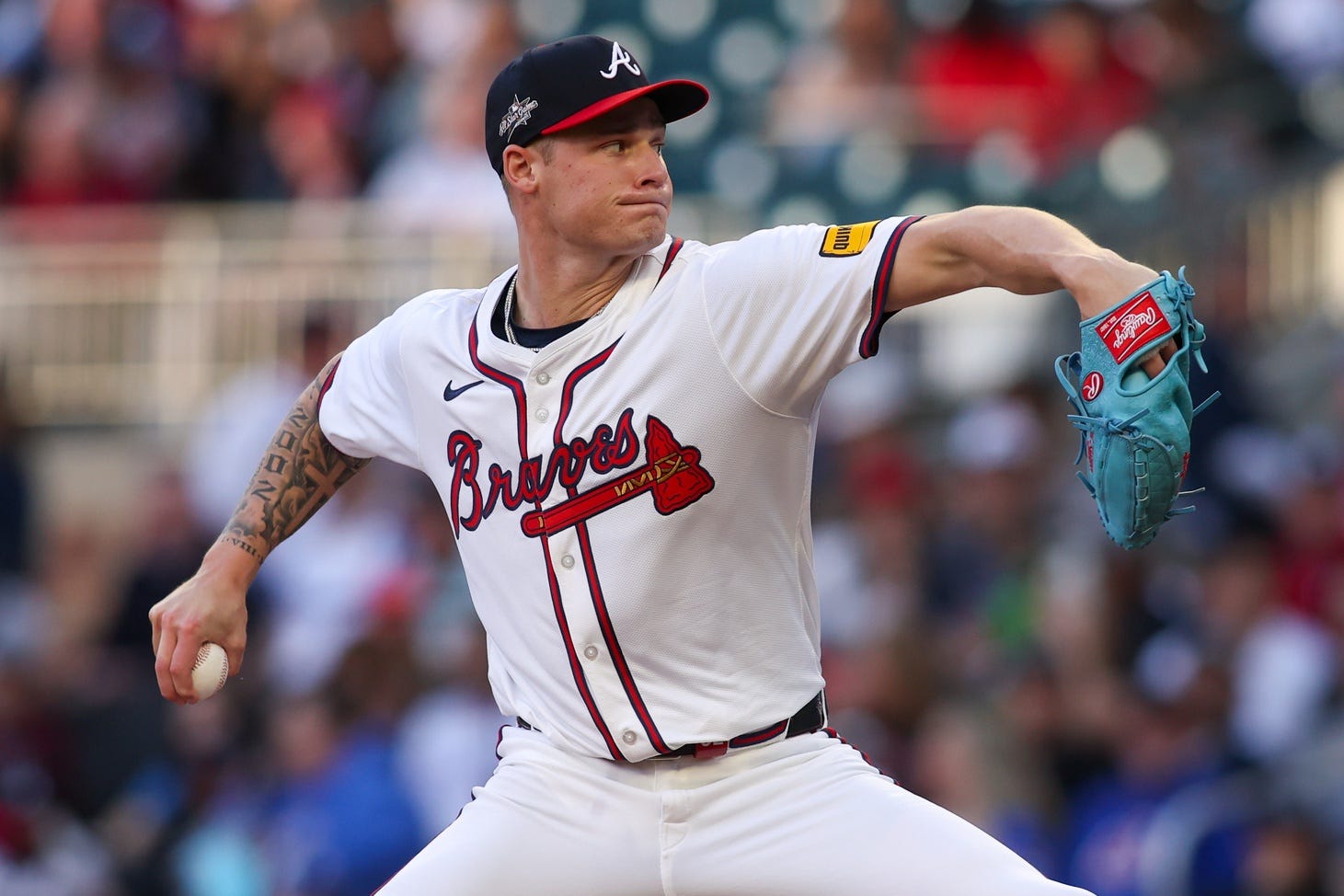
One of the ongoing conversations around the Atlanta Braves this winter has been whether they need to add a starter or simply want to. President of Baseball Operations Alex Anthopoulos has been consistent in his stance that any rotation addition would need to be an ‘impact starter’, someone capable of pushing multiple existing arms into lesser roles.
Whether or not that pitcher still exists on the market is a separate question. But part of the reason Anthopoulos’ bar is set so high has less to do with talent evaluation and more to do with roster mechanics.
The Braves already have several pitchers who, from a pure quality standpoint, are good enough to make the Opening Day roster but offer almost no flexibility. Even after losing José Suarez on waivers last week, Atlanta is bringing Grant Holmes, Bryce Elder, and Joey Wentz into camp, and none of the three have minor league options remaining.
While Wentz and Holmes’ options weren’t used by the Braves, the resulting lack of flexibility is still Atlanta’s problem. Is the Braves’ aggressive promotion philosophy starting to work against them? Let’s talk about it.
It’s not always their fault
Joey Wentz did not have his minor league options used by the Braves. Drafted with the 40th overall pick in 2016 by Atlanta, he was dealt to the Detroit Tigers in July of 2019 before ever hitting the 40-man roster. The Tigers were the ones that used his options, ultimately designating him for assignment late in 2024 after just 26 major league starts.
But Atlanta is now dealing with the lack of flexibility that comes with it.
Grant Holmes is in a similar situation. Once a first-round pick of the Los Angeles Dodgers back in 2014, the righty was dealt to the then-Oakland Athletics in 2016 in a deal for outfielder Josh Reddick and pitcher Rich Hill. Oakland then used his three option years in 2019, 2020, & 2021 before finally outrighting and then releasing him in 2022.
Atlanta now needs to figure out how to keep those players without exposing them to waivers. Per Anthopoulos, the organization knows that they are good enough to get claimed if they are exposed to waivers, something the Braves learned when they tried to sneak Suarez through a few weeks ago and lost him to the Baltimore Orioles.
But some of these out-of-options problems are self-imposed.
The Braves are doing this to themselves
MLB’s minor league option rules have a unique quirk: An optioned player only loses one of his three options if he spends 20 days in the minor leagues.
Starter Bryce Elder spent exactly 20 days in the minors last year.
Atlanta sent him down on March 23rd, after he didn’t make the Opening Day roster. The team was breaking camp and heading out west, stopping in Arizona to play two exhibition games against the Chicago Cubs ahead of their season opener in San Diego against the Padres. That timer actually began on Opening Day, so this counted as four days.
Atlanta recalled him on March 31st, however, as the corresponding move for Reynaldo López’s shoulder injury. Brian Snitker told us at the time they always intended to use him early, given that the team was playing seven games in seven days on the road to open the season. He started on April 2nd in Los Angeles against the Dodgers, allowing three runs on three hits in four innings as the Braves were walked off by Shohei Ohtani in the 9th to start 0-7.
Elder didn’t go back down until May 16th, spending 16 days in Gwinnett and returning to the major league roster on June 1st, where he would finish the season.
It’s hard to argue that the Braves couldn’t have found one day somewhere in this stretch to keep him in Atlanta, given what was at stake.
His midsummer move was two days after his last start, but the corresponding promotion was for lefty reliever Dylan Dodd…who went back down to Gwinnett on May 19th without appearing in a game.
While the knowledge that there’s an available reliever in the bullpen can’t be overlooked, Elder’s spot in the rotation didn’t come back around until May 20th - keeping Elder in the majors until his rotation spot came back around, and until Spencer Strider was activated, would have preserved an additional option year.
(Edit: This section originally referenced three additional days in the minors for Elder, but thanks to Reddit for reminding me that the option counter began on Opening Day.)
And lest it be looked at as nitpicking here, the Braves have made similar mistakes with Hurston Waldrep and Michael Soroka.
Last season, Waldrep officially exhausted his rookie eligibility after making one final start, coming on September 23rd for a 75-83 ballclub. That start, in which he pitched six innings and allowed one run, pushed him past MLB’s 50-inning threshold for rookie eligibility.
The previous season, Michael Soroka was able to make one final start at the end of the season, enough time in the majors to push him over five years of service and granting him the ability to reject any assignment to the minors. Faced with a loss of flexibility with the out-of-options sinkerballer, the Braves included him in a package deal for Chicago White Sox lefty reliever Aaron Bummer after the season.
The problem is not going away
Hurston Waldrep enters 2026 already down to his final option year. As part of their efforts to buy additional rest for their starters in the 2024 season, the Braves used lefty reliever Ray Kerr as a starter in late May, but after he tore his UCL and went on the injured list, Atlanta turned to Waldrep. The righty turned in two poor performances, striking out only three in seven innings, opposite eight walks and thirteen runs, before Atlanta pivoted to other options.
While he pitched well enough down the stretch to make the Opening Day rotation, going 6-1 with a 2.88 ERA and 3.22 FIP, the Braves may still need to use his final option to create space for the out-of-options Elder.
Similarly, more young pitchers are faced with a lack of options.
AJ Smith-Shawver, currently out after internal brace surgery last summer, made his debut in 2023 and pitched a combined 29.2 major league innings between that season and 2024. It was only in 2025, his final option year, that he seemingly won a rotation spot to start the season…only to then be optioned down in mid-April after only three starts.
The ‘saving grace’ here is that after being recalled fifteen days later, Smith-Shawver made six starts before going on the injured list with a torn UCL. He’s due back late in 2026 and, because the Braves were not able to send him down for another minimum-length stint last season, they still can send him to Gwinnett after he’s activated from the injured list. Were he to have used his final option last year (at the age of 23, mind you), the Braves would have needed to stick him in the bullpen.
Smith-Shawver isn’t the only young pitcher to be brought to the majors very early. Didier Fuentes debuted last season at just twenty years and three days old, the youngest debuting starting pitcher for the Braves since 1970. His four starts and thirteen innings showed he wasn’t quite ready for the show, with 23 hits and 20 runs allowed, and he was sent back to Gwinnett. He’ll use his second option year in 2026 and enter the following season in his final option year at just 22 years old.
(The caveat here is that it’s a lot tougher to blame the Braves for rushing a prospect in 2025, a season in which they dealt with unprecedented rotation injuries. Fuentes debuted in mid-June to replace Chris Sale, the 3rd of Atlanta’s Opening Day starters to go down with injury.)
Similar to Fuentes debuting in response to an injury, infielder Nacho Alvarez Jr. debuted in July 2024 in similar circumstances. Atlanta had just lost Ozzie Albies to a fractured wrist, and Alvarez was the immediate replacement at second base before the Braves were able to make a deal with DFA’d veteran Whit Merrifield. Alvarez played in eight games and got 32 plate appearances before being sent back to Gwinnett.
In the last two seasons, Alvarez has gotten 240 total plate appearances while serving as an injury replacement at both second and third base. He now enters 2026 in his final option year at age 22, without even a half-season of major league plate appearances.
The Fuentes and Alvarez promotions were pushed on the Braves by injuries, but even there, those repercussions will be felt down the line.
Have they learned their lesson?
Despite all of last season’s injuries, one notable bit of patience the Braves exhibited in 2025 was with their rotation replacements. Having pitching prospects J.R. Ritchie and Blake Burkhalter in Gwinnett and available to take innings was likely tempting to Anthopoulos, with the team needing starts and knowing that any sort of struggles weren’t exactly going to doom the team’s record or anything.
But knowing there was a looming roster crunch this winter, Atlanta wisely went with ‘disposable’ veterans like Erick Fedde and Carlos Carrasco for their starts over adding a bunch of prospects to the 40-man. And because they weren’t added to the roster, they won’t use an option year to be sent down after spring training.
Whether it was a conscious roster decision or simple workload management, preserving all of their options was the correct outcome either way.
Let’s see if Atlanta keeps making those decisions when the next injury forces their hand.
Thank-you.
Thanks for the run-down. It’s going to be an interesting ST to see how the team sorts this out. What is AJSS status on the roster and what happens when he comes back? Does he automatically come back on to the roster and has to be optioned to rehap? If he builds up and comes up to start in the ML does he lose an option, etc.?