


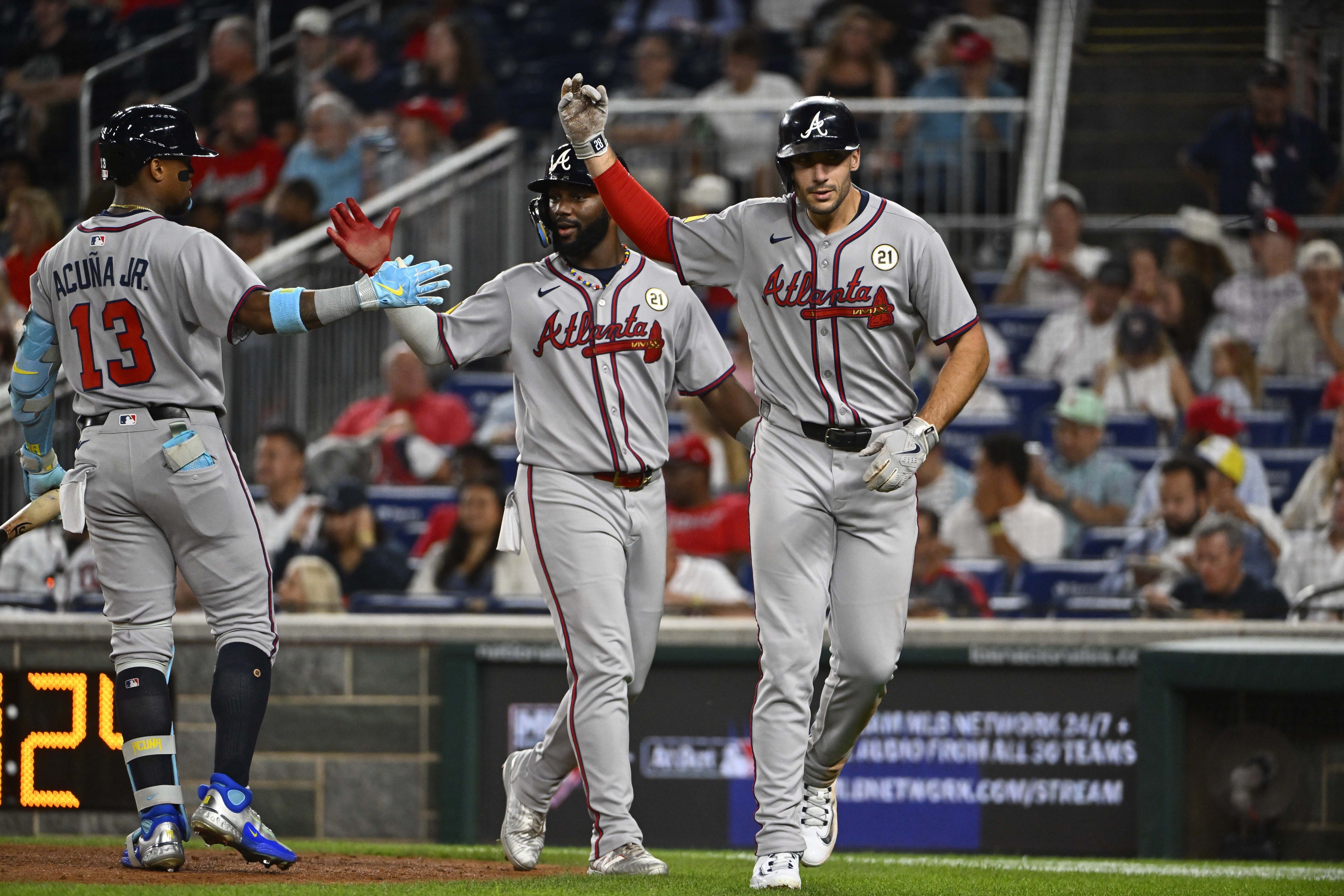
Lost amid Atlanta’s rotation injury disaster last season was the fact that the offense did not hold up its end of the bargain. The Atlanta Braves offense hit .245/.320/.399, producing a 101 wRC+ that ranked only 14th in baseball.
It was a far cry from the miraculous 2023 season, when Atlanta fielded a record-setting offense with a 126 wRC+ and a team slugging percentage over .500. That offense is unlikely to return anytime soon, unless MLB decides to juice the baseball again.
But the Braves are positioned not only to get better performance from their stars this season, but also to lose less ground when the inevitable injuries strike, as the projection systems suggest that improvement is coming almost everywhere in the lineup.
Let’s talk about it.
Disappointing production from the starters
The Braves didn’t see the usual production they were expecting from the stalwarts in the lineup last season. Some of this was simple underperformance, while others were injury-induced.
Austin Riley is one player that we’ve discussed recently - short of his goal of 30 homers and 100 RBI, Riley hit .260/.309/.428 (103 wRC+) with 16 homers and 54 games prior to going on the injured list for season-ending core muscle surgery.
He has said all the right things so far in camp - that he’s “loves” where he’s at right now health-wise, that he spent a lot of time this winter with hitting coach Tim Hyers to fix his mechanics, and plans to get back to that 30/100 threshold. Let’s see if it happens, but I’m hopeful.
He’s not the only lineup stalwart that’s underproduced the last two seasons - Michael Harris II and Ozzie Albies were two of the ten worst qualified hitters in MLB at the All-Star Break, although they recovered somewhat during the second half of the season. Harris finished at .249/.268/.409 (a 83 wRC+), while Albies posted a .240/.306/.365 line (87 wRC+). Catcher Sean Murphy, playing through a torn hip labrum, hit just .199/.300/.409, although he finished with a respectable 97 wRC+, partially thanks to his 16 homers in 94 games.
The projections for 2026 are a bit more optimistic for several of these hitters, partially because ZiPS incorporates three years of data, meaning 2023 still factors into the projections, but also because many of them so drastically underperformed last winter’s assumptions.
Riley had a 130 wRC+ projection last year, while Harris was at 124 (tied with Matt Olson) and Albies was at 105. Murphy was at 111, although Drake Baldwin going from a 97 wRC+ projection to an actual 125 helped mitigate Murphy’s slide somewhat.
This year, the projections believe in multiple rebounds. Here are some of the relevant offensive lines for several of Atlanta’s stars:
Riley: .262/.325/.411, 120 wRC+
Harris: .275/.308/.455, 109 wRC+
Albies: .250/.309/.404, a 97 wRC+
Murphy: .224/.316/.430, a 107 wRC+
Three of these four hitters dealt with injury last year, with Harris the only open question on whether an offensive rebound is likely.
But with those three hitters all missing time last year, as well as Ronald Acuña Jr. playing just 95 games and Jurickson Profar playing just 80, there was another significant factor that contributed to Atlanta’s underwhelming offense: The injury replacements.
Exceptionally poor performance from the backups
Several of Atlanta’s injury replacements were not capable of providing even replacement-level production.
Atlanta gave 383 plate appearances to the combination of outfielders Alex Verdugo (66 wRC+), Jarred Kelenic (47 wRC+), Stuart Fairchild (68 wRC+), and Bryan De La Cruz (27 wRC+) to cover the early-season absences of Acuña and Profar.
If one of those two misses time this season, their primary backups would be some combination of Mike Yastrzemski (projection of 108 wRC+ in a platoon role) and Eli White (85 wRC+).
It’s a similar situation at shortstop, where light-hitting Nick Allen (53 wRC+) has been replaced early in the season by utilityman Mauricio Dubón (projected 80 wRC+) and, sometime in May, shortstop Ha-Seong Kim (95 wRC+). Even if Dubón goes down prior to Kim’s return from January finger tendon surgery, backup Jorge Mateo is projected at a 70 wRC+, itself a modest improvement over Allen.
Similarly, Drake Baldwin’s backup going into the season is not last year’s underwhelming options of Chadwick Tromp or Sandy León, but rather veteran Jonah Heim (75 wRC+).
Simply put, it’s the deepest lineup the Braves have had under Alex Anthopoulos.
They did this for a reason
Atlanta’s President of Baseball Operations acknowledged on Friday that building this deep bench was strategic, not just for injury reasons but to help the pitching staff this season. “ The last two seasons, we’ve put so much more pressure on the rotation because the offense hasn’t been the same, right? We’ve had to win games three to one, four to two, and so on.”
But with a deeper lineup, not only is there less pressure on an once-again injury-depleted pitching staff to be great, the rest of the lineup can breathe a little easier as well.
“From a talent standpoint, this is the deepest group of position players that we’ve had. And so I think the pressure on all these guys to be their best is not as great. Now, the upside’s there if they are, but we feel like one through nine, it’s a really deep lineup. And even our bench, we feel it’ll be a lot stronger as well. And especially when Sean Murphy and Kim come back, we’re gonna get that much stronger and we’re gonna have some tough calls to make.”
And this is the big thing to me. When the offense was mostly underperforming last season, the pressure on the stars to produce like stars was immense on a nightly basis. For Atlanta’s offense to carry its weight, the top of the order had to significantly outperform its projections, something it wasn’t all capable of doing.
But when there’s a much deeper and reliable lineup, the pressure on every single player is lessened slightly, as they’re accounting for a smaller percentage of the production on a nightly basis.
The real significance of these upgrades is not just the possibility of a bounce-back season, but the stability they create for the Atlanta Braves offense over the full six-month grind. Projection systems do not require career years for this lineup to improve meaningfully; they simply require healthier seasons and more competent depth. If those two things hold, Atlanta does not need to recreate the historic 2023 offense to become one of the National League’s most productive lineups again. It only needs to be consistently better across the board, and the roster is now built to make that outcome far more likely.
My fingers are crossed (and toes) that Ozzie does Ozzie things for the next 4 or 5 years.
Acuña stays healthy.
Riley is back and strong — and I truly believe he’ll make whatever adjustments he needs. And maybe this year he won’t be trying to hit with one arm tied behind his back.
Murphy… if he can hit like he did those first three months of his 1st Braves season? That changes everything. And honestly, it would make it totally okay for Baldwin to go through the struggles he should have as a young player.
Harris is a bit of a dilemma.
He’s in front of his hometown. The eyes are on him. He’s young. He’s trying to carve his path as a young man in a city full of athletes — not just from Atlanta, but around the country that live in Atlanta.
And right now, the style points vs the small things at the plate… the winning approach… that seems to be the struggle.
One thing about Dubón: he’s on a contract year.
I could absolutely see him dominating at shortstop while Kim is out — and playing like a guy who wants a full-time SS gig next year. He could have a big impact.
Yaz and Profar? I think they’re going to be All-Star level production.
Olson won’t have all the pressure of carrying the entire offense. I think he has another huge year.
And honestly? I think he might benefit more than anybody from the automated strike zone. I think he’ll walk even more, get more 3–1 counts, and really make pitchers pay.
The results of this analysis will have a far greater impact on whether the Braves make the playoffs than AA acquiring another SP. The anger at not gettting another SP has gone way overboard. There was so much noise, I decided to do a simple analysis. In 2025, teams that won 89+ games had an average of 2.6 “quality” starters. (I defined quality as 125+ innings with an ERA under 4.00). The Dodgers had 1. (The WS Champ had ONE SP that pitched 125+ innings and a sub 4.00 ERA). M’s, Yankees and Jays had 2. Phillies, Brewers, Red Sox and Padres had 3. The only team with 4 was the Cubs. In contrast, every one of the 89+ win teams was top 10 in runs scored with the exception of the Padres.