


In 1974, Los Angeles Dodgers pitcher Tommy John was told his career was probably over.
The ulnar collateral ligament in his left elbow had been damaged beyond repair. At the time, there wasn’t really a roadmap for what came next. Team physician Dr. Frank Jobe proposed an experimental procedure that had never successfully returned a Major League pitcher to the mound. The surgery involved taking a tendon from John’s wrist and using it to replace the damaged ligament.
Jobe reportedly told John he had roughly a one percent chance of pitching again.
Today, the procedure is so commonplace that it’s named after the pitcher who first underwent it. Fans barely blink when a pitcher tears his UCL. We discuss timelines, recovery schedules, and expected return dates. What was once considered a desperate last resort has become another obstacle modern medicine expects athletes to overcome.
Baseball changes quickly. Sometimes our assumptions don’t.
For many fans, Jacob deGrom still exists in the category of pitcher he’d have occupied a decade ago: an electric arm whose injury history makes him impossible to trust. But the sport has become increasingly comfortable betting on elite pitchers returning from surgeries and injuries that once would have ended careers.
Which brings us to a somewhat unconventional trade deadline idea.
While much of baseball focuses on acquiring Detroit Tigers ace Tarik Skubal, the Atlanta Braves should be calling the Texas Rangers about Jacob deGrom.
Let’s talk about it.
The Results Were Better Than The Process
Atlanta’s starting pitching either had a great weekend or a terrible weekend, depending on who you ask.
The half-full glass would look at it this way:
Veteran Martín Pérez had perfectly crumulent results on Friday night, allowing three earned runs in his five innings before yielding to the bullpen. Spencer Strider matched him on Saturday, allowing three runs on five hits. And Bryce Elder outperformed both of them with two earned runs on only two hits on Sunday afternoon as Atlanta swept the Pirates.
But the other side of this coin is that the process to get to much of that doesn’t feel sustainable.
Pérez’s max velocity was…90.0 mph, although it didn’t stop him from putting up an average exit velocity allowed of only 81.2 mph. Strider had only six whiffs (including none on 20 swings against his fastball) and a 14% CSW. Elder was, in a sign of the changing times, the most reliable, leaning on his new cutter to navigate the loss of his four-seamer on Sunday afternoon.
Is this going to work in the postseason? The growing consensus among Braves Country is that it won’t, and that Atlanta needs to prioritize adding an impact starter at this year’s deadline.
Why Everyone Will Focus On Tarik Skubal
Tarik Skubal is the obvious answer.
The Tigers ace has won the last two American League Cy Young Awards, posting a 2.30 ERA across 387.1 innings with 469 strikeouts and just 68 walks. Alongside Chris Sale, Cristopher Sánchez, and Garrett Crochet, he’s firmly established himself among baseball’s elite left-handed starters.
Any contender looking to upgrade its rotation would be interested.
That’s exactly the problem.
ESPN’s Jeff Passan recently connected Skubal to practically every established contender, including the Los Angeles Dodgers, New York Yankees, and Philadelphia Phillies. If Detroit makes him available, there won’t be a shortage of suitors. There rarely is when one of the five or ten best pitchers in baseball reaches the market.
And while Atlanta probably has the prospect capital to participate in those conversations, that’s not the same thing as being the favorite to win them.
The Braves would be competing against organizations with deeper farm systems, larger payrolls, and every bit as much urgency to win now. The result is a bidding war that could quickly escalate beyond what Atlanta is willing to pay, particularly for a pitcher who can become a free agent after the season.
That’s not an argument against Skubal.
If the Tigers make him available, the Braves should absolutely pick up the phone.
But the better question isn’t whether Skubal would help Atlanta.
It’s whether there’s another frontline starter who offers a more realistic intersection of talent, availability, and long-term control.
That’s where the conversation gets interesting.
The Better Question: Who’s Actually Available?
The easiest part of trade deadline coverage is identifying the pitchers you’d like to acquire.
Logan Webb would look great in a Braves uniform. Tarik Skubal would pair with Chris Sale to be the most intimidating starting duo since the days of Maddux and Glavine and Smoltz.
The hard part is finding a way to acquire them.
Fans often discuss trade targets as if every player in baseball exists on the same marketplace. In reality, the most important question isn’t whether a player would help your team. It’s whether his current team is willing to move him.
And that’s where the trade deadline gets complicated.
The mediocrity of the American League makes this exercise more challenging than even the initial years of the expanded playoffs have been.
As of Sunday night, only five American League teams have winning records. Yet thanks to the Wild Card structure, nearly every club can still convince itself that a postseason run is possible.
The result is a league filled with teams that should probably listen on veterans but aren’t quite ready to declare themselves sellers.
We’ve seen this before. Last season, several clubs waited until the final days before the deadline to determine their direction. Front offices spent weeks preparing for conversations that never materialized while simultaneously scrambling to engage on opportunities that emerged unexpectedly.
That uncertainty makes it difficult to identify realistic trade targets in June.
But it also creates opportunity.
The Rangers sit in an especially interesting position.
At 32-33, they’re currently occupying the final Wild Card spot despite a losing record. They’re close enough to justify buying, but far enough from contention that a bad few weeks could force uncomfortable conversations. They’re a disappointing 25th in runs scored while being top five in runs allowed, but with Jacob deGrom almost single-handedly carrying their rotation - no other starter has an ERA below 3.50.
And if Texas ultimately decides to sell, Jacob deGrom becomes one of the most fascinating names in baseball.
Not because he’s the best pitcher available.
Because he might be the best pitcher available who actually has a chance of becoming a member of the Atlanta Braves.
The Case For Jacob deGrom
There are three predominant reasons why Jacob deGrom, if he becomes available, makes a ton of sense for the Atlanta Braves.
He’s Still A Frontline Starter
deGrom was the consensus best starter of the late 2010s. The right-hander won consecutive Cy Young awards in 2018 & 2019 after 421.0 innings of 2.05 baseball. He struck out 32% of batters faced while walking just 5.5% and sitting in the high-90s with his fastball.
This may genuinely be the reddest statcast card I’ve ever seen.
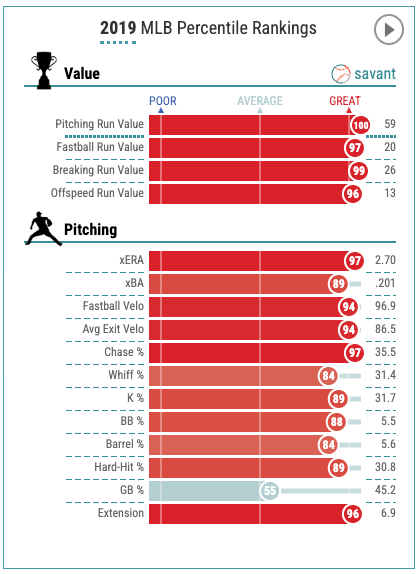
But then injuries struck, with deGrom throwing just 156.1 innings combined between 2021 & 2022 and then walking in free agency, signing with the Texas Rangers.
Since returning from his second Tommy John surgery, deGrom’s been a bit of a different pitcher - he’s deliberately backed off his velocity a bit in an effort to stay healthy and ended up covering 172.2 innings last season at a 2.97 ERA. He’s currently at a 3.18 ERA this season, seeing some small-sample-size regression in his fastball results but nothing to suggest that aging curves are returning him to mere mortal status.
The Contract Is Long Enough To Matter
DeGrom signed for five years and $185M with the Rangers after 2022, adding on a sixth year via club option that would cover his age-40 season.
And the remainder of that contract is the main reason the Braves should be interested in deGrom over Skubal.
Skubal is on a one-year, $32M arbitration award that set a record when it was awarded. Any team acquiring him is getting a very expensive rental, with Skubal represented by big game-hunting agent Scott Boras. The consensus #1 free agent in this winter’s class, it’s believed that Skubal and Boras are looking to set a new record for a pitching contract in annual value. While he won’t break the length of Yoshinobu Yamamoto’s 12-year deal he signed at the age of 25 with the Los Angeles Dodgers, the $42M annual value of Zack Wheeler’s three-year, $126M deal signed prior to 2025 is absolutely in danger of falling.
Giving up premier talent for a rental in Skubal isn’t a concern for the Braves if they acquire deGrom, as the righty is already under contract. His $38M salary for this season would be about $12M on a prorated basis for the rest of the season, almost exactly matching the remainder of the funds they saved from the 2nd PED suspension of Jurickson Profar. He’s owed $37M in 2027, which is a jump in payroll for the Braves but one that can be easily covered by the expiring contract of Ha-Seong Kim ($20M), Raisel Iglesias ($16M), and Joe Jiménez ($9M).
The 2028 club option has a bit of a complication, being priced at $20M but converting to a $37M player option if deGrom finishes next season with 160+ innings pitches, finishes in the top five of Cy Young voting, and does not go on the injured list.
That’s a tradeoff that Atlanta would love to make.
And there are other, off-the-field, reasons to think that deGrom would be willing to waive the no-trade clause he was given by Texas in the deal.
The Braves Already Have Connections
deGrom went to Stetson University in DeLand, FL, where the Mets took him in the 9th round. Growing up in Central Florida, he’s admitted to being a Braves fan in his childhood, with Chipper Jones (a fellow Florida native) being his childhood idol. Said deGrom, “Chipper Jones. He was from Pierson [Fla.], which is 10 minutes, 15 minutes from my house, and played for the Braves. I grew up kind of a Braves fan just ’cause of that, and I played infield, so that’s who I kinda looked up to as a player.”
Due to those connections, deGrom was reportedly interested in signing with the Braves in free agency, but Atlanta either wasn’t able or wasn’t interested in reaching the same financial stratosphere as what deGrom received from the Rangers.
There’s another factor that helps Atlanta in this: deGrom’s ties to the current Braves coaching staff. The end of deGrom’s tenure with New York overlapped with current Braves pitching coach Jeremy Hefner, who assumed that role for the 2020 season. The two were reportedly said to have a good relationship, with Hefner receiving at least some of the credit for deGrom’s career-best start to 2021 (1.08 ERA and 146 strikeouts in 92 innings) before going down with lat and flexor issues that prematurely ended his season.
The Risk Is Real—But So Is The Upside
It’s important to point out that deGrom was, at one point in time, the hardest-throwing starting pitcher in baseball. And in accordance with the stereotype of extreme velocity pitchers, he eventually went down with injury. DeGrom is in that rare group of MLB starters that has had two Tommy John surgeries in his career, with the first coming while in the minors in 2010 and the second, commonly referred to as a ‘revision’, coming shortly after he debuted for the Rangers in 2023.
While he’s taken measures to mitigate the risk, including a new focus on “mechanical simplicity” and intentionally pitching below his capability when he feels minor discomfort or otherwise not himself, his injury history and the financial commitment make him a risky proposition for the Braves.
But of course he’s risky - every frontline starter is.
The bigger question isn’t whether Jacob deGrom comes with risk.
It’s whether the market is pricing that risk correctly.
Because every reason that makes fans nervous about deGrom - his age, his injury history, the remaining money on his contract -is also a reason he could become available in the first place.
Tarik Skubal may be the better pitcher. He may even be the safer pitcher.
But the Braves aren’t operating in a vacuum. They’re competing against every contender in baseball, many of whom possess deeper farm systems and larger payrolls. Winning a bidding war for the most coveted arm on the market is difficult. Finding value where others see complications is how Alex Anthopoulos has built much of Atlanta’s roster.
And that’s what makes deGrom so fascinating.
If Texas falls out of contention, the Braves wouldn’t be acquiring a mid-rotation arm or a short-term patch. They’d be acquiring a pitcher who still has the ability to form one of baseball's most formidable postseason duos alongside Chris Sale while remaining under contract long enough to help solve questions that extend beyond this October.
The Braves should absolutely check in on Tarik Skubal, and Alex Anthopoulos will. He checks in on everybody - league polls frequently have him near the top for “most engaged” baseball executive, classifying him as “aggressive” at initiating conversations to gauge potential trade interest.
But if they’re looking for the intersection of elite talent, future control, realistic availability, and organizational fit, Jacob deGrom may be the most interesting starting pitcher on the trade market.
Let’s see if Texas gives them the opportunity.
Like Tom, I don't believe we MUST make ANY move at the trade deadline. And, I can picture some small upgrade from AA that will anger the masses. But "stars" are the players that "shine the brightest when the lights are the hottest." These are your POST-season clutch players. Like Reggie Jackson. The 2026 Braves are SOOOO much better than 2024 & 2025. Walt is as close to perfection (my opine only) as he can get. Unless getting "stars", I'm good with staying pat.
As much as I would enjoy watching Waldrep and/or Schwellenbach progress in time to carry the team through August and September, I'm concerned that with the Phillies surging things could get tight and I don't think our current rotation is strong enough to prevail. We need a strong addition to the rotation and another elite arm in the pen. Walt has been brilliant but he can't be turning the game over to the bullpen in the 5th inning every night. - the leverage guys are going to be fried by the AS break. AA, you need to make something impactful happen.