


Just like the movie Clue, there are a lot of different ways that Atlanta’s offseason can end. On Tuesday, we examined what it could look like if the Braves focused on upgrading the top of their rotation, devoting most of their available pitching money to a frontline starter. The downside is that it would require them to nail the evaluations on their budget additions everywhere, as well as concentrating most of the risk in that high-priced addition.
Ending B starts with the same offseason framework, but reaches a different conclusion through redefining the question:
Is Atlanta’s pitching concern for next season really the lack of a second ace, or is it the number of innings currently assigned to pitchers that the Braves shouldn’t reasonably expect to be healthy, effective, or both?
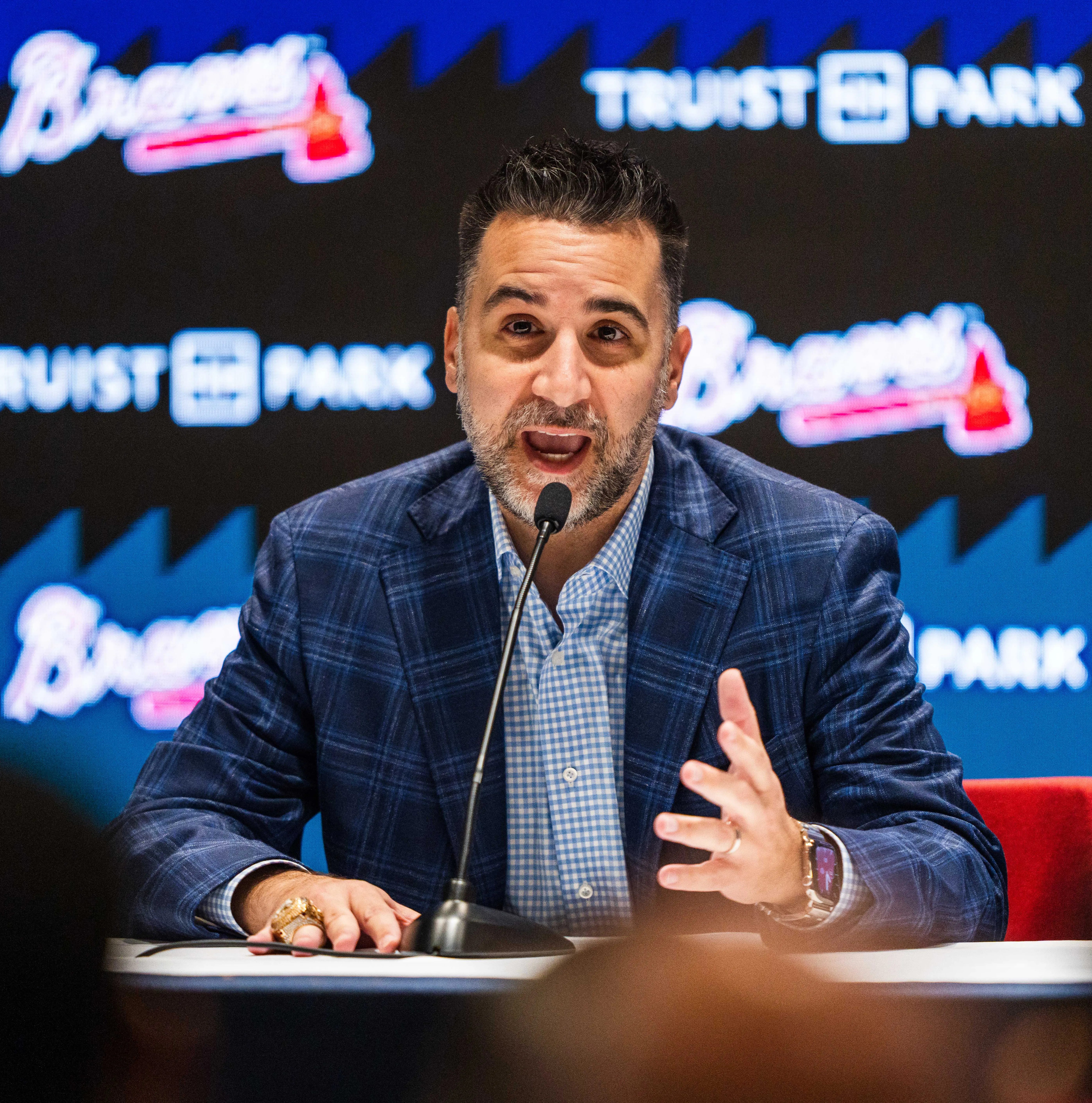
If you take Alex Anthopoulos at his word when he openly questioned whether the team was “creating too much risk” by relying on getting the best possible versions of Spencer Strider (elbow), Reynaldo López (shoulder), Spencer Schwellenbach (elbow), and the organization’s young pitchers like Didier Fuentes and JR Ritchie, then Ending B is for you.
Instead of spending $30 million on one frontline starter like Michael King or Freddy Peralta and then supplementing with some sort of cheap $5 million depth, Atlanta could divide that money between two established starters. And ideally, they’d do different things for you, too.
So what can the Braves actually do with the hypothetical $50 million budget we established for this exercise under this scenario? Maybe more than you’d think.
Let’s talk about it.
The standard for Ending B
Before we start throwing out names and projected contracts, let’s remember what the Braves are trying to do here: add two starters and roughly 300 innings to the 2027 rotation. One of these guys should be reasonably expected to take the ball 28-30 times, while the other needs enough upside to start a postseason game behind Chris Sale.
Ideally, you’d avoid pairing similar profiles between these two guys. Two aging starters don’t diversify the risk, and neither do two starters with extensive injury histories.
And if possible, preserving $12-15 million for some sort of offensive addition would be nice, even if the actual player comes via trade instead of the open market.
The balanced plan only works if the two pitchers complement each other. Signing two free-agent contracts for the same type of player doesn’t necessarily buy certainty.
We’re using the FanGraphs price sheet from Ben Clemens for this exercise, but we’ll stress test these projections with the crowd-sourced estimates. Believe it or not, The Wisdom of Crowds is absolutely a thing and translates pretty well to sports. Every spring, Clemens reviews everyone’s free agency projections and the crowd almost always wins.
Here are four names that stand out to me, for various reasons, that we need to start with:
RHP Sonny Gray
2027 Age: 37
Contract estimate: 1 yr, $25M
Crowd median: 2 yrs, $52M ($26M AAV)
2027 Projection: 168 innings, 3.81 ERA, 3.0 fWAR
Feature: Workload reliability
For the 312th offseason, we’re discussing Sonny Gray potentially joining the Braves. A Tennessee native that went to Vanderbilt, Gray’s averaged 175 innings per year over the last four seasons with a collective 3.41 ERA. His 2026 in Boston was one of his best years, with a 2.72 ERA, although his expected numbers (3.87 xERA) suggest he overperformed his underlying contact quality by more than a run.
A good plus here would be that he’s a unique profile the Braves don’t currently have, with a sinker/sweeper as his primary pairing, but Gray sports a broad enough arsenal to adjust to both any age-related declines and whatever’s working (or not working) that day.
RHP Michael Soroka
2027 Age: 29
Contract estimate: 2 yrs, $34M ($17M AAV)
Crowd median: 2 yrs, $36M ($18M AAV)
2027 Projection: 142 innings, 4.28 ERA, 1.8 fWAR
Feature: Upside
Hey, we know that guy!
The prodigal son’s rebuilt a lot of his value after a trio of devastating Achilles surgeries led to his inclusion in a 40-man-clearing trade in November of 2023. The slurve’s still there, but supported by a four-seamer now instead of that once-devastating sinker, while he’s dropped his arm angle and added both a cutter and a sweeper.
The downside here is that he’s broken 100 innings just once in the last three seasons, having put up 116 innings in 2026. The two seasons before that, it was 89.2 and 79.2 innings, owing to a combined five injured list stints over the last three years. He’s been good when he’s been on the mound - he was pitching at a 4.0 fWAR pace this season when he went down - but that’s just been rare.
RHP Tyler Mahle
2027 Age: 32
Contract estimate: 2 yrs, $30M ($15M AAV)
Crowd median: 2 yrs, $32M ($16M AAV)
2027 Projection: 154 innings, 4.10 ERA, 2.1 fWAR
Feature: Upside
The real question here is if Atlanta can bring back their trade deadline savior and get his post-deadline results (1.99 ERA) instead of his San Francisco results (5.13 ERA). Unlike Soroka, he’s not particularly adept at adding new pitches, with the sinker and slider that caused him trouble with the Giants virtually disappearing with the Braves.
Health will be the big caveat here, with Mahle going on the injured list three times in the two seasons since he returned from Tommy John surgery.
RHP Kevin Gausman
2027 Age: 36
Contract estimate: 1 yr, $17M
Crowd median: 2 yrs, $44M ($22M AAV)
2027 Projection: 179 innings, 4.08 ERA, 2.8 fWAR
Feature: Workload reliability
Another old friend here, Gausman is another short-term veteran play, although clearly the crowd thinks it’ll take multiple years on a deal to sign him. Like Mahle, Gausman is a four-seamer/splitter guy. Unlike Mahle, health isn’t an issue here: Gausman hasn’t gone on the injured list since 2021.
That said, his results have become increasingly volatile. Whether his splitter is working often determines whether Gausman has a good outing or a disastrous one. He had 14 quality starts out of 32 this season, divided between the Blue Jays and Cubs, but also had six starts of five or more runs, with three of them coming for Chicago down the stretch.1
Let’s look at the pairings
We’ve labeled Sonny Gray and Kevin Gausman as reliable sources of innings, with Tyler Mahle and Michael Soroka serving as upside plays. Let’s look at some of these pairings and what it would do to Atlanta’s budget.
Gray and Mahle: highest-WAR pairing, weakest budget balance
These two would combine for $40M in the projections and $42M in the crowdsourced median, delivering 322 innings and 5.2 fWAR. Gary is the reliable source of innings, Mahle is the upside…but the Braves would only have about $8-10 million left for other needs, to include the offense and the bullpen.
Soroka and Gausman: BRING THEM HOME, AA
This pairing would require somewhere between a $34-40 million investment, depending on Gausman’s contract. It forecasts to roughly the same innings total as Gray/Mahle (321 instead of 322) but “only” 4.6 fWAR. I feel like this one depends on the Gausman contract (the remainder is somewhere near $10-16M), as well as whether he (or Soroka) harbors any ill will towards the Braves after their first tenures with the team.
Mahle and Gausman: the best spreadsheet answer
Underrated pairing, with 333 innings and 4.9 fWAR at somewhere between $32-38 million. One concern here is this gives you two guys mainlining four-seam/splitter in the same rotation, so a lack of repertoire diversity could be a concern. That’s typically something that’s more prominent with relievers (like with Raisel Iglesias and Robert Suarez this year), but in a short series, it’d come up.
Gray and Soroka: almost no money left
This is 310 innings and 4.8 fWAR, coming in somewhere around $42-44 million at the current salary projections. That leaves like $6-8 million for the rest of the team’s needs, meaning similar to the Ace plan, it requires Alex Anthopoulos to nail the evaluations on all the ancillary pieces and buy-low additions he adds around the two.
Combos that don’t work
There are a few pairings that just don’t make sense here. Gausman and Gray are two over-35 veterans that would take most of the budget, while Mahle and Soroka are younger and more affordable, but with their own injury concerns. Their combined projection is for only 296 innings, the lowest total among the possible pairings, meaning Atlanta’s internal depth needs to step up in a way that this outcome was trying to avoid.
The other factor here is whether there are other pitchers who aren’t in that grouping that can sub in for cheaper. Lefty Foster Griffin is projected at a one-year, $14 million deal and Steamer forecasts him for 165 innings with a 3.90 ERA and 2.6 fWAR. Pair Griffin with Gausman and that’s roughly 5.4 fWAR and 344 projected innings, while also having roughly $19M left to address other needs.
Now, the caveat is that Atlanta has to believe that Griffin’s one post-NPB season is legit while also trusting that the command and contact management can make up for his underwhelming stuff. (Also, the crowdsourced projection for Griffin is three years and $48 million, so it’s possible that he gets paid on terms that the Braves aren’t comfortable committing to without a longer track record.)
What two additions do to the rotation
Ignore the possible pairings for a minute and focus on what this would do for Atlanta. Here’s the new rotation:
Chris Sale
Veteran starter (upside)
Veteran starter (innings)
Didier Fuentes, potentially
Bryce Elder or Grant Holmes, unless there’s someone out of the health or development buckets that’s ready to take this role.
Think about what this changes for the Braves. Spencer Strider no longer needs to be treated as a dependable 100+ inning starter, and Atlanta has a chance to see if his elbow can hold up as a starter or even stick him in the bullpen. Reynaldo López can be used wherever his shoulder can withstand, likely a bullpen role. The young guns in AJ Smith-Shawver, JR Ritchie, and Owen Murphy become depth and upside instead of guys you’re counting on just to find the 900 rotation innings next year. And a spring training injury creates a competition between several options rather than immediately thrusting a prospect or bullpen conversion candidate into the rotation.
What happens to the offense?
This is the hard part. Most of these pairings end up costing more than getting one high-level ace at roughly $30 million per year, so the offensive addition is likely more of a complement than a meaningful key piece.
Gray & Mahle leave roughly $10 million, so that’s bringing back Mauricio Dubón and otherwise running it back. Soroka & Gausman is somewhere between $10-16 million, depending on whether Clemens or the crowd is more on track. Mahle & Gausman, the third realistic pairing, is roughly $12-18 million remaining.
But if you assume the Braves need to spend five million on the bullpen, bench, and ordinary price slippage from the projections, that’s only roughly $5M, $11M, and $13M remaining in the most optimistic scenarios.
Ending B of two veterans can solve more of the innings problem than Ending A of one ace. But the difference between spending $32M and spending $40M comes out to the difference between a meaningful lineup addition and adding another bench or platoon bat.
Mahle and Gausman aren’t the most exciting combination, but they best satisfy the actual assignment. That’s 333 innings and roughly $18M left to address other needs, while spreading the rotation risk between one of its most durable veteran starters and a younger pitcher who’s already familiar with how the Braves can optimize his stuff for success.
But if the crowd’s right, and Gausman’s in line for a multi-year deal at a higher salary figure, the advantage shrinks and the Braves would be served to revisit Soroka, a speculative add of Foster Griffin, or a pure upside play like Dustin May, Casey Mize, or even just-posted NPB star Kaima Taira.
And at the end of the day, deciding between Ending A and Ending B is asking about what you’re trying to do: Do you want the most intimidating October rotation, or do you want a rotation far more likely to make it to October intact?
Tomorrow, we’ll look at the third option: Throwing money at the offense and trusting pitching coach Jeremy Hefner to work his magic with the rotation once again.
For proponents of game score, he had seven games of 35 or less and seven of 65 or better.