


If you’ve ever studied history (or gone to the theater circa 1997-ish), you know that an iceberg sank the Titanic.
And that’s true…but that isn’t the whole story.
The ship was designed to remain afloat with four of its forward compartments flooded. The problem is that the collision with the iceberg breached five, and after the first four compartments at the bow of the ship, the rest did not have a bulkhead that went high enough to keep water from spilling from one to the next.
The watertight doors did their job, but the flooding couldn’t be contained because of that flaw. The immediate problem was the iceberg, but the fatal flaw was what happened after the impact.
And that analogy feels kind of relevant when discussing Logan Webb.
The most obvious red flag in Logan Webb’s peripherals is his declining ground-ball rate, which fell from 62.7% in 2023 to 51.8% last year. But Webb’s sinker still generated ground balls at a 62.4% rate in 2026. The pitch itself didn’t lose its single most useful feature; he just threw it less often.
The more consequential problem was Webb’s diminished ability to throw strikes, especially when he wasn’t in San Francisco’s Oracle Park. His first-pitch strike rate plummeted, while his road walk rate remained significantly higher than his home rate and 2025’s spike in strikeouts (that covered up for that) disappeared this season.
The Braves pursued Webb at last summer’s trade deadline and look poised to do it again, now that reporting’s out that the Giants front office is open to a move of their veteran ace.
Before the Braves decide what they would surrender to acquire Webb, they need to identify which part of his decline is the iceberg - the obvious damage - and which is the bulkhead failure that could make the damage structural.
Let’s talk about it.
Is Logan Webb ACTUALLY available?
Friend of the Program Gabe Burns of the AJC broke the news shortly after the MLB Trade Deadline that the Braves didn’t only strike out on Texas Rangers veteran Jacob deGrom, but that they called the San Francisco Giants for Logan Webb and were told he wasn’t available, either.
It was the same story nearly a week ago, with USA Today’s Bob Nightengale reporting that the Giants were rebuffing teams that called on Webb.
That stance has seemingly changed over the last few days, with President of Baseball Operations Buster Posey reportedly being “open to listening to offers” on Webb, according to FanSided’s Robert Murray just last weekend.
But just because they’re open to offers doesn’t mean they’re looking to trade him, and it doesn’t bring down the price at all.
He’s owed just $47 million over the next two seasons ($23 million in 2027 and $24 million in 2028), a perfectly reasonable salary for a dependable upper-rotation starter, and is reportedly happy in San Francisco.
They don’t need to move him. They'd be choosing to move him, with a commensurate prospect cost.
And for Atlanta, it’s not a question of if Logan Webb would improve their rotation; he unquestionably would. The real question is which version of Logan Webb they’d be paying a hefty prospect cost to acquire.
Webb’s deterioration is not linear
Webb was the runner-up for the National League Cy Young award in 2023, throwing a league-leading 216 innings of 3.25 ERA ball. His 3.6% walk rate was third-best among qualified starters, leading the NL with a 1.3 BB/9 and 6.26 strikeouts per walk.
He continued to pace the league in dependability in 2024 and 2025, throwing more than 200 innings in each season and putting up ERAs in the low-to-mid 3s each time. His 627 innings during that three-year span not only led the league, but were also nearly 62 innings better than the next closest pitcher, Houston’s Framber Valdez.
2026 wasn’t nearly as good of a season, though, as the following chart illustrates:
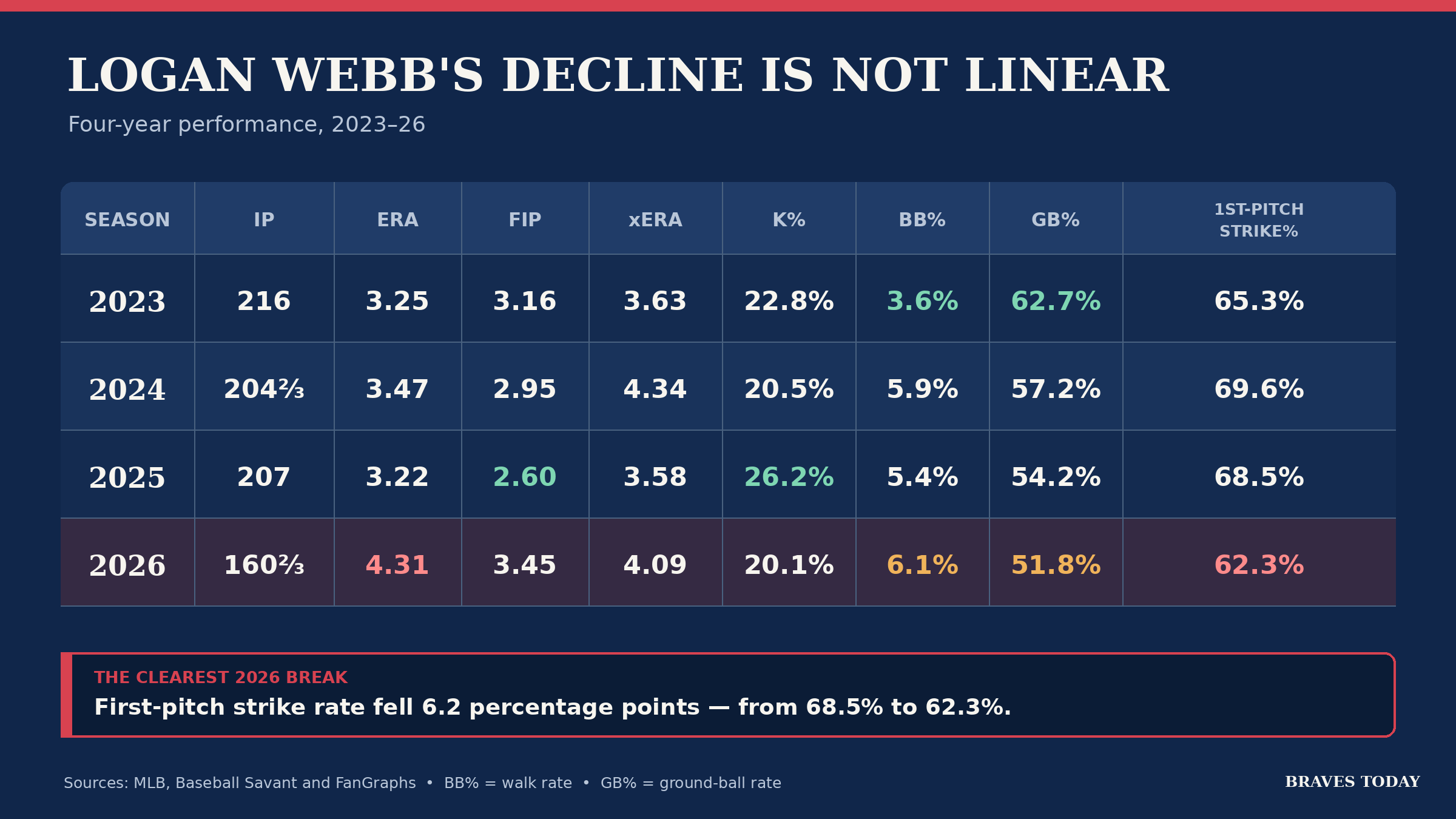
The 2026 ERA increased by more than a run, to its highest full-season figure of his career. While the Fielding Independent Pitching remained in the same band at 3.45, the fact that his expected ERA also deteriorated shows that this wasn’t just bad luck. And the one-year blip in his strikeout rate, which hit a career-high 26.2% in 2025, dropped back to his career 20-ish percent range.
Those worse results came despite his contact management actually improving, with his average exit velocity allowed dropping by over a mile per hour (89.7 mph —> 88.3), his hard-hit rate ticking down (40.2% —> 38.9%), and his barrel rate plummeting from 8.3% to just 5.8%.
Despite his ground-ball rate getting worse, those additional fly balls didn’t cause more damage. The declining ground-ball rate might have changed the shape of his performance, but it does not fully explain why the results deteriorated so badly.
Is he an Oracle Park merchant?
When you dive into Logan Webb, one of the red flags that comes up is that he’s been notably worse away from his home Oracle Park:
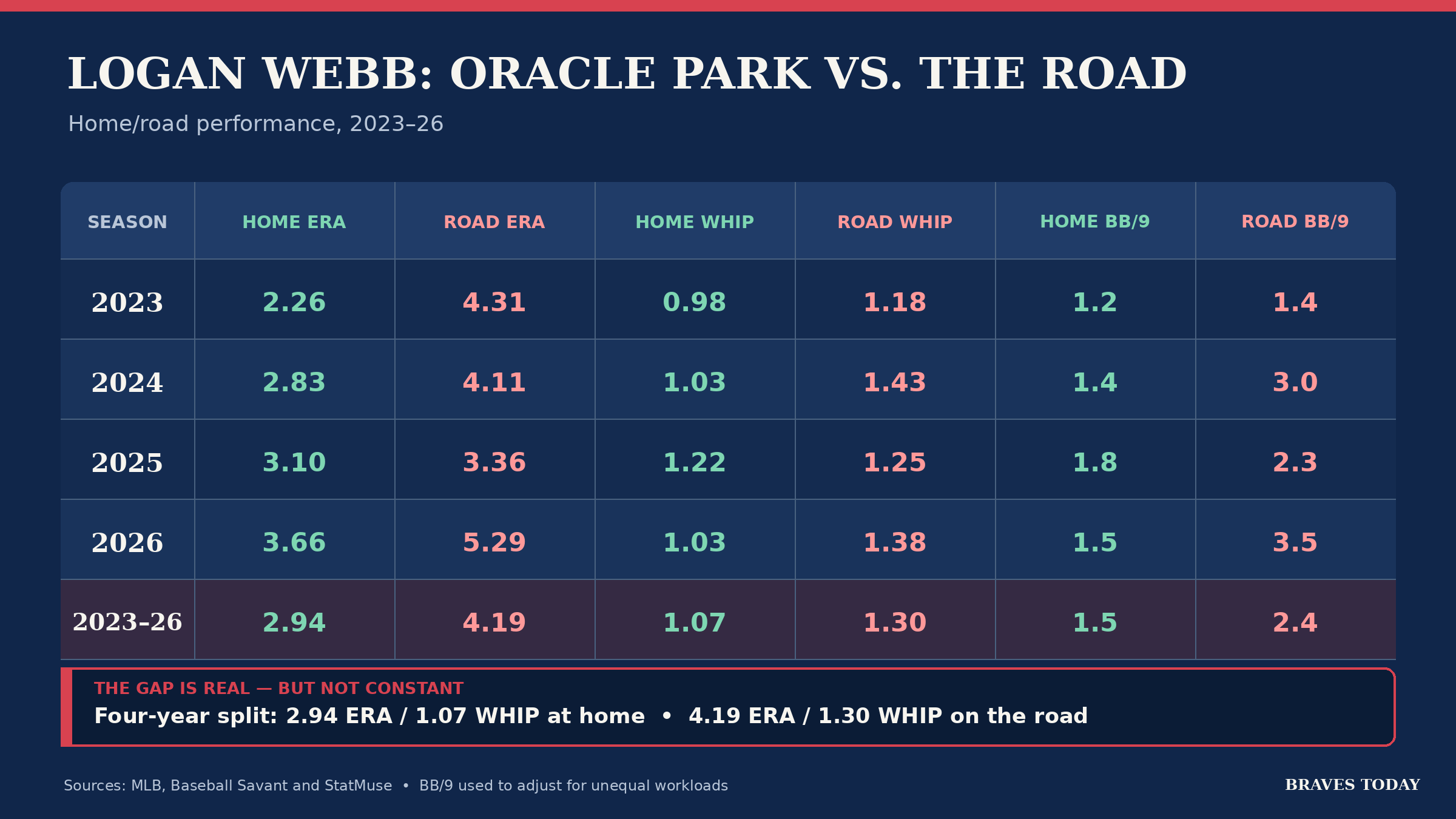
More than a run worse on the road, across 360+ innings, isn’t some sort of statistical small-sample anomaly (although it did almost completely disappear in 2025, which may have been a small-sample size anomaly).
It’s important to point out that Oracle Park suppresses home runs, and so Truist Park being close to neutral introduces some environmental risk. The meaningful differences here are mostly contained in walks and hits, with Webb’s WHIP rising from 1.07 at home to 1.30 on the road. Those runners came around to score more often, too, with Webb’s 73% strand rate at home dropping to just 70.3% on the road.
Why does his command become less dependable on the road, even when his stuff is roughly the same?
There are a lot of potential explanations. Oracle Park’s mound and that environment may be playing an outsized role. Is Webb’s transition to calling his own pitches via PitchCom partially to blame? Could this just be some ordinary home-road variance, amplified by two particularly poor road seasons?
No matter what it was, there are some things that feel like we could eliminate due to the four-year sample. The Giants having changed catching personnel recently, shipping generational defender Patrick Bailey to Cleveland, could explain some of the 2026 decline but doesn’t address the larger home/road split over the last few seasons. Neither does the knee trouble, which pushed him to the injured list this last season.
To be clear, I’m not saying that Logan Webb can’t survive outside Oracle Park. What I am saying is that his greatest strength - strike-throwing - has not consistently traveled with him on the road.
The ground-ball decline is real…but intentional?
One of the main criticisms of Webb has been that his ground ball rate has followed the same decline as his ERA, going from a career-high 62.7% in 2023 to just 51.8% last year.
But his sinker’s ground-ball rate was still 62.4% last year. It’s not the pitch; it’s how often he uses it. Webb went from throwing his sinker 39.7% of the time in 2024 to just 29.4% last year. And that’s pretty much the only difference in the pitch: its movement remained stable, and the velocity dropped by only half a mile per hour or so.
Instead of mainlining sinkers, Webb attempted to diversify with significantly more four-seamers and cutters, which together accounted for 26.6% last season. That’s up from just 8.1% just three years ago.
The good news for Atlanta is that an intentional shift away from his bread-and-butter sinker is potentially reversible, especially given Atlanta’s pitch-mix adjustments with Tyler Mahle when they acquired him at the trade deadline.
But is it really as simple as asking Webb to throw more sinkers? Not so fast, my friend.
Asking Webb to throw more sinkers may not be the fix
Let’s chart the three fastballs, because each pitch does have reasons why he should throw it:
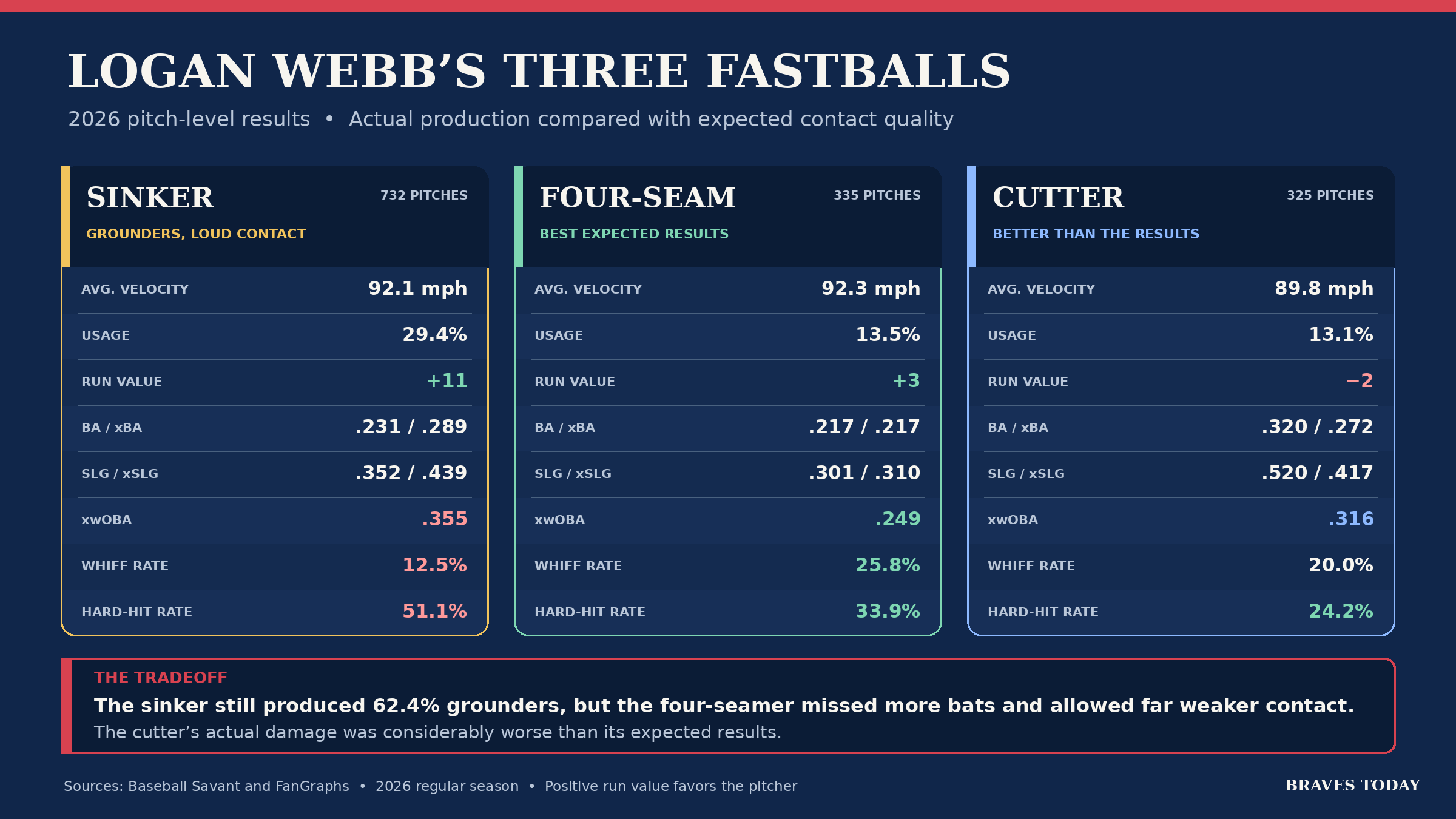
The sinker consistently produces groundballs, but gets hit hard when opponents make contact with it. The four-seamer misses the most bats and should be the best pitch on the estimators, while the cutter suffered from some small-sample bad luck - only 66 were put into play last season, and Webb significantly underperformed all of the expected production on those.
(Being honest, I’m not that worried about the hard-hit rate on a sinker in general. The hard-hit rate on the flyballs is much more important, and Webb allowed only 13 flyballs on sinkers all season.)1
A 60-plus-percent ground-ball rate is less comforting when 51.1% of the contact against the pitch is hard hit. Ground balls are generally safer than fly balls, but they are not harmless, especially when they leave the bat at triple-digit velocity. Even Atlanta’s infamously sound infield defense allowed a .373 average on hard-hit grounders, worse than San Francisco’s .306 average.
A trade for Logan Webb would be a bet that Jeremy Hefner and team could optimize the five-pitch version of Webb, not pulling a Tyler Mahle and reducing him to a sinker-heavy three-pitch version.
The number that should concern Atlanta
I think the bigger question for Atlanta to answer ahead of a trade is actually 62.3%: Webb’s first-pitch strike rate in 2026.
He’s typically hovered near 70%, including 69.6% in 2024 and 68.5% in 2025, but dropped precipitously last season. Not getting ahead of batters early means more hitter-friendly counts, as well as restricting access to the chase portions of Webb’s arsenal. It also puts more pressure on the sinker to bail him out and get back to advantage counts.
Was this a pitch selection or approach problem, or was it rooted in command? Because at the end of the day, the trick to Logan Webb’s success wasn’t just “get groundballs”. It was “get groundballs without giving away plate appearances via walk,” but he wasn’t nearly as reliable on the second half of that equation last year.
Could this be a health thing?
The notoriously resilient Webb went on the injured list twice last season, missing time for right-knee bursitis. Webb tried to pitch through the injury before finally shutting it down, his first injured-list placement in five seasons, and then a finger blister eventually ended his season.
In his last five starts, he had a 9.55 ERA and on video, It is tempting to connect Webb’s late mechanical drift to the knee. At times, his lower half appeared unstable and his delivery seemed to fly open early, despite Webb’s claims that knee had not bothered him after the cortisone shot he received in May. It’s a plausible explanation for his inconsistent mechanics and command, and explains why the Braves could expect improvement. But it doesn’t guarantee improvement.
Ultimately, Atlanta’s medical and pitching personnel need to answer:
Did Webb regain his normal delivery after the knee treatment?
Was the first-pitch strike decline concentrated around the injury?
Has the slight velocity decline stabilized?
Is the blister likely to recur?
Can he reasonably return to a 180–200-inning workload?
Was 2025’s strikeout rate sustainable, or was that the real outlier?
Webb still makes sense for Atlanta, though
I just spent 1000 words throwing cold water on the idea of a Logan Webb acquisition…so let’s talk about why they should still do it.
The biggest advantage to adding Logan Webb is that you’re committed for only two seasons. For a front office that’s seemingly allergic to long-term commitments for outside options, the Braves can neatly fit Webb into their two-year World Series window without being signed up for his decline years.
But he also provides them stability. We’ve previously discussed how the Braves are looking at four different starters who might all need additional rest in Chris Sale, Didier Fuentes, and both Spencer Strider and Spencer Schwellenbach. Logan Webb’s averaged 196 innings per season across the last five years, making a league-leading 159 starts during that stretch.
And there’s also some upside here. While we discussed the ERA blip he suffered in 2026, the underlying performance suggests he was closer to his historic performance, especially with a still-effective sinker, a five-pitch arsenal that has multiple paths to improvement, and potentially having a historically strong Braves defense behind him.
That said, there is some risk here.
San Francisco reportedly wants an ace-level return, likely requiring one of the “big three” prospects in SS Tate Southisene, OF Eric Hartman, or LHP Cam Caminiti to be in the package.
(Given that Baseball America’s updated Top 10 prospects has four middle infielders and five pitchers, I’m guessing their choice of headlining prospect would likely be Eric Hartman.)
And the Braves would need to have answers for both the home-road splits and the deteriorated strike-throwing, as well as confidence that the injured list placement was an isolated injury that’s behind him instead of something that will recur in Atlanta.
What should they do here?
The ground-ball decline should not keep the Braves from making the call to San Francisco to set Webb’s price. The sinker still can generate the ground balls, and the overall decline represents what appears to be an intentional expansion of his arsenal.
The concern is whether the Braves can restore his command.
If the knee issues explain the first-pitch strike decline, Webb may represent a buy-low at a position of need: A durable, upper-rotation starter that’s available at a salary below the top of the free-agent market.
But if the loss of command represents some sort of age- or workload-related decline, Atlanta could be trading the largest prospect package since the Matt Olson deal for a pitcher who represents a workhorse mid-rotation starter rather than a tailor-made #2 behind their ace.
Don’t start by asking whether Atlanta can restore Webb’s 60-percent ground-ball rate. Ask whether it can restore his strike-throwing.
Yes, they were CRUSHED - .462 avg and 1.692 OPS, with a 101 avg EV, but again, it was only 13 all season.