


(Anthopoulogy is Braves Today’s running series where we step into the shoes of President of Baseball Operations Alex Anthopoulos and focus on roster questions — evaluating trade targets, internal options, lineup usage, and the cost-benefit math behind potential moves. These are shorter, focused breakdowns built around one question at a time.)
The Atlanta Braves didn’t invent the ‘low service time’ contract extension, but they’ve certainly had the most success with them.
Under Alex Anthopoulos, the Braves have given five players who were 26 or younger at the time of signing a long-term extension: Michael Harris II (22), Ozzie Albies (22), Ronald Acuña Jr. (22), Spencer Strider (24), and Austin Riley (26). Riley was the only one of the group with more than two years of service time when signing the deal.
Additionally, the Braves acquired and subsequently extended Sean Murphy and Matt Olson at age 28, Joe Jiménez at age 29 (technically a re-signing), and Chris Sale at the age of 36, as well as several shorter, ‘year-to-year’ extensions with veterans like Travis d’Arnaud and now- retired Charlie Morton.
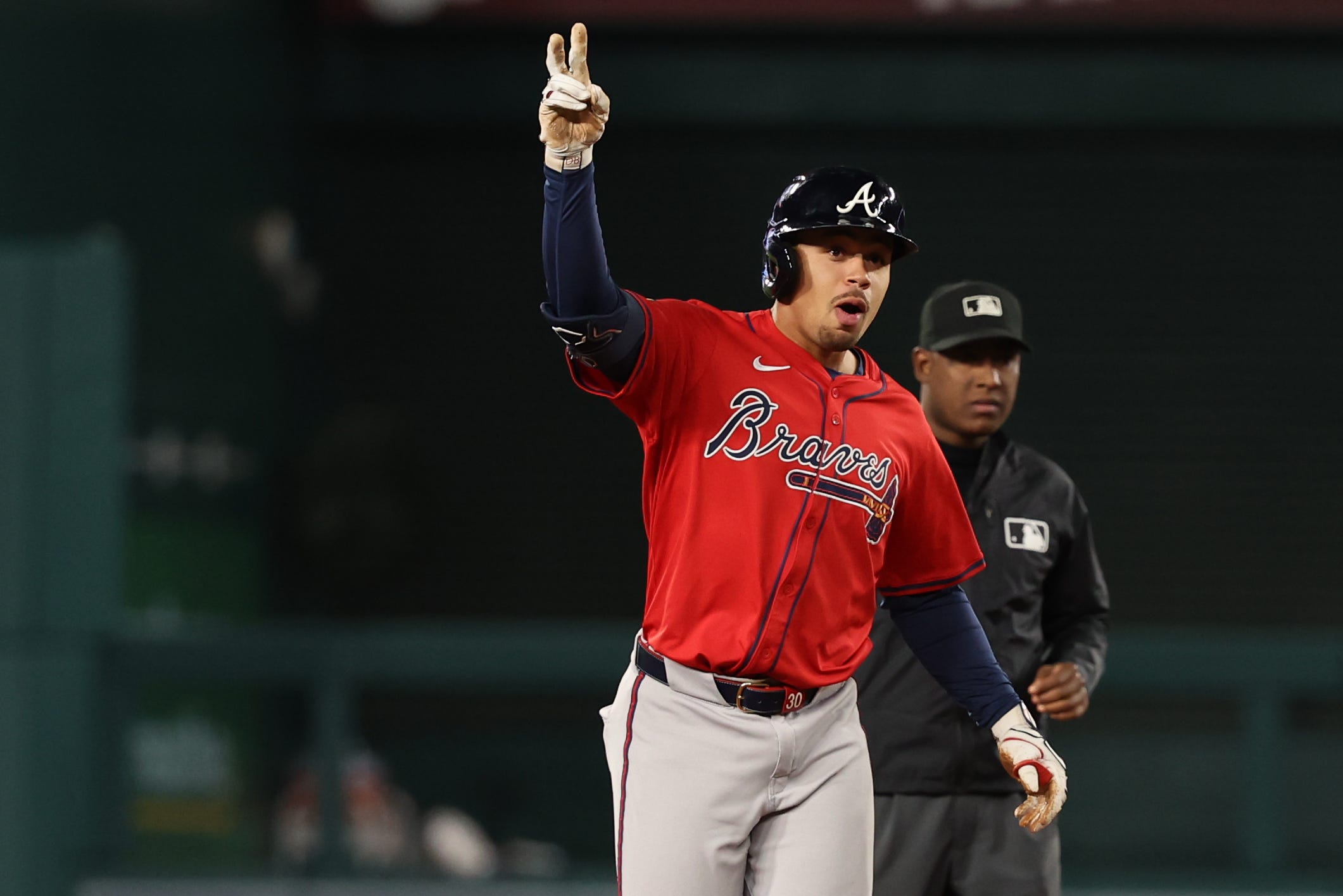
Should reigning NL Rookie of the Year Drake Baldwin be the next one to sign an early-career extension? Let’s talk about it.
The benefit to Atlanta of extending Drake Baldwin comes down to two things: cost certainty and value.
The first one makes sense: Arbitration is based on precedent and the previous year’s salary, but you don’t know exactly what that salary will be until either you settle early in the offseason or go through an arbitration hearing in early February.
However, if you extend Baldwin and buy out his arbitration years, you know exactly what he will be making in each year of the deal, barring any sort of performance incentives (which the Braves don’t make a habit of including in their contracts).
And the value could be enormous. The cost of one WAR in free agency varies based on the player’s production - it’s easy (and cheaper) to find a two-WAR player than a four-WAR player - but let’s ballpark it at Eno Sarris’ estimate of $11M per WAR.
Take the Sean Murphy extension, which he signed ahead of the 2023 season for six years and $73M. It bought out three arbitration years and three free agent years, with a seventh year of team control attached as a $15M club option.
Here are the salaries per year:
2023 (Arb 1): $4M
2024 (Arb 2): $9M
2025 (Arb 3): $15M
2026-2028 (FA 1-FA 3): $15M each
Murphy produced 5.0 fWAR in 2023, 0.8 in 2024, and 2.0 in 2025. Even in his worst season (72 games in 2024), he roughly matched his $9M salary and created excess value in the other two.
Baldwin, by contrast, was worth 3.1 WAR last season and has already accumulated 0.4 fWAR in just the first six games of this season. A Braves-style extension would lock in a ton of excess value going forward, even if it were closer to a Cal Raleigh (6/$105M) or Will Smith (10/$140M) -sized contract rather than a typical Braves deal.
But there’s a warning signal here
Both Sean Murphy and Spencer Strider, who are signed to a combined $148M across 12 years, have missed significant time in recent seasons due to injury.
After 108 games in his first season (2023) in Atlanta, Murphy has just 166 games of 89 wRC+ production and most of his value comes from defense, not offense. Strider, after 186.2 innings of 5.5 fWAR baseball in 2023, has just 134.1 innings and 0.9 fWAR since.
Is catcher, arguably the most physically demanding non-pitching position, really where you want to commit long-term money? Especially when the team already has a significant annual salary tied up in the position with the $15M owed to Murphy annually?
Do you even need to pay him?
And there’s also this: Baldwin is just now entering his second year in the majors. After this season, the young backstop will have four additional years of control and won’t reach arbitration until 2028 and won’t hit free agency until after 2030. He currently projects to receive just the league minimum this season, somewhere around $760,000.
And before the argument is made that the Braves need to reward Baldwin financially for his exemplary performance last season, that’s been handled. The league’s pre-arbitration bonus pool, implemented as part of the last CBA negotiation, rewards pre-arbitration players for both winning awards and their overall performance. Baldwin received two payouts from the pool: a $750,000 award for winning Rookie of the Year and another $425,583 based on a WAR calculation.
He’s already been financially rewarded for last season’s performance.
Could the new CBA change things?
An argument to go ahead and pay Baldwin is rooted in this upcoming offseason. Based on multiple reports, we’re expecting the owners/management side of the negotiations to renew their push for a salary cap in baseball.
While the players have resisted all efforts to institute a salary cap for the entirety of the existence of the players’ association, it is conceivable that some sort of result that emerges from the negotiations could impact the team’s status with Baldwin.
I personally expect that, while a salary cap and floor in name won’t be implemented, the existing mechanisms in place will be strengthened to work as a pseudo cap and floor. Examples of these could include making the penalties for excessive spending, such as crossing the third and fourth tiers of the Competitive Balance Tax, more punitive and/or no longer tied to strictly financial penalties.1 Instead of your first draft picks being moved back ten spots for exceeding the third tier of the CBT, what if the pick was taken away altogether? Instead of a 110% tax on any third-tier overage for a three-time offender, which the Dodgers were willing to pay to give Kyle Tucker a short-term deal with an AAV of $57M, what if you were unable to make trades or waiver claims?
And on the bottom, requiring revenue-sharing funds to be spent directly on payroll instead of “improving the major league product” is just one of the many ways to strengthen the existing mechanisms to replicate a cap and floor in baseball.
(If you want more of my ideas on this, I spent the third segment of a recent episode of the Braves Today podcast discussing this very topic in response to a listener question - a timestamped link is below.)
One of the hot-button topics for the MLB Players Association has been the length of time to reach free agency. Currently, MLB players can be controlled for up to twelve years before finally becoming free agents when you combine six years in the minor under the uniform player contract and the existing service time system in the majors.
Could the league and MLBPA trade stricter spending penalties for a shorter path to free agency? I think that answer could be yes, which would make waiting on Baldwin much riskier.
What do the Braves do here?
The easy, gut answer is to say “extend him”, but think of the logistics: Does signing a second big-dollar deal at catcher (Murphy’s $12.2M AAV is already a top-five figure) tie up too much money in an injury-prone and physically demanding position? If Baldwin and Murphy are dominating the catching and designated hitter positions, what does that mean for the ability to do some “load management” on Ronald Acuña Jr. Does it impact the team’s willingness to extend him, knowing that moving him to part-time DH will be tougher as long as both catchers are healthy?
On the other hand: If you don’t sign Baldwin to an extension soon, will you be able to afford him? Just six games into his second season in the league, he already looks like he’s reached a new offensive level that should leave him on the short-list of ‘best offensive catcher in baseball’. Waiting too long might price Baldwin out of Atlanta’s comfortable spending range.
That’s the decision in front of the Braves.
Pay now for cost certainty and long-term value, or wait and risk a higher price later while betting on the years of control you already have.
The Braves have almost always chosen early extensions under Anthopoulos. The question here is whether catcher — with its cost, risk, and roster implications — is the position where that philosophy finally gets tested.
Say it with me: A financial penalty is merely the cost of doing business.
I'm just as sure the Lords of Baseball will screw up everything as I'm sure Jerry Jones will screw up the Dallas Cowboys until they commit him to a institution or he dies.
There are 30 MLB teams, half are really minor league teams on life-support dependent on revenue sharing, extra draft picks, extra international bonus pool money, ad nauseum.
Excellent article as usual, Lindsay. If I WERE AA, I'm putting 7/$115 in front of Baldwin and making him say no. But that choice, based on how they approached this offseason, is probably not his to declare.
I think Big Time Terry is making those calls to some extent. But the roster situation is surely interesting, and with Murphy's value as low as it is I don't see how you buy out controllable years of Drake unless you plan to trade Murphy, or make him a DH.