


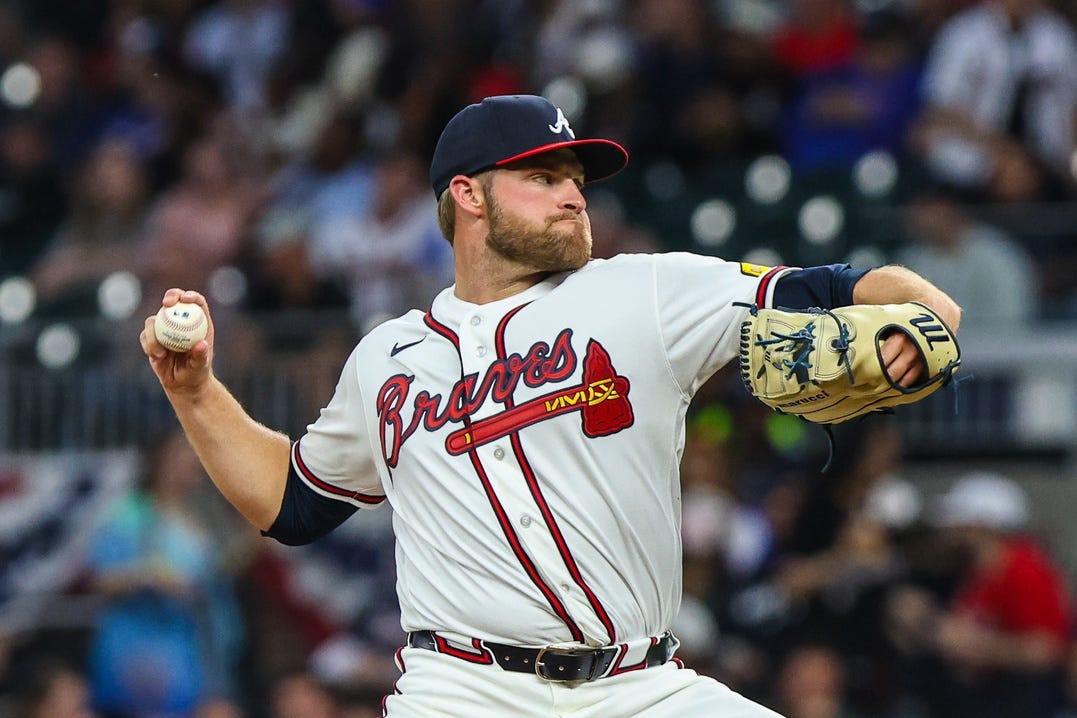
I never thought this day would come…but honestly, I’m still not happy.
Bryce Elder has added a cutter, something I’ve been requesting for a very long time. He threw it seven times on Monday night in Atlanta’s 4-0 win, but the way he used it wasn’t quite right.
Let’s talk about it.
Where did he get it from?
Despite the evidence, we still don’t know for a fact that the Braves read Braves Today.
And for Elder, we know that he got the cutter from someone else - Hall of Famer Greg Maddux.
A few years ago in Gwinnett, John Smoltz visited with the pitching staff, which turned into a relationship between him and Elder. This offseason, Elder capitalized on that relationship and asked Smoltz to set up a meeting between him and Maddux. Elder flew out to Las Vegas, where he threw a bullpen with Maddux, had dinner, and played a round of golf the next morning. After Elder shot a 77, losing to Maddux by six strokes, ‘Mad Dog’ took him for a second bullpen and taught him a cutter, the same one he used last night. It’s a variation that removes the middle finger from the equation, with the index finger being the dominant pressure source under a modified four-seamer grip.
(To get technical here, you start with a four-seam grip, but rotate the ball so the horseshoe faces inward and the pads of the index finger are on the seam. The middle finger is lifted off the ball almost entirely, allowing the index finger to do all the work.)
For Elder, that grip resulted in an 89-mph version with 10 inches of induced vertical break and only two inches of horizontal movement, pretty close to a true cutter but with more velocity than he would normally be expected to have from his velocity base.
It’s an...okay cutter so far, not getting any whiffs on the three swings it elicited on Monday. But it was also being used very oddly.
It fixed a problem that wasn’t a problem
In 2025, Bryce Elder had a glaring platoon split. Against lefties, he held his own, allowing a line of .239/.313/.391 across 335 plate appearances. Right-handed hitters, however, gave him fits, putting up a .301/.348/.498 line.
So would it shock you to hear that every single cutter Bryce threw on Monday night was to a left-hander?
Elder went to it in the very first at-bat of the game, throwing an elevated 1-2 cutter to Nick Kurtz that the hulking first baseman fouled off.
Later in the first, he tried to front-hip Tyler Soderstrom, with the pitch missing inside, before then running a changeup off the plate that Soderstrom weakly beat into the ground to second base.
This usage continued with two inside cutters off the plate to Lawrence Butler in the 2nd inning. Elder finally ran that inside cutter over the plate, but with poor results. In his second at-bat against Soderstrom, Elder threw it inside but missed over the plate, with the leftfielder ripping it to right field at 108.7 for a one-out single. But Elder did successfully get the strike on Jeff McNeil in the 5th inning, with the veteran fouling one off that was on the black before swinging through a slider thrown to the same location that dropped below the cutter.
Here’s the foul ball:
And here’s catcher Jonah Heim setting up for the cutter but calling a slider, letting it drop below the glove for a check swing strike.
Will he expand the usage?
According to Elder himself, yes. Discussing the cutter after the game, he admitted that he will gradually start to introduce the pitch against right-handers.
“A little different plane moving in to lefties and eventually I’ll throw it to righties, probably pretty soon.”
And Elder touched on an important reason that he added the cutter in this comment - his current pitch arsenal. He’s primarily running a vertical game, with the occasional four-seamer up and sinkers and sliders down. While he does get some armside movement with his changeup and sinker, he’s looking to drop a slider below your bat for whiffs.
The cutter gives him something else - exposure to gloveside movement without much drop.
It’s a strong addition to his arsenal. The shape makes sense, the velocity works, and it gives him something he’s never really had before.
But the value of the pitch is going to come down to how he uses it. If it stays a show-me pitch to lefties, it’s not solving the problem it was brought in to fix. When it starts showing up against right-handers, especially early in counts, that’s when it can actually change who Bryce Elder is as a pitcher.
Lindsay, As you said, it's a process and getting comfortable with the pitch to both right handed and left handed batters.
I think those of us here reading Braves Today understand what Bryce is and what he isn't. I'd just like him to be a little more consistent, but I also understand why he isn't. His margin of error is very small. He has to live on the black and at the edges of the strike zone.
When he's got his good command, he can be as good as he was last night. When he doesn't, it can get ugly pretty fast.
Hopefully, as he gains an increased comfort level with the cutter to both RHB and LHB, it can lead to more consistency. Fingers crossed! I'm trying to speak it into existence! LOL
Interesting. I don't understand why he has been reluctant to use the cutter against RHB's.