


Tarik Skubal will not be considered a “bargain” this winter, and you don’t really need a sophisticated model to predict this.
Skubal possesses premium stuff, misses bats and converts those misses into strikeouts. Every interested organization knows what he is, and his eventual contract will reflect it.
The more relevant question for the Atlanta Braves is who is available behind Skubal. Which starters have skills that haven’t entirely manifested in their ERAs or projected contracts? At the trade deadline, evaluating Stuff+, whiff rate, and strikeout rate helped us understand why Anthopoulos was willing to “open the farm system” in an attempt to get Skubal, but why Jacob deGrom was the only other known Atlanta target that offered a comparable foundation.
But when neither pitcher was attainable, Atlanta pivoted. The Braves acquired Giants starter Tyler Mahle for his command, workload, and relatively dependable floor, then got better results than Skubal gave the Dodgers for a fraction of the prospect cost.
That distinction matters this winter. The Braves need someone capable of raising the rotation’s ceiling, but they also need enough reliable innings to survive the uncertainty surrounding their current rotation options.
The goal this winter isn’t to pretend the Braves can find Diet Tarik Skubal by mining Stuff+. But we can identify the pitchers who possess two parts of an ace’s foundation and determine whether the missing third piece represents both a potential discount and a realistic, attainable goal through focused pitching development.
Let’s talk about it.
Our three-part test
Back in August, we identified two criteria that Anthopoulos was looking for in his definition of an impact starter, reverse-engineering the players we know the Braves were in on: High-caliber pitches and the proven ability to miss bats.
Determining that can be done through three stats: Whiff rate, strikeout rate, and Stuff+.
Stuff+
Measures the physical characteristics of the arsenal: velocity, movement, release traits and other pitch-shape components.
100 is league average; Our standard: above 100.
Downside: Stuff+ identifies quality weapons, but does not tell us whether a pitcher can locate or sequence them.
Whiff rate
Measures misses per swing rather than misses per pitch or plate appearance.
Our standard: at least 25%.
Shows whether the arsenal actually defeats major-league swings.
Downside: Can be driven by one elite pitch without guaranteeing a complete starting repertoire.
Strikeout rate
Measures how frequently the pitcher converts an entire plate appearance into a strikeout.
Our standard: at least 25%.
Strikeouts are the lowest-variance outs: they cannot find a defensive hole or be misplayed.
Downside: This is the result Atlanta ultimately wants to engineer from the other two traits, but it’s the hardest to get as it requires multiple factors to come together.
Just to clarify, this is a screening tool, not a complete evaluation of a pitcher’s suitability to join the team this winter. There’s a ton of other factors - command, health, workload, batted-ball management and price, among others - that do still matter. And a pitcher does not become useless because he fails one, or even all three, of these standards. Atlanta’s entire rotation this year, outside of Chris Sale, was built by guys that might have hit one of these three benchmarks, at best, and they were still a top-ten rotation by ERA this season.
The test does not tell us which pitcher Atlanta should sign. It tells us which pitchers deserve a closer look.
Skubal is the answer to the easy question
The easy question is which free-agent starter offers the greatest combination of stuff, bat-missing ability and proven results.
It’s Skubal, and it’s not particularly close.
He put up a 117 Stuff+ this season, tied for third-best in baseball and one point behind Chris Sale. He had a 31.7% whiff rate, 90th percentile and behind only seven starters, translating to a 30% strikeout rate that was 91st percentile.
And in a vacuum, adding Skubal to Atlanta’s rotation would be the best ceiling-raising move they could make. Sale and Skubal are two of the sport’s best starters, and are both lefties to boot. We saw the Tampa Bay Rays tweak their rotation over the weekend in the World Series, opting to save staff ace Drew Rasmussen for game two so that he wasn’t paired up against one of the game’s best pitchers in Milwaukee’s Jacob Misiorowski. Having TWO of the game’s top…five starters (?) in Sale and Skubal makes that sort of gamesmanship almost impossible; if you try to hold your best ace to avoid those two, you could be down 2-0 in a best-of-five or seven series right off the jump. In a rotation based on uncertainty - can Spencer Schwellenbach make it back to the same level after having a screw inserted in his elbow, or can Spencer Strider find the requisite elbow health to return to upper-90s velocity? - Skubal would provide top-end dominance not seen in Atlanta since the “Big Three” of Greg Maddux, John Smoltz, and Tom Glavine roamed the same clubhouse (and golf courses).
That being said, it’s likely that adding Tarik Skubal would be the only substantial thing you would be doing this winter. 27 MLB insiders polled by ESPN’s Kiley McDaniel returned an aggregate contract projection of eight years and $355M, a $44.6M average annual value that would shatter several different records: Yoshinobu Yamamoto’s highest total pitcher guarantee of $325M, Max Scherzer’s highest pitcher average annual value at $43.3M, and Gerrit Cole’s less-than-ten-years guarantee record of nine years, $324M.
(Scott Boras, Skubal’s agent, was also the agent for both the Scherzer and Cole deals.)
Skubal is the best pitcher available. But “best pitcher” and “best use of Atlanta’s resources” are not automatically the same answer.
The most interesting pitchers will probably miss one box
Here’s a chart of all of the relevant free agent starters (or those likely to be available, given that no mutual options have been exercised since Aramis Ramirez & the Brewers ran it back in 2015):
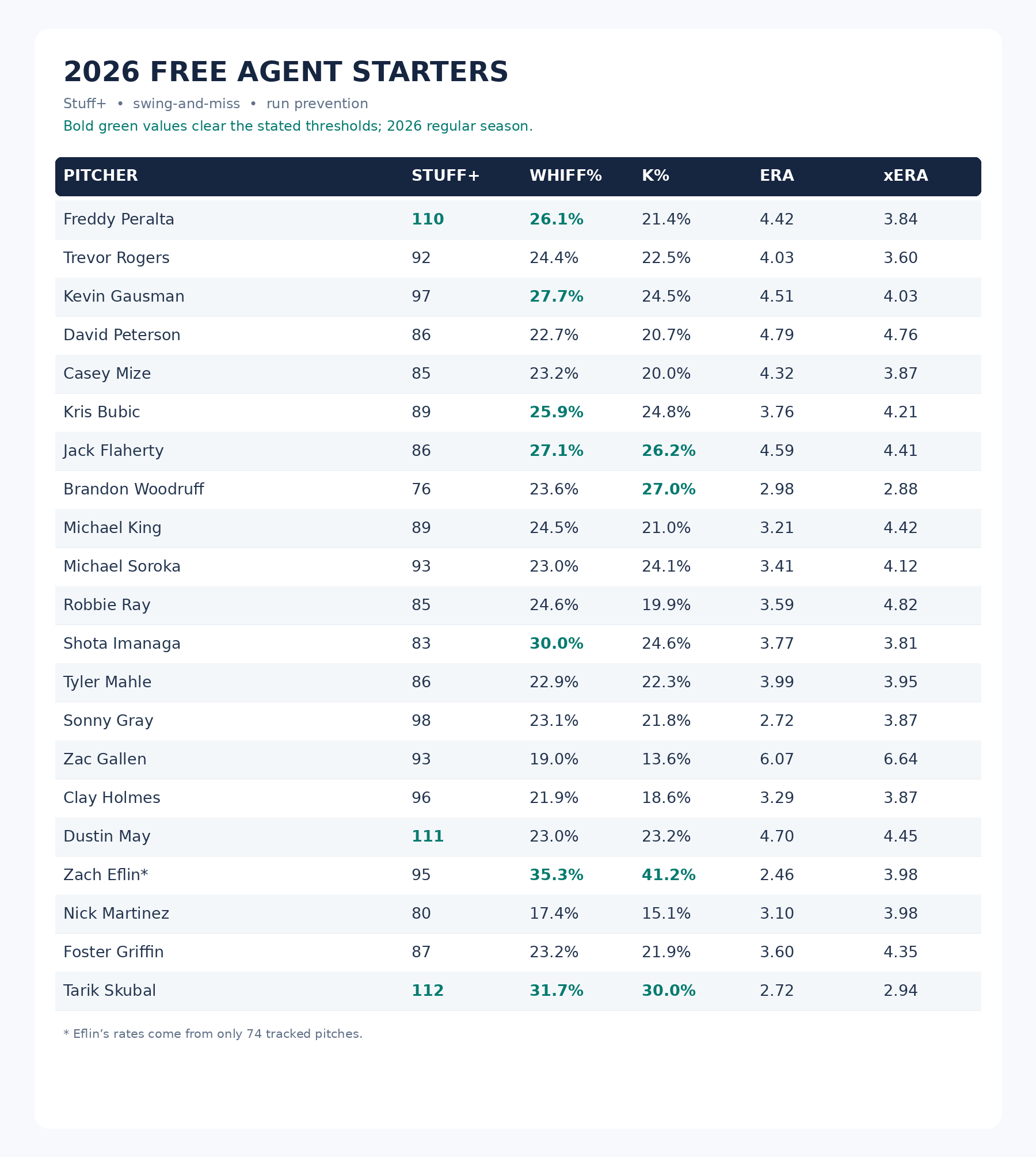
Let’s break out some of the most interesting starters by the box they happen to miss:
Good stuff and whiffs, but not enough strikeouts
This is the most attractive subset here to find bargains, because they already have the requisite tools, it just hasn’t congealed into a whole mess of strikeouts.
For each of the guys, the research Atlanta will likely be doing includes answering the following questions:
Why aren’t the whiffs becoming strikeouts?
Does he lack a dependable two-strike pitch?
Is he missing the strike zone before reaching two strikes?
Is the catcher or team calling an inefficient sequence?
Does he get too predictable when ahead?
Is there an obvious pitch-mix adjustment?
Remember, you need to have a plan to fix this guy if you get him, or else you’re just signing up for the same problems his last team had.
A pitcher who can already make hitters miss may not need a new weapon, he may only need a better way to deploy the ones he has. Let catcher Sean Murphy plan his outings and call his starts, or let Jeremy Hefner work on some new locations and sequences with him in the bullpen.
Freddy Peralta (110 Stuff+, 26.1% whiff) is the obvious standout here, and we know he’s a name that will appeal to Atlanta - they attempted to trade for him last winter, before he was dealt to the Mets, but weren’t willing to give up JR Ritchie for him without an extension being agreed on.
Whiffs and strikeouts without impressive Stuff+
These are the guys that are getting it done without the high-octane, meaning they’re going to tickle the fancy of the old-school pitching enthusiasts. This is usually some combination of command, deception, extension, sequencing, tunneling, and unusual release angles or deliveries.
Jack Flaherty, with a 27.1% whiff and 26.2% strikeout, stands out here.
The concern is whether those advantages are durable. Raw stuff provides a wider margin for error; command- and deception-dependent pitchers can decline quickly if either deteriorates, whether due to injury, fatigue, or the pitcher just having an off day. It’s a narrower path to being successful if you can’t improve your stuff.
Above-average stuff without the whiffs
This is the most dangerous projection, as there’s something flawed with the player that is not allowing their stuff to translate on the field.
Is Stuff+ overrating an arsenal that hitters see well?
Does the pitcher lack sufficient velocity separation?
Are his best individual pitches poorly paired?
Is the location neutralizing otherwise excellent movement?
Is there a pitch-design change Atlanta could realistically make?
In Dustin May’s case, his 111 Stuff+ is translating to only a 23% whiff rate and 23.2% strikeout rate because of poor locations and a lack of an out-pitch to lefties. Bringing in May, which I’m tentatively in favor of, would be a calculated risk by the Braves due to his inability to translate his stuff into results.
Just because Jeremy Hefner’s in the dugout and the Maven Baseball Lab’s in Atlanta does not mean that every gap is fixable or every deficiency can be corrected. Signing up for one of these guys might end up getting you someone with great stuff that can’t command it and ultimately needs to be bumped to the bullpen (while maintaining their starter salary).
Freddy Peralta shows why the full-season number can mislead
This section could have also been titled “never trust the Mets to do anything right,” but it’s a cautionary tale for why trends are sometimes more important than full-season results. His Mets performance, from either an ERA or a strikeout perspective, didn’t resemble the pitcher he was in Milwaukee.
After a disastrous tenure with the Mets, with a 4.99 ERA and nine losses in 22 starts, he was dealt at the deadline to the Tampa Bay Rays and rebounded nicely - a 3.25 ERA, including a 0.75 ERA in his final six starts (all Rays wins). He continued that heater in the postseason, with a 1.08 ERA in four starts entering tonight’s World Series game three.
The Rays did a few things to straighten out Peralta after the deadline, all of which worked. Pitching coach Kyle Snyder suggested a mechanical change to ditch the windup and start from the stretch with a preloaded back leg, noticing Peralta’s ability to use a slide step while maintaining velocity.
“He said, ‘I always feel comfortable pitching out of the stretch,’” explained bullpen coach Jorge Moncada to ESPN. “So we were like, ‘Go with what makes you most comfortable,’ and he went back.”
He also moved to the third base side of the rubber, slightly raised his arm angle, and ramped up the right-on-right changeups that Tampa Bay’s become known for this season.
The changes Tampa Bay instituted not only helped him find the strikeouts, but they also helped him throw harder, too, thanks to a new set of drills that the Rays gave him to generate more strength from his legs and mechanical changes that harnessed it. A 99.2 mph fastball he threw against the Guardians in the Divisional Series is the hardest pitch he’s ever thrown.
Something that helped is that Peralta showed up willing to work and the Rays made sure he was comfortable with what they were asking him to do. “Everything changed when I got traded,” Peralta told ESPN. “I said it before that I’ve been treated here as a king, and I feel really good about it. They’re working me really well here.”
This is where Alex Anthopoulos’ newfound return to the clubhouse culture that makes Atlanta distinct comes in. Rays pitching coach Kyle Snyder gave a lot of the credit for Peralta’s improvement to the player feeling comfortable with the environment in Tampa. “There’s some minor adjustments here and there,” Snyder said. “But I think more than anything else, it was just getting him back to feeling like himself. I think if you get the environment right, a lot of other things can snowball in the right direction for you.”
And seeing how quickly Peralta was “fixed” after getting out of New York is a cautionary tale. A full season of stats can prevent us from overreacting to six good weeks, but it can also obscure the moment a pitcher genuinely changed.
Not every successful starter will pass this test
Not every successful starter will hit even one of these benchmarks, but that doesn’t mean a pitcher can’t succeed.
Sonny Gray, a common target for Atlanta the last few seasons, fits the Charlie Morton-esque veteran acquisition mold that the Braves have followed in the past despite not hitting a single benchmark here: 98 Stuff+, 23.1% whiff rate, 21.8% strikeout rate.
It’s true that there’s some smoke and mirrors in his full-season performance, with an actual ERA of 2.78 that’s significantly better than the projection of 3.87 xERA. He got a lot of his results through avoiding walks, which offset the low strikeouts, and getting a well-above-average percentage of ground balls (46.4%, 73rd percentile). After a rough first month in Boston (4.30 ERA), he only once had an ERA above 2.40 in any other month of the season.
Kevin Gausman’s in a similar boat, but for a different reason - his variability. His below-average Stuff+ (97) disguises that while nothing was better than his splitter’s 100, everything else was in the mid-90s, so the floor is high. And his mastery of that splitter allowed his whiff rate to sit at 27.7%, a qualifying mark in our criteria.
But similar to how a knuckleballer can get rocked if they don’t have their stuff, Gausman was prone to streakiness depending on whether he had his splitter that day. He finished a 2026 season divided between the Blue Jays and the Cubs with ten starts of no or one run, but also six starts of five or more runs.
There’s also the reality that Atlanta may prefer the idea of a high floor for their acquisition, which was a factor in their acquisition of Mahle at the deadline, as AA explained to us in his end-of-season press conference:
“We figured the floor is a 3.60 (ERA), and he can go deep in a game, which is important to us.”
The Braves needed strikes, fastball command, a useful off-speed pitch, the ability to turn over a lineup, and length that could provide relief for an overworked bullpen. Mahle could do all of that and more, as his postseason dominance showed.
Nick Martinez represents an even more extreme version of this: few strikeouts, very few walks, but he covered 180 innings. Pitchers like that may fail our bat-missing screen while filling a need that Skubal cannot solve by himself: covering the other four days.
A pitcher can be a useful signing without being a hidden Stuff+ bargain. The mistake would be asking a stability acquisition to become Atlanta’s October ace - it’s hard if that addition is the only offseason rotation addition.
What the Braves actually need
When you think back to that press conference, one AA quote keeps standing out to me about the pitching, and it’s a comment about Spencer Strider and Spencer Schwellenbach:
“I don’t think it’d be responsible to sit there and say, ‘Okay, those guys are going to start 30 games, throw 180 innings.’”
When you look at Atlanta’s current rotation, Chris Sale remains excellent but benefits from additional rest - he barely qualified on ERA leaderboards, finishing his 162nd inning of the season in his final start. Strider’s ceiling is likely still there, evidenced by his 3.52 xERA last year, but the innings can’t be assumed given his health struggles of late. Schwellenbach has his own health and workload uncertainty as he attempts to pitch in the majors for the first time since 2025, doing it after an uncommon procedure (for baseball) to insert a screw in his elbow. Didier Fuentes is being prepared as a starter, but isn’t projected a full starter’s workload. Mahle and Martín Pérez are free agents, while AJ Smith-Shawver has yet to reestablish himself as a major league starter after Tommy John. Bryce Elder is returning from a minor knee scope and has a track record of providing the innings, but is still too variable in the quality of those innings.
Atlanta needs both quality and volume, and that’s why one ace versus several additions cannot be decided solely through WAR or AAV.
The Skubal path
One enormous contract.
True Game 1 starter-caliber stuff, even if he’d start a Game 2 behind Sale.
Highest October ceiling, but an incredibly significant financial and injury concentration that means other innings must come internally or through inexpensive additions.
The portfolio path
One bat-missing starter who clears two of the three tests.
One dependable innings source.
Potentially one short-term rebound bet.
Greater regular-season protection, but no guarantee any acquisition can match an opponent’s ace in October.
(If you’re interested in more discussion on this tradeoff, we’re talking about it on the Monday episode of the Braves Today podcast at noon Eastern.)
Building the portfolio
If the Braves were to take the portfolio approach, which is more their style than going after the top-of-the-market signing, here are some possible players to look out for:
Best overall alternative to Skubal
Freddy Peralta.
Our criteria like him, with a 110 Stuff+ and a 26.1% whiff rate. We also know the Braves like him, as they tried to acquire him over the offseason. While he’s never taken that final leap into top-ten or fifteen pitcher territory, the capacity’s there if he can maintain some of the improvements Tampa Bay’s instilled in him down the stretch.
Spotrac predicts him for a seven-year, $201M deal, an AAV of $28.7M which would put him right up there with Sale on the team’s payroll chart.
Best upside bargain
Old friend Michael Soroka.
While his Stuff+ isn’t the best, coming in at a 94 overall, he has a high pitch floor similar to Gausman in that everything but his changeup sits in the mid-to-high 90s or better. And the seldom-used slider’s a promising weapon at a 137 Stuff+. Among pitchers that threw 110 innings or more, it was the best in the game, and it wasn’t particularly close - the next closest was Jacob Misiorowski’s at 129, although the Miz threw his 286 times, while Soroka’s was used less than 50 times.
If he can stay healthy, which isn’t a given - he went on the IL twice in each of the last two seasons, missing time for a biceps and a shoulder in 2025 and a hamstring and an arm in 2026 - there’s the potential for a rebound there with Soroka.
Spotrac predicts him for a four-year, $79.9M deal, an AAV of $20.0M.
Best innings bargain
There are a few here, but Kevin Gausman and Nick Martinez stand out.
Gausman gave his two teams a combined 177.2 innings last year, and is not only qualifying offer ineligible but is being projected for a salary of just $19M per year. The caveats here are numerous, though: He has to want to come back to Atlanta, he played through injury last season, and that contract projection from Spotrac is based on a four-year deal.
Martinez would be more expensive, projected for $21.3M AAV on a two-year deal, but gave the Rays 180 innings of a 3.10 ERA. It’s the ultimate contact management profile, though - he struck out only 15.1% of the batters he faced, with a 17.4% whiff rate and a Stuff+ of only 80, making his hay through an elite hard-hit rate of only 32.9% (88th percentile) and while walking just 3.6% of batters, literally a 100th percentile mark in the sport this year. He strangely got plenty of chase (66th percentile mark of 32.1%) but it didn’t translate into strikeouts, but he’s a fly ball pitcher that’s almost never allowing hard hits. Is this replicable in an outdoor stadium (he had a road ERA of 2.38, so maybe?) or is the xERA of 3.98 more of what can be expected going forward?
What to do here
The Braves don’t need a model to tell them Tarik Skubal is good. They need one to determine how much quality remains on the board after the ink is dry on Skubal’s contract with someone else.
Stuff+ can identify the weapons. Whiff rate can show us if those weapons can fool a hitter. Strikeout rate tells us if the pitcher can put it all together to finish the job.
But Atlanta’s rotation can’t be rebuilt on stuff alone. It needs innings, and health, and enough redundancy to survive another season where Sale’s not pitching on regular rest and Strider and Schwellenbach might not pitch that much, if at all.
The best course of action here might not be a pitcher that checks every box. It instead might be a combination, with one starter that’s undervalued for their talent and another whose reliability has been overlooked.
Atlanta may decide that paying Tarik Skubal leaves too many other questions without obvious answers. But just refusing to pay Skubal in and of itself isn’t enough - it’s only prudent if the Braves repurpose their resources to acquire both qualities the rotation lacks: one starter whose talent provides meaningful upside, and another whose reliability protects the club from the existing uncertainty.
Atlanta may not find another Tarik Skubal. It can still build a rotation that does not require one pitcher to solve every problem.