


One of my favorite things to do is to watch an expert - not a professional, but an artist - do something. There’s a strange beauty in watching someone do something difficult with almost no wasted motion.
A master chef making a perfect omelet in ninety seconds. A concert pianist barely appearing to move while playing impossibly fast passages. An F1 pit crew replacing four tires before your brain fully processes what happened.
Baseball has its own version of this.
Raisel Iglesias entering a game, throwing nine pitches, recording three outs, and leaving like nothing happened.
Let’s talk about it.
Not all saves are equal
When you think of the platonic ideal of a save in baseball, the image that comes to mind is probably some sort of hulking flamethrower, probably with a goatee or mustache, coming out of the bullpen to just throw gas past three hitters, striking them all out to seal a win for their team.
It might be through sheer velocity, like modern marvel Mason Miller. It might be through one outlier pitch that no one can seem to hit, like Hall of Famers Mariano Rivera’s cutter or Trevor Hoffman’s changeup.
But there’s another kind of save that’s just as dominant, but doesn’t get nearly as much attention.
It’s the quick save, one that happens all in the span of three or four minutes, retiring the opposing side before they have a chance to discuss their game plan for the 9th inning.
And Raisel Iglesias is the master of it.
Here’s an example
May 25th, 2023.
The Braves are home against Philadelphia, and Iglesias enters to secure an 8-5 win.
He does it in eight pitches. There are single at-bats in every game that take longer than this entire save.
First is Kody Clemens. Iglesias strikes him out on four pitches: a called strike on a changeup in the zone, a whiff on a perfectly dotted heater up and in, a fouled-off changeup away, and then another cambio below the zone for strike three.
Next comes Bryson Stott. Iglesias steals strike one with another fastball painted on the outer edge, misses just off the plate for ball one, then drops a changeup beneath that same location. Stott weakly flares it to left for the second out.
Now it’s Trea Turner, who has spent the inning watching the exact same sequence unfold from the dugout and on-deck circle. Fastballs on the edges. Changeups dropping below the barrel. He’s ready for all of it…except for the fastball that stays above his barrel in the lower third of the zone, producing a weak popup to second for the final out.
Eight pitches.
Maybe four minutes.
Zero stress for Braves fans.
What is he doing differently?
Iglesias has never been bad at striking out opposing hitters. His career strikeout rate of 29.4% perennially stands as one of the better marks in baseball every year, although it’s not in the same stratosphere as the best closers in the game.
But what Iglesias also does well is both get groundballs and do it quickly.
In Iggy’s best seasons with the Braves, he’s run ground ball rates over 40%. That doesn’t seem like a lot when compared to some of the preeminent groundball artists in baseball, but as compared to other closers, it’s pretty good.
The most dominant closer in baseball right now, Mason Miller, has a career groundball rate of 38.4%. Kenley Jansen? 32.2%.
Iglesias also does it quickly. Per Statcast, he’s faced 894 batters in his Braves career through Monday’s off day, and needed 3,318 pitches to do it. That’s 3.71 pitches per plate appearance, a figure lower than every team's average in baseball this season.
Some of this is his pitch arsenal - he’s one of the few closers who prominently feature a changeup, with the cambio sitting somewhere between 1st and 2nd in his arsenal for usage in any given year. Pairing that with a sinker is a recipe to get early groundballs.
Some of this is also his tempo. From 2024 through Monday, Iglesias is one of the fastest pitchers with regard to pitch tempo, the time from when the pitch receives the return throw from his catcher to when he begins his delivery. Iggy’s ‘bases empty’ time of 12.8 seconds is tied for 10th in that span with teammate Bryce Elder, and that’s relatively pedestrian for him. With runners on base, Iglesias’ 15.5-second tempo is the 3rd fastest in all of baseball.
Working quickly to deliver pitches that can get ground ball outs has a way of shortening some of your outings, both on the clock and in our minds.
Presenting: The “Iggy”
Greg Maddux was so prolific at complete game shutouts in 100 pitches or less that eventually, just that accomplishment was referred to as a “Maddux.” The Hall of Famer accomplished it thirteen times after 1988, the first year complete pitch count data was available. The current leader for active players, Max Fried, has just three.
Iglesias isn’t quite as dominant in his namesake stat, but he’s still pretty notable.
I wrote some code to pull every single save from MLB from 2021 through Sunday’s games, checking to see how many pitches it took that reliever to record it. When you filter the leaderboard by a minimum threshold of 50 total saves, you see why Iglesias is getting a statistic named after him.
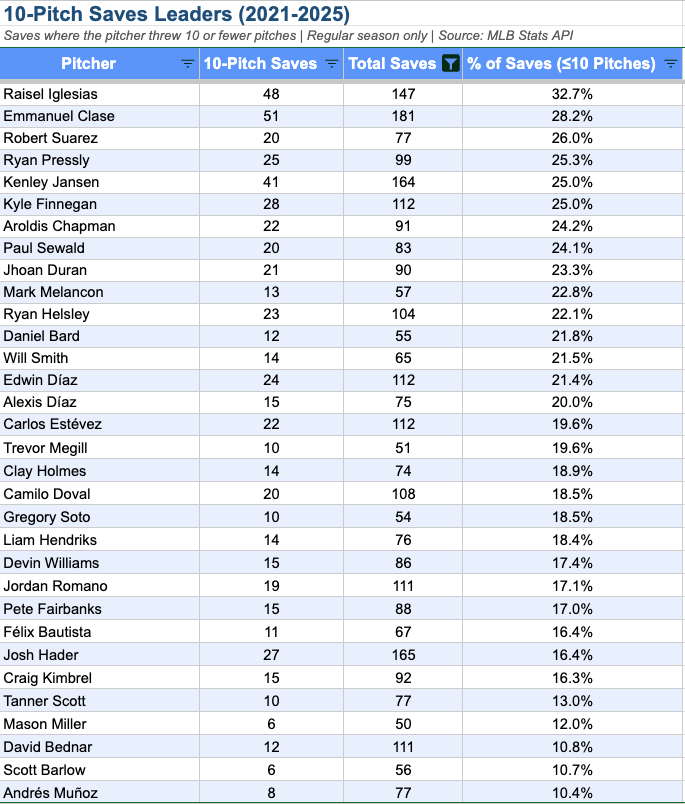
Nearly one-third of all of Iglesias’ saves in this time period were accomplished in ten pitches or less. The sample’s average for 10 pitches or fewer saves is only 19.8%, so he’s working significantly more efficiently than his peers.
Why The “Iggy” Matters
There’s a psychological component to this kind of outing that doesn’t show up in the box score.
A stressful save lingers. A walk brings the tying run to the plate. A nine-pitch at-bat changes the energy in the stadium. Fans start bargaining with the baseball gods in real time.
The “Iggy” doesn’t allow any of that to happen.
Three hitters come up. Weak contact happens quickly. The handshake line appears before the opposing lineup ever settles into the inning.
That kind of efficiency matters over a 162-game season.
Quick innings mean less wear on the bullpen behind him. Fewer stressful pitches mean less cumulative fatigue. And on nights where Atlanta’s offense gives him a narrow lead, Iglesias has spent years turning the ninth inning into little more than a formality.
That’s why the save statistic alone doesn’t fully capture what he’s been for the Braves.
Some saves feel like survival. Iglesias’ best ones feel pre-written.
The Bigger Picture
Baseball has always loved naming things.
The Mendoza Line. The Maddux. The Golden Sombrero. Over time, the sport naturally creates language for the kinds of performances that happen often enough to become recognizable patterns.
And Raisel Iglesias has created one of those patterns.
Not through overwhelming velocity or cartoonish strikeout totals, but through ruthless efficiency. Through getting ahead quickly, forcing contact, and ending innings before they ever have a chance to spiral.
The “Iggy” might not be an official statistic.
But if a save completed in ten pitches or fewer needs a name, it’s hard to argue anyone’s earned it more.
So i ask again. Why do they keep saying this is Iglesias last year with Braves ?
No chance of resigning ? Don't want to pay him ?
Having two of the top three in the < 10 pitch saves table makes me feel warm and fuzzy!