


It’s Atlanta Braves baseball! Let’s break down everything you need to know about this afternoon’s matchup.
Game Info
First Pitch: 7:10 PM ET
Location: Daikon Park, Houston TX
TV: BravesVision (local)
Radio: 680 AM/93.7 FM The Fan
Weather: The Astros refuse to open the Daikon Park roof, so this doesn’t matter.
Atlanta Braves Lineup
DH Drake Baldwin
RF Ronald Acuña Jr.
1B Matt Olson
CF Michael Harris II
SS Mauricio Dubón
2B Ozzie Albies
LF Mike Yastrzemski
3B Austin Riley
C Sean Murphy
Quick thoughts:
No changes to Atlanta’s lineup for game two.
Houston Astros Lineup
SS Jeremy Peña
DH Yordan Alvarez
3B Isaac Paredes
2B Jose Altuve
C Yanier Diaz
CF Daulton Varsho
1B Christian Walker
RF Cam Smith
LF LaMonte Wade Jr.
Quick thoughts:
The Astros have returned Cam Smith to the lineup, batting 8th, as well as starting catcher Yanier Diaz, batting 5th.
Please don’t let Yordan Alvarez beat you.
Pitching Matchup
Braves Starter: RHP Grant Holmes (9-5, 3.49)
Quick snapshot:
3.49 ERA / 4.86 xERA / 4.69 FIP
18.3% K / 9.8% BB / 8.5% K-BB%
Pitch mix:
vs LHH: 34% slider, 28% four-seamer. 12% cutter, 11% curveball, 10% changeup, 6% sinker
vs RHH: 40% slider, 31% four-seamer, 20% sinker, 3% each cutter, curveball, & changeup
What to watch from Grant Holmes
The September ERA looks better than the underlying performance. Holmes has a 1.38 ERA in 13 innings this month, but only seven strikeouts against four walks. He failed to record a strikeout over four innings against Philadelphia in his last start. For the full season, his 3.49 ERA sits against a 4.83 xERA, 91.3-mph average exit velocity and 44.1% hard-hit rate. Holmes’s Statcast profile
His secondaries provide a clear path through Houston. The slider has a 39.6% whiff rate, while the curveball is at 36.8%. Hitters are batting .156 and slugging .188 against the kick change. Holmes’s four-seamer, sinker and cutter have been much less forgiving:
Four-seamer: .458 SLG, .382 xwOBA
Sinker: .410 xwOBA, 60.8% hard-hit rate
Cutter: .605 SLG, .414 xwOBA
Houston’s righties are the more dangerous matchup. Right-handed hitters have a .746 OPS against Holmes, compared with .674 for lefties. That matters against Altuve, Peña, Paredes, Díaz and Cam Smith. Holmes throws 40.3% sliders and 20.4% sinkers to righties, but his kick-change usage drops to only 2.8%.
This is another opportunity for the same-handed kick change. Holmes throws it 9.5% of the time to lefties, even though its unusual power-change characteristics should allow it to work against righties as well. With Houston likely to stack right-handed bats and the fastballs absorbing hard contact, occasionally replacing a right-on-right sinker with the kick change could give hitters a different speed and vertical look.
The middle innings remain the danger zone. Holmes has a 2.57 first-inning ERA and .533 opponent OPS, but those figures deteriorate to a 4.62 ERA/.878 OPS in the fourth and 4.35/.796 in the fifth. If Houston forces him through the order twice, Atlanta should be prepared for a quick bullpen decision.
Daikin Park magnifies his contact risk. Holmes’s 20.5% pulled-air rate is also well above average. Given his reverse platoon split and the number of Houston righties capable of pulling the baseball, elevated four-seamers and cutters toward the inner half carry particular danger tonight.
The Astros against Holmes:
The good: LaMonte Wade Jr. (2-for-5, 2B), Christian Vázquez (1-for-1); Christian Walker is 0-for-1 but has drawn two walks.
The bad: Daulton Varsho (0-for-3, BB), Jorge Barrosa (0-for-2, K), Isaac Paredes (0-for-1)
Most of Houston’s lineup has never faced him, so the pitch-shape matchup is substantially more useful than the historical results.
Opposing Starter: RHP Hayden Wesneski (5-2, 3.70 ERA)
Quick snapshot:
3.70 ERA / 3.71 xERA / 3.71 FIP
19.2 K% / 8.1 BB% / 11.1% K-BB%
The arsenal:
Sweeper: 29%, 81.1 mph
Four-seamer: 25%, 93.4 mph
Sinker: 17%, 92.4 mph
Cutter: 16%, 89.4 mph
Changeup: 12%, 86.4 mph
Atlanta’s path against Hayden Wesneski
Wesneski is a managed starter, not an opener. He has completed at least six innings four times in nine starts since returning in late July, but Houston has not allowed him to exceed 91 pitches. Atlanta can reach the bullpen early by extending plate appearances, although Wesneski has demonstrated that he can work six or seven innings when he is efficient.
His last start was ugly, but not entirely alarming. Tampa Bay scored seven runs against him in three innings, but four were unearned after Jeremy Peña dropped what should have been the third out. The more relevant concern was that Wesneski’s four-seamer averaged only 92 mph, down from 93.6 in his previous starts. Wesneski called the velocity dip a one-off. Tonight should tell us whether he was right.
The rest pattern favors Wesneski tonight. His two starts on four days’ rest since surgery have produced 12 runs—eight earned—in seven innings. He has allowed only 12 total runs across 41⅔ innings in his other seven starts, all with at least five days’ rest. He enters tonight with five days’ rest.
Atlanta’s clearest target is the cutter. Hitters have batted .290 and slugged .677 against it. His four-seamer and sinker have also allowed hard-hit rates above 51%. Conversely, the sweeper has held opponents to a .140 average and .209 slugging percentage while producing a 38.1% whiff rate. The changeup owns a 37.8% whiff rate. The Braves want firm pitches in the zone—not the sweeper traveling away from righties or the changeup diving below lefties.
He changes his fastball plan dramatically by handedness, with lefties receiving four-seamers and changeups but righties getting sinkers and sweepers. The actual results are almost perfectly balanced: a .643 OPS by lefties and .658 by righties. There’s no sense in trying to make a platoon lineup here.
Be selectively aggressive early. Wesneski owns a 67.2% first-pitch-strike rate despite putting only 44% of all pitches in the zone. Once he gets ahead, his 35.1% chase rate allows the sweeper and changeup to take over. Atlanta shouldn’t concede strike one, but swinging early only works if the pitch is firm and in a damage location.
The Crawford Boxes could matter. Wesneski’s 20.4% pulled-air rate is well above the MLB rate of 16.9%. Riley’s only hit in three at-bats against him is a homer, and Atlanta’s right-handed hitters possess the most direct path toward Houston’s short left field. Wesneski has not allowed a home run in 22 home innings, however, so this remains more matchup theory than demonstrated vulnerability.
The Braves against Wesneski:
The good: Austin Riley (1-for-3, HR), Ha-Seong Kim (2-for-5)
The bad: Kyle Farmer (1-for-7, 2B), Matt Olson (0-for-4, 2 K), Michael Harris II (0-for-4), Ronald Acuña Jr. (1-for-4)
Mike Yastrzemski is 0-for-2 but has drawn two walks. Every sample here is tiny.
How he attacks hitters (all graphics courtesy of Thomas Nestico)
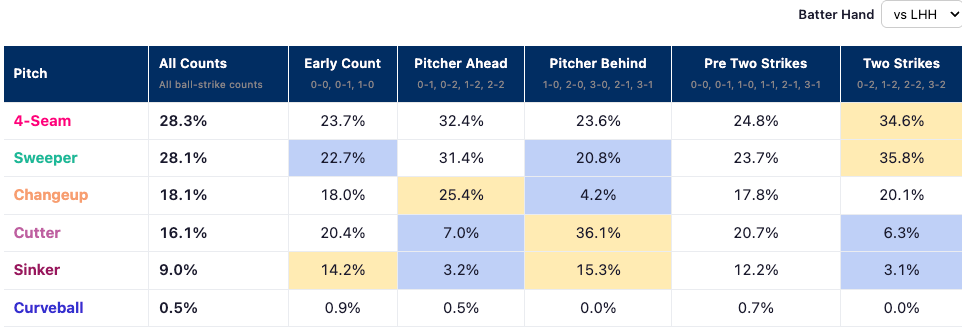
vs LHH: Somewhat surprisingly, the off-handed sweeper is a major piece of Wesneski’s game plan versus lefties, with the changeup playing a supporting role and the four-seamer being the prominent fastball. The curveball is practically never thrown here, and the sinker and cutter are mostly early in the at-bat and when he’s behind.
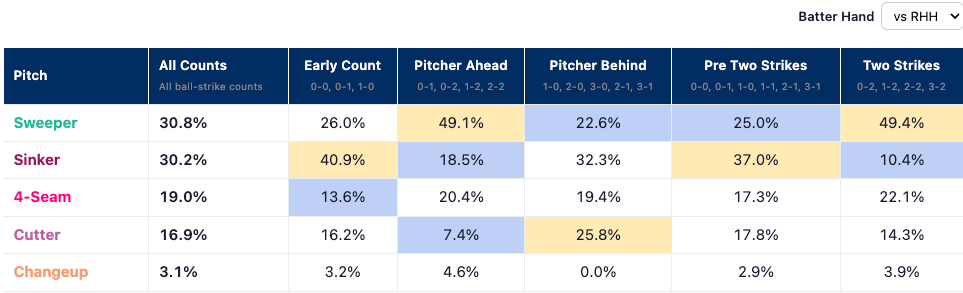
vs RHH: Sinker/sweeper is the play, with the usual adjustments to their usage based on the count. Neither the curveball nor the changeup play much of a role here; it’s just the sweeper and the fastball family.
Sequencing:
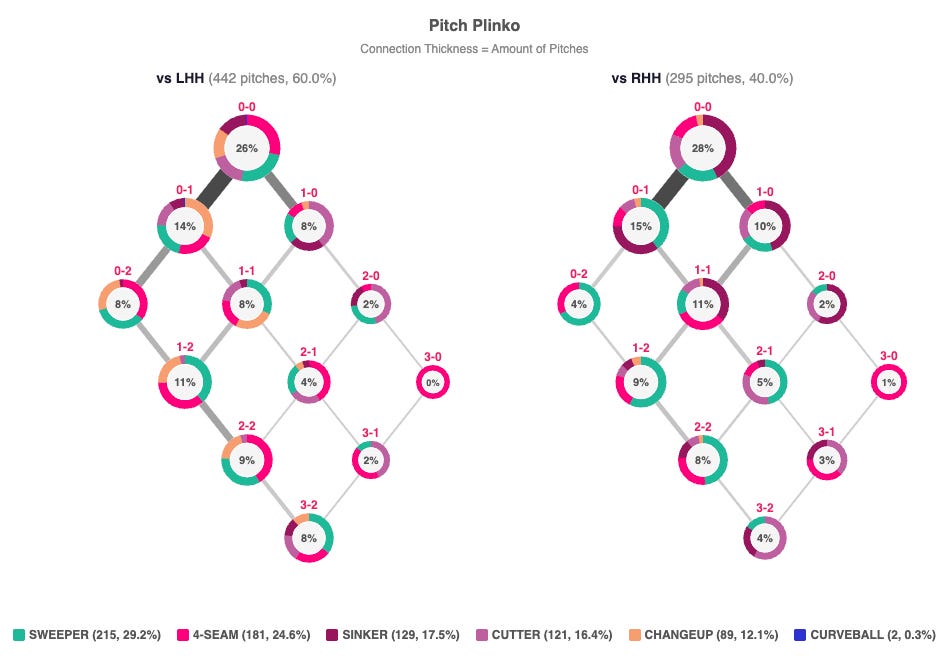
How to read a plinko chart: Each circle represents the usage of a pitcher’s arsenal in a given count (color key is on the bottom of the graphic). The thickness of the connecting lines reflects how often each count occurs, helping show how a pitcher navigates an at-bat.

Are you ready for retirement? Ford Stokes and Zac Blackerby are Braves fans who want to help you make sure you have income for life. Email Zac (zac@activewealth.com) or Ford (ford@activewealth.com) for your free Social Security roadmap today.
Braves Bullpen Status
(Reminder: these are all assumptions based on pitch count and recent usage)
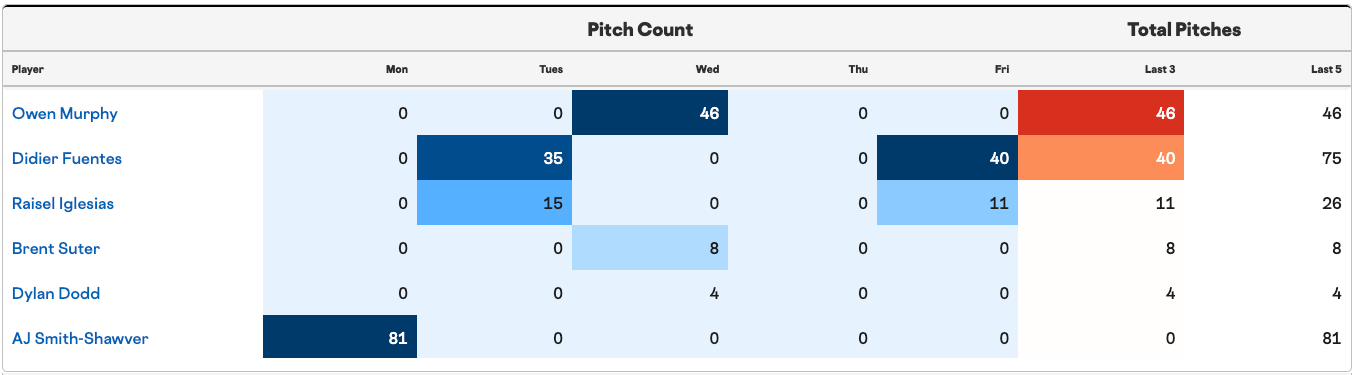
Likely available/potential limitations:
Didier Fuentes will be down today, based on 40 pitches last night. Dylan Dodd and Dylan Lee both warmed up but never got into the game, so I imagine Atlanta might try to use them today.
Quick takeaway:
The Braves should be good to go here, although if it’s another close game, who steps up for Fuentes as a setup man for Raisel Iglesias?
Opponent Bullpen Status
Likely Available:
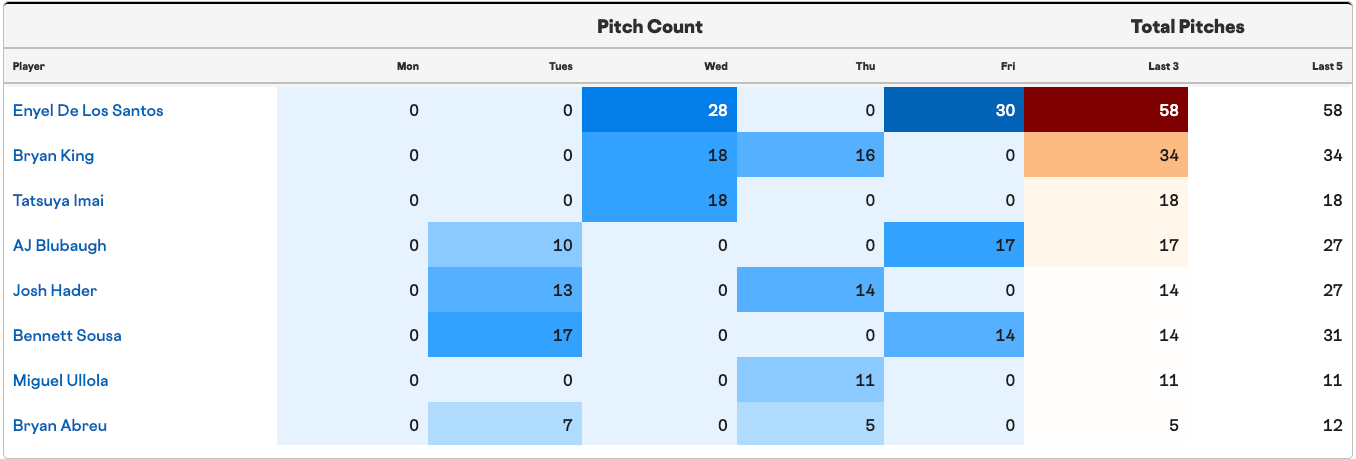
The leverage arms that were either coming off back-to-backs (Bryan King) or had pitched twice in a three-day span during the Royals series (Josh Hader and Bryan Abreu) are likely both available after getting last night off.
Potential Limitations:
Old friend Enyel De Los Santos is likely down, given that he threw 30 pitches last night and his three-day usage is nearly 60.
Quick takeaway:
The Astros are in a good place for game two, if they can get a lead.
Final Thought
The Braves are +110 on the moneyline to Houston’s -130 and FanDuel has set the over/under at 8.5 runs. The hinge point is Which starter can prevent his hard stuff from getting pulled in the air? Atlanta must avoid allowing Wesneski’s high first-pitch-strike rate to funnel hitters into his sweeper and changeup. Holmes must use his slider, curveball - and perhaps more same-handed kick changes - to keep Houston’s righties from sitting on his vulnerable fastballs. Both pitchers allow pulled air at an above-average rate, and at Daikin Park, one elevated firm pitch to a right-handed hitter can turn an otherwise solid outing into a Crawford Boxes problem.
Let’s Talk About It
If you’d rather watch this, here’s the Braves Today live stream from this afternoon, after lineups were announced.
Given that Astros are fighting for the playoffs and Braves haven’t officially clinched the division, it’s not “appropriate” to start playing the young guys, but I wouldn’t work the key guys in the pen to try and win this game today. And after tomorrow, I hope we see a lot of the youngsters.