


(Trying something completely different with the Scouting Report today - more explanation via prose, fewer bullet points. Not sure how I feel about it just yet, but let me know if you like this more or less than the usual structure.)
The Atlanta Braves open a three-game series at Camden Yards on Friday night with the better record, the better place in the standings and an unusual position in the betting market. Despite Atlanta entering at 60–42 and atop the National League East, Baltimore is 50–53 and fourth in the American League East, the Orioles are still favored.
Baltimore enters as a −132 favorite on the line from Braves Today sponsor FanDuel, with Atlanta at +112 and the over/under set at nine runs. Doesn’t make a lot of sense… until you dive into it.
Trevor Rogers presents an unusual matchup for Atlanta’s left-handed hitters, Grant Holmes has struggled to suppress hard contact, and Baltimore enters with a considerably fresher bullpen.
Here is everything to know before the series opener. Let’s talk about it.
Game Information
First pitch: 7:05 p.m. EDT
Location: Oriole Park at Camden Yards
TV: BravesVision
Radio: 680 AM/93.7 FM The Fan
Spanish-language radio: Los Bravos
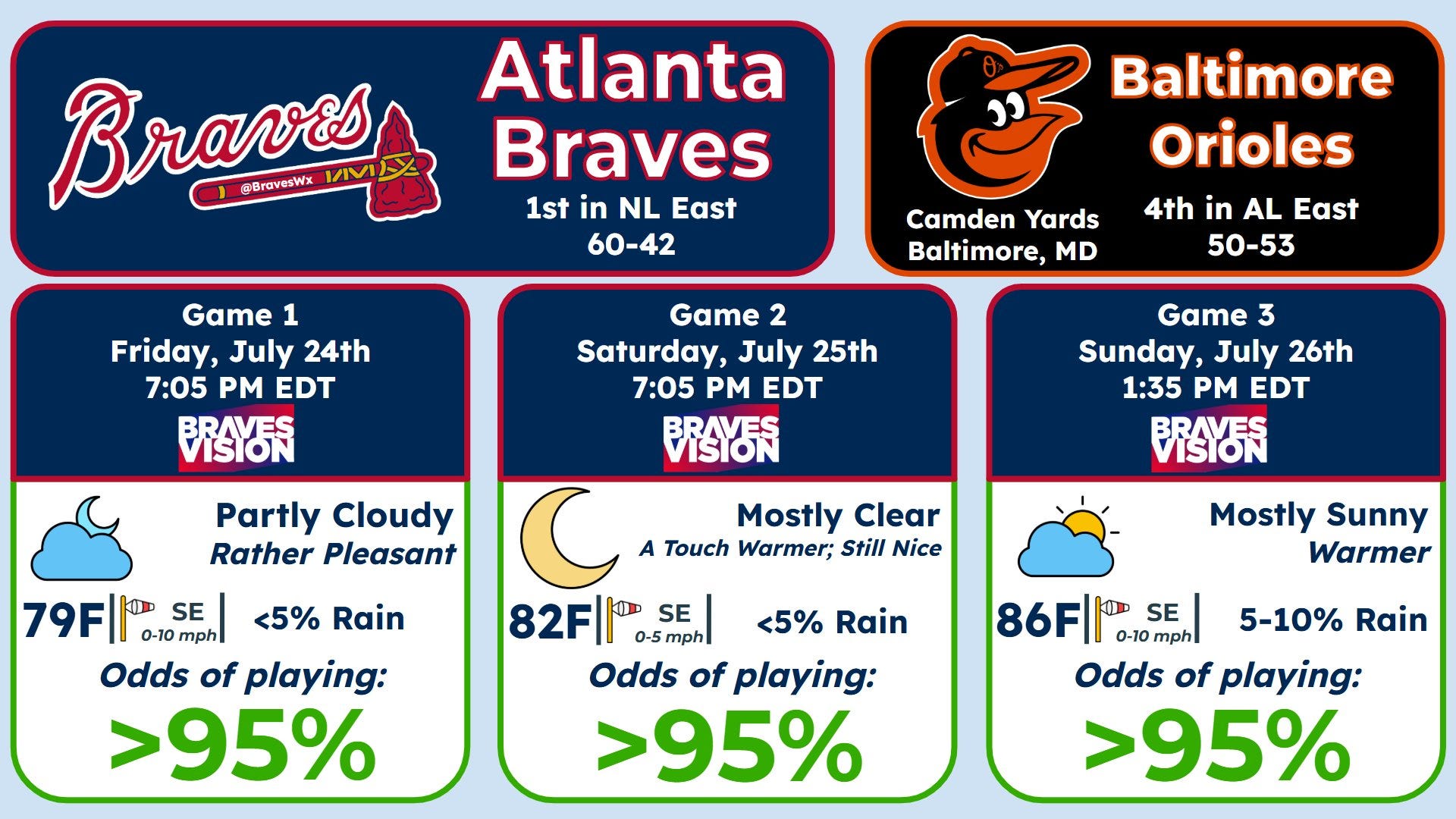
Weather: Partly cloudy and 79 degrees, with a southeast wind at 0–10 mph. The chance of rain is below 5%, with greater than 95% odds of playing, according to @BravesWx.
Braves Lineup
DH Drake Baldwin
2B Ozzie Albies
1B Matt Olson
CF Michael Harris II
LF Mauricio Dubón
3B Austin Riley
RF Eli White
C Joey Bart
SS Jorge Mateo
Orioles Lineup
LF Dylan Beavers
1B Pete Alonso
SS Gunnar Henderson
DH Taylor Ward
CF Colton Cowser
RF Leody Taveras
2B Jackson Holliday
3B Christian Encarnacion-Strand
C Chadwick Tromp
Quick Thoughts
Revenge game potential here for both teams, with the former Oriole Mateo and the former Brave Tromp both batting 9th for their respective clubs.
The Pitching Matchup
Trevor Rogers Against the Braves
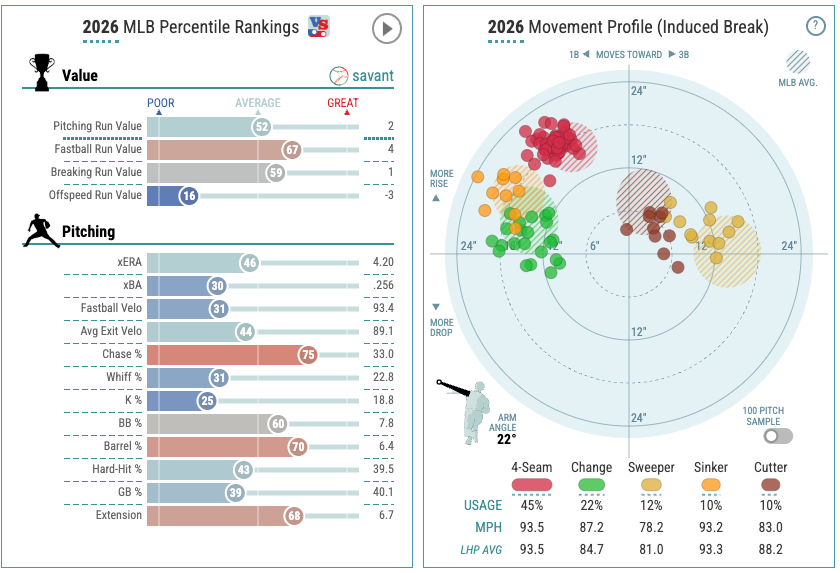
Rogers has produced a mostly average overall profile, but the way he gets there is interesting.
His 4.20 expected ERA ranks in the 46th percentile, hurt by his inability to miss bats, but offset by his ability to prevent damage.
His 18.8% strikeout rate and 22.8% whiff rate are both below average, while his 33% chase rate ranks in the 75th percentile. Rogers gets hitters to leave the strike zone, but he does not miss bats at a particularly high rate overall. His success depends on converting those chases into manageable contact, and he’s done that fairly well. Rogers’ 6.4% barrel rate ranks in the 70th percentile, and hitters have produced an average exit velocity of 89.1 mph against him.
His low 29-degree arm angle adds deception to a mostly-horizontal arsenal with significant velocity separation:
Four-seam fastball: 93.5 mph
Sinker: 93.2 mph
Changeup: 87.2 mph
Cutter: 83.0 mph
Sweeper: 78.2 mph
The four-seamer is his primary pitch, but Atlanta’s hitters will see two different versions of Rogers depending on which side of the plate they occupy.
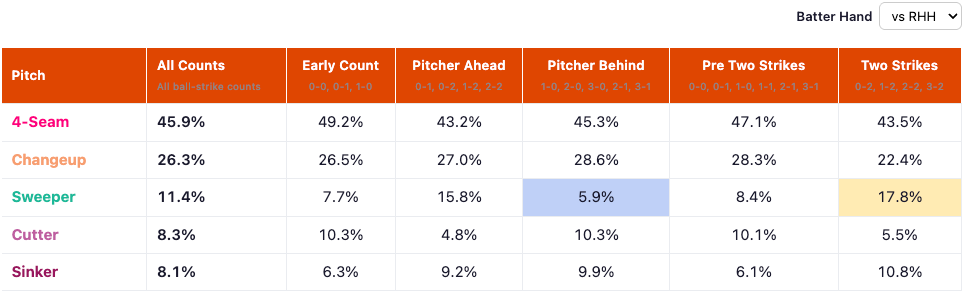
Against righties, Rogers relies heavily on his four-seamer and changeup. Those pitches account for 72.2% of his overall usage.
The four-seamer remains his most-used pitch in every count, while his changeup generally stays between 26% and 29% until he reaches two strikes. At that point, the sweeper becomes more important, rising to 17.8%.
When Rogers falls behind, his sweeper usage drops to 5.9%. That makes his approach more predictable for Albies, Dubón, Riley, White, Bart and Mateo.
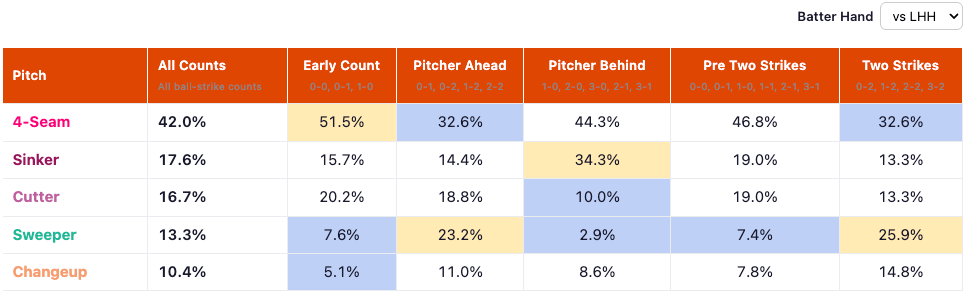
Against lefties, Rogers emphasizes the fastball family.
His four-seamer, sinker and cutter account for 76.3% of his overall pitches to left-handed hitters. That rises to 87.4% early in counts and 88.6% when he falls behind.
The equation changes once Rogers gets ahead. His sweeper usage climbs to 23.2% in pitcher-friendly counts and 25.9% with two strikes. His changeup also rises to 14.8% with two strikes.
For Baldwin, Olson and Harris, the most hittable pitches may arrive early. If they allow Rogers to reach his finishing sequences, they will have to account for considerably more sweep and speed separation.
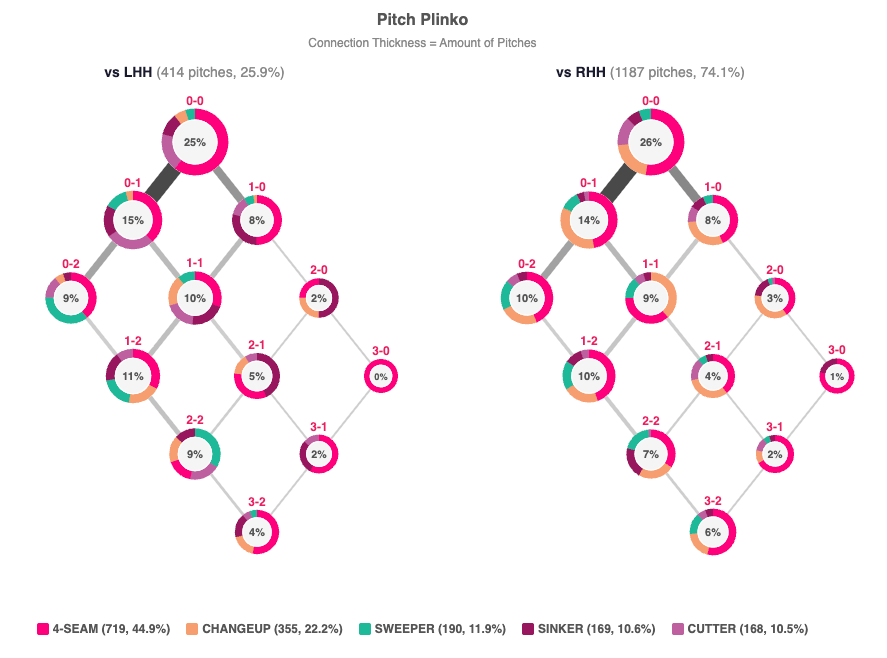
How to read a Plinko chart: Each circle represents the pitch usage in a given count. The percentage in the middle shows how frequently he pitched in that count, while the thickness of the connecting lines shows the most common pathways.
Rogers consistently avoids extended stretches in hitter-friendly counts. More of his pitches travel through 0–1 than 1–0 against hitters on both sides, while relatively few reach 2–0 or 3–0.
Atlanta’s clearest game plan is to prevent Rogers from getting ahead in the count. The Braves should be trying to ambush the various fastballs early. Trying to work the count might result in worse individual incomes, as it would allow Rogers to reach the sweeper sequences he wants.
Grant Holmes Against the Orioles
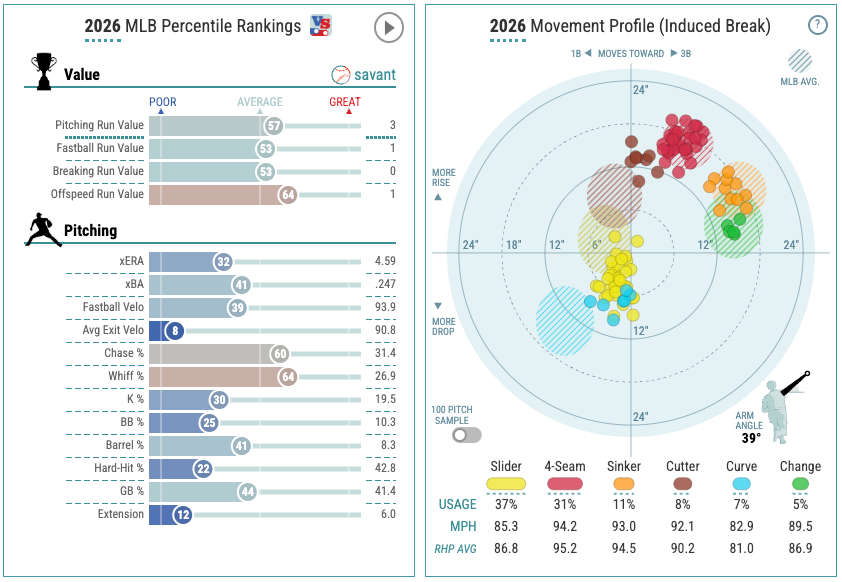
Holmes offers more bat-missing ability than Rogers, but his profile comes with greater risk.
His 26.9% whiff rate ranks in the 64th percentile, and his 31.4% chase rate is also above average. However, those swings have translated into only a 19.5% strikeout rate.
Command is part of the problem. Holmes has walked 10.3% of the hitters he has faced, while his contact-quality numbers create another concern - Opponents have produced a 90.8 mph average exit velocity and a 42.8% hard-hit rate against him. As a result, his expected ERA sits at 4.59.
Holmes uses six pitches, led by his slider:
Slider: 37% at 85.3 mph
Four-seam fastball: 31% at 94.2 mph
Sinker: 11% at 93.0 mph
Cutter: 8% at 92.1 mph
Curveball: 7% at 82.9 mph
Changeup: 5% at 89.5 mph
The depth of the arsenal allows Holmes to change his approach based on handedness, which will be important against Baltimore’s alternating lineup. (The problem is, we’ve also seen Holmes struggle the second time through the order when he makes those changes, so it’s a fine line to walk.)
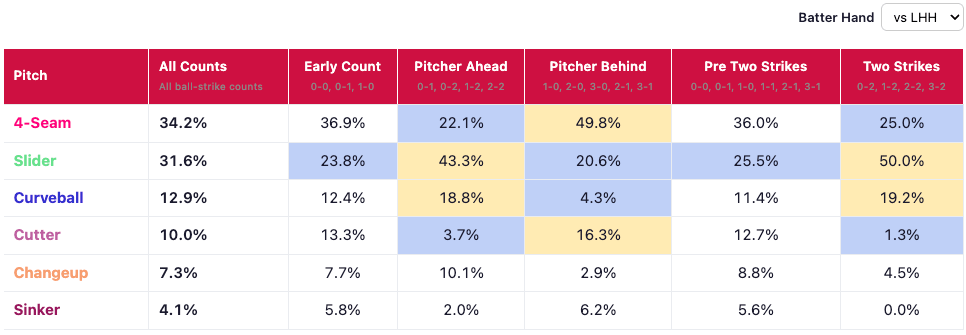
Against lefties, Holmes uses all six pitches. His four-seamer leads at 34.2%, followed closely by the slider at 31.6%.
The balance disappears when the count moves in either direction, via mostly expected adjustments.
When Holmes falls behind a left-handed hitter, his four-seam usage climbs to 49.8%. Including the cutter and sinker, fastballs account for 72.3% of his pitches in those situations.
When he gets ahead, he turns toward his breaking pitches. Slider usage climbs to 43.3%, with the curveball at 18.8%.
The pattern becomes even stronger with two strikes. Holmes throws a slider 50% of the time and a curveball another 19.2%. The sinker disappears completely, while the cutter falls to 1.3%.
Beavers, Henderson, Cowser, Taveras and Holliday can look for velocity if they get ahead. If Holmes controls the count, nearly seven out of every 10 two-strike pitches will be a slider or curveball.
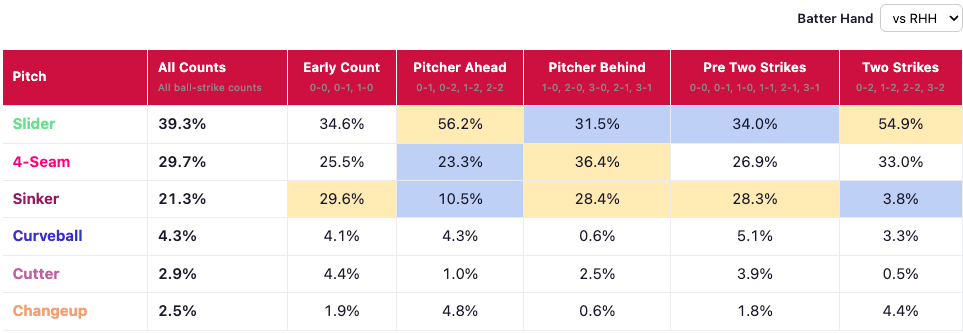
Holmes simplifies his approach against righties. The slider, four-seamer and sinker account for 90.3% of his pitches.
The sinker is most prominent early, when Holmes uses it 29.6% of the time. When he falls behind, the four-seamer and sinker combine for 64.8%.
Once Holmes gets ahead, the slider takes over. He throws it 56.2% of the time in pitcher-friendly counts and 54.9% of the time with two strikes. The sinker falls to only 3.8% with two strikes.
Alonso, Ward, Encarnacion-Strand and Tromp should have a relatively straightforward plan: force Holmes behind, look for velocity and avoid expanding against the slider when he gets ahead.
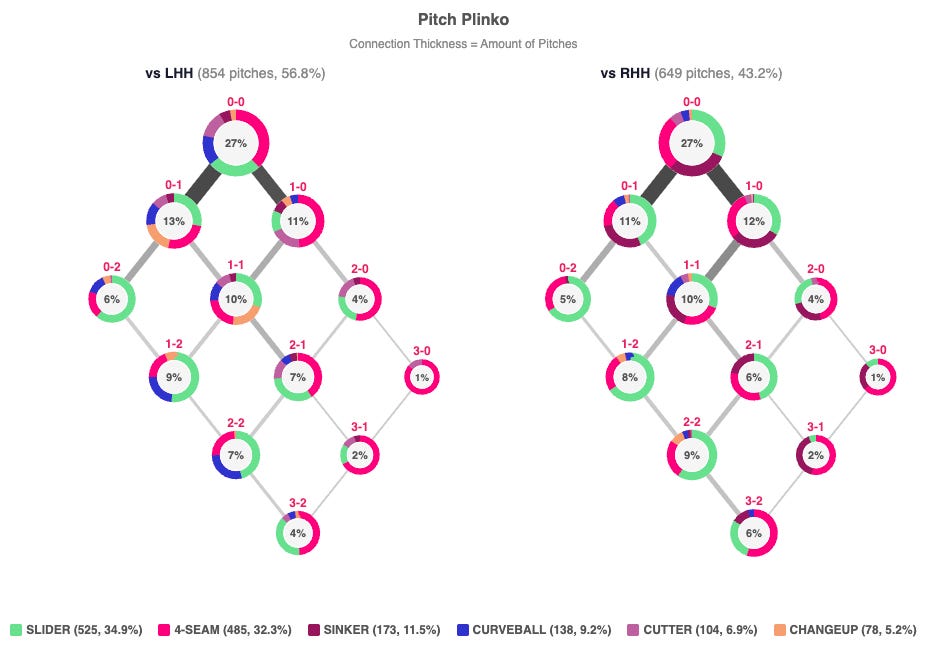
Holmes’ Plinko chart illustrates one subtle difference between his handedness splits.
Against lefties, more traffic moves through 0–1 than 1–0. Against righties, that relationship reverses slightly, and a greater percentage of his pitches arrive in 2–2 and full counts.
The Orioles’ alternating lineup is well suited to test both versions of Holmes. He will have to repeatedly shift from a broad six-pitch plan against lefties to a concentrated slider-and-fastball approach against righties.
Bullpen Status
Baltimore enters with a significant rest advantage.

Yesterday’s off day reset the Baltimore pen. Andrew Kittredge threw 11 pitches Wednesday, Tyler Wells threw nine and Yennier Cano threw 10. Anthony Nunez had the heaviest recent workload with 27 pitches Wednesday, but he got a full day of rest yesterday.
Rico Garcia and Grant Wolfram have not pitched since Sunday, while Albert Suárez is available for length.
Baltimore should have its entire late-inning structure available.
Atlanta’s options are more complicated.
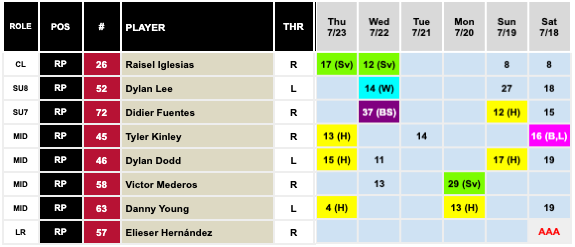
Raisel Iglesias threw 17 pitches while recording a save Thursday after throwing 12 pitches in another save Wednesday. After working on consecutive days, he is likely unavailable or limited Friday, although rules are always different for closers.
Dylan Dodd also worked both games, throwing 15 pitches Thursday after 11 Wednesday. His workload reduces Atlanta’s left-handed flexibility (although Dodd’s a reverse splits guy anyway).
Tyler Kinley threw 13 pitches Thursday but did not pitch Wednesday, so he should remain available. Danny Young needed only four pitches Thursday.
Dylan Lee and Victor Mederos last pitched Wednesday, throwing 14 and 13 pitches, respectively. Didier Fuentes received Thursday off, although his 37-pitch outing Wednesday may still limit how much Atlanta wants to ask from him. Elieser Hernández remains the primary length option.
All bullpen availability projections are based on recent usage and pitch counts rather than confirmed declarations from either club.
What This Means for the Braves
The bullpen disparity increases the importance of Holmes providing length, which hasn’t really been a thing for him recently.
If Atlanta has to begin matching relievers with Baltimore in the fifth or sixth inning, the Orioles will have more freedom to deploy their preferred options. The Braves may need to navigate the late innings without Iglesias and with Dodd limited.
That also places additional pressure on Atlanta’s offense to score before Rogers leaves the game.
Rogers’ underlying numbers make him beatable, but the Braves cannot afford to spend the first several innings chasing his pitches and waiting for Baltimore’s rested bullpen to take over. The best opportunity may come against his early-count fastballs, particularly for the left-handed hitters near the top. Think of it similarly to what they did against the Padres - get to the starter and build a lead so that you can take closer Mason Miller out of the equation altogether.
What to Watch
Can Atlanta’s lefties attack Rogers early?
Baldwin, Olson and Harris should see fastballs early before Rogers shifts toward his sweeper with two strikes. Their unusual concentration near the top of the lineup will either validate Atlanta’s confidence in the matchup or allow Rogers to move quickly through the Braves’ most dangerous hitters.
Can Holmes turn over the lineup?
Holmes’ breaking pitches give him a legitimate finishing plan, especially against Baltimore’s lefties. The problem first comes when walks and deep counts force him back toward predictable fastballs, and then the second time through, he has to either go with that same game plan and hope they haven’t adjusted/acclimated to it or he has to do something different and hope he can still be effective.
Who handles the ninth inning for Atlanta?
Iglesias has recorded saves on consecutive days. If the Braves take a narrow lead into the late innings, Walt Weiss may have to improvise against a Baltimore bullpen that enters at full strength.
Final Thought
Atlanta is the better team by record, but Baltimore has the cleaner setup for Friday night and consequently, goes into this one with the betting edge.
The Orioles have the fresher bullpen, the platoon-balanced lineup and a starter whose sequencing can punish an offense that waits too long to attack.
The Braves can pull this one off - they just need to win the early counts before Baltimore gets the opportunity to win the late innings.