


It’s Atlanta Braves baseball! Let’s break down everything you need to know about this afternoon’s matchup.
Game Info
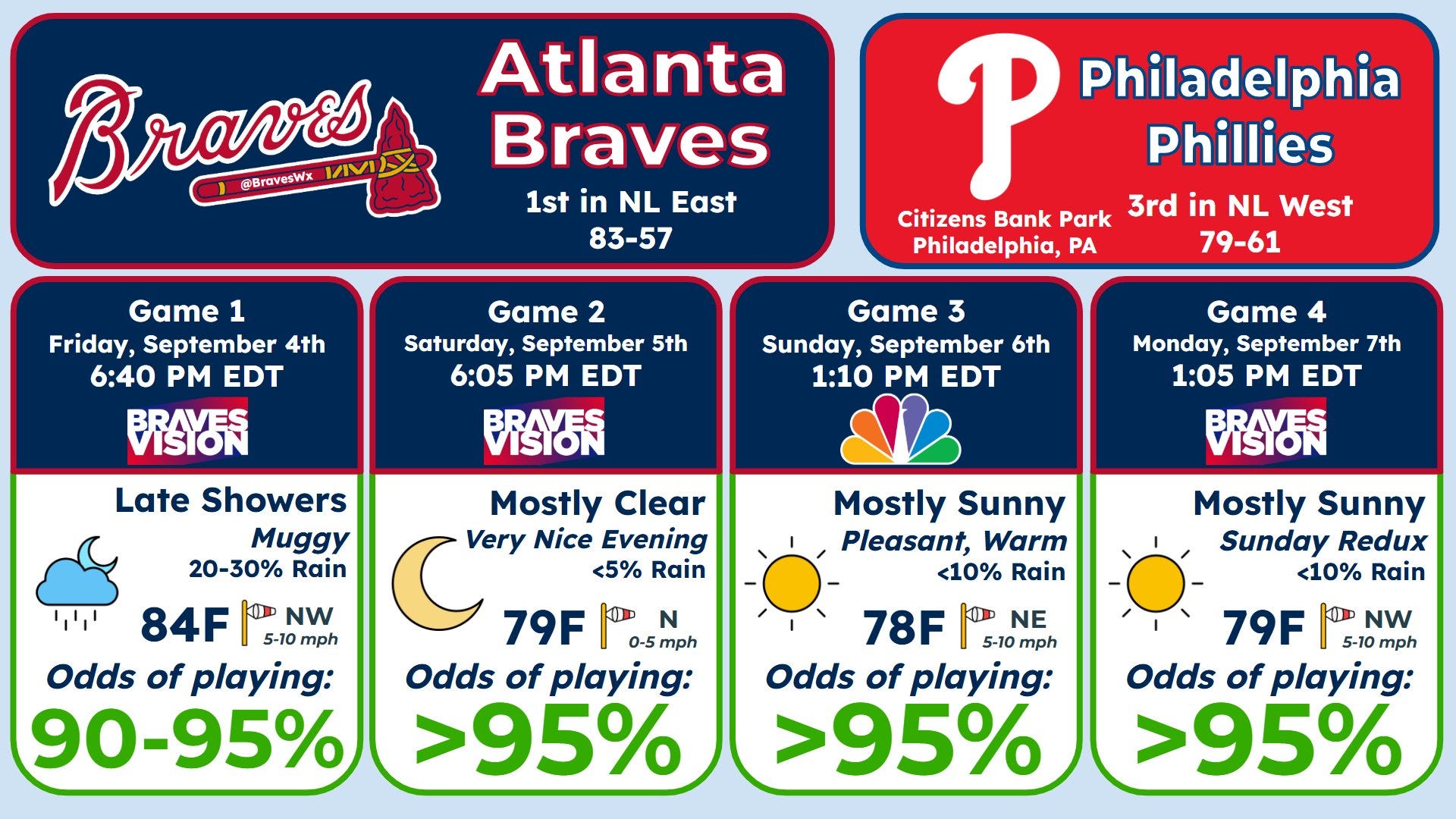
First Pitch: 6:40 PM ET
Location: Citizens Bank Park, Philadelphia PA
TV: BravesVision
Radio: 680 AM/93.7 FM The Fan, Los Bravos
Weather: Courtesy of @BravesWX on X
Atlanta Braves Lineup
RF Ronald Acuña Jr.
DH Drake Baldwin
2B Ozzie Albies
1B Matt Olson
LF Lane Thomas
CF Mauricio Dubón
C Sean Murphy
3B Austin Riley
SS Ha-Seong Kim
Quick thoughts:
Michael Harris II gets the day off, which is not something I expected for what could be argued is the biggest game/series of the year.
Philadelphia Phillies Lineup
DH Kyle Schwarber
SS Trea Turner
RF Bryce Harper
2B Luis Arraez
1B Alec Bohm
LF Edmundo Sosa
3B Bryson Stott
C JT Realmuto
CF Derek Hill
Quick thoughts:
With a lefty on the mound for Atlanta, Brandon Marsh gets the night off to go, dunno, simultaneously wash his beard and dry his hair.
Pitching Matchup
Braves Starter: LHP Chris Sale (13-9, 2.06)
Quick snapshot:
2.06 ERA / 2.99 xERA / 2.19 FIP
30.7% K / 4.9% BB / 25.9% K-BB%
Pitch mix:
vs LHH: 38% slider, 34% sinker, 27% four-seam fastball, 1% changeup
vs RHH: 46% four-seamer, 40% slider, 14% changeup, 1% sinker
What to watch:
Sale enters in absurd form. He posted a 2.00 ERA with 34 strikeouts, two walks and zero home runs allowed across 27 August innings. His last start was a 109-pitch shutout of the Dodgers with 11 strikeouts; he touched 100.1 mph and threw his final pitch at 98.6. The seven days between starts should help him recover from that workload.
The defining change is that Sale’s four-seamer has become a legitimate finishing pitch. It has overtaken the slider as his most-used offering at 41.3%, averaging 96.1 mph after sitting 94.8 last season. Hitters have managed a .217 average and .340 slugging percentage against it, and its whiff rate has climbed from 21.1% to 26.5%. Sale is now throwing it 42% of the time with two strikes, up from 32% last year.
The slider remains the pitch Philadelphia must somehow eliminate. It has held hitters to a .189 average, .244 slugging percentage and .221 xwOBA with a 38.5% whiff rate—and Sale has not allowed a home run with it all year. The four-seamer can be hit hard when poorly located; the slider has produced almost no authoritative contact.
Sale gives the Phillies’ lefties a different attack. He essentially replaces the changeup with his sinker against left-handed hitters, pairing two fastball shapes with the sweeping slider. Lefties have a .623 OPS against him, compared with .552 for righties, so Philadelphia’s heavily left-handed lineup is not necessarily the automatic disadvantage it appears to be.
Kyle Schwarber is the platoon-proof danger. Schwarber has a .899 OPS with 12 home runs against left-handed pitching this season. Bryce Harper, by comparison, is at .659. Sale has dominated Philadelphia twice this year—13 innings, one earned run, 16 strikeouts and three walks—but Schwarber remains the hitter most capable of turning one elevated fastball into instant damage.
Who to watch:
Most of Philly’s hitters have faced Sale, with most of them not being able to do much off the lefty.
Bad: Bryce Harper (.133 BA/.266 OPS in 15 PAs), JT Realmuto (.133 BA/.400 OPS in 15 PAs), Bryson Stott (0-3), Brandon Marsh (0-2)
Good: Kyle Schwarber (.263 AVG/1.017 OPS with 2 HR in 19 ABs), Alec Bohm (.278 AVG/.594 OPS in 18 ABs), Trea Turner (.316 AVG/.802 OPS in 19 ABs)
Opposing Starter: LHP Cristopher Sánchez (16-4, 2.52 ERA)
Quick snapshot:
2.52 ERA / 3.27 xERA / 2.58 FIP
27.8 K% / 5.4 BB% / 22.5% K-BB%
The arsenal:
Sinker (43%, 95.1 mph)
Changeup (38%, 87.0 mph)
Slider (19%, 86.3 mph)
Atlanta’s path against Sánchez:
Atlanta’s path against Sánchez: Attack the sinker before the changeup and slider take over. Sánchez throws only three pitches: a 95.1-mph sinker 43.4% of the time, changeup 37.7% and slider 18.9%. The changeup and slider carry whiff rates of 47.1% and 45.5%, respectively. The sinker produces only a 12.3% whiff rate and has allowed a .343 average, .475 slugging percentage and .365 xwOBA.
This should be controlled aggression, not generic patience. Sánchez puts 60% of his sinkers in the strike zone, compared with only 33% of his changeups. Atlanta cannot repeatedly take hittable early-count sinkers and then attempt to survive a changeup that has generated a +16 run value and 111 strikeouts. Hunt the sinker in the zone; reject the changeup underneath it.
Load the lineup with right-handed hitters—but understand the tradeoff. Lefties have produced an almost unbelievable .155/.171/.186 line and .357 OPS against Sánchez. Righties are at .280/.333/.404 with a .737 OPS. Sánchez has reinforced that split by throwing approximately 66.5% sinkers to lefties but only 38.3% to righties; against righties, his changeup usage jumps to 45.3%. Acuña, Riley, Dubón, Kim and Murphy offer Atlanta’s better route, but they will see his best pitch constantly.
The second look has been the best opportunity. Opponents have a .593 OPS the first time through the order and .706 the second time, with Sánchez’s home-run rate climbing from 0.44 to 1.39 per nine. The third-time-through OPS drops slightly to .652, so Atlanta shouldn’t structure its plan around waiting him out until the sixth inning. The fourth and fifth innings may contain the best combination of familiarity and fastball availability.
Atlanta has already shown it can create traffic against him. The Braves collected eight hits in six innings during the April matchup, although all three runs were unearned and the decisive rally required defensive mistakes. That game demonstrated a plausible formula—put sinkers in play and make Philadelphia execute—but not a repeatable three-run offensive breakthrough.
Sánchez is coming off seven scoreless innings, but baserunners are not impossible. He owns a 2.52 ERA with 202 strikeouts and only 39 walks, yet has allowed 170 hits and carries a 1.19 WHIP. He has succeeded despite a .335 BABIP because the strikeouts, ground balls and limited walks prevent traffic from becoming crooked numbers.
The Braves against Sánchez:
The good: Ronald Acuña Jr. (4-13, HR), Ozzie Albies (8-15, 1.230 OPS), Drake Baldwin (3-6), Matt Olson (6-20, 2 HRs, 1.033 OPS), Austin Riley (6-12, HR, 1.212 OPS), Lane Thomas (8-14, HR, 1.576 OPS)
The bad: Michael Harris II (2-15), Sean Murphy (2-11), Mike Yastrzemski (0-4)
How he attacks hitters (all graphics courtesy of Thomas Nestico)
vs LHH: More sinkers when behind, more sliders when ahead, virtually no changeups unless it’s a pitcher’s count.

vs RHH: More changeups when ahead, more sinkers when behind, relatively static use of a slider at just under 1-in-every-5-pitches.

Sequencing:
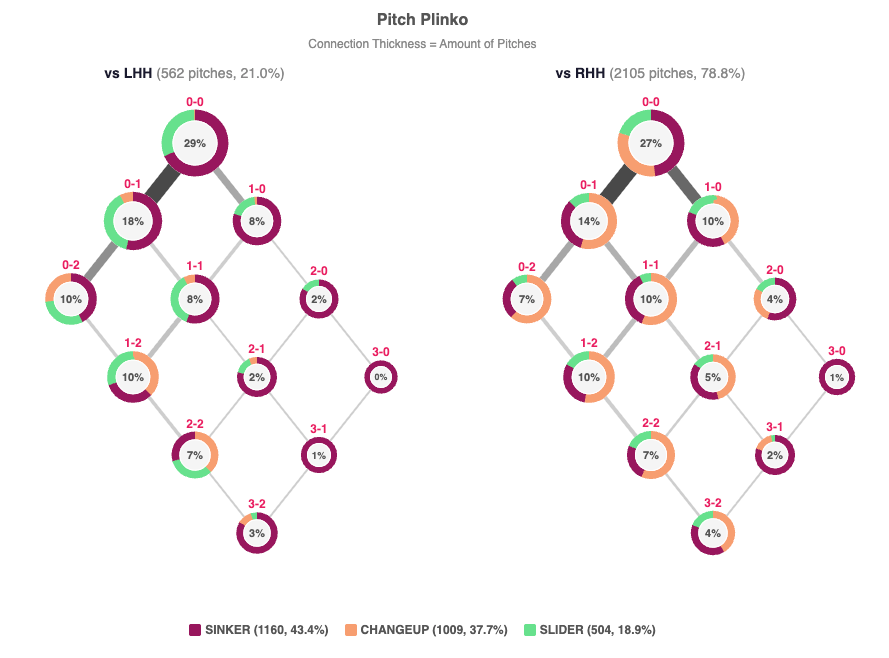
How to read a plinko chart: Each circle represents the usage of a pitcher’s arsenal in a given count (color key is on the bottom of the graphic). The thickness of the connecting lines reflects how often each count occurs, helping show how a pitcher navigates an at-bat.
Braves Bullpen Status
(Reminder: these are all assumptions based on pitch count and recent usage)
Likely available:
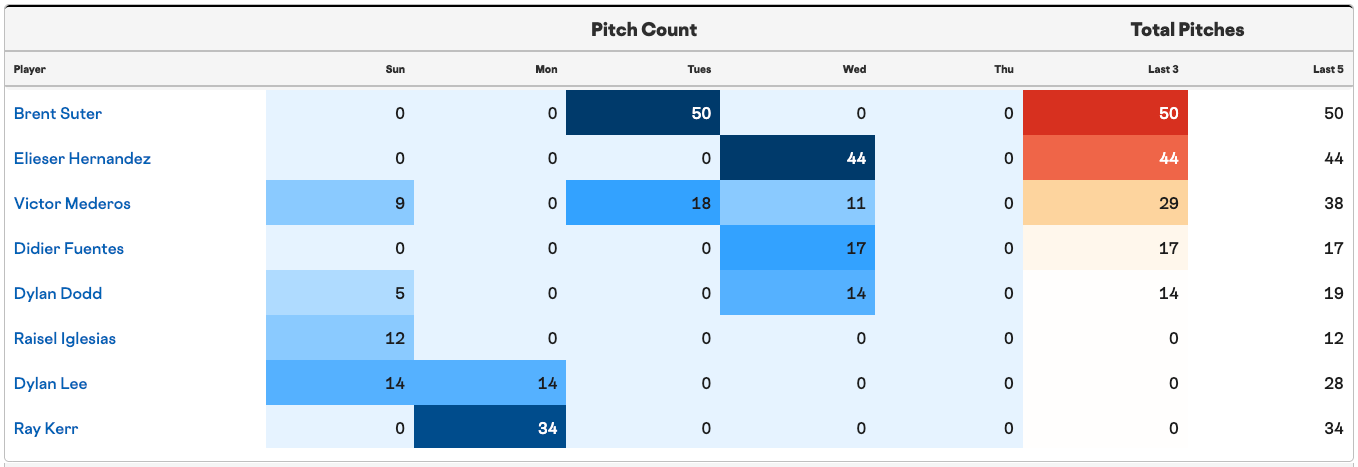
All of the leverage arms that pitched on Wednesday are recovered and back, while the team’s been able to give both Raisel Iglesias and Dylan Lee an extended break.
Potential limitations:
Elieser Hernandez is probably down for one more day after throwing 44 pitches on Wednesday.
Quick takeaway:
I’m particularly interested in how Atlanta’s lefties, and specifically Ray Kerr, do against Philly’s lefty-heavy lineup/bench.
Opponent Bullpen Status
Likely Available/Potential Limitations:
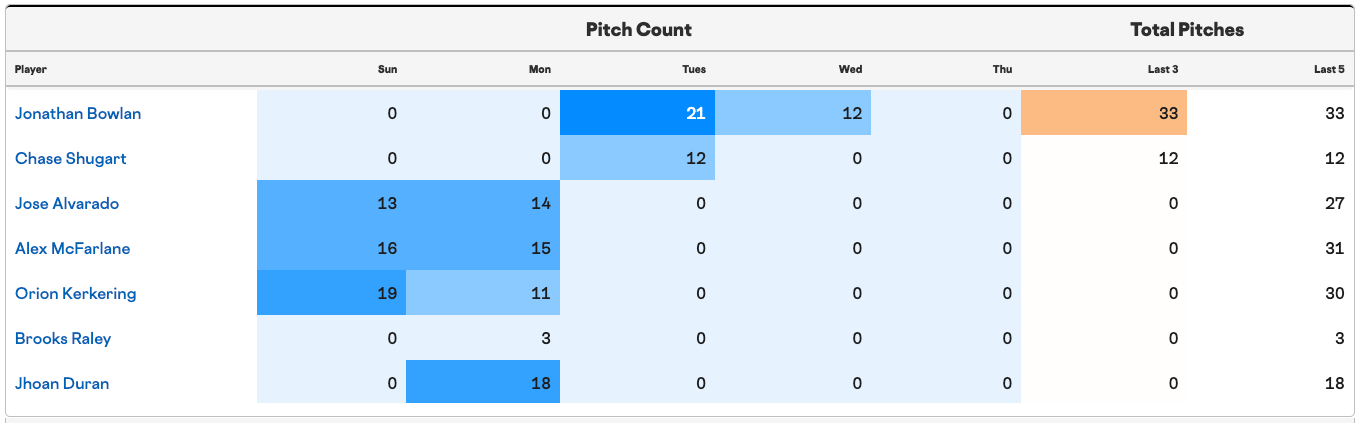
Based solely on usage, everyone should be on the board for Philly tonight.
Quick takeaway:
This may be the freshest bullpen I’ve ever seen for game 141 of a season.
Final Thought
The Braves are -106 on the moneyline to Philly’s -110 and FanDuel has set the over/under at only seven runs. This game will be decided by which offense converts early-count fastballs before the secondary pitches take over. Atlanta has the clearer target: Sánchez’s hittable sinker. Once Braves hitters fall behind, his changeup and slider can make the strike zone effectively disappear. Philadelphia’s assignment is harder because Sale’s four-seamer has transformed from his vulnerability into an out pitch—but Schwarber supplies one very real exception. In a matchup featuring two pitchers who become terrifying with two strikes, the most important swings may come before either hitter reaches one.
Let’s Talk About It
If you’d rather watch this, here’s the Braves Today live stream from this afternoon, after lineups were announced.
You knew I was responding to your comment on Marsh, right?
HAHA!! Man, cut that crap OFF!! No wash job will do. Gotta have a razor from his neck to the top of that greasers head! He's disgusting!!