


It’s Atlanta Braves baseball! Let’s break down everything you need to know about this afternoon’s matchup.
Game Info
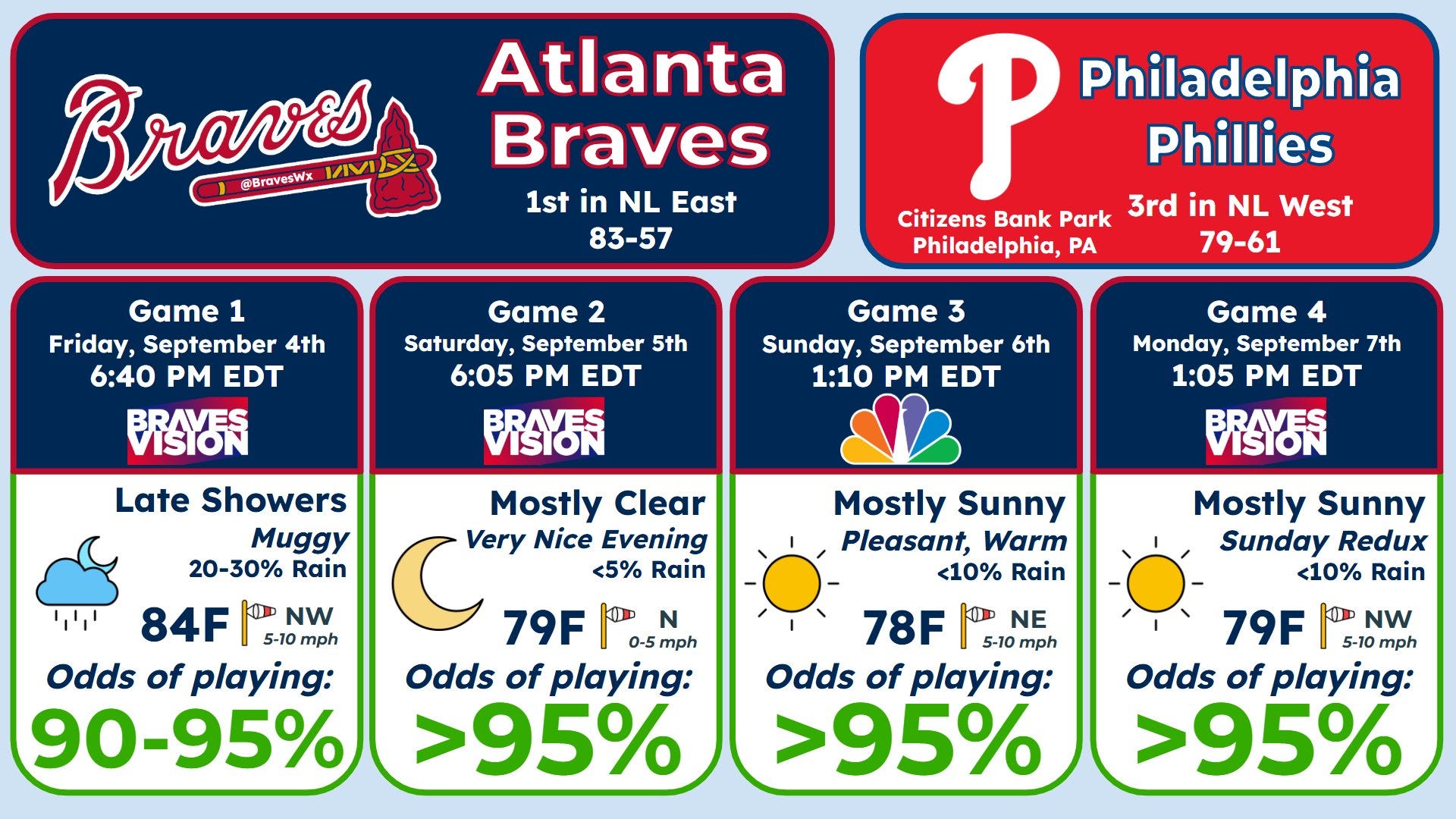
First Pitch: 1:05 PM ET
Location: Citizens Bank Park, Philadelphia PA
TV: BravesVision
Radio: 680 AM/93.7 FM The Fan, Los Bravos
Weather: Courtesy of @BravesWX on X
Atlanta Braves Lineup
DH Ronald Acuña Jr.
C Drake Baldwin
2B Ozzie Albies
1B Matt Olson
RF Lane Thomas
CF Michael Harris II
LF Mauricio Dubón
3B Austin Riley
SS Ha-Seong Kim
Quick thoughts:
Sean Murphy, despite a lefty on the mound, gets the day off so that Acuña can have a “half-day” at DH.
Philadelphia Phillies Lineup
DH Kyle Schwarber
SS Trea Turner
RF Bryce Harper
2B Luis Arraez
1B Alec Bohm
3B Bryson Stott
LF Brandon Marsh
C JT Realmuto
CF Justin Crawford
Quick thoughts:
Garrett Stubbs goes back to the bench in favor of Realmuto, who returns to the #8 spot in the order.
Pitching Matchup
Braves Starter: RHP Grant Holmes (9-5, 3.62 ERA)
Quick snapshot:
3.62 ERA / 4.73 xERA / 4.71 FIP
18.5% K / 9.8% BB / 8.7% K-BB%
Pitch mix:
vs LHH: 35% slider, 28% four-seamer, 12% cutter, 11% curveball, 9% changeup, 6% sinker
vs RHH: 41% slider, 30% four-seamer, 21% sinker, 3% each of cutter, curveball, & changeup
What to watch:
Holmes’s recent run prevention has been solid, but the dominance hasn’t returned. He owns a 3.15 ERA over his last seven starts, yet has only 21 strikeouts against 12 walks in 34⅓ innings. His last appearance ended after three hitless innings because of a 1-hour, 26-minute rain delay, so the short outing wasn’t performance- or health-related.
The slider has to carry him. Holmes throws it 37.1% of the time, and it has generated a 39.3% whiff rate while holding hitters to a .280 wOBA. The curveball has also been effective, but the fastball group is much more vulnerable: His four-seamer has allowed a .354 wOBA, his sinker .358 and his cutter .471. Hitters are slugging .610 against the cutter.
The second trip through the order remains the danger zone. Opponents have a .546 OPS the first time they see Holmes, but that jumps to .897 on the second trip before falling to .661 on the third. That unusual rebound doesn’t make the middle innings harmless—Holmes generally faces too few hitters a third time for it to offset the much larger second-look problem.
The season ERA is considerably friendlier than the contact underneath it. Holmes has a 3.62 ERA but a 4.73 xERA, with an 18.5% strikeout rate, 43.6% hard-hit rate and .333 xwOBA allowed. His chase and whiff rates remain above average, but hitters make too much contact inside the zone once they decline the slider.
This isn’t a conventional platoon problem. Lefties have a .698 OPS against Holmes and righties a .716. The difference is how the damage arrives: Lefties have hit 12 of his 19 home runs and drawn 38 walks, making Schwarber and Harper the obvious threats even though righties have produced the higher batting average.
Holmes has already faced Philadelphia twice this season. He allowed five runs and three homers across 10⅔ innings, with eight strikeouts and four walks. Atlanta won both games, but that 4.22 ERA came with enough traffic and power damage to reinforce the need for a reasonably quick bullpen trigger.
Who to watch:
The Phillies against Holmes:
The good: Bryce Harper (2-for-4, HR, three walks, 1.964 OPS), Trea Turner (2-for-7, HR, two walks, 1.159 OPS), Kyle Schwarber (1-for-7, HR, two walks, .905 OPS) and Garrett Stubbs (2-for-3).
The bad: Alec Bohm (0-for-7), J.T. Realmuto (0-for-4), Brandon Marsh (2-for-9, .556 OPS) and Bryson Stott (2-for-8, .583 OPS).
Worth noting: The entire active roster has only 65 combined at-bats against Holmes, so these are matchup notes rather than strong predictive samples.
Opposing Starter: RHP Jesús Luzardo (13-5, 3.02 ERA)
Quick snapshot:
3.02 ERA / 2.94 xERA / 2.86 FIP
30.0 K% / 7.3 BB% / 22.7% K-BB%
The arsenal:
Sweeper: 38%, 86.1 mph
Four-seamer: 26%, 96.8 mph
Changeup: 19%, 86.0 mph
Sinker: 17%, 95.8 mph
Atlanta’s path against Luzardo:
Stack the lineup with as many credible right-handed bats as possible. Lefties have been nearly erased by Luzardo, hitting approximately .145/.195/.175 against him. Righties are at .246/.318/.395—a .713 OPS compared with roughly .370-.420 for lefties, depending on the endpoint. Olson, Harris and any other left-handed starter face an exceptionally difficult assignment; Acuña, Riley, Albies and Thomas provide the clearer route.
Win the count before the sweeper takes over. Luzardo throws the pitch approximately 38% of the time, but its usage rises to 54.3% when he is ahead and about 50% with two strikes. Hitters are batting .117 and slugging .169 against it, with a 47.9% whiff rate. It is one of baseball’s most valuable individual pitches.
Which Braves righties handle the sweeper best? Ronald Acuña Jr. presents the strongest contact-quality matchup. Against all sweepers this season, he owns a .380 xwOBA and .553 xSLG; against left-handed sweepers specifically, those figures rise to .410 and .590, albeit in only seven plate appearances. Ozzie Albies has provided the most reliable contact from the right side, batting .313 with a .438 slugging percentage and only a 21.1% whiff rate across 20 plate appearances. Mauricio Dubón has the best actual results—.500 average and .700 slugging—but his ten-plate-appearance sample and .360 xwOBA counsel caution. Austin Riley offers damage potential, including a barrel on one of his two balls in play against lefty sweepers, but his 42.1% whiff rate makes him the group’s boom-or-bust option. Acuña and Albies appear to be Atlanta’s strongest bets against Luzardo’s defining pitch.
The four-seamer is Atlanta’s preferred target. Despite averaging nearly 97 mph, it has allowed a .282 average, .449 slugging percentage and .355 wOBA, with only an 18.5% whiff rate. The changeup has also surrendered a .451 slugging percentage, although its 38.1% whiff rate makes it far more dangerous to hunt. The practical plan is to attack a fastball in an advantage count—not simply sit on anything hard.
His improvement is real, not an ERA illusion. Luzardo enters with a 3.02 ERA, 2.86 FIP, 209 strikeouts and 51 walks over 169⅔ innings. He has a 1.90 ERA over his last 10 starts, and his underlying metrics have rated him among baseball’s best starters. The primary evolution has been throwing fewer four-seamers while leaning more heavily on his sweeper and improved sinker.
The home split offers Atlanta at least a sliver of encouragement. Luzardo has a 4.52 ERA and 12 home runs allowed in 77⅔ innings at Citizens Bank Park, compared with a 1.76 road ERA. Twelve of his 15 homers have been surrendered at home. Much of that was created by his ugly April, so I wouldn’t call it a current weakness—but the park’s short porches have punished his mistakes much more severely.
The Braves against Luzardo:
The good: Lane Thomas (9-for-22, four HR, 1.504 OPS). Ronald Acuña Jr. is 4-for-14 with four walks and a .444 OBP, although all four hits have been singles.
The bad: Matt Olson (5-for-27, HR, .519 OPS), Ozzie Albies (5-for-22, .625 OPS), Michael Harris II (3-for-13, .641 OPS) and Austin Riley (6-for-23, .694 OPS).
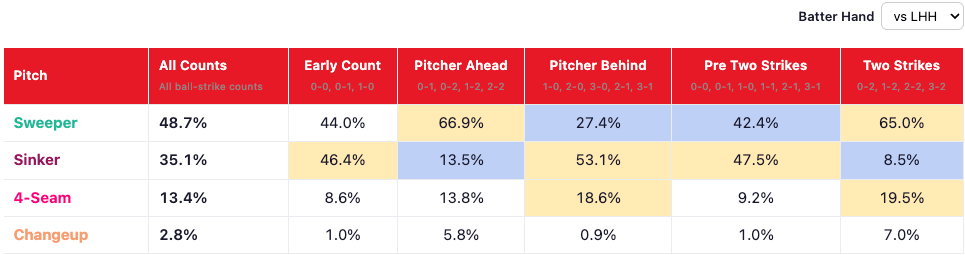
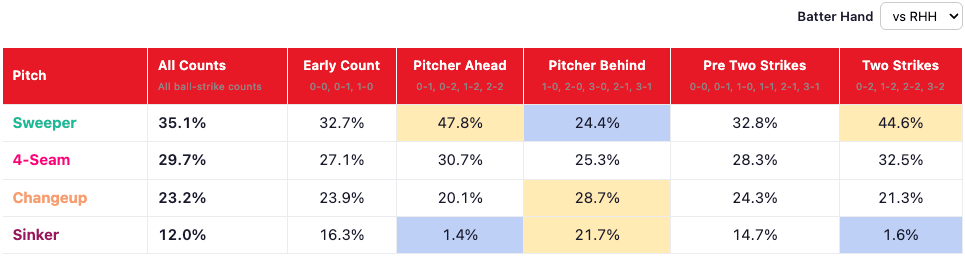
How he attacks hitters (all graphics courtesy of Thomas Nestico)
vs LHH: A mostly two-pitch attack based on the sweeper, one that swaps fastball usage between sinkers and four-seamers based on count. Changeups are mostly reserved for pitcher’s counts, but even then are mostly to surprise with a velocity change.
vs RHH: Here’s your explanation for the dramatic OPS difference - an off-handed sweeper is still his primary pitch against righties, with the changeup becoming the third offering. It’s a balanced, four-pitch attack when behind and a three-pitch arsenal when ahead.
Sequencing:
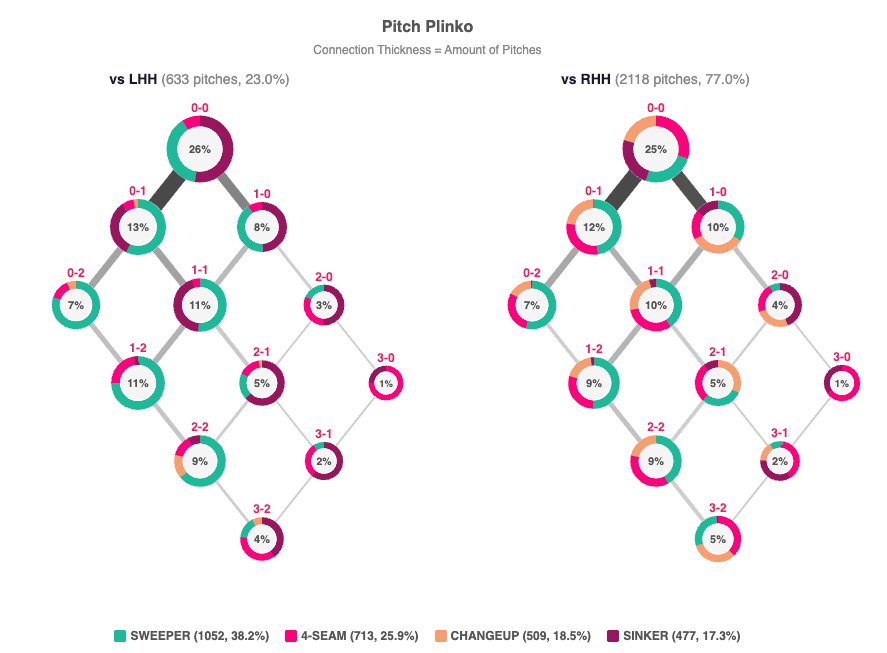
How to read a plinko chart: Each circle represents the usage of a pitcher’s arsenal in a given count (color key is on the bottom of the graphic). The thickness of the connecting lines reflects how often each count occurs, helping show how a pitcher navigates an at-bat.
Braves Bullpen Status
(Reminder: these are all assumptions based on pitch count and recent usage)
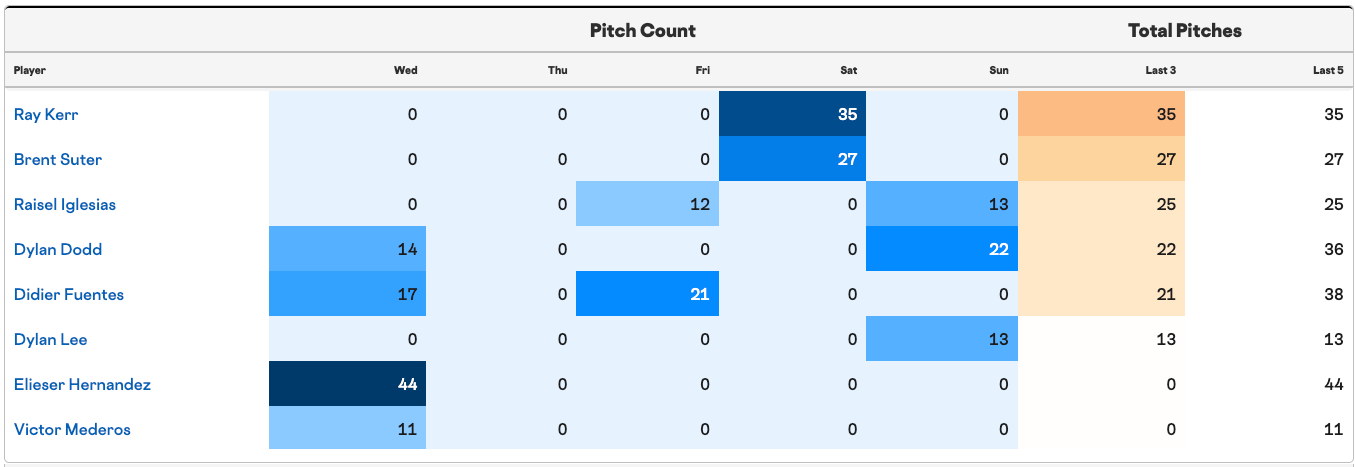
Likely available:
None of the leverage arms had pitch counts on Sunday (or in the series) that would prohibit them from returning today.
Potential limitations:
Ray Kerr (35 pitches on Sat) is likely down for one more, although Brent Suter (27) could probably come back, if needed.
Quick takeaway:
The pitch counts are starting to tick up, but the Braves are still in a good spot here.
Opponent Bullpen Status
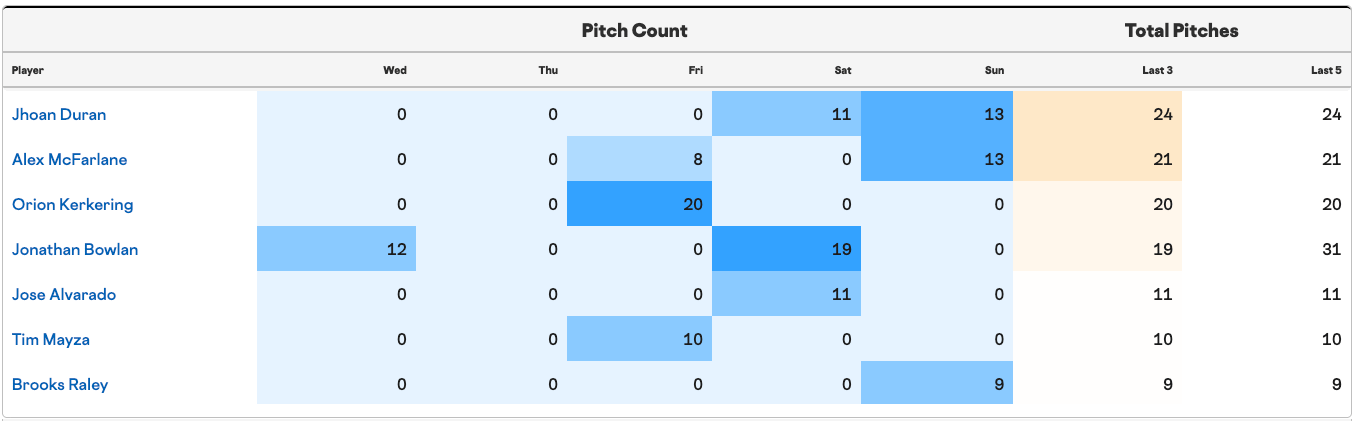
Likely Available/Potential Limitations:
Philly’s pitch counts are also starting to tick up, most specifically with closer Johan Duran now on a back-to-back, but no one should be off-limits for Philly in the finale.
Quick takeaway:
Atlanta got the best-case scenario of Philly’s leverage arms throwing in a loss, but none of them went deep enough into their outings to take them off the board for the finale.
Final Thought
The Braves are +146 on the moneyline to Philly’s -174 and FanDuel has set the over/under at eight runs. Can Atlanta’s right-handed hitters damage Luzardo’s fastball before reaching sweeper counts? If Luzardo consistently gets ahead, his sweeper can neutralize the lineup and carry him seven innings. Atlanta’s opening comes through Acuña, Riley, and especially Thomas, forcing four-seamers into the strike zone. Holmes’s corresponding job is to survive the second trip through Philadelphia’s order without allowing walks in front of Schwarber and Harper.
Let’s Talk About It
If you’d rather watch this, here’s the Braves Today live stream from this afternoon, after lineups were announced.