


It’s Atlanta Braves baseball! Let’s break down everything you need to know about this evening’s matchup.
Game Info
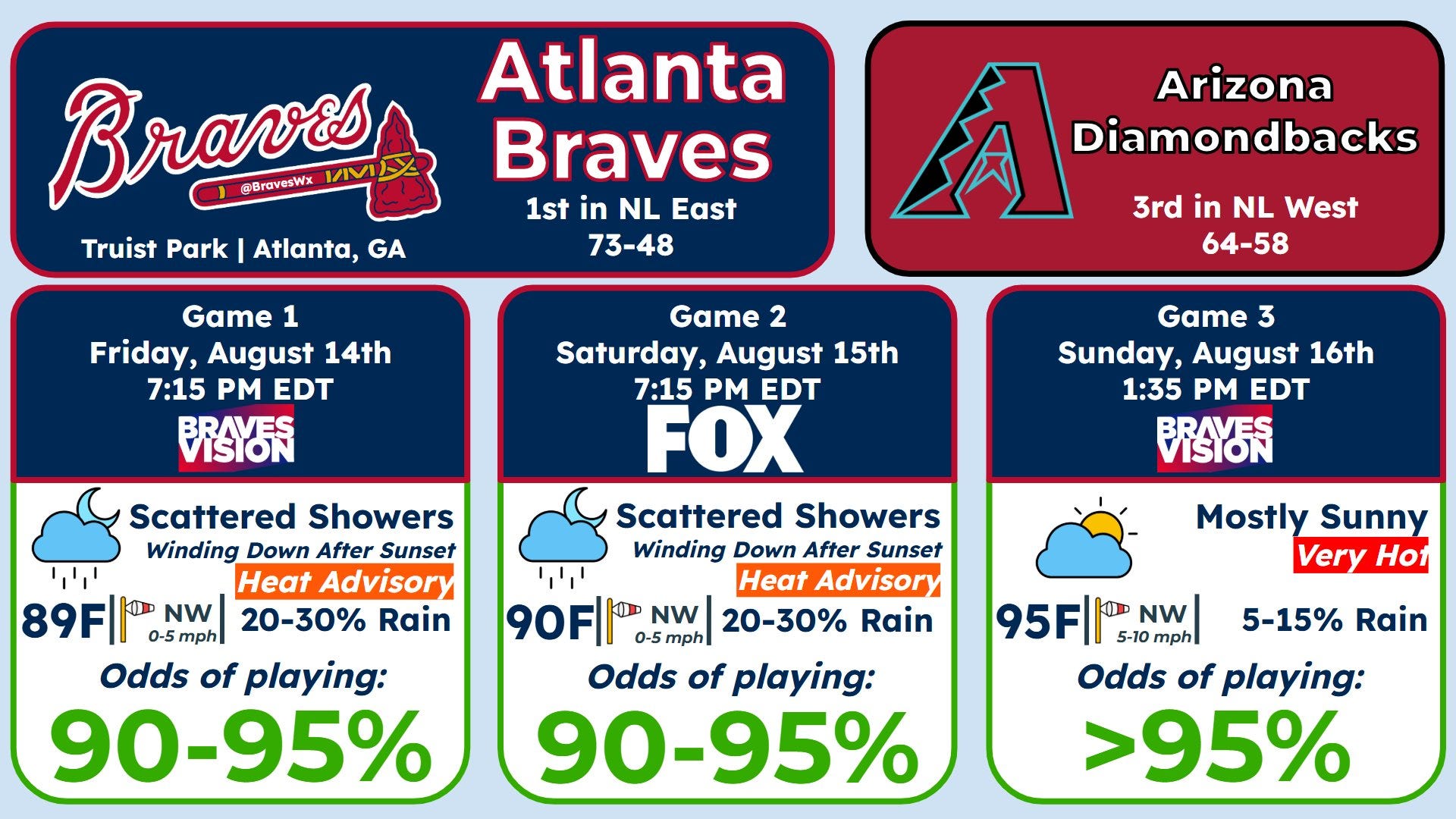
First Pitch: 1:35 PM ET
Location: Truist Park, Atlanta
TV: BravesVision
Radio: 680 AM/93.7 FM The Fan, Los Bravos
Weather: Courtesy of @BravesWX on Twitter/X
Atlanta Braves Lineup
C Drake Baldwin
RF Ronald Acuña Jr.
1B Matt Olson
CF Michael Harris II
LF Mike Yastrzemski
2B Ozzie Albies
DH Dominic Smith
3B Austin Riley
SS Jim Jarvis
Quick thoughts:
Mauricio Dubón gets the day off, with Dom checking in at designated hitter and both Ronald and Yastrzemski in the outfield corners.
Arizona Diamondbacks Lineup
SS Geraldo Perdomo
RF Corbin Carroll
DH Gabriel Moreno
2B Ketel Marte
LF Max Kepler
3B Nolan Arenado
1B Tim Tawa
C James McCann
CF Jorge Barrosa
Quick thoughts:
Ketel Marte, who left Friday night’s game with “left knee soreness” and missed Saturday, is back in for the finale.
Pitching Matchup
Braves Starter: RHP Bryce Elder (8-7, 4.03)
Quick snapshot:
4.03 ERA / 4.08 xERA / 4.59 FIP
19.4% K / 8.1% BB / 11.3% K-BB%
Pitch mix:
vs LHH: 30% four-seamer, 23% slider, 19% cutter, 15% sinker, 14% changeup
vs RHH: 52% sinker, 26% slider, 10% four-seamer, 7% cutter, 5% changeup
What to watch:
Elder’s last start looks more like a blowup than the beginning of another collapse. Before allowing seven runs to the Mets, he had surrendered five earned runs over his previous four starts and 24 innings. His 4.03 ERA and 4.09 xERA are closely aligned, so there isn’t an obvious statistical warning that his entire season is about to unravel.
Arizona’s right-handed hitters are the larger threat. Righties have hit .282/.327/.436 with a .334 wOBA against Elder, compared with .211/.287/.383 and a .295 wOBA for lefties. Arizona’s contact-heavy approach could make Nolan Arenado, Gabriel Moreno and the switch hitters more problematic than Corbin Carroll and the other lefties. Elder’s excellent changeup gives him a better weapon against left-handed bats.
Elder’s defining task: Stay out of fastball counts. Opponents have a .275 wOBA after he gets ahead 0-1, but that rises to .304 after 1-0 and .429 after 2-0. Arizona is difficult to strike out, so Elder needs the freedom to use his slider and changeup on the edges instead of supplying predictable sinkers and four-seamers.
The changeup should be especially important. It has held opponents to a .180 average, .220 slugging percentage and .218 xwOBA while producing Elder’s best contact-quality numbers. His slider remains the better swing-and-miss offering, but the changeup gives him a way to produce poor contact from a lineup that refuses to whiff.
Who to watch:
The only player with more then seven ABs against Elder is Nolan Arenado at 3-14 (crosses fingers), no one on Arizona’s roster has taken Elder deep (does an unjinxing dance) and no one’s really been dominant against him in their limited looks (sacrifices a chicken at an altar).
Opposing Starter: RHP Michael Soroka (8-3, 2.92 ERA)
Quick snapshot:
2.92 ERA / 4.16 xERA / 2.93 FIP
23.6 K% / 5.7 BB% / 17.9 % K-BB%
The arsenal:
Slurve (33%, 80.6 mph)
Four-seamer (32%, 93.6 mph)
Changeup (12%, 85.9 mph)
Cutter (12%, 89.0 mph)
Sinker (10%, 93.3 mph)
Sweeper (1%, 83.0 mph)
What This Means for the Braves
Soroka after the IL: The arsenal remained essentially unchanged. In his return against Colorado, he threw 32% slurves, 27% four-seamers, 14% cutters, 13% changeups and 12% sinkers. His season rates are 33%, 32%, 12%, 12% and 10%, respectively. The only noticeable adjustment was taking roughly five percentage points from the four-seamer and distributing them among the other pitches, which is very much within the range of normal variation from start to start.
The slurve came back intact. Soroka generated four whiffs and three of his four strikeouts with it. Its 80.9 mph velocity and movement were almost identical to his season averages. That matters because the slurve is the main reason for his resurgence this season: opponents have a .194 average and .265 xwOBA against it, with a 33.5% whiff rate.
The fastball velocity is concerning, but not yet alarming. His four-seamer averaged 92.8 mph in his return, down from 93.6 for the season, while his sinker was down from 93.3 to 92.7. He still reached 94.6, and the injury was a left-glute strain rather than an arm problem, but Atlanta should see whether the average velocity rebounds in his second start.
The biggest post-IL difference was his strike-throwing. Soroka walked three in 4⅓ innings after issuing only 17 walks in his previous 82 innings. His first-pitch strike rate fell from 64.1% for the season to 56% in the return, and only 47 of his 77 pitches were strikes. He still allowed just three hits and generated weak contact, but the scoreless line was cleaner than the underlying command.
There may still be a workload opportunity. Soroka made only one four-inning rehab start before returning and was removed at 77 pitches against Colorado. Arizona may allow him to approach 85–90 today, but Atlanta should not help him cruise through five innings. The Braves made him throw 91 pitches in five innings when they faced him in April, drawing three walks despite scoring only once.
Atlanta’s path against Soroka: Prioritize the lefties and force him away from the slurve. Left-handed hitters have produced a .270/.327/.416 line and .326 wOBA against him, compared with just .177/.215/.274 and a .218 wOBA for righties. The slurve is his clear finishing pitch; the cutter has allowed a .313 average, .625 slugging percentage and .403 wOBA. Atlanta wants to avoid expanding against the slurve below the zone and make Soroka supply fastballs and cutters in hitter’s counts.
Soroka’s 2.92 ERA remains somewhat misleading. His 4.17 xERA is more than a run higher, and Statcast estimates that the contact he has allowed would normally have produced approximately 10 home runs rather than six. His improved slurve and strikeout-to-walk foundation are legitimate, but the run prevention has received some assistance from favorable home-run results.
The Braves against Soroka: all small sample sizes here, sadly - the most ABs anyone has against him is eight by Dom Smith, and only two of those have been after 2020.
The good: Drake Baldwin is 1-4 with a homer, while both Michael Harris II and Mauricio Dubón are 2-3. Matt Olson’s 1-4 with a double.
The bad: Ozzie Albies is 0-4 and Ronald Acuña Jr. is 0-2, while Austin Riley is 1-5.
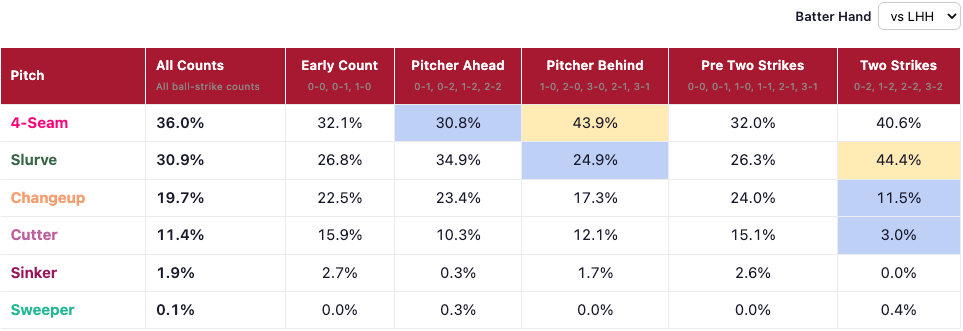
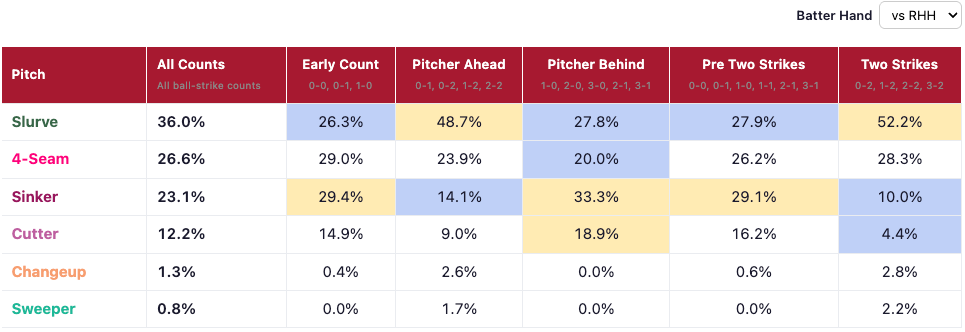
How he attacks hitters (all graphics courtesy of Thomas Nestico)
vs LHH: A well-rounded mix with some expected tendencies: less breaking balls and more fastballs when behind, and more of that killer slurve when ahead and with two strikes.
vs RHH: A slurve-and-fastball-group-dominant package, one that makes the expected changes based on state of the at-bat - more fastballs when behind, more slurves when ahead.
Sequencing:
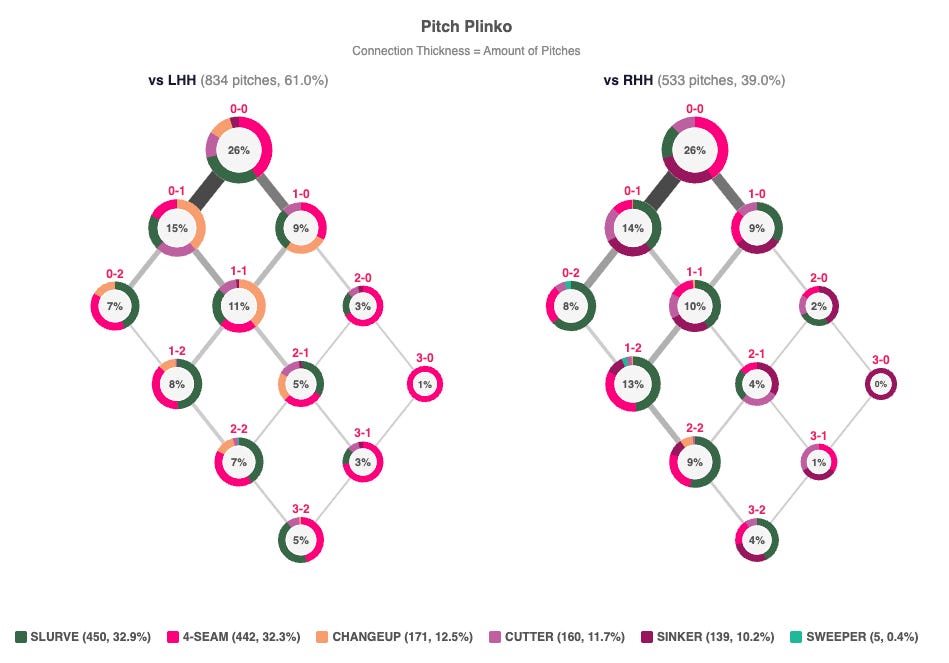
How to read a plinko chart: Each circle represents the usage of a pitcher’s arsenal in a given count (color key is on the bottom of the graphic). The thickness of the connecting lines reflects how often each count occurs, helping show how a pitcher navigates an at-bat.
Braves Bullpen Status
(Reminder, these are all assumptions based on pitch count and recent usage)
Likely available:
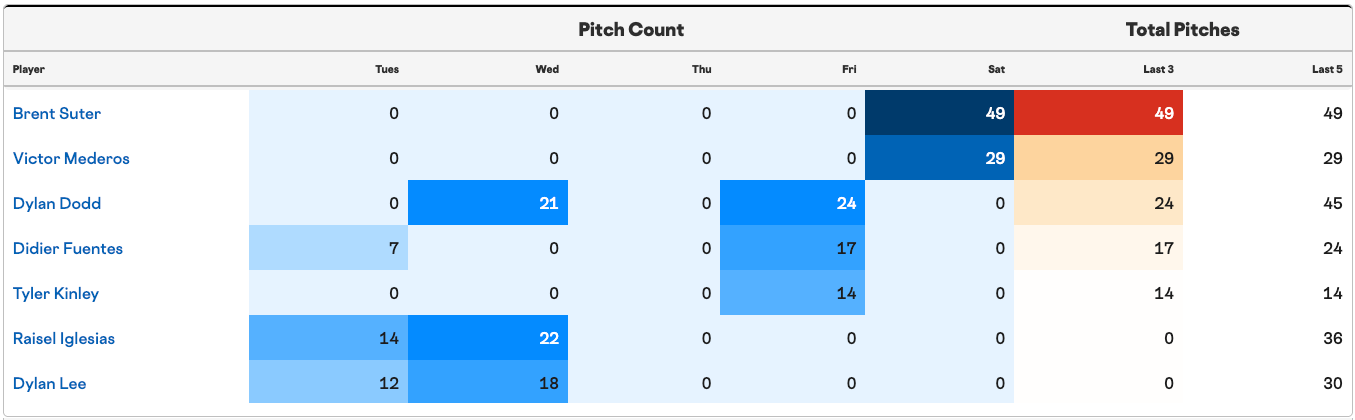
The leverage group is well rested, with Didier Fuentes being given last night’s game off even if it was close (per a source).
Potential limitations:
You’d worry about the Braves having length issues given that Victor Mederos threw 29 pitches last night and Brent Suter threw 49, but Atlanta DFA’d Danny Young to call up lefty Ray Kerr this morning. He hasn’t thrown for Gwinnett since Wednesday and has already shown the ability to throw 30+ pitches in an outing.
Quick takeaway:
Atlanta has the bullpen pieces they need to prevent a sweep.
Opponent Bullpen Status
Likely Available/Potential Limitations:
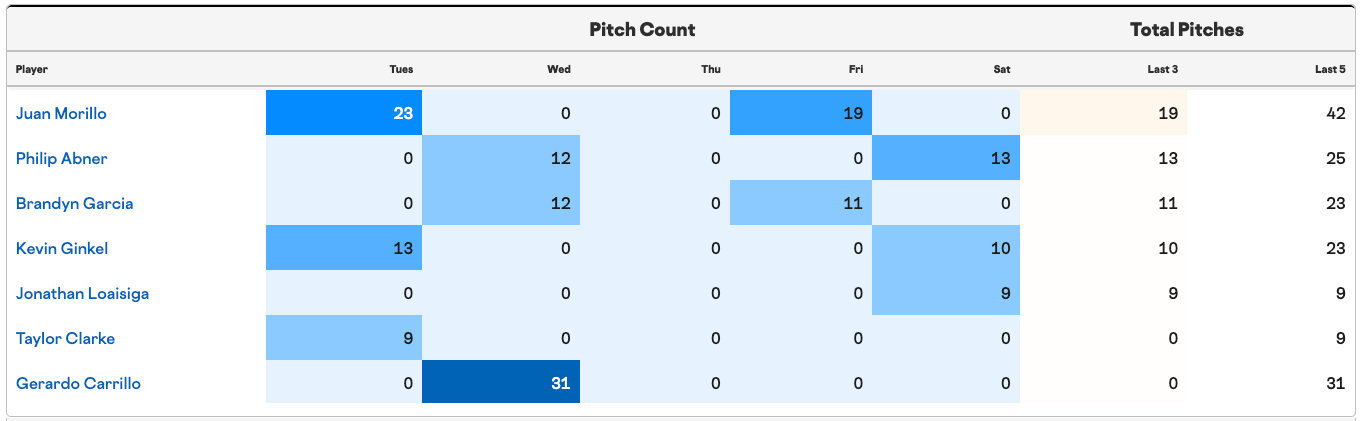
I’d guess the entire pen is still available today, as both of the outings from Diamondbacks starters so far this series have allowed them to just throw single innings from non-key relievers.
Quick takeaway:
Amazing what length from your rotation can do for your bullpen, isn’t it?
Final Thought
Atlanta is a slight favorite on the moneyline (-122 to Arizona’s +112), and FanDuel has set the over/under at nine runs. This one is likely decided by who is better at throwing a first-pitch strike. Soroka’s command was rusty in his return, while Elder’s results deteriorate quickly whenever he falls behind. Whichever pitcher consistently gets to 0-1 will be able to lean on his best secondary pitch - Soroka’s slurve or Elder’s slider/changeup combination. If Atlanta stays patient without becoming passive, it can turn Soroka’s workload restrictions into an early trip to the Arizona bullpen.
Let’s Talk About It
If you’d rather watch this, here’s the Braves Today live stream from this morning, after lineups were announced.
So, Ray Kerr is the new WE GIVE UP pitcher? I bet Bart could have given up 3 runs per inning pitched and STILL contributed as a catcher once Murphy goes back on IR. Do we have another ONE HOMER PER INNING guy to take Kinley's spot yet?