


It’s Atlanta Braves baseball! Let’s break down everything you need to know about this evening’s matchup.
Game Info
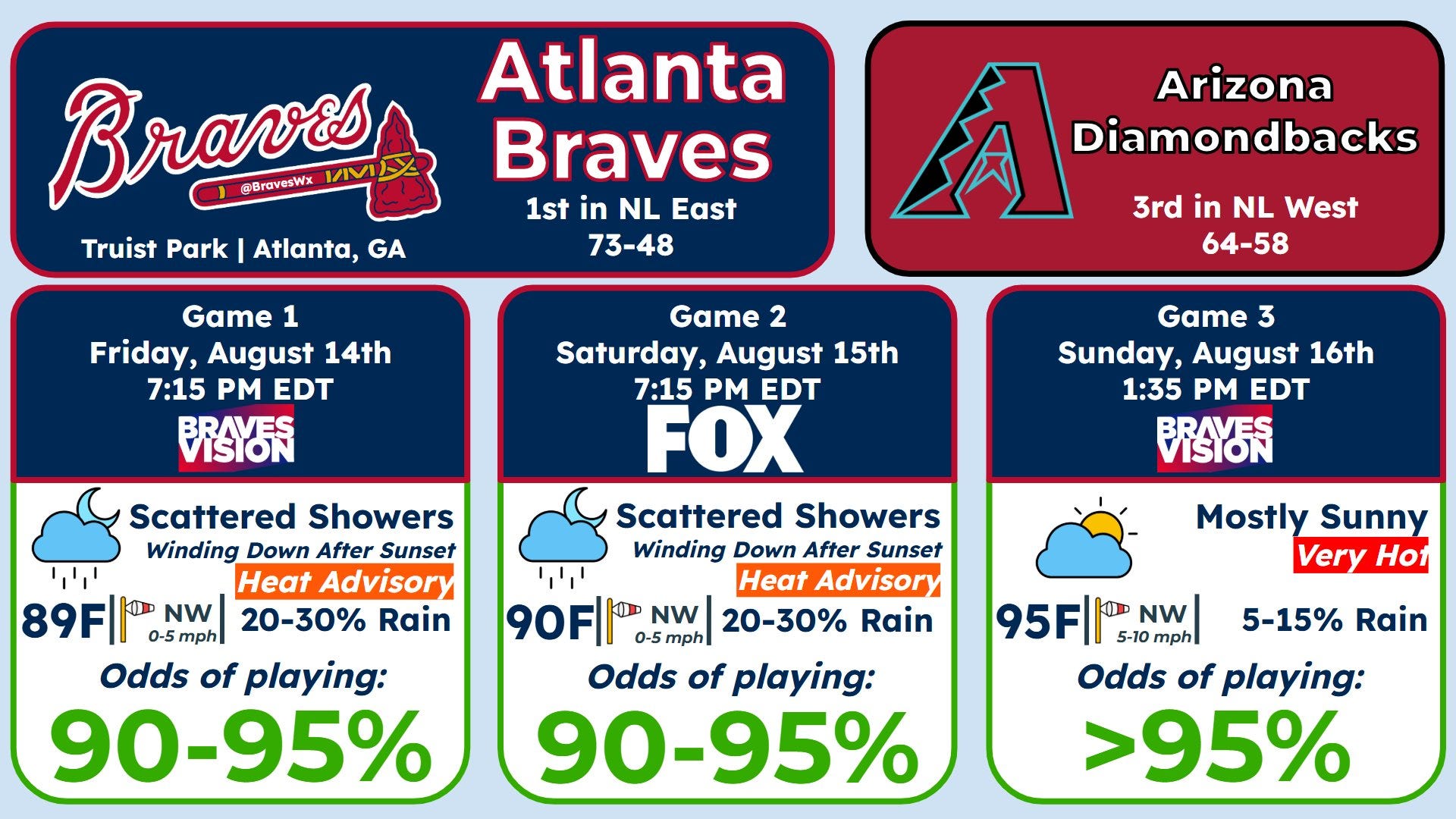
First Pitch: 7:15 PM ET
Location: Truist Park, Atlanta
TV: Fox (National Broadcast)
Broadcast crew: Brandon Gaudin (PxP), Adam Wainwright (analyst)
Radio: 680 AM/93.7 FM The Fan, Los Bravos
Weather: Courtesy of @BravesWX on Twitter/X
Atlanta Braves Lineup
RF Ronald Acuña Jr.
DH Drake Baldwin
1B Matt Olson
2B Ozzie Albies
CF Michael Harris II
SS Mauricio Dubón
LF Lane Thomas
3B Austin Riley
C Sean Murphy
Quick thoughts:
With a lefty on the mound, Dubón kicks down to shortstop to make room for Thomas, while Murphy enters the lineup behind the plate.
Arizona Diamondbacks Lineup
DH Lars Nootbaar
RF Corbin Carroll
SS Geraldo Perdomo
C Gabriel Moreno
LF Max Kepler
3B Nolan Arenado
1B Tim Tawa
2B Ildemaro Vargas
CF Ryan Waldschmidt
Quick thoughts:
Ketel Marte, who left last night’s game with “left knee soreness”, is out of today’s lineup for Arizona
Pitching Matchup
Braves Starter: RHP Grant Holmes (7-4, 3.47)
Quick snapshot:
3.47 ERA / 4.73 xERA / 4.82 FIP
19.3% K / 9.9% BB / 9.4% K-BB%
Pitch mix:
vs LHH: 34% slider, 29% four-seamer, 13% cutter, 11% curveball, 8% changeup, 5% sinker
vs RHH: 40% slider, 29% four-seamer, 22% sinker, 3% cutter, 2% curveball & changeup
What to watch:
Arizona doesn’t avoid chasing, it just makes contact when doing it. The Diamondbacks’ 22.3% whiff rate is well below the 25.1% MLB average, with above-average contact both inside the zone and on pitches outside it. Their chase rate is essentially average. Holmes can’t assume that he can just spam his slider outside the zone to get strikeouts; Arizona is particularly good at fouling those pitches off or putting them in play.
Holmes needs called strikes more than extra fastballs. His first-pitch strike rate is only 59.5%, and Arizona swings less frequently than the average lineup. The opportunity is to steal early strikes with sliders and curveballs that touch the zone, not nibble into 2-0 counts against hitters who are difficult to finish.
Don’t confuse “make them put it in play” with “feed them heaters.” Holmes’ four-seamer, sinker and cutter have produced expected wOBAs of .377, .410 and .424, respectively. His curveball has a .209 xwOBA and 35.8% whiff rate, while the slider remains his primary weapon at a 38.7% whiff rate. The curve should be a larger part of today’s plan, particularly as an early-count strike and a way to disrupt Arizona’s ability to track the slider.
The slider still has to lead the way. Holmes faced this club on April 3 and threw six scoreless innings, getting nine of his 14 whiffs with the slider. Arizona’s lineup is not identical now, but that outing offers a blueprint: remain slider-heavy while adjusting his sequencing to disrupt when and where they’re expecting it to appear.
Holmes’ defining stretch: the second trip through the order. Opponents have a .397 wOBA and .581 slugging percentage against him the second time through, and 14 of his 18 home runs allowed have occurred during that pass. He has been substantially better during both the first and third trips, so this isn’t fatigue. Watch whether he introduces more curveballs and changeups beginning around the fourth inning.
Who to watch:
The only Arizona hitters with success off of Holmes are Nolan Arenado (1-7), Max Kepler (1-2 as a member of the Phillies), Ketel Marte (1-6), Gabriel Moreno (2-7, 2 RBI) and Geraldo Perdomo (1-8).
Opposing Starter: LHP Eduardo Rodriguez (11-4, 2.70 ERA)
Quick snapshot:
2.70 ERA / 4.78 xERA / 3.83 FIP
17.1 K% / 8.0 BB% / 9.2 % K-BB%
The arsenal:
Four-seamer (39%, 92.0 mph)
Changeup (27%, 85.7 mph)
Cutter (13%, 88.6 mph)
Curveball (12%, 79.6 mph)
Sinker (9%, 91.5 mph)
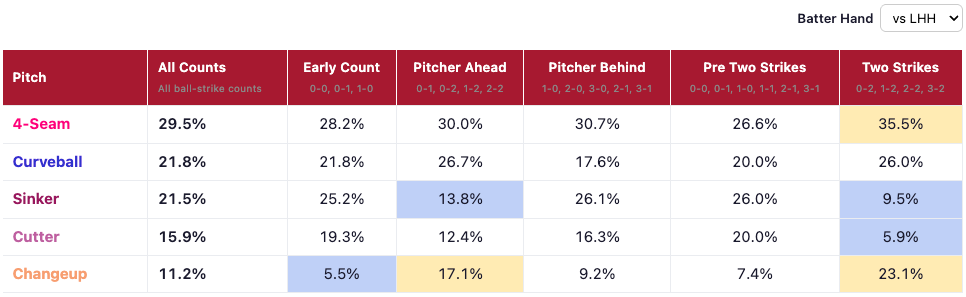
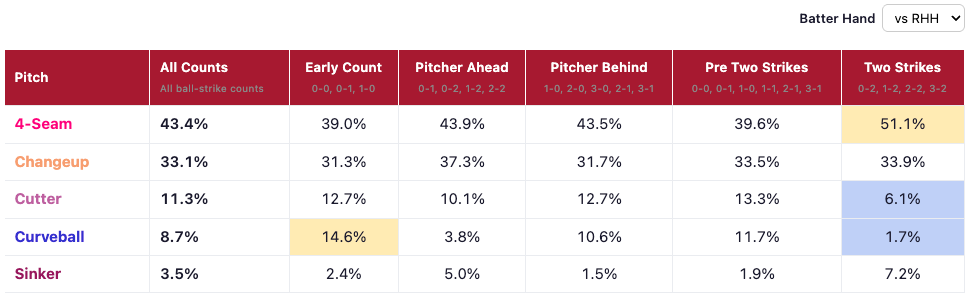
How he attacks hitters (all graphics courtesy of Thomas Nestico)
vs LHH: A well-rounded kitchen sink mix, one that dramatically cuts sinkers when ahead and both sinkers and cutters with two strikes in favor of more four-seam fastballs and changeups.
vs RHH: A pretty four-seam/changeup package, one that throws more curveballs early in the count and when behind to steal strikes and almost entirely leans on the four-seam/changeup combo to put hitters away.
Sequencing:
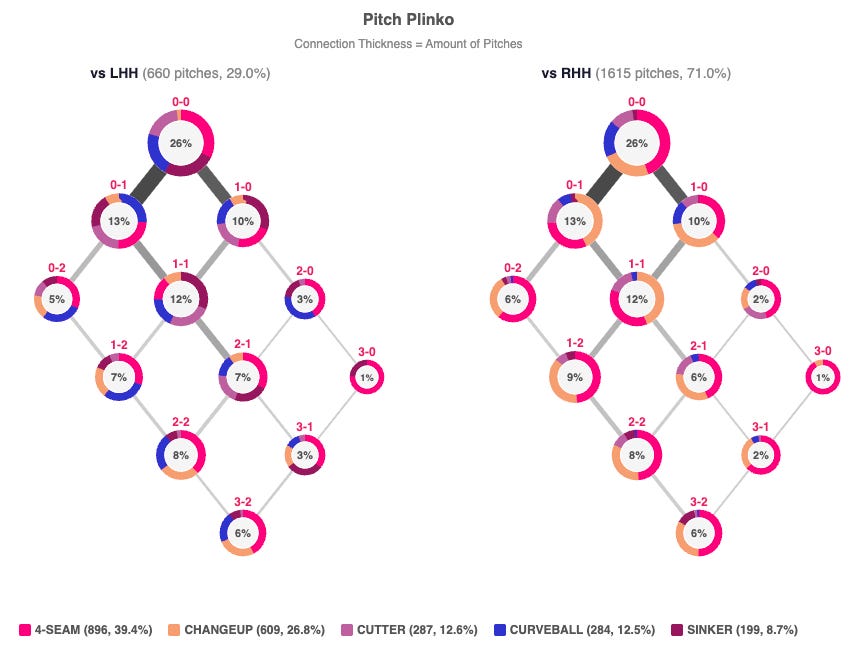
How to read a plinko chart: Each circle represents the usage of a pitcher’s arsenal in a given count (color key is on the bottom of the graphic). The thickness of the connecting lines reflects how often each count occurs, helping show how a pitcher navigates an at-bat.
What This Means for the Braves
Atlanta’s path against Eduardo Rodríguez: remember the changeup. Rodríguez threw it 37 times (41% usage) while blanking Atlanta for seven innings in their April meeting. It has also been his most reliable weak-contact pitch this season. The Braves cannot sit on the four-seamer and treat the changeup as merely a two-strike offering.
The pitches Atlanta should hunt are the cutter and sinker. Rodríguez’s cutter has allowed a .418 xwOBA and .580 xSLG, while the sinker has a .399 xwOBA and only a 7.2% whiff rate. Atlanta’s right-handed hitters have the slightly better matchup overall, but their success will depend upon recognizing the changeup and forcing Rodríguez back toward those two less effective pitches.
Rodríguez’s 2.70 ERA slightly oversells his current form. He has a 4.30 second-half ERA with opponents batting .294, although his most recent start - seven innings, two runs and nine strikeouts against the Dodgers - was a strong rebound. This isn’t a pitcher in free fall, but he has been more hittable recently than his full-season ERA suggests.
Braves to watch: Ozzie Albies is 4-7, while several Braves are hitting exactly .333 in a small sample like Ronald Acuña Jr. (nine ABs), Drake Baldwin (three ABs), and Lane Thomas (six ABs).
Matt Olson’s only 1-10 against Rodriguez, but that one hit? A homer, of course. Austin Riley’s 0-5 and Michael Harris II is 0-2.
Braves Bullpen Status
(Reminder, these are all assumptions based on pitch count and recent usage)
Likely available:
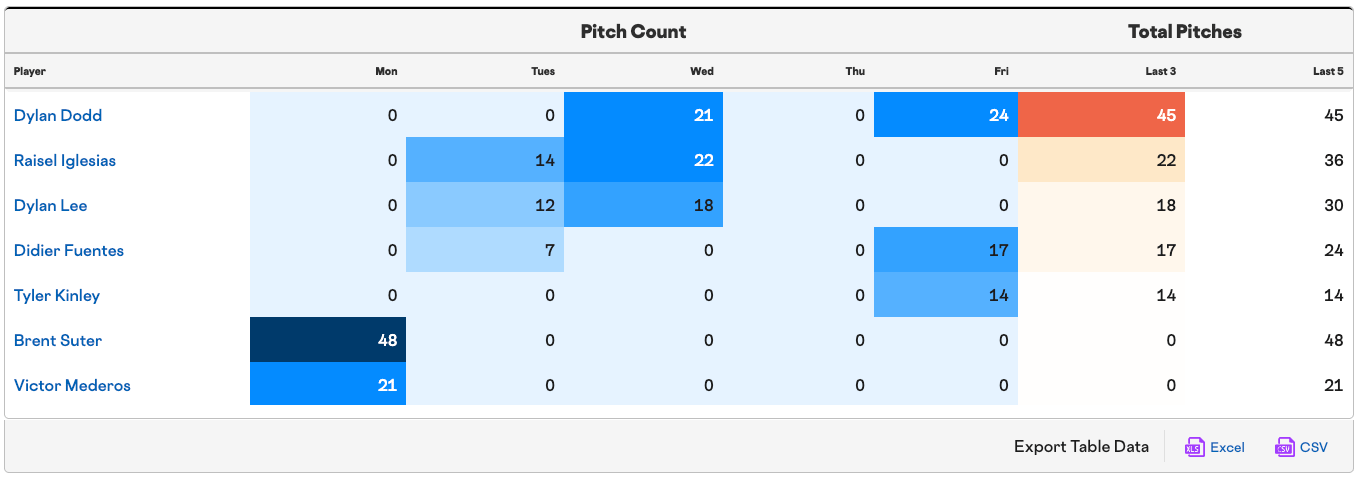
Raisel Iglesias and Dylan Lee have rebounded from their midweek back-to-backs and should be good to go for game two.
Potential limitations:
45 pitches in the last three days for Dylan Dodd? Yeah, I’m thinking he’s down today. Does Atlanta also hold out Didier Fuentes from a back-to-back if they don’t have Dodd? Probably an in-game decision based on how deep Holmes can make it into the game.
Quick takeaway:
If Atlanta can manage to score, they have the pieces to hold that lead.
Opponent Bullpen Status
Likely Available/Potential Limitations:
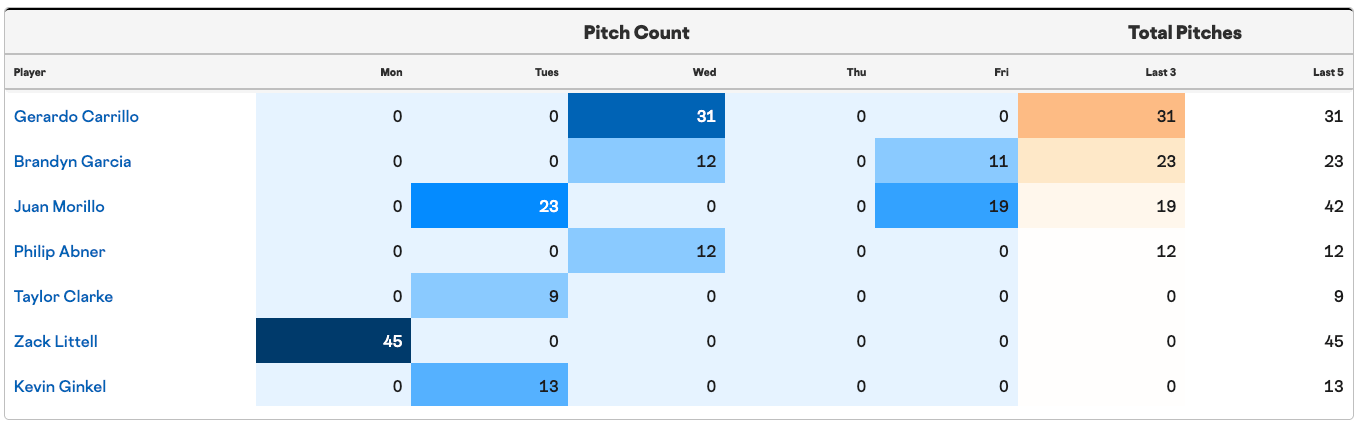
I’d guess the entire pen is available tonight, as neither of the outings from Brandyn Garcia or Juan Morillo were enough to hold them out of game two.
Quick takeaway:
Arizona’s bullpen has the rest advantage for game two.
Final Thought
Atlanta is a slight favorite on the moneyline (-130 to Arizona’s +120), and FanDuel has set the over/under at nine runs. Eduardo Rodríguez’s 2.70 ERA makes the matchup look more imposing than his underlying numbers suggest, but that won’t matter if Atlanta allows his changeup to keep them off the barrel again. For Grant Holmes, the answer to Arizona’s contact-heavy lineup isn’t throwing more hittable strikes, it’s stealing early strikes with his breaking balls and changing the pattern before the second trip through the order. If he falls behind and has to lean on his fastballs, Arizona’s ability to extend at-bats could make the middle innings the difference in this one.
Let’s Talk About It
If you’d rather watch this, here’s the Braves Today live stream from this afternoon, after lineups were announced.
Always liked Ed-Rod. Was hoping he might be a Brave in his Free Angency.
But people love living in the Desert.
"If Atlanta can manage to score..."
From your lips to God's ear...