


It’s Atlanta Braves baseball! Let’s break down everything you need to know about this evening’s matchup.
Game Info
First Pitch: 7:15 PM ET
Location: Truist Park, Atlanta GA
TV: BravesVision
Radio: 680 AM/93.7 FM The Fan, Los Bravos
Weather: 79°, mostly cloudy but with a chance of thunderstorms from 7-8PM
Atlanta Braves Lineup
C Drake Baldwin
2B Ozzie Albies
1B Matt Olson
LF Mauricio Dubón
CF Michael Harris II
DH Lane Thomas
RF Mike Yastrzemski
3B Austin Riley
SS Ha-Seong Kim
Quick thoughts:
Ronald Acuña Jr. is getting the day off, while Kim gets rewarded for last night’s heroics with a start at short.
Los Angeles Dodgers Lineup
DH Shohei Ohtani
CF Tommy Edman
SS Mookie Betts
1B Freddie Freeman
LF Teoscar Hernández
2B Miguel Rojas
RF Alex Call
3B Enrique Hernández
C Ben Rortvedt
Quick thoughts:
Los Angeles goes to their platoon lineup with a lefty on the mound for Atlanta.
Pitching Matchup
Braves Starter: LHP Chris Sale (12-9, 2.20)
Quick snapshot:
2.20 ERA / 3.05 xERA / 2.24 FIP
30.6% K / 5.2% BB / 25.5% K-BB%
Pitch mix:
vs LHH: 38% slider, 33% sinker, 28% four-seamer, 1% changeup
vs RHH: 45% four-seamer, 40% slider, 14% changeup, 1% sinker
What to watch:
Sale’s second half has been even better than his 2.20 season ERA. Across six starts, he has a 2.19 ERA, 0.81 WHIP and 49 strikeouts against only three walks in 37 innings. He has also avoided allowing a home run since the break.
The slider remains the foundation. Sale throws it approximately 39% of the time, and it has held hitters to a .188 average, .242 slugging percentage and .226 xwOBA with a 38.7% whiff rate. He has not surrendered a homer with it. If the Dodgers consistently force the slider into the strike zone rather than chasing it, they can make this a much less comfortable assignment.
Nearly all of Sale’s home-run vulnerability belongs to the four-seamer. Seven of his eight homers allowed have come against the fastball; the slider and sinker have allowed none. That pitch has been much better than it was in 2025, but it remains the offering Los Angeles is best equipped to punish when Sale misses over the plate.
Freddie Freeman already provided the blueprint. When Sale faced Los Angeles on May 8, he completed seven innings with seven strikeouts and no walks, but Freeman hit a center-cut 96.8-mph four-seamer for a two-run homer. Sale averaged a season-best 96.4 mph that night; the mistake was location, not velo.
The platoon split is unexpectedly narrow. Lefties have a .645 OPS against Sale, compared with .560 for righties. He has still allowed only one homer to a left-handed hitter, but Ohtani and Freeman aren’t automatically disadvantaged simply because Sale throws from the left side.
There is a modest third-time-through power wrinkle. Opponents have a .569 OPS the first time through and .545 the second, rising to .651 on the third trip. More importantly, his home-run rate increases from below 0.4 per nine on the first two trips to 1.15 on the third. The Dodgers’ clearest opportunity may arrive when Ohtani, Betts and Freeman see him for the third time.
Who to watch:
Lots of experience on LA’s roster off of Sale, but a lot of it is mixed.
Sale’s won: Max Muncy (1-7), Miguel Rojas (1-9), Kyle Tucker (1-8, 2 RBI), Tommy Edman (2-8, both singles)
Sale’s gotten got: Freddie Freeman (4-12, 2 HR, 2 doubles, 4 RBI), Teoscar Hernández (5-20, 1 HR, two doubles, two RBI and three walks), Shohei Ohtani (3-11, double, RBI), Mookie Betts (5-14, HR, two doubles, four RBI)
Opposing Starter: RHP Yoshinobu Yamamoto (12-7, 2.61 ERA)
Quick snapshot:
2.61 ERA / 3.02 xERA / 3.27 FIP
24.9 K% / 6.0 BB% / 18.9% K-BB%
The arsenal:
Splitter (27%, 91.4 mph)
Four-seamer (27%, 96.1 mph)
Cutter (15%, 91.6 mph)
Sinker (13%, 95.5 mph)
Curveball (12%, 77.1 mph)
Slider (6%, 86.9 mph)
Atlanta’s path against Yamamoto
The four-seamer is the pitch Atlanta should hunt—even though its actual results look excellent. Hitters are batting only .140 with a .325 slugging percentage against it, but the expected numbers are much less dominant: .223 xBA, .481 xSLG and .344 xwOBA. It also carries a 48.1% hard-hit rate, easily the highest of his six pitches. LA’s defense isn’t that great, so a lot of this comes down to favorable bounces.
The splitter has officially become his primary pitch. Yamamoto is throwing it 26.9% of the time, narrowly ahead of the four-seamer at 26.8%. The 91.4-mph splitter has held hitters to a .173 average, .292 slugging percentage and .211 xwOBA while producing a 32.5% whiff rate. When Yamamoto is ahead, Atlanta’s job becomes substantially harder.
“Take the splitter” is too simplistic. Yamamoto lands it in the strike zone 48% of the time when he is behind in the count, compared with less than 30% when using it with two strikes. Atlanta must remain aware of the count and location: attack the elevated or hanging version, but refuse to follow the chase version below the zone.
There is no meaningful platoon escape hatch. Lefties have a .180/.241/.286 line and .527 OPS against Yamamoto; righties are at .195/.246/.336 with a .582 OPS. Loading up on left-handed hitters would produce only a marginal advantage and could weaken Atlanta elsewhere.
The 2.61 ERA isn’t fraudulent, but the underlying metrics are slightly less overwhelming. His 3.03 xERA and 3.34 FIP suggest that his run prevention has outperformed the quality of contact and outcomes he most directly controls. That doesn’t make him lucky; it means Atlanta is facing an excellent pitcher rather than an untouchable one.
The first inning has been his most approachable early frame. Yamamoto has a 3.91 ERA and .663 opponent OPS in the opening inning. He then becomes absurd in the second: 0.78 ERA, .232 OPS and 29 strikeouts in 23 innings. Atlanta’s top of the order may receive the night’s best immediate opportunity.
Waiting for the third trip isn’t much of a plan. Opponents have a .529 OPS the first time through, .539 the second and .601 the third. He becomes somewhat more hittable, but not enough to justify passing up early fastballs in favorable locations.
Yamamoto enters in excellent form. He has a 1.98 ERA, 0.85 WHIP and .526 opponent OPS across six second-half starts. In August, he has allowed six runs over 26 innings and struck out nine in each of his last two outings.
The Braves against Yamamoto: Not a ton of experience or success here
The good: Ha-Seong Kim (1-5, home run), Austin Riley (1-3)
The bad: Ozzie Albies & Lane Thomas (0-2), Matt Olson (0-3), Mike Yastrzemski (1-6)
How he attacks hitters (all graphics courtesy of Thomas Nestico)
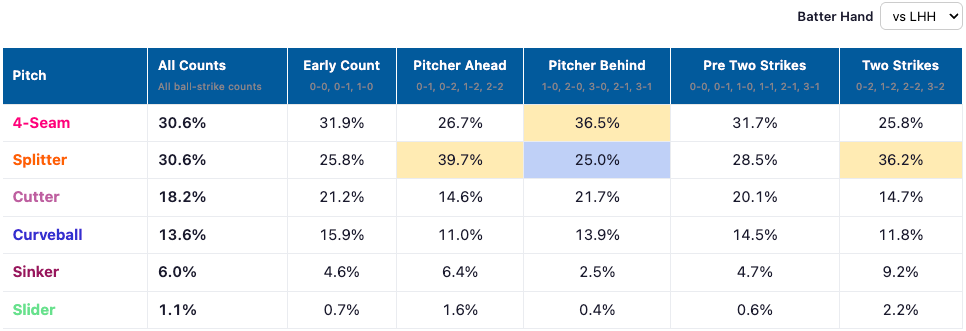
vs LHH: Primary out pitch is the splitter, with occasional curveballs. Slider isn’t really used here, just 1.1% overall, and the goal vs lefties is to get ahead and unleash the splitter, but he is willing to throw the splitter in the zone to get ahead.
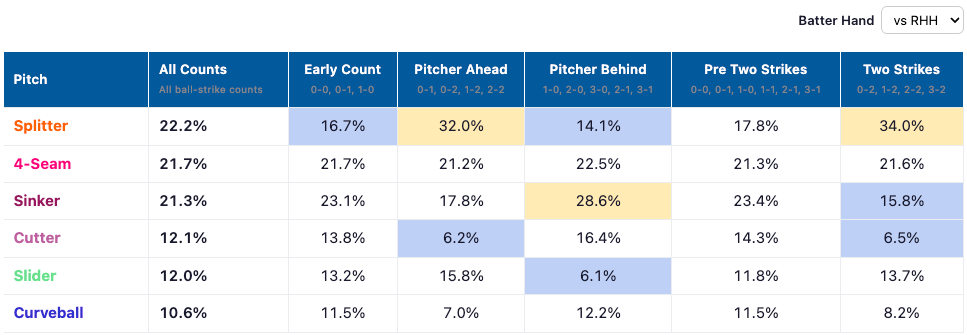
vs RHH: The alternate fastball here is the sinker, not the cutter, and the slider does play a small but meaningful role. It’s much more of a true six-pitch mix than lefties will see.
Sequencing:
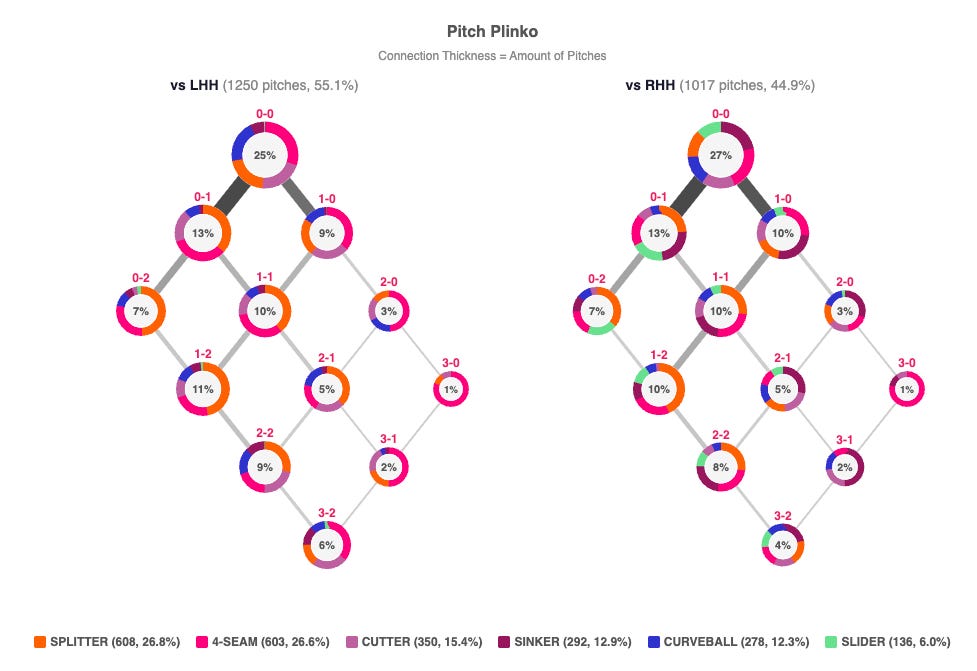
How to read a plinko chart: Each circle represents the usage of a pitcher’s arsenal in a given count (color key is on the bottom of the graphic). The thickness of the connecting lines reflects how often each count occurs, helping show how a pitcher navigates an at-bat.
Braves Bullpen Status
(Reminder, these are all assumptions based on pitch count and recent usage)
Likely available:
Uh, Brent Suter?
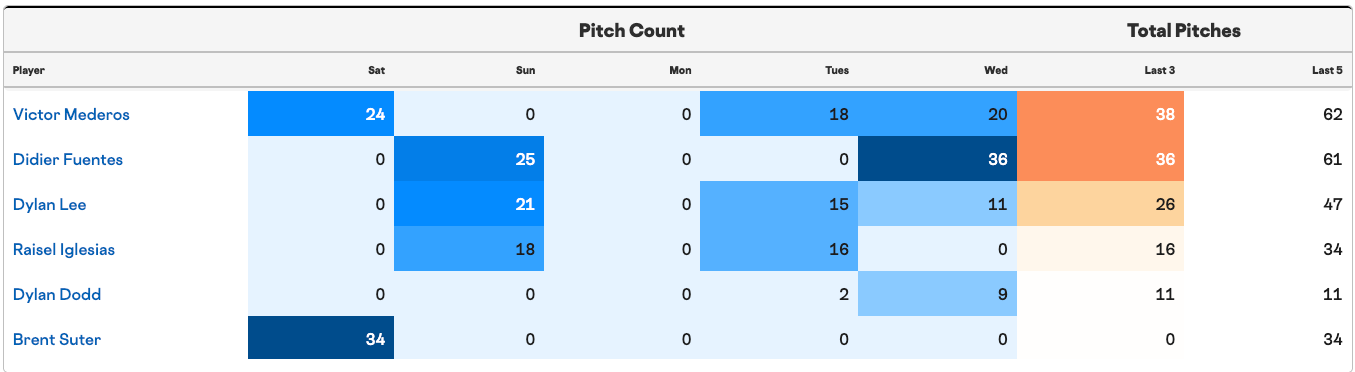
Being serious, Atlanta has Raisel Iglesias on one day of rest, a fully rested Brent Suter, and Ray Kerr (who warmed up to potentially take the 10th inning but wasn’t used) available today.
Potential limitations:
Victor Mederos, Dylan Lee, and Dylan Dodd are all coming off back-to-backs, while Didier Fuentes threw 36 pitches last night and is almost certainly down.
Dodd only threw two pitches on Tuesday, but he was warming up for several innings and so they likely treated that as a standard outing for him.
Quick takeaway:
If Chris Sale can’t give you length, we’re either going to get a lot of Ray Kerr or find out if the team was ready to move Grant Holmes into the bullpen, I guess.
Opponent Bullpen Status
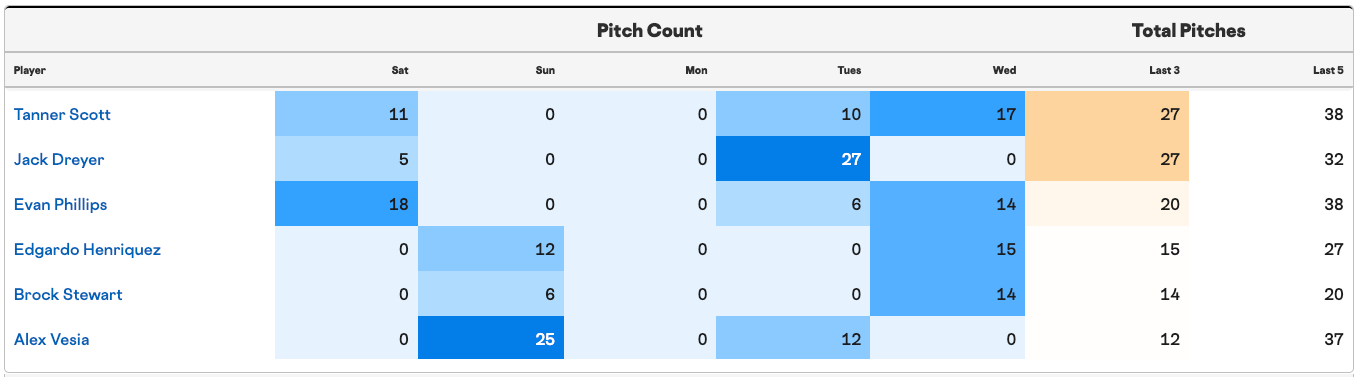
Likely Available:
Right-handed setup men Edgardo Henriquez and Brock Stewart are both available to come back, as is lefty Alex Vesia and maybe lefty Jack Dryer
Potential Limitations:
Swingman Eric Lauer threw 52 pitches last night and is down, so Kyle Hurt is the likely longman for LA today.
Closer Tanner Scott’s coming off a back-to-back for LA and likely unavailable, but as he’s taken the loss in each of the first two games of the series, the Dodgers might not be too heartbroken about that.
Quick takeaway:
Los Angeles has the bullpen advantage today, but in a matchup of starters who generally go deep, that might not matter as much.
Final Thought
The Braves, believe it or not, are favored on the moneyline: -124 to LA’s +114, and FanDuel has set the over/under at 6.5 runs. The likely hinge point is Which offense punishes the rare four-seamer left in a liftable location? Yamamoto’s splitter and Sale’s slider are the pitches each starter wants to feature once he controls the count. Atlanta must attack Yamamoto’s fastball before being pushed beneath the zone; Sale must prevent the Dodgers from sitting on the heater when his slider forces them to protect downward.
Let’s Talk About It
If you’d rather watch this, here’s the Braves Today live stream from this afternoon, after lineups were announced.
Good Lord.. In his 5 inning start this week Caminiti had 18 SWINGING STRIKES. And 7 strikeouts.
Gave up 1 run I believe. Very young 20 year old in double A.
I had Caminiti in mind for the #9 pick in the draft. Gio Rojas, lefthander from Miami.. 6 feet 4. Best high school pitcher in the Draft.
Why do you have a guy who "doesn't hit righthanders" being a RIGHT-HANDED DH tonight!!! Where's Dom Smith???