


It’s Atlanta Braves baseball! Let’s break down everything you need to know about this evening’s matchup.
Game Info
First Pitch: 7:15 PM ET
Location: Truist Park, Atlanta GA
TV: BravesVision
Radio: 680 AM/93.7 FM The Fan, Los Bravos
Weather: 91° and sunny
Atlanta Braves Lineup
DH Drake Baldwin
RF Ronald Acuña Jr.
1B Matt Olson
SS Mauricio Dubón
CF Michael Harris II
2B Ozzie Albies
LF Mike Yastrzemski
3B Austin Riley
C Sean Murphy
Quick thoughts:
Atlanta’s (hopefully) giving more run to Sean Murphy in an attempt to get his bat going, with the slugger batting 9th against a righty.
Los Angeles Dodgers Lineup
DH Shohei Ohtani
1B Freddie Freeman
SS Mookie Betts
3B Max Muncy
2B Tommy Edman
RF Kyle Tucker
LF Alex Call
CF Alek Thomas
C Hunter Feduccia
Quick thoughts:
LA’s giving Teoscar Hernandez the day off, going with a decidedly suboptimal outfield of Call-Thomas-Tucker (although Tucker has been better away from Dodger Stadium).
Pitching Matchup
Braves Starter: RHP Bryce Elder (8-7, 3.92)
Quick snapshot:
3.92 ERA / 4.02 xERA / 4.57 FIP
19.5% K / 7.9% BB / 11.6% K-BB%
Pitch mix:
vs LHH: 29% four-seamer, 22% slider, 19% cutter, 15% sinker, 14% changeup
vs RHH: 51% sinker, 26% slider, 10% four-seamer, 8% cutter, 5% changeup
What to watch:
Elder’s defining variable: the extra rest, not necessarily the knee. He’ll pitch on eight days’ rest after Atlanta skipped his turn. In four starts this season with six or more days’ rest, Elder has allowed 19 earned runs and eight homers in 20 innings—a brutal 8.55 ERA. Compare that with a 3.20 ERA on four days’ rest and 3.48 on five. It’s only four starts and overlaps with his June downturn, but the contrast is too large to ignore. Interestingly, he threw more strikes in those extra-rest outings; the issue was pitches catching too much plate, not simple wildness.
What to watch: Has the changeup become Elder’s primary answer to lefties? Over his last three starts, Elder has increased his changeup usage from 11% for the season to 25%, while cutting his slider from 24% to 12%. That makes sense: the changeup has held hitters to a .169 average, .203 slugging percentage and .207 xwOBA with a 29.1% whiff rate. With Ohtani and Freeman awaiting him, maintaining that confidence could be essential.
Don’t expect the May rematch to look identical. Elder blanked Los Angeles for 5⅔ innings on May 10, allowing one hit with eight strikeouts and four walks. That was an unusually overpowering Elder outing: 13 whiffs on 83 pitches, with his four-seamer averaging 93.4 mph and sinker 92.2. In his last start, those pitches averaged 91.0 and 89.5, respectively. He says the knee is fully recovered, so the early velocity readings will help tell us whether that dip was physical or merely an isolated low-gear afternoon.
The handedness split is backward—but probably somewhat BABIP-driven. Lefties have managed only a .206/.279/.371 line against Elder, while righties are at .286/.332/.448. The sizable batting-average gap appears heavily influenced by balls finding grass, but it still means Betts, Hernández and the Dodgers’ other righties shouldn’t be treated as the softer portion of the assignment.
Who to watch:
Most of LA’s roster has faced Elder, with decidedly mixed results
Elder’s won the matchup: Mookie Betts (2-11, albeit with a home run), Shohei Ohtani (2-10, albeit with a home run), Max Muncy (3-14, albeit with a home run), Kyle Tucker (0-4), Teoscar Hernandez (2-7)
Elder’s gotta be better: Tommy Edman (1-3, HR, 2 RBI), Freddie Freeman (4-12)
Opposing Starter: RHP Tyler Glasnow (3-0, 2.72 ERA)
Quick snapshot:
2.72 ERA / 2.61 xERA / 3.24 FIP
33.1 K% / 8.8 BB% / 24.3% K-BB%
The arsenal:
Curveball (30%, 81.2 mph)
Four-seamer (29%, 95.3 mph)
Sinker (25%, 95.7 mph)
Slider (16%, 89.3 mph)
What This Means for the Braves
Atlanta’s path against Glasnow: Make him throw the four-seamer. His curveball group has generated a 50% whiff rate and .125 xwOBA, while the slider is at 41.3% and .175. The four-seamer is the glaring exception: only an 11.8% whiff rate with a .389 xwOBA and .649 slugging percentage allowed. Atlanta cannot afford to chase the breaking balls below the zone and let Glasnow hide that fastball.
Rust is not the obvious bet. In his final rehab start, Glasnow threw 77 pitches over 5⅓ innings, allowed one hit and one walk, and struck out nine. His four-seamer averaged 95.5 mph, and his knuckle curve generated six of his 12 whiffs. He finished the assignment with 17 strikeouts across his final nine innings. The stuff appears ready; the better question is whether Atlanta can force enough deep counts to make 77 pitches feel like a meaningful workload ceiling.
Loading up on lefties is about creating traffic, not necessarily hitting him. Left-handed hitters are batting only .145 against Glasnow, but they have drawn 11 of the 13 walks he has issued. Righties have 21 strikeouts against only two walks. Baldwin, Olson, Harris and Atlanta’s other left-handed options offer the best chance to run up his pitch count.
There isn’t a compelling first-inning or times-through-the-order vulnerability. Glasnow has a 2.57 first-inning ERA with ten strikeouts in seven innings. His second-time-through ERA is 4.80, but the accompanying .260 wOBA and 15-to-3 strikeout-to-walk ratio argue against treating that as a real weakness.
The Braves against Glasnow: Not a ton of experience or success here
The good: Sean Murphy (1-2, HR), Mike Yastrzemski (1-3)
The bad: Ronald Acuña Jr.(2-8), Matt Olson and Austin Riley (both 1-10), Ozzie Albies (0-9), Michael Harris II (1-8)
How he attacks hitters (all graphics courtesy of Thomas Nestico)
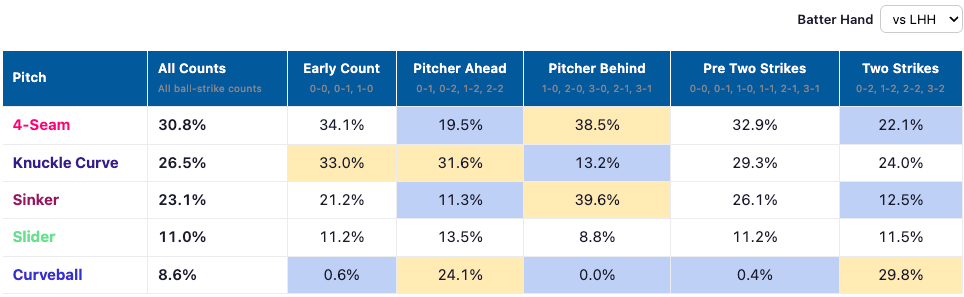
vs LHH: A fairly common curveball-based arsenal, one that ramps up curveball usage when ahead and both fastballs when behind.
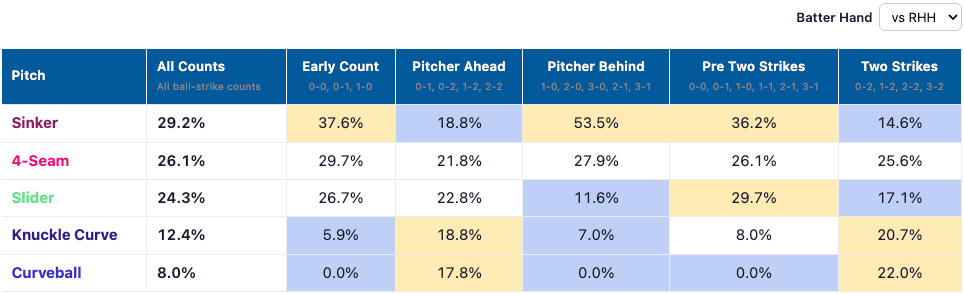
vs RHH: A multi-fastball arsenal with relatively static four-seam use. He severely ramps up the curveball(s) when ahead, swapping that usage for the sinker when behind, as well as using the slider mostly prior to two strikes.
Sequencing:
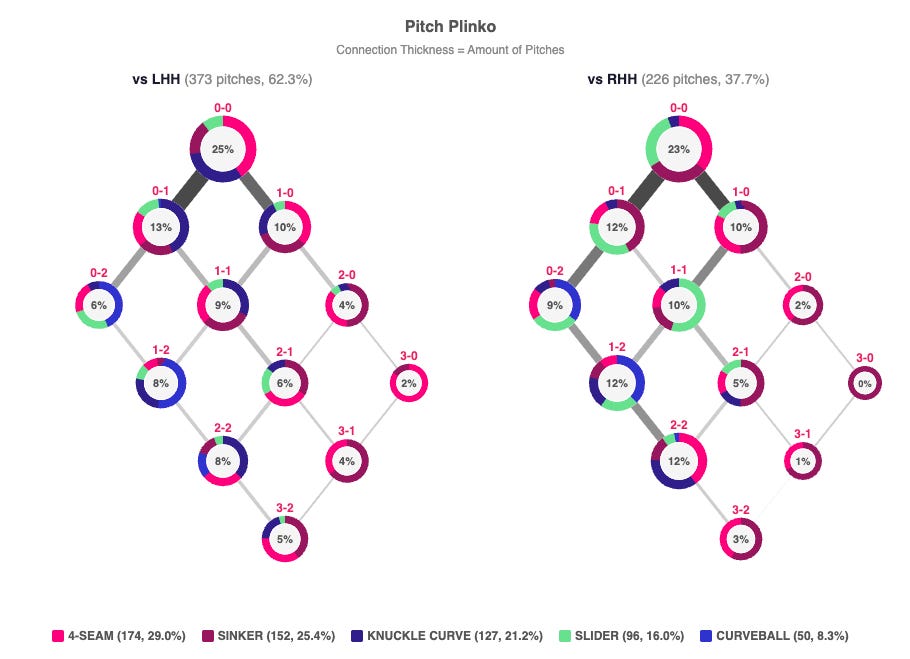
How to read a plinko chart: Each circle represents the usage of a pitcher’s arsenal in a given count (color key is on the bottom of the graphic). The thickness of the connecting lines reflects how often each count occurs, helping show how a pitcher navigates an at-bat.
Braves Bullpen Status
(Reminder, these are all assumptions based on pitch count and recent usage)
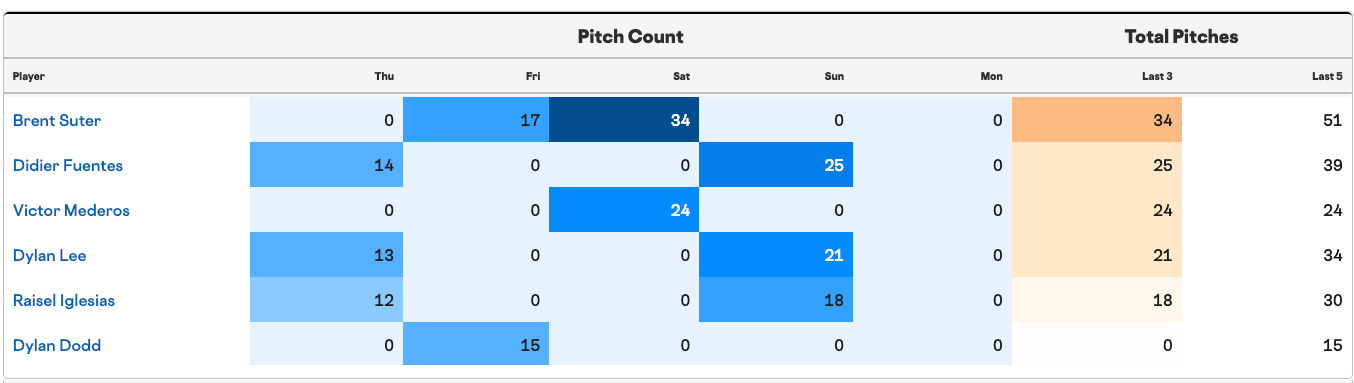
Likely available/Potential limitations:
Everyone’s had at least one day off, although I’d imagine the pitch count for Didier Fuentes from Sunday means you’d like to avoid him if this wasn’t, y’know, the Dodgers.
Quick takeaway:
Atlanta has the pieces they need to secure a win, if they can get a lead here.
Opponent Bullpen Status
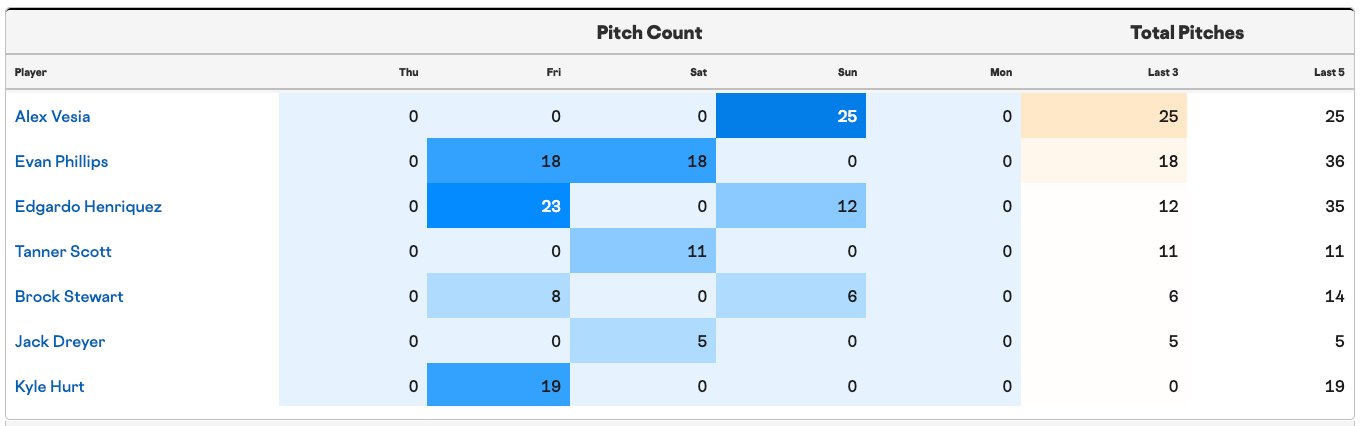
Likely Available/Potential Limitations:
None
Quick takeaway:
Los Angeles is as close to full availability as you can get for a late-August regular season matchup, thanks to both light weekend usage and Monday’s off day.
Final Thought
Braves are a heavy underdog on the moneyline: +138 to LA’s -148, and FanDuel has set the over/under at 8.5 runs. The likely hinge point is Count Leverage: If Atlanta expands against Glasnow’s curveballs, his rehab workload won’t matter because he can dominate five efficient innings. If the Braves take those pitches and force him back toward the four-seamer, they can both attack his weakest offering and reach the Dodgers’ bullpen early. For Elder, the corresponding question is whether the extra rest produces refreshed velocity so he can get swing-and-miss on the slider, or if it instead results in the center-cut mistakes and home runs that have defined his other long-rest outings.
Let’s Talk About It
If you’d rather watch this, here’s the Braves Today live stream from this afternoon, after lineups were announced.