


It’s Atlanta Braves baseball! Let’s break down everything you need to know about this evening’s matchup.
Game Info
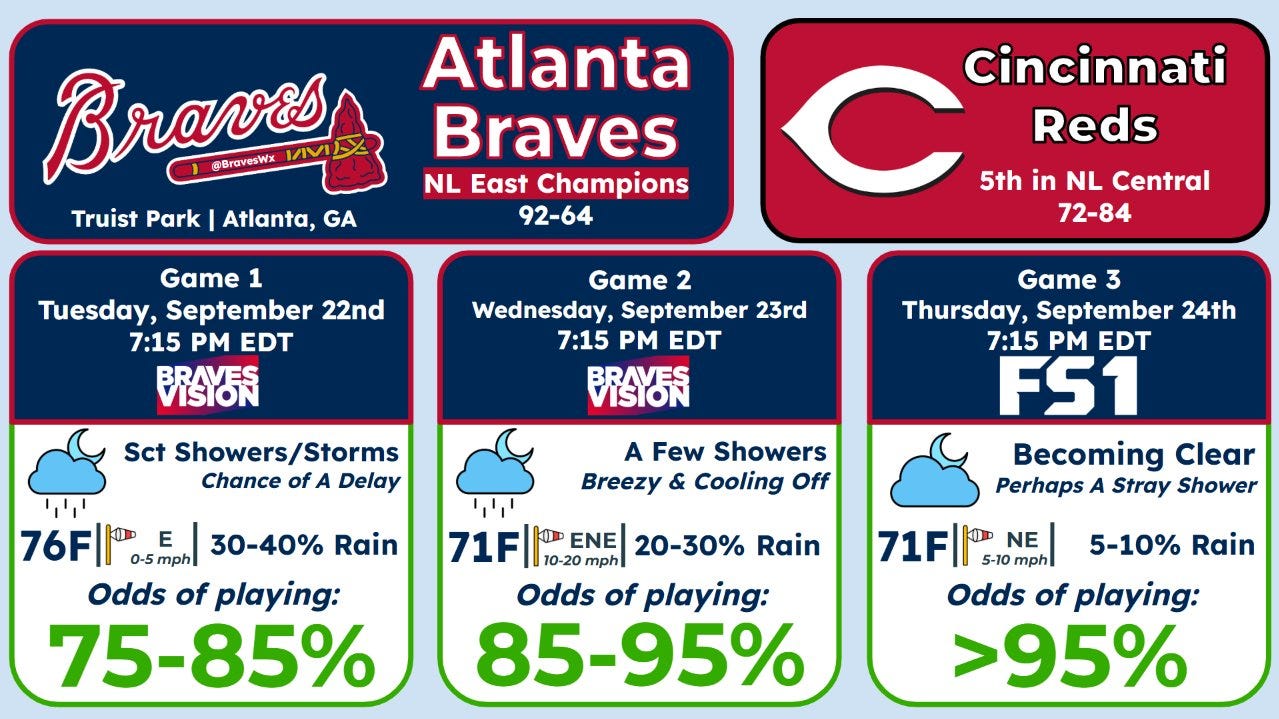
First Pitch: 7:15 PM ET
Location: Truist Park, Atlanta GA
TV: BravesVision locally, FS1 outside of the Atlanta market
Radio: 680 AM/93.7 FM The Fan
Weather: Courtesy of @BravesWX on X/Twitter.
Atlanta Braves Lineup
DH Drake Baldwin
RF Ronald Acuña Jr.
1B Matt Olson
CF Michael Harris II
SS Mauricio Dubón
2B Ozzie Albies
LF Mike Yastrzemski
3B Austin Riley
C Sean Murphy
Quick thoughts:
Ronald Acuña Jr. returns to the lineup, batting second and in right field. Consider that crisis officially averted.
Cincinnati Reds Lineup
CF Carlos Jorge
SS Elly De La Cruz
1B Sal Stewart
C Tyler Stephenson
LF JJ Bleday
DH Eugenio Suárez
RF Héctor Rodríguez
2B Matt McLain
3B Ke’Bryan Hayes
Quick thoughts:
Some rotation in the lineup for Cincinnati, with Hayes at third base in lieu of Suárez and with Jorge in center in place of Dane Myers for the finale.
Pitching Matchup
Braves Starter: RHP Tyler Mahle (7-10, 3.81)
Quick snapshot:
3.81 ERA / 3.87 xERA / 3.85 FIP
22.5% K / 7.4% BB / 15.0% K-BB%
Pitch mix:
vs LHH: 50% four-seamer, 35% splitter, 15% cutter, <1% slider, no sinkers
vs RHH: 47% four-seamer, 22% splitter, 16% cutter, 13% slider, 2% sinker
What to watch from Mahle
Mahle’s final regular-season start doubles as his last postseason tuneup. He enters at 7–10 with a 3.81 ERA overall, but Atlanta has received a 1.28 ERA, 0.89 WHIP and 44 strikeouts against seven walks across eight starts. He has allowed two earned runs or fewer in every Braves appearance.
Atlanta’s streamlined pitch plan continues to work. Through his first seven Braves starts, Mahle threw 48.5% four-seamers, 38.6% splitters, 10.9% cutters and only 2% sliders. That’s 87.1% four-seamers and splitters after throwing those pitches 77.3% of the time across the full season.
vs. LHH: 47.4% four-seamer, 40.6% splitter, 12% cutter
vs. RHH: 50.4% four-seamer, 35% splitter, 9% cutter, 5.6% slider
Shelving the slider may be the most important part of the adjustment. Hitters have batted .324 and slugged .514 against it, with a .397 xwOBA. The four-seamer has a .293 xwOBA and the splitter sits at .292. Atlanta hasn’t invented a new pitch; it has simply concentrated Mahle’s workload around the two pitches that give him the best chance.
The 1.28 Atlanta ERA oversells him, but not by enough to invalidate the improvement. Entering his last start, Mahle had a 3.87 xERA and 3.03 FIP with the Braves. Some regression is built into the gap, but the stronger strikeout-to-walk ratio, simplified arsenal and reduced slider exposure represent legitimate change.
Cincinnati’s righties remain the greater danger. Mahle’s full-season reverse split has been substantial, and the slider—the only pitch he exclusively reserves for righties with Atlanta—is still his weakest offering. Sal Stewart, Eugenio Suárez, Spencer Steer and Tyler Stephenson provide a more difficult path than Cincinnati’s left-handed bats.
The Reds already authored Mahle’s worst start of the season. On April 15, he allowed eight runs, eight hits, five walks and four homers in four innings. Stewart hit two three-run homers, while Suárez and Elly De La Cruz also went deep; Steer added two singles. That was the older, broader-mix San Francisco version of Mahle, but Cincinnati has firsthand evidence that his fastball can be punished when his command disappears.
The early innings remain worth watching. Even after his remarkable Atlanta run, Mahle carries a first-inning ERA above 5.00. He has repeatedly settled into games after early traffic, but Atlanta may prefer a clean five or six innings rather than allowing its likely No. 2 postseason starter to grind through a stressful late frame.
Opposing Starter: RHP Brady Singer (6-15, 5.67 ERA)
Quick snapshot:
5.67 ERA / 5.71 xERA / 5.55 FIP
17.7 K% / 8.5 BB% / 9.2% K-BB%
Pitch mix:
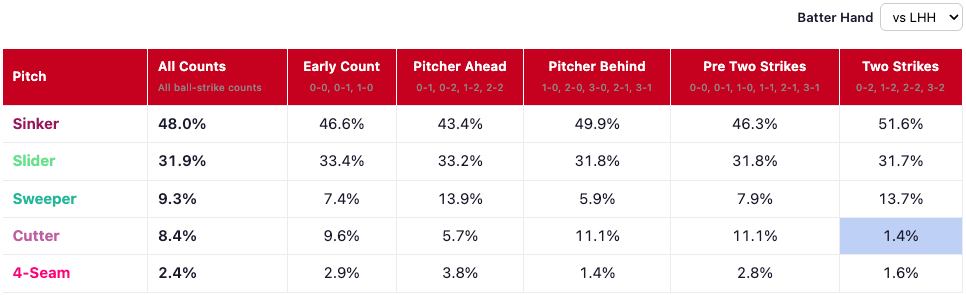
vs. LHH: 48% sinker, 29% slider, 13% sweeper, 8% cutter, 2% four-seamer
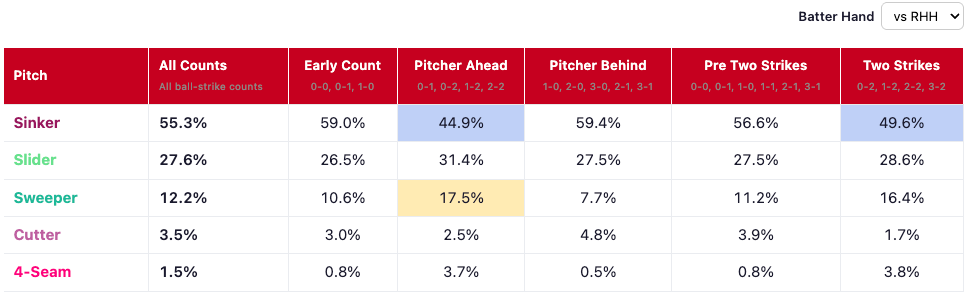
vs. RHH: 55% sinker, 24% slider, 15% sweeper, 4% cutter, 1% four-seamer
Atlanta’s path against Singer
Load up on lefties, control the breaking-ball chase and make him locate the sinker. Left-handed hitters have demolished Singer for a .312/.381/.528 line and .909 OPS, compared with a .752 OPS by righties. They have hit 23 of the 31 home runs he has allowed.
Singer’s old sinker-slider reputation still mostly applies, but the distinct sweeper is now important. His current mix is 50.5% sinkers, 27.3% sliders, 13.4% sweepers, 6.8% cutters and 2% four-seamers. He doesn’t throw a changeup, leaving him without a conventional pitch moving away from Atlanta’s lefties.
The sweeper is the pitch Atlanta should avoid helping. It owns Singer’s best expected results at a .298 xwOBA and generates a 40.9% whiff rate. The sinker has a .373 xwOBA and 47.1% hard-hit rate, while the slider has allowed a .291 average and .479 slugging percentage. The plan should be to reject the sweeper off the plate and force Singer back toward the sinker.
His September has become a full-scale command collapse. Singer has allowed 21 earned runs in 12⅓ innings, walking 15 against only eight strikeouts. His last start against Los Angeles lasted 3⅓ innings: nine hits, seven runs, four walks and no strikeouts. Fewer than half of his pitches reached the strike zone.
The larger decline is about missing fewer bats while allowing more damaging contact. Singer’s strikeout rate has fallen from 22.8% to 17.7%, while his barrel rate has climbed to 10.1%. His 5.67 ERA is almost perfectly supported by a 5.72 xERA, and his 5.40 FIP was the worst among qualified starters in mid-September.
There is a clear home-run route at Truist Park. Singer has surrendered a career-high 31 homers, owns a 23.3% HR/FB rate and allows pulled air contact 19.1% of the time, compared with the 16.9% MLB average. Olson and Atlanta’s other lefties should be looking to elevate a sinker that leaks over the inner half.
Don’t let him escape merely because the first inning is quiet. Singer’s third-inning ERA is 6.67, followed by 8.23 in the fourth and 7.20 in the fifth. The middle innings are where his weakening contact management and limited strikeout ability have repeatedly caught up with him.
The Braves against Singer: He faced Atlanta on May 30 and allowed three runs over five innings, surrendering solo homers to Acuña and Jorge Mateo while walking four.
The good: Ronald Acuña Jr. is 3-for-5 with a homer and a walk; Matt Olson is 4-for-12 with two homers and three walks; Sean Murphy is 3-for-9 with two homers.
The bad: Michael Harris II is 1-for-9 with three strikeouts; Ozzie Albies is 3-for-13
The mixed: Austin Riley is 2-for-9 with a homer, but five of his nine at-bats have ended in strikeouts.
How he attacks hitters (all graphics courtesy of Thomas Nestico)
vs LHH: It’s predominantly a two-pitch attack to lefties, going sinker/slider. The sweeper comes out in pitcher’s counts and with two strikes, which explains why he’s so bad versus lefties, while the cutter gets more usage when behind in the count.
vs RHH: It’s an even stronger two-pitch concentration, albeit it also becomes a three-pitch mix with the sweeper when Singer’s ahead in the count.
Sequencing:
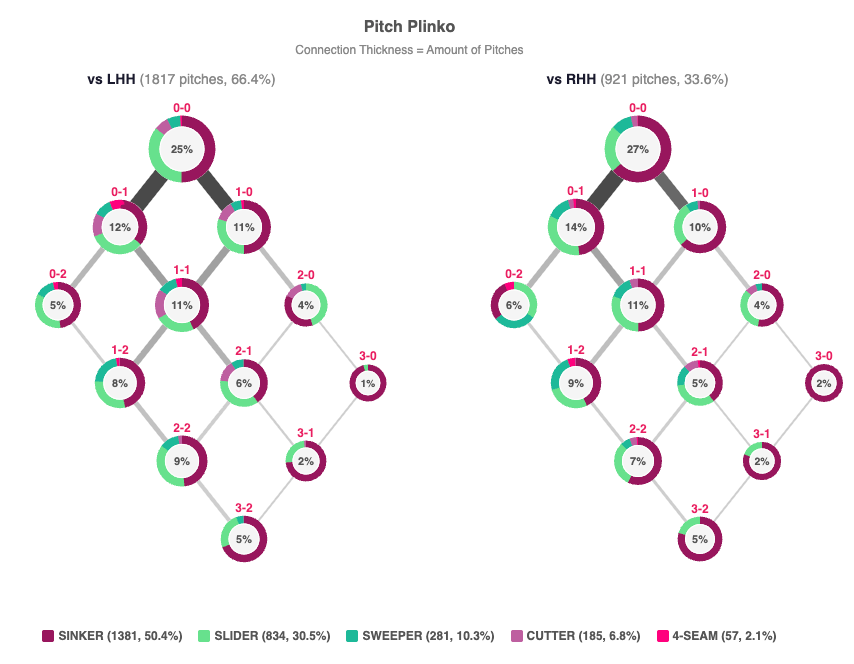
How to read a plinko chart: Each circle represents the usage of a pitcher’s arsenal in a given count (color key is on the bottom of the graphic). The thickness of the connecting lines reflects how often each count occurs, helping show how a pitcher navigates an at-bat.

Are you ready for retirement? Ford Stokes and Zac Blackerby are Braves fans who want to help you make sure you have income for life. Email Zac (zac@activewealth.com) or Ford (ford@activewealth.com) for your free Social Security roadmap today.
Braves Bullpen Status
(Reminder: these are all assumptions based on pitch count and recent usage)
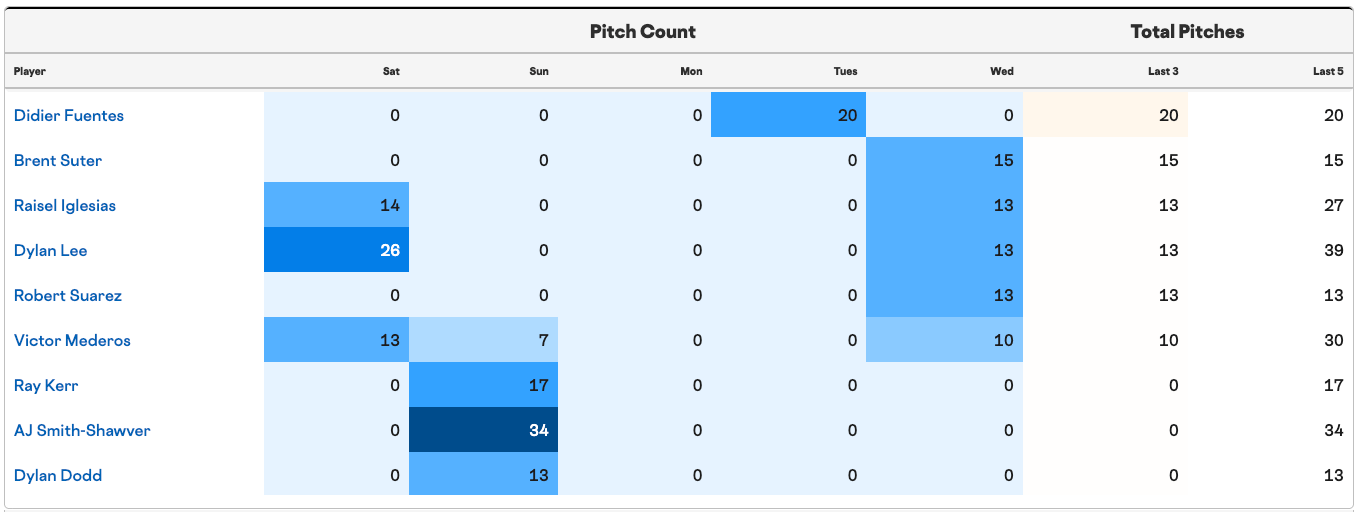
Likely available/potential limitations:
Robert Suarez is scheduled for only one more outing this week, and I’m guessing it isn’t going to come tonight.
Quick takeaway:
Just to be clear, these pitch counts aren’t going to dictate usage this week. Walt Weiss said that the pitching plans will be a bit more preset for the rest of the regular season.
Opponent Bullpen Status
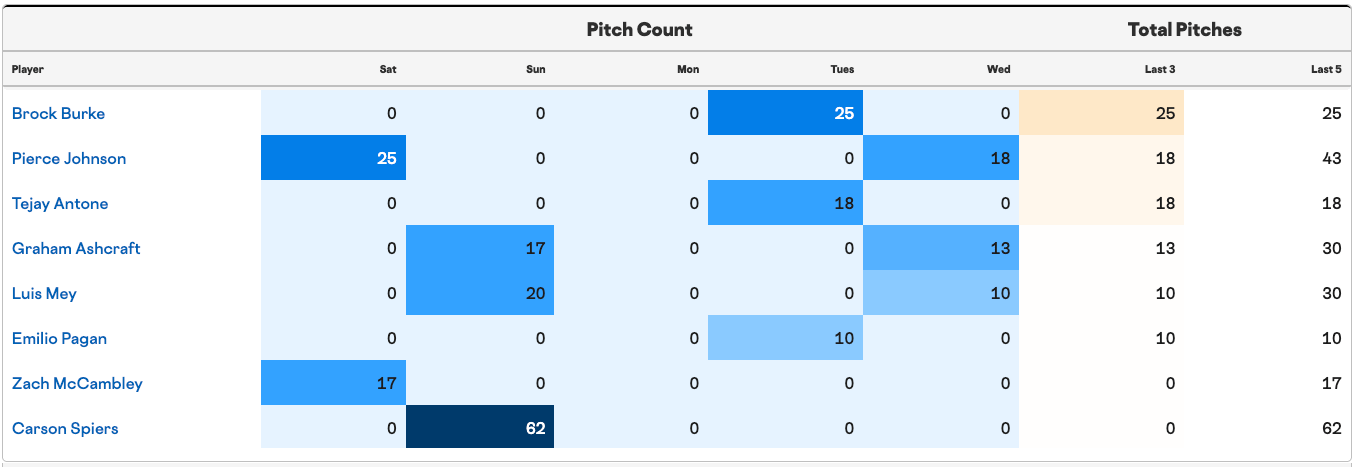
Likely Available/Potential Limitations:
Despite extra innings, Cincinnati’s bullpen is in a good place, based on pitch counts.
Quick takeaway:
Brock Burke’s the only lefty in Cincinnati’s pen and he likely gets called on again in this one.
Final Thought
The Braves are -220 on the moneyline to Cincy’s +184 and FanDuel has set the over/under at 7.5 runs. The hinge point is Can Atlanta remain disciplined without becoming passive? Singer is throwing only 45.8% of his pitches in the zone and has begun just 58.4% of plate appearances with a strike. Chasing the sweeper is the one way the Braves can rescue him. If Atlanta takes the breaking ball off the plate and attacks sinkers in the zone—particularly with its left-handed power—it should create both walks and pulled-air damage.
For Mahle, the corresponding question is whether the splitter keeps Cincinnati from repeating April. The Reds punished his fastball four times in that meeting; the Atlanta version now throws far more splitters and almost no sliders. That adjustment is the primary reason this should be a very different matchup.
Let’s Talk About It
If you’d rather watch this, here’s the Braves Today live stream from this afternoon, after lineups were announced.