


It’s Atlanta Braves baseball! Let’s break down everything you need to know about this afternoon’s matchup.
Game Info
First Pitch: 4:10 PM ET
Location: Truist Park, Atlanta GA
TV: BravesVision
Radio: 680 AM/93.7 FM The Fan, Los Bravos
Weather: courtesy of @BravesWX on X.

Atlanta Braves Lineup
C Drake Baldwin
RF Ronald Acuña Jr
1B Matt Olson
SS Mauricio Dubón
CF Michael Harris II
2B Ozzie Albies
LF Mike Yastrzemski
3B Austin Riley
DH Dominic Smith
Quick thoughts:
Dominic Smith re-enters the lineup for the first time in a week, batting ninth. Which, frankly, blows my mind - if he’s hitting so poorly right now that he needs to be in the #9 hole, then why is he your designated hitter? It’s not like he’s providing any defensive value. I’d rather see Lane Thomas or even Sean Murphy in the spot versus Smith, but maybe this is a “give him two days of playing time before we DFA him to get the 40-man spot back by the postseason eligibility deadline of Tuesday” scenario.
Colorado Rockies Lineup
DH Jake McCarthy
CF Cole Carrigg
C Hunter Goodman
1B TJ Rumfield
2B Connor Norby
3B Willi Castro
RF Mickey Moniak
LF Jordan Beck
SS Ezequiel Tovar
Quick thoughts:
Zac Veen’s getting the day off, and it’s a continuation of a trend where they’ve protected him against left-handed pitching.
Pitching Matchup
Braves Starter: LHP Martín Pérez (8-8, 3.12)
Quick snapshot:
3.12 ERA / 4.41 xERA / 4.26 FIP
17.9% K / 10.1% BB / 7.8% K-BB%
Pitch mix:
vs LHH: 53% sinker, 26% changeup, 13% cutter, 6% curveball, 2% four-seamer
vs RHH: 32% changeup, 27% sinker, 26% cutter, 9% curveball, 6% four-seamer
What to watch:
Pérez’s results remain better than his underlying performance. A 3.12 ERA is excellent, but the 4.41 xERA and 4.26 FIP tell a more ordinary story. His strikeout rate is below average, his walk rate is elevated and his .244 BABIP is doing meaningful work. Pérez has legitimately limited damaging contact, but the margin between “effective veteran starter” and “traffic jam” remains fairly thin.
August has been excellent, but built on contact management rather than dominance. Pérez has a 1.80 ERA in five August starts, allowing only 18 hits and one homer in 25 innings. He has also struck out only 16 while walking 11. The run prevention is real; the under-the-hood profile is of a veteran who is still successfully walking a fine line to get his results
His last two starts have contained considerably more traffic. Minnesota and Milwaukee combined for 13 hits, five walks and only five strikeouts in nine innings against him. Pérez allowed four earned runs in the first inning at Minnesota, then needed 97 pitches to complete four innings in Milwaukee after his own error prolonged a 37-pitch third. Only one of Milwaukee’s four runs was earned, but inefficient innings can shorten his outing regardless of how they are scored.
The changeup remains the pitch that makes everything work. Hitters have batted .153 and slugged .287 against it, with a 34.6% whiff rate and .280 xwOBA. His sinker has produced good actual results, but its .348 xwOBA and 45.2% hard-hit rate are less convincing. The cutter has allowed a .483 slugging percentage, and the seldom-used four-seamer has been hit even harder. Pérez needs the changeup to prevent Colorado from sitting on his fastball family.
Pérez’s platoon split contains two different vulnerabilities. Righties have hit only .209/.302/.342, but they have drawn 41 of his 48 walks. Lefties have walked only seven times but slugged .409 and hit five homers in 127 at-bats. Colorado’s righties are the greater traffic threat; its lefties have surprisingly supplied the greater rate of power.
Jake McCarthy cannot be treated like an ordinary left-on-left matchup. He has hit .316/.360/.521 against left-handed pitching this season. Hunter Goodman, recently returned from a shoulder injury, has a .876 OPS and nine homers against lefties. Those are the two bats most capable of punishing a Pérez mistake, regardless of traditional platoon expectations.
There isn’t a dramatic times-through-the-order penalty. Opponents have a .663 OPS the first time through, .677 the second and .625 the third. The larger concern is whether Pérez pitches efficiently enough to receive that third look: only four of his 21 starts have reached six innings, and two of his past three have ended after three or four.
Truist Park has been especially kind to him. Pérez owns a 2.02 ERA and 1.04 WHIP at home, compared with a 4.42 ERA and 1.42 WHIP on the road. The caution is a .195 home BABIP, suggesting some of that enormous gap is good fortune rather than a park-specific skill.
Who to watch:
Not a ton of experience on Colorado’s roster off of Pérez, and only two players have faced him more than twice.
Pérez won: Ezequiel Tovar (1-9), Willi Castro (3-15, RBI), Jordan Beck and Connor Norby (0-2), Mickey Moniak (0-1)
Pérez has gotten got: Hunter Goodman (2-2, homer), Jake McCarthy (1-2, RBI)
Opposing Starter: RHP Ryan Feltner (5-8, 6.08 ERA)
Quick snapshot:
6.08 ERA / 5.54 xERA / 5.53 FIP
16.1 K% / 9.9 BB% / 6.2% K-BB%
The arsenal:
Four-seamer (28%, 94.8 mph)
Slider (24%, 89.1 mph) ← Think of this as a cutter, based on movement profile
The average RHP slider is 1.4 inches IVB and 3.6 inches of gloveside movement at 86.9 mph, Feltner’s is 5.5 IVB & 4.6 glv at 89.1 mph. For a guy that’s not already sitting high-90s, this only makes sense if it’s a misclassified cutter. (Statcast defers to the player’s term for the pitch)
Changeup (17%, 85.2 mph)
Sinker (14%, 94.3 mph)
Sweeper (10%, 82.3 mph)
Curveball (7%, 79.4 mph)
Atlanta’s path against Feltner
Make Feltner beat you with something other than the changeup. The changeup is easily his best pitch, holding hitters to a .178 average, .288 slugging percentage and .185 xwOBA with a 45.8% whiff rate. His two most-used pitches are dramatically more vulnerable: the four-seamer has allowed a .448 wOBA and .427 xwOBA, while the “slider” has allowed a .416 wOBA and .426 xwOBA. Atlanta should hunt those two pitches rather than expanding against the changeup.
His velocity is legitimate; its effectiveness is not. Feltner averages 94.8 mph with the four-seamer and 94.3 with the sinker, and he has reached 98.3. But the four-seamer produces only a 12.5% whiff rate, while the sinker is at 15.1%. Atlanta does not need to treat his velocity like overpowering velocity.
This is one of the clearest power matchups Atlanta has received recently. Feltner has allowed 19 home runs and a 10.9% barrel rate, with opponents producing a .490 expected slugging percentage. The four-seamer, slider, sweeper and curveball have all allowed at least a .570 expected slugging percentage. The changeup is the only pitch in the arsenal that has consistently prevented damaging airborne contact.
Leaving Coors Field has not solved the problem. Feltner has a 5.86 road ERA, 1.72 WHIP and 1.67 homers allowed per nine innings. Just as with Sugano yesterday: This is not a ballpark problem; it’s a Feltner problem.
Attack him from the jump. Opponents have an .861 OPS the first time through the order, and Feltner has a 5.40 first-inning ERA. His third-time-through OPS climbs to .965, but he is already vulnerable before familiarity becomes a factor.
The recent version has been even worse. Feltner owns a 7.00 ERA and 1.78 WHIP in August, with 34 hits and 14 walks against 16 strikeouts in 27 innings. He has allowed 12 earned runs across his past two starts, although Washington did not record its first hit against him until the fifth inning Monday. The stuff can briefly look convincing, but once traffic arrives, he has struggled to stop the inning.
The Braves against Feltner: Both a lot of previous experience - all but three Braves have seen him - and a lot of that experience is good.
The good: Acuña (3-5), Albies (3-7), Olson (2-8), and Riley (3-8) have all homered, while Albies, Olson, and Riley have combined for ten RBI). Lane Thomas is 2-4, while Dom Smith and Sean Murphy are both 1-3 and Michael Harris is 2-6. Even Ha-Seong Kim is 4-8 off of Feltner.
The bad: Really, nobody? Olson is ‘only’ 2-8, but with a homer and three RBI, and it’s hard to argue that anyone’s been outright bad.
Haven’t seen him: Drake Baldwin, Mauricio Dubón, Brewer Hicklen
How he attacks hitters (all graphics courtesy of Thomas Nestico)
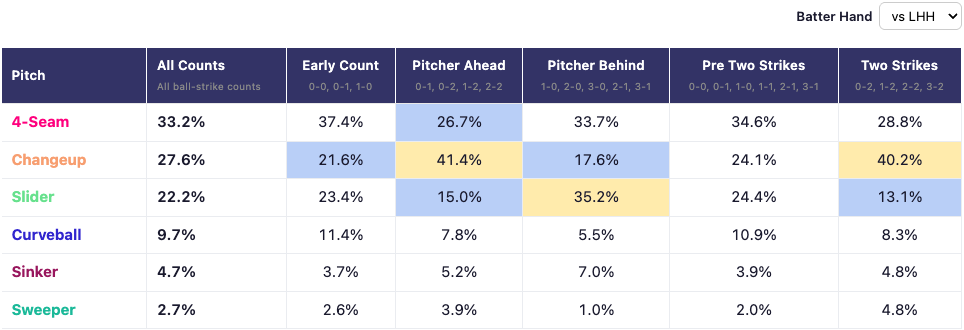
vs LHH: Two fastball variants immediately, with the changeup taking precedence when he’s ahead/has two strikes and the “slider” taking over when he’s behind in the count. The curveball functions more as an early strike stealer than a legit whiff weapon.
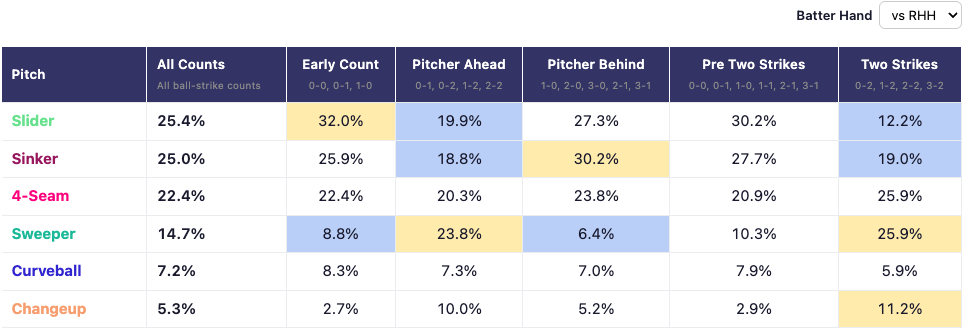
vs RHH: All three fastballs dominate the at-bat until he gets ahead, at which point the same-handed sweeper ramps up. The changeup is mostly reserved for pitcher advantage counts.
Sequencing:
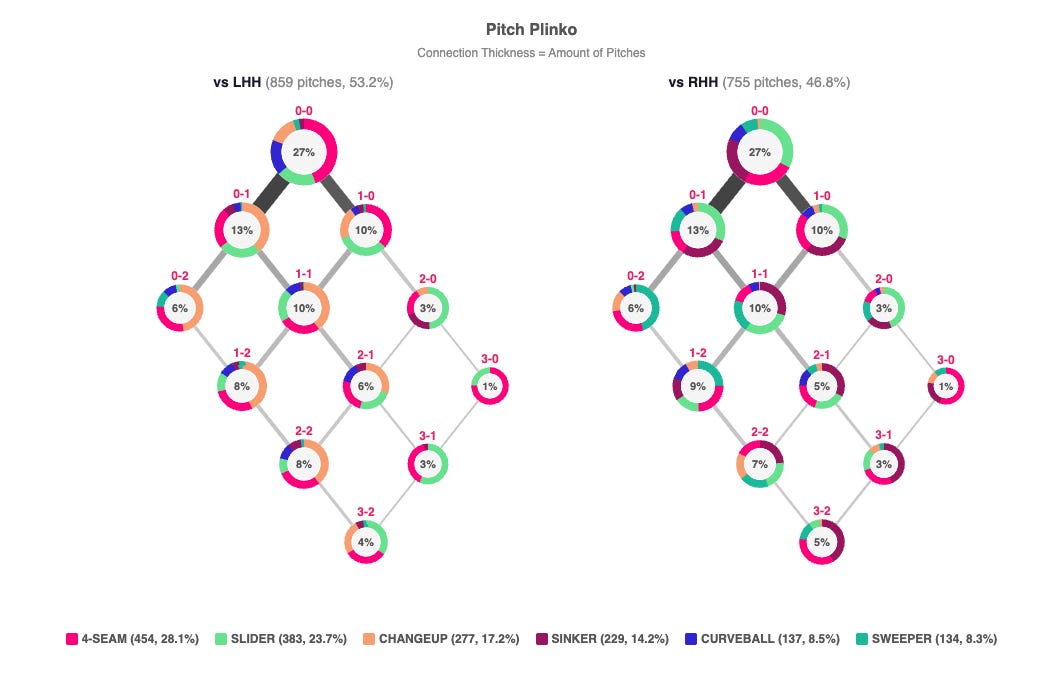
How to read a plinko chart: Each circle represents the usage of a pitcher’s arsenal in a given count (color key is on the bottom of the graphic). The thickness of the connecting lines reflects how often each count occurs, helping show how a pitcher navigates an at-bat.
Braves Bullpen Status
(Reminder, these are all assumptions based on pitch count and recent usage)
Likely available:
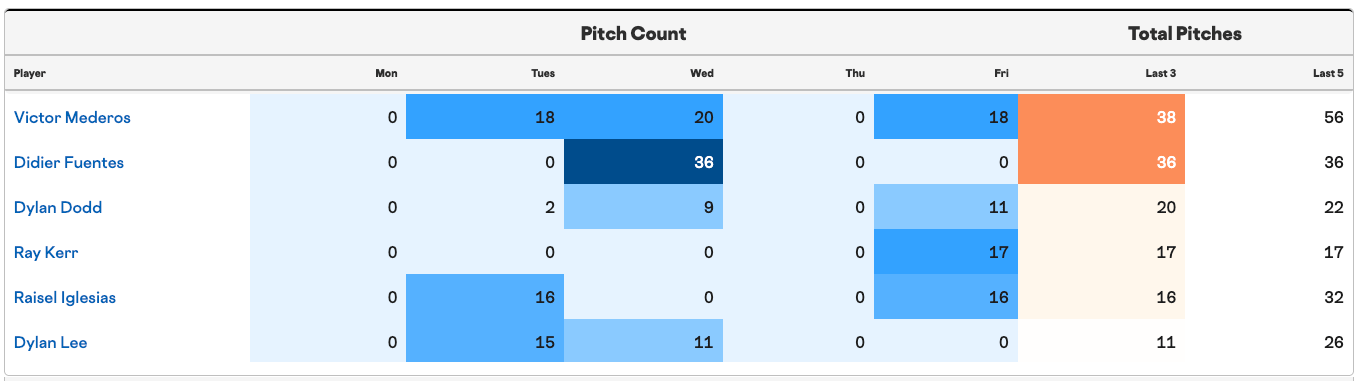
The leverage combo of Didier Fuentes and Dylan Lee (two days off) and Brent Suter (last Saturday) are your freshest guys in the armbarn today.
Potential limitations:
Victor Mederos has thrown three times in the last four days, hitting 38 pitches over the last three and 56 in the last four, so I imagine they’d like to get him a day off if possible.
Quick takeaway:
Winning a game by more than three runs sure would be nice! Let’s shoot for a three-inning save for Brent Suter, yeah?
Opponent Bullpen Status
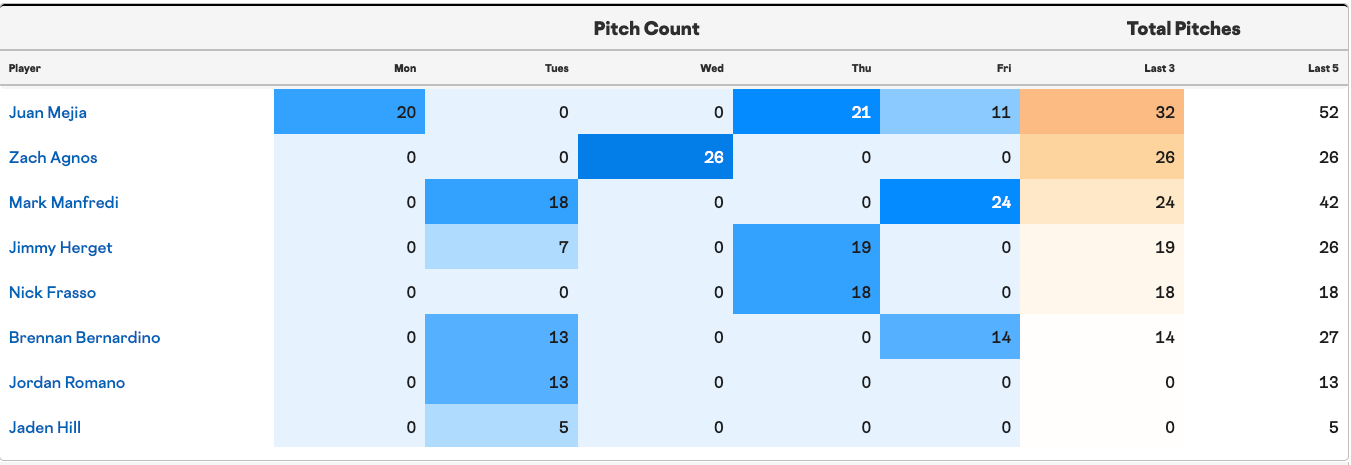
Likely Available:
Closer Jordan Romano and flamethrower Jaden Hill are working off of three days rest, while longman Zach Agnos has two days of rest.
Potential Limitations:
Middle reliever Juan Mejia is now coming off a 32-pitch back-to-back, so I’d imagine he’s down today. Mark Manfredi’s 24 pitches likely has him as a yellow light for today, but that’s probably it for Colorado’s inactives.
Quick takeaway:
I’d love to give Colorado more rest by winning with a position-players-are-eligible-to-pitch margin, yeah?
Final Thought
The Braves are favored on the moneyline at -220 to Colorado’s +200 and FanDuel has set the over/under at nine runs, the exact same margins as yesterday. The likely hinge point is Which offense can force the opposing starter to operate without his changeup? Feltner’s changeup is the only pitch consistently preventing hard contact, and Pérez’s changeup is the pitch that protects an otherwise hittable sinker-cutter combination. If Atlanta’s lefties win counts and remove Feltner’s changeup while Pérez keeps his available against Colorado’s right-handed bats, the Braves should own both sides of the matchup.
Let’s Talk About It
If you’d rather watch this, here’s the Braves Today live stream from this afternoon, after lineups were announced.
Lindsay: "YEAH, indeed!!!" They should have picked up Mateo!!"