


It’s Atlanta Braves baseball! Let’s break down everything you need to know about this afternoon’s matchup.
Game Info
First Pitch: 2:15 PM ET
Location: Truist Park, Atlanta GA
TV: NBC/Peacock
Radio: 680 AM/93.7 FM The Fan
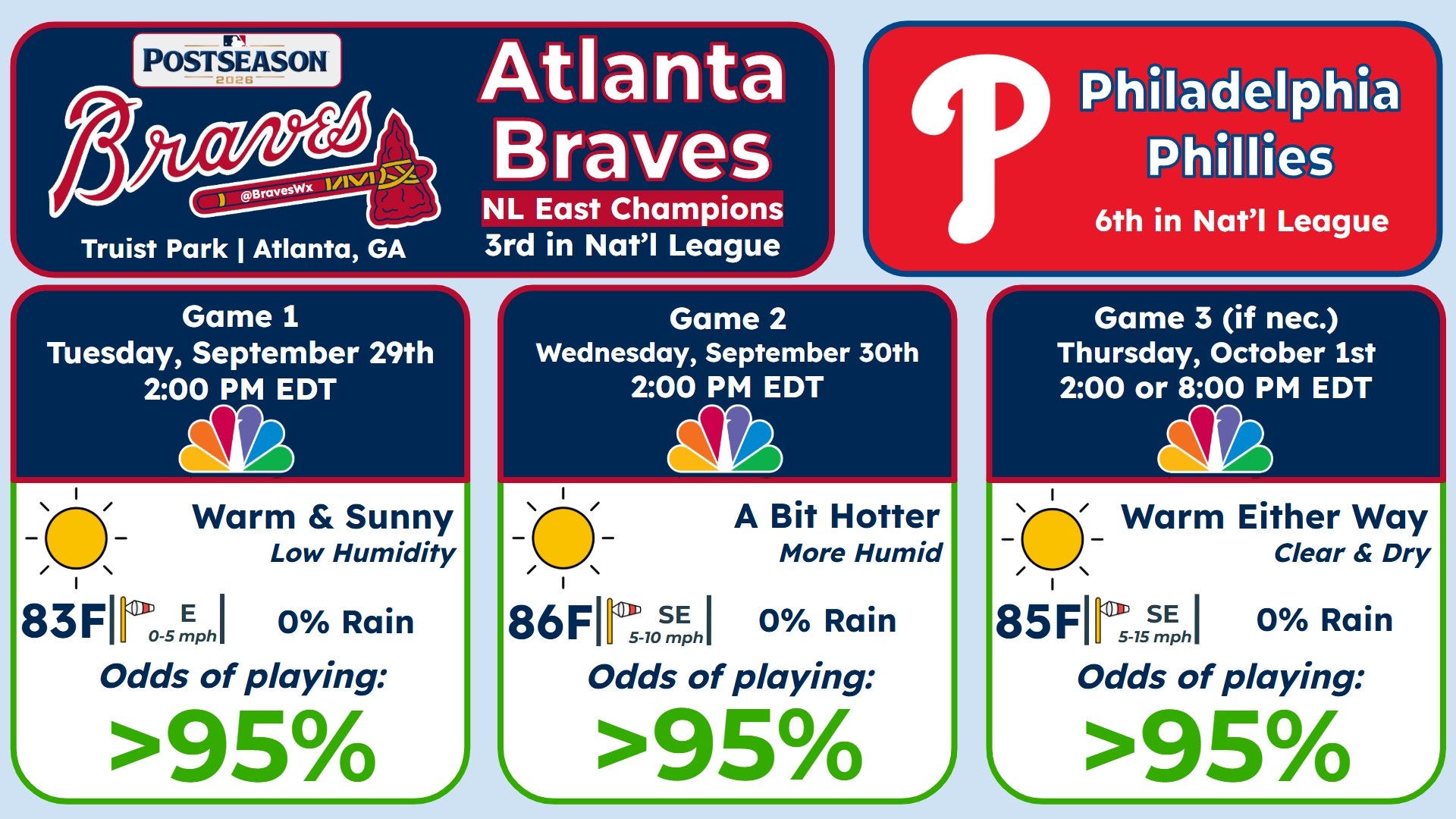
Weather: Courtesy of BravesWX on Twitter/X
Atlanta Braves Lineup
C Drake Baldwin
RF Ronald Acuña Jr
1B Matt Olson
LF Mauricio Dubón
CF Michael Harris II
2B Ozzie Albies
3B Austin Riley
DH Mike Yastrzemski
SS Ha-Seong Kim
Quick thoughts:
A lefty is opening the game for Philly, but the Braves are clearly not treating this as an extended outing. Mike Yastrzemski is in the lineup to begin the day, working as the designated hitter and batting 8th, with Dubón in left field and Kim at shortstop.
Bench breakdown:
Atlanta has a massive bench for the series, including two potential 1B/DH bats in Dominic Smith and Rowdy Tellez. They’re also carrying Brewer Hicklen as a fourth outfielder, DaShawn Keirsey Jr. as a pinch-runner, and Luke Williams as both a pinch-runner and a jack-of-all-trades utilityman.
Atlanta’s taxi squad includes pitchers JR Ritchie and AJ Smith-Shawver, as well as infielder Kyle Farmer and catcher Maverick Handley.
Philadelphia Phillies Lineup
SS Trea Turner
DH Kyle Schwarber
RF Bryce Harper
1B Alec Bohm
CF Derek Hill
LF Bryan De La Cruz
2B Bryson Stott
3B Edmundo Sosa
C JT Realmuto
Quick thoughts:
Turner in front of Schwarber is something Philly went back to on Saturday, hoping to create some RBI opportunities for their DH.
Bench breakdown:
Philly has a five-man bench, including two catchers in Rafael Marchán and Garrett Stubbs, as well as utilityman Otto Kemp (replacing the injured Luis Arraez). Justin Crawford and Brandon Marsh, who views left-handed pitching as the boogeyman, are the two rotational outfielders who are out of the lineup today with a lefty on the mound for Atlanta.
Philly’s three catchers this season put up a collective .539 OPS, the worst mark in baseball.
Pitching Matchup
Braves Starter: LHP Chris Sale (14-9, 2.16)
Quick snapshot
2.16 ERA / 2.96 xERA; 200 strikeouts and 31 walks in 162⅔ innings.
Approximately 41% four-seamer, 40% slider, 10% changeup and 9% sinker. His four-seamer averages 96.1 mph; the slider averages about 80.
Pitch usage by handedness
Percentages are rounded shares of pitches thrown to each side.
vs. LHH: Roughly 39% slider, 33% sinker, 27% four-seamer, 1% changeup
The sinker runs in on lefties, while the slider is the finishing pitch. The changeup is virtually absent.
vs. RHH: Roughly 46% four-seamer, 40% slider, 14% changeup, 1% sinker
The elevated fastball changes eye level; the slider moves across and below the zone. The changeup gives him another pitch moving away from righties.
What to watch from Sale:
The velocity and command check comes immediately. Sale’s September 23 tuneup produced 10 strikeouts, no walks and one run in 5⅔ innings. Atlanta arranged his rest specifically to give him an extra day before Game 1. The first inning should tell us whether he has the same 96–97 mph fastball and feel for the slider, or if there’s some sort of postseason velo bump.
Philadelphia has seen him often, yet the matchup has largely favored Sale. In four 2026 starts against the Phillies, he allowed six earned runs in 26 innings—a 2.08 ERA—and struck out 29. That includes a less tidy September 11 start: three runs in the second inning, then no more over seven innings.
Treat the star-hitter history carefully. Bryce Harper is 2-for-21 against Sale, but Kyle Schwarber has two career homers off him. The broader pitch plan matters more than either small head-to-head line.
Opposing Opener: RHP Jesús Luzardo (14-5, 2.86 ERA)
Quick snapshot
2.86 ERA after his one-inning return / about 2.85 xERA; 221 strikeouts in 179⅔ innings.
Approximately 38% sweeper, 26% four-seamer, 18% changeup and 17% sinker. The fastballs average roughly 96–97 mph.
Pitch usage by handedness
vs. LHH: 48% sweeper, 36% sinker, 13% four-seamers, 3% changeups
This is a lateral game, with sweepers running away and sinkers running in. The four-seamer up serves as the bridge pitch, with only occasional changeups used as a tendency breaker.
vs. RHH: 35% sweeper, 30% four-seamer, 23% changeup, 12% sinker
More of a well-rounded arsenal, but the same basic idea - sweepers running in (instead of away), four-seamers up, and the sinker & changeup give something that runs away.
Atlanta’s path against Luzardo
The sweeper is the central problem. Opponents hit .112 and slugged .159 in plate appearances ending on it; it produced a 47.6% whiff rate. He throws it to both sides, with a particularly severe overall result against lefties: they managed only a .373 OPS against him, versus .691 for righties.
His approach changes with the hitter. The changeup is overwhelmingly a right-on-left matchup pitch; an earlier season snapshot recorded 455 of 473 changeups to right-handed batters. It still misses bats—37.5% whiffs for the season—but his four-seamer is a clearer contact opportunity: .445 slugging allowed and a 19.5% whiff rate. The practical instruction is to make him bring a firm pitch into the zone without offering at the sweeper below it.
The September 7 shutout and Tuesday’s workload can both be true. Luzardo held Atlanta to two hits, one walk and no runs while striking out 12 on 109 pitches. Shoulder soreness followed; he did not face hitters again until Sunday, when he got three groundouts on four fastballs. That outing established that he could pitch, but gave little evidence of how long he can sustain and command the full four-pitch arsenal; JT Realmuto told reporters that Luzardo couldn’t throw strikes in the bullpen during his warm-up. Watch the sweeper’s shape, fastball velocity and command before guessing at an innings limit.
Acuña and Atlanta’s other right-handed bats are important, but this is a substitution puzzle. Luzardo is substantially tougher on lefties, while Painter reverses the throwing hand. A lineup built entirely to face Luzardo may spend more of the game facing Painter. I’m assuming Yastrzemski being the DH today is so that they can pinch-hit for him, if needed, without needing to worry about changing the outfield defenders.
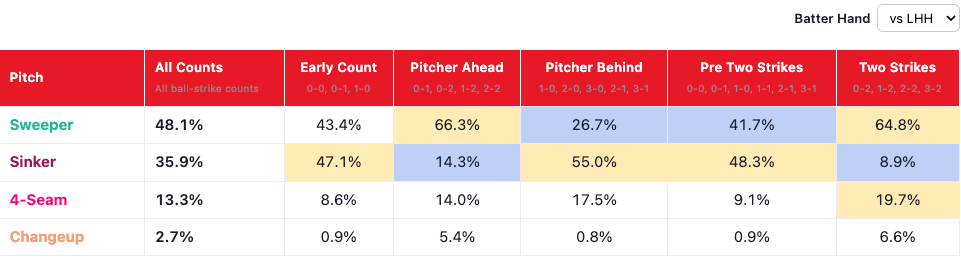
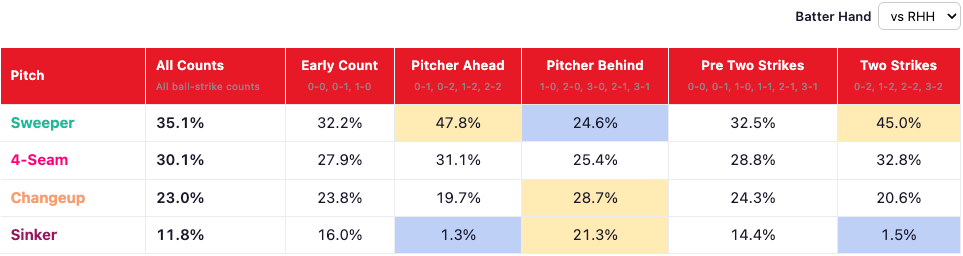
How he attacks hitters (all graphics courtesy of Thomas Nestico)
vs LHH: A sinker/sweeper heavy mix early, with the four-seamer taking over as the primary fastball with two strikes. The left-on-left changeup is used occasionally when ahead and with two strikes.
vs RHH: More of a well-rounded arsenal, with the four-seamer taking over as the primary fastball and the sinker mostly being used early and when behind. Changeups are a legitimate third pitch in the mix, although used slightly more in hitter’s counts.
Sequencing:
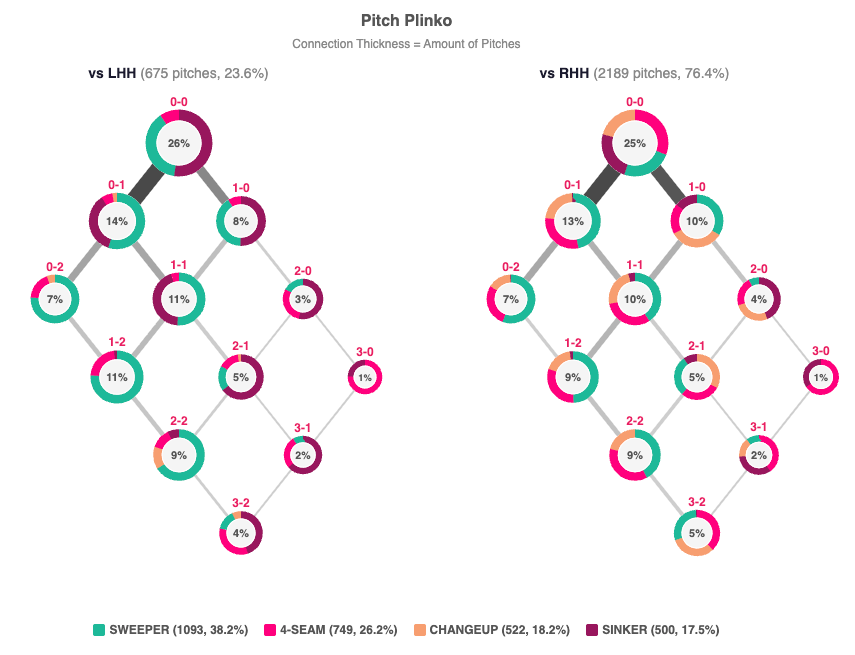
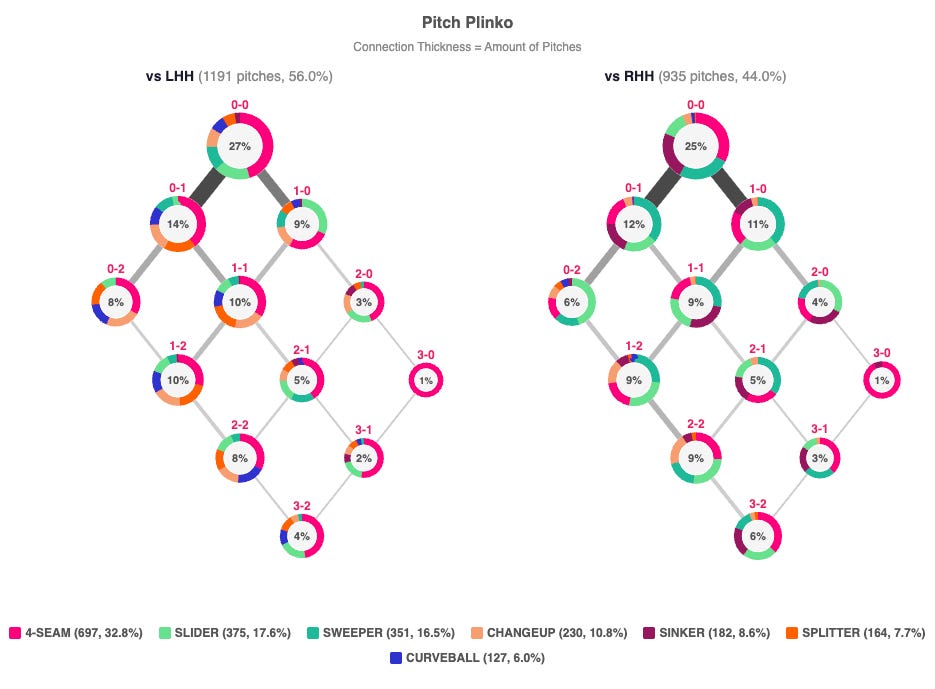
How to read a plinko chart: Each circle represents the usage of a pitcher’s arsenal in a given count (color key is on the bottom of the graphic). The thickness of the connecting lines reflects how often each count occurs, helping show how a pitcher navigates an at-bat.
Possible bulk reliever: RHP Andrew Painter
Quick snapshot: 5.40 ERA / roughly 4.41 xERA; 20.8% strikeouts and 8.5% walks. His seven-pitch mix is led by a 96.6-mph four-seamer (33%), slider (18%) and sweeper (17%), followed by changeup (11%), sinker (9%), splitter (8%) and curveball (6%).
If Painter follows: The season-long four-seamer is the pitch to test: opponents hit .354 and slugged .567 against it, with only a 16.4% whiff rate. His breaking and offspeed choices make “sit fastball” too simple a plan, though. He held Atlanta to one run in five innings on September 13 despite four walks, then struck out eight Brewers over six one-run innings on September 24. His September ERA was 3.49. Atlanta should be ready for a better pitcher than the 5.40 season ERA suggests, while making him prove he can land the fastball. Lefties had a .784 OPS against him, righties a .756 OPS; this is a less dramatic platoon split than Luzardo’s.
How he attacks hitters (all graphics courtesy of Thomas Nestico)
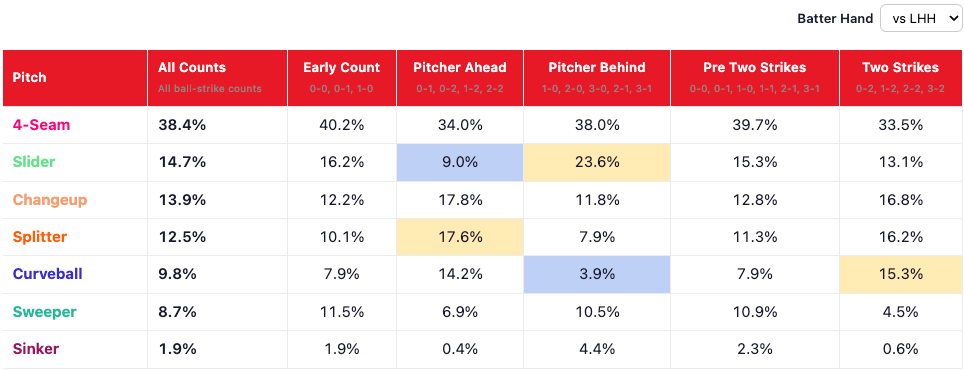
vs LHH: A well-rounded arsenal, anchored by strong velo on the four-seamer. Slider’s more a strike stealer when behind, similar to a cutter’s usage, with the splitter and curveball being the primary whiff offerings.
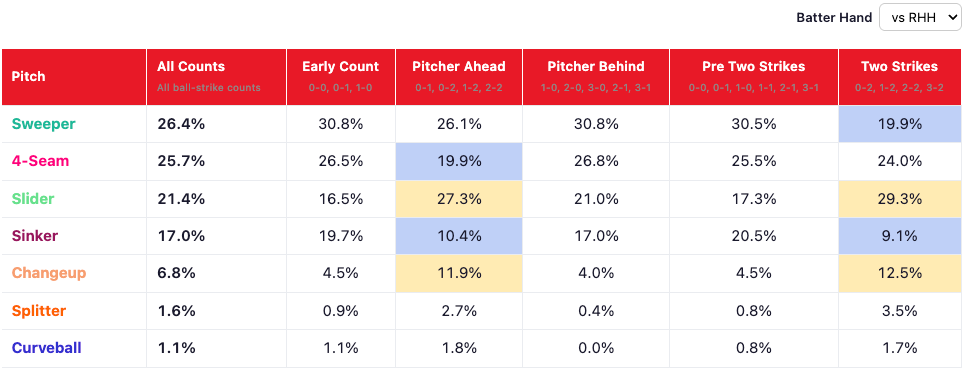
vs RHH: Sweeper/four-seamer is the primary pairing early, but the slider becomes the primary whiff offering when ahead and with two strikes, followed by the sweeper and the changeup. Splitter and curveball are seldom used.
Sequencing:

Are you ready for retirement? Ford Stokes and Zac Blackerby are Braves fans who want to help you make sure you have income for life. Email Zac (zac@activewealth.com) or Ford (ford@activewealth.com) for your free Social Security roadmap today.
Braves Bullpen Status
(Reminder: these are all assumptions based on pitch count and recent usage)
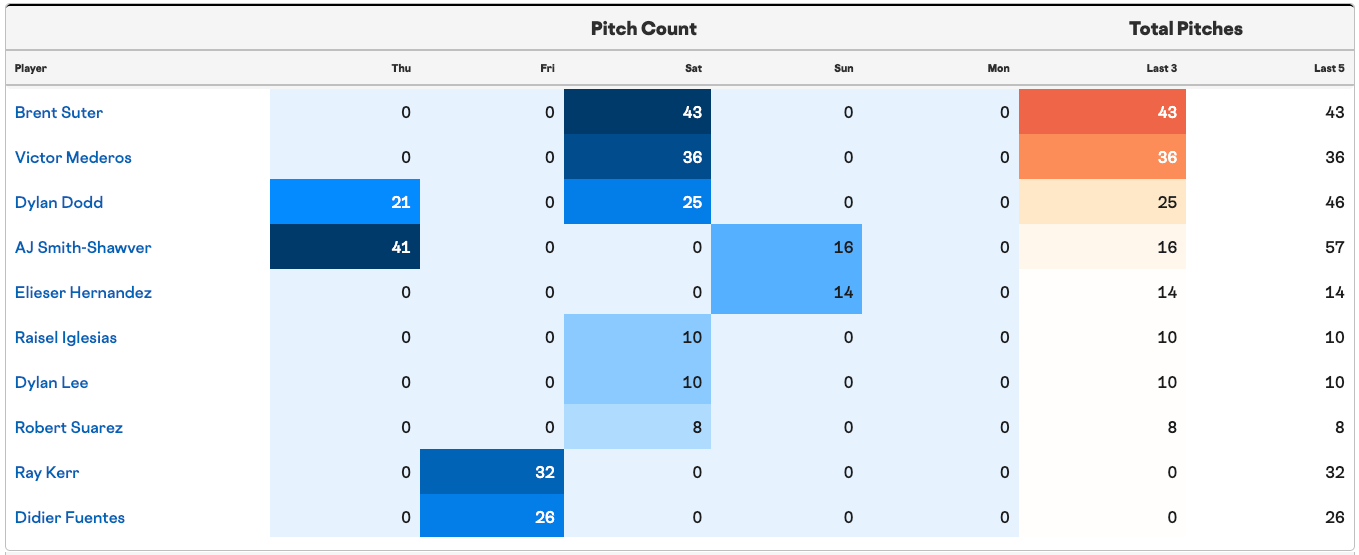
Likely available/potential limitations:
Atlanta did a good job of making sure they have all of their key relievers well-rested and ready to go for the opener.
Quick takeaway:
No specific availability concerns for Game 1.
Opponent Bullpen Status
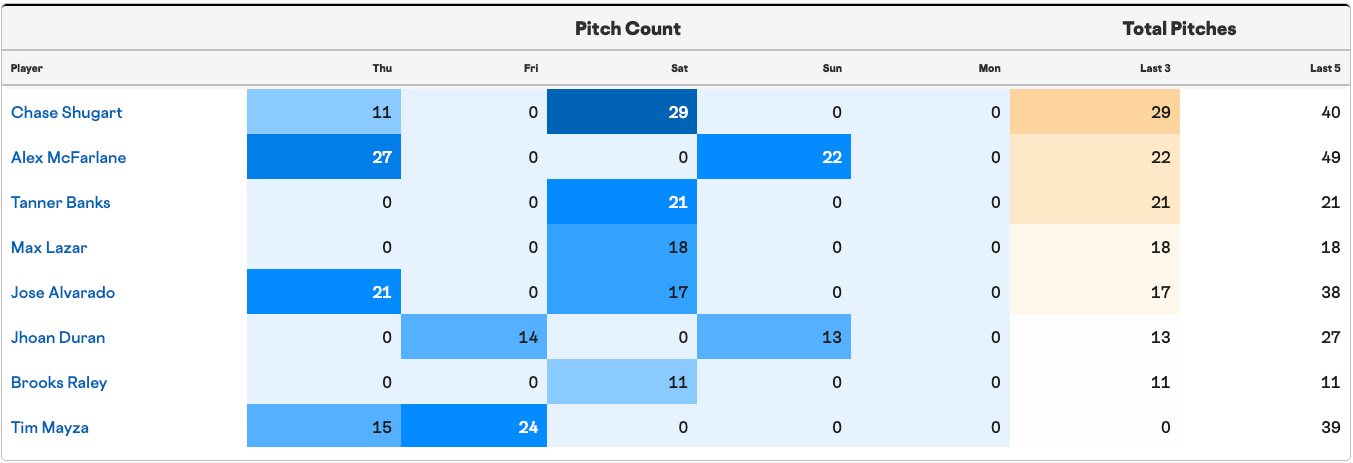
Likely Available/Potential Limitations:
Philly rode the bullpen hard on Saturday, but managed to escape Sunday without too much usage.
Quick takeaway:
If the Phillies use Duran or McFarlane today, what does that do for the availability and pitch counts for game two (and maybe three)?
Umpire information
The home plate umpire today is Dan Merzel; if that name’s familiar, he’s the same umpire who called Chris Sale for a balk in New York and then ejected him from the game the next day after Sale complained about it. Just to make sure he was disliked by both teams, he also ejected Phillies hitting coach Kevin Long last week for arguing an out-of-the-basepaths call on second baseman Luis Arraez.
UmpScorecards grades his 29 regular-season plate games at 93.88% accuracy on 4,513 taken pitches, versus 94.10% expected given the pitches he saw. Without heat maps and given how close he was to his expected accuracy, it’s hard to predict if this will be a wide zone or tight zone. The scorecard record shows 71 overturns on 135 challenges; challenged pitches are selected precisely because someone disputes the call, so that fraction is not his overall error rate. The postseason uses ABS challenges: each club begins with two and retains successful ones, same as the regular season.
Final Thought
The Braves are -196 on the moneyline to Philly’s +164 and FanDuel has set the over/under at 6.5 runs. The hinge point is Can Atlanta score before Philadelphia chooses its handoff? Luzardo’s best pitch can erase left-handed hitters, but his shoulder makes the length of his outing uncertain. Painter can absorb innings, yet his four-seamer has been hittable. Atlanta’s best path is to decline Luzardo’s sweeper off the plate, attack a fastball it can lift, and keep useful left-handed bats available for the possible switch to Painter. Meanwhile, Sale can put Philadelphia in the position of asking a bullpen with a 5.79 September ERA to protect or recover a close game.
Let’s Talk About It
If you’d rather watch this, here’s the Braves Today live stream from this morning, after lineups were announced.
Excuse me for laughing, but the funniest thing i heard this summer was "Braves fans want Atlanta to lose so they can get rid of A.A." This was a reaction to the disappointing Trade Deadline non-moves.
Now Southern Cal fans are hoping Trojans loses so they can get rid of Lincoln Riley. His buyout would be $ 50-60 million.
Hell , i've been hoping for 30 years Jerry Jones would be struck Deaf and Dumb.