


It’s Atlanta Braves baseball! Let’s break down everything you need to know about this evening’s elimination game.
Game Info
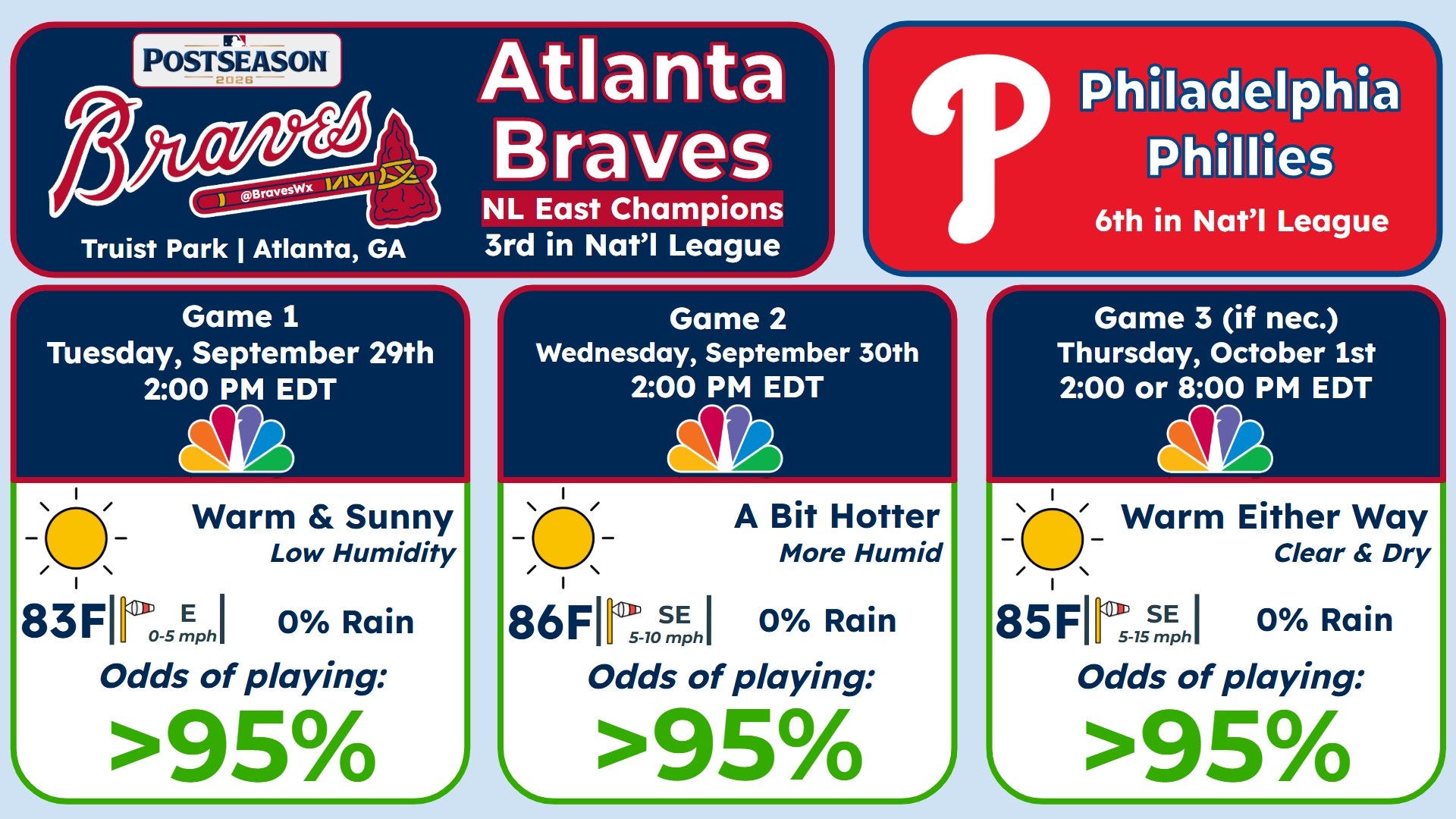
First Pitch: 8:15 PM ET
Location: Truist Park, Atlanta GA
TV: NBC/Peacock
Radio: 680 AM/93.7 FM The Fan
Weather: Courtesy of BravesWX on Twitter/X
Atlanta Braves Lineup
C Drake Baldwin
RF Ronald Acuña Jr.
1B Matt Olson
CF Michael Harris II
SS Mauricio Dubón
LF Mike Yastrzemski
3B Austin Riley
2B Ozzie Albies
DH Dominic Smith
Quick thoughts:
WOO BOY do I have thoughts on this one - Dominic Smith instead of Sean Murphy seems like some sort of focus on Smith’s career numbers off of Nola (.774 OPS) instead of how they’ve played recently - Smith hasn’t seen Nola since 2024, when he singled off of him, and he hasn’t recorded an XBH off Nola since 2021. The lone homer in Smith’s career off of Nola came back in 2018. Dominic is 3-14 off of Nola in the last four seasons, striking out six times, so yeah, let’s go with your designated hitter in the #9 spot in the order.
I hope I’ve reverse jinxed this. Slander works, after all. We’ve always said that.
Sure, Murphy’s not been that good off of Nola - 0-6 this year and 3-17 lifetime - but at least he’s hitting the ball well right now. He SCORCHED a double off of Cristopher Sánchez yesterday, while Smith struck out looking to end the game in extras.
Bench breakdown:
Atlanta’s bench today will have:
Lefty 1B/DH bat: Rowdy Tellez
4th outfielder: Brewer Hicklen
Backup catcher: Sean Murphy
Infielder: Ha-Seong Kim
Pinch-runners: DaShawn Keirsey Jr. and Luke Williams, who also serves as the backup utility man.
Atlanta’s taxi squad includes pitchers JR Ritchie and AJ Smith-Shawver, as well as infielder Kyle Farmer and catcher Maverick Handley.
Philadelphia Phillies Lineup
SS Trea Turner
DH Kyle Schwarber
RF Bryce Harper
1B Alec Bohm
2B Bryson Stott
LF Bryan De La Cruz
3B Edmundo Sosa
C J.T. Realmuto
CF Justin Crawford
Quick thoughts:
I wondered, with the Braves using a lefty opener, if the Phillies would punt an early AB to get Brandon Marsh in the starting lineup. They did not, but they split the difference by putting Justin Crawford in there but moving him down to the #9 spot in the order. They clearly don’t expect Kerr to get there.
After Edmundo Sosa apparently aggravated his groin injury by beating out an infield grounder yesterday, he is IN today’s lineup.
Bench breakdown:
Two catchers: Rafael Marchán and Garrett Stubbs
Philly’s three catchers this season put up a collective .539 OPS, the worst mark in baseball.
Utilityman Otto Kemp (on the roster for injured Luis Arraez).
Platoon outfielder Brandon Marsh, who I’m guessing gets into the game as soon as Kerr leaves.
Backup outfielder Derek Hill (CF/LF defensive option)
Pitching Matchup
Braves Opener: LHP Ray Kerr (0-0, 1.47)
Quick snapshot
1.47 ERA in 18⅓ innings since returning in August. It is an encouraging run, with a small sample behind it.
His 2026 mix: 35.8% four-seamer, 31.1% curveball, 22.6% sinker, 6.6% slow curve and 3.8% cutter. The four-seamer has averaged 94.9 mph.
What to watch:
The assignment is Schwarber and Harper, not a predetermined number of innings. Kerr gives Atlanta a left-hander against the two left-handed hitters who changed Game 2 with back-to-back homers. Lefties have gone 4-for-23, all singles and a double, against Kerr this year. That is a reason to choose the matchup, though 23 at-bats cannot guarantee the result.
They have already rehearsed the opener-to-Holmes handoff. Atlanta opened with Kerr before Holmes’s scheduled turn last Friday. Kerr worked three scoreless innings against Miami; Weiss has described the decision to use him as matchup-driven. Today’s first inning will determine whether Atlanta takes a quick handoff or asks Kerr for more.
Do not reduce Kerr to a left-on-left specialist. Righties went 5-for-37 against him this season, although both home runs he allowed came against them. If Trea Turner reaches ahead of Schwarber and Harper, Kerr still has to deal with a dangerous right-handed hitter before he gets to the platoon advantage.
Watch the curveball’s location. Kerr’s four-seamer held hitters to a .130 average in its limited 2026 sample, while the curveball produced a 33.3% whiff rate but also a .450 slugging percentage against. It can finish a plate appearance; a curveball that stays up can also undo the reason for opening with him.
Braves Bulk Arm: RHP Grant Holmes (10-6, 3.47)
Quick snapshot
3.44 ERA / 5.05 xERA in 151⅔ innings, with a 17.9% strikeout rate and 9.7% walk rate. He posted a 2.94 ERA over his final 14 starts.
Six-pitch mix led by a 36.2% slider, followed by 28.3% four-seamer, 12.5% sinker, 8.1% cutter, 7.7% curveball and 7.3% changeup.
What to watch
The slider is his route to misses. Hitters batted .211 against it, and it generated a 40.3% whiff rate. His four-seamer generated only a 15.6% whiff rate, with opponents slugging .480 against it. Holmes needs the fastball in useful spots so Philadelphia cannot wait for a firm pitch while declining the slider below the zone.
The opener may protect the most important part of Holmes’s outing. Opponents posted a .590 OPS on their first look at Holmes in a game and an .886 OPS on their second. If Kerr gets through the top of the order, Holmes could first encounter Philadelphia’s middle and lower hitters. The difficult decision comes when Schwarber and Harper cycle back for their second look at Holmes later on.
The lefties have not been his chief platoon problem this year. Left-handed hitters produced a .683 OPS against Holmes; righties produced a .753 OPS. Kerr’s value is concentrated at the start of the game, particularly after yesterday’s eighth inning. Once Holmes enters, the entire lineup matters, including Bohm and J.T. Realmuto.
His ERA and contact indicators tell different stories. The 5.05 xERA is substantially higher than his 3.44 ERA. That does not predict a bad outing tonight, but it makes early hard contact more meaningful than a clean score line might suggest. Weiss should be ready to act before a second trip through the heart of the order becomes a third.
Opposing Starter: RHP Aaron Nola (7-12, 4.67 ERA)
Quick snapshot
7–12, 4.67 ERA / 4.18 xERA, with a 23.8% strikeout rate and 7.9% walk rate.
Pitch mix: 33.3% curveball at 78.4 mph; 24.0% four-seamer at 92.3; 18.2% sinker at 91.6; 16.3% changeup at 85.6; 7.6% cutter, with a seldom-used slider.
Atlanta’s path against Nola
The curveball is still the pitch to respect. It accounts for one-third of Nola’s pitches, and hitters have batted .177 against it with a 41.1% whiff rate. The Braves need to recognize the curve early enough to take the one that drops below the zone. Its movement and Nola’s willingness to throw it make a simple “sit fastball” plan difficult.
His fastballs present the scoring chance. Nola’s four-seamer averages 92.3 mph, his sinker 91.6. The season gap between his 4.67 ERA and 4.18 xERA suggests some of the damage exceeded what Statcast’s contact model expected, but neither figure turns the fastball into his best weapon. Atlanta should be prepared to attack one in the zone before falling into curveball counts.
Neither side of the plate offers a safe matchup for Nola. Lefties hit .251/.332/.464 with 22 homers against him; righties hit .278/.303/.509 with 15 homers. The left-handed Braves can pressure him without requiring Riley and Acuña to carry every scoring opportunity.
His recent work deserves more weight than his season ERA alone. Nola had a 3.33 second-half ERA and a 4.50 ERA in three starts against Atlanta this season. He is capable of giving Philadelphia real length, which matters because the Phillies used Andrew Painter for the final three innings of Game 2.
The Braves might have to beat a second starter. Philadelphia has discussed Zack Wheeler as a Game 3 option, including in relief. Manager Don Mattingly has called the pitching plan “all hands on deck”; Luzardo and Painter also said they could be available, although Painter’s three innings yesterday make any further assignment a workload decision. Atlanta cannot assume that removing Nola means a conventional middle reliever is next.
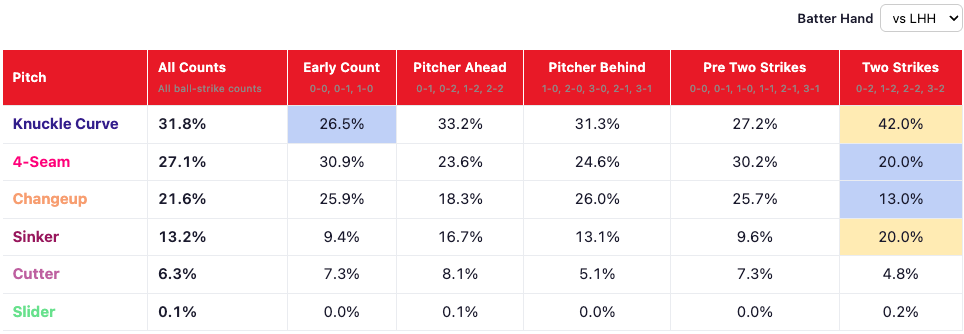
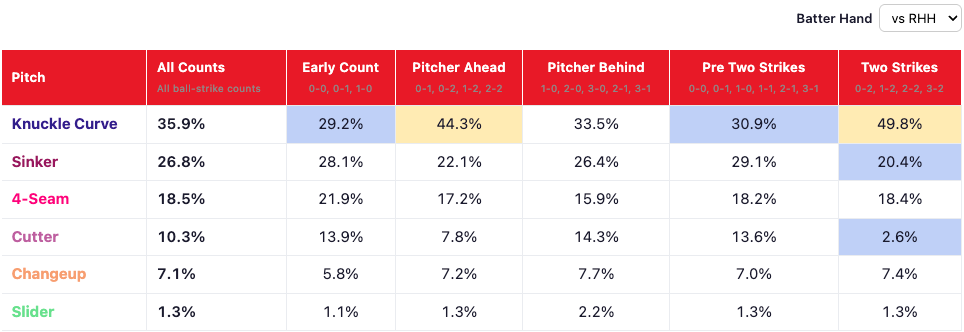
How he attacks hitters (all graphics courtesy of Thomas Nestico)
vs LHH: The goal here is to get to the knuckle curve - Nola goes four-seam/changeup early, ramping up the curve and the sinker when ahead. He throws more cutters early in the at-bat than when he gets to two strikes, while the four-seam and changeup fade out of the picture with two strikes.
vs RHH: It’s knuckle-curves and the fastball family versus righties, with the changeup fading back to a minor role. All three fastballs cut back when he gets ahead in favor of more curves, while the cutter almost entirely fades with two strikes.
Sequencing:
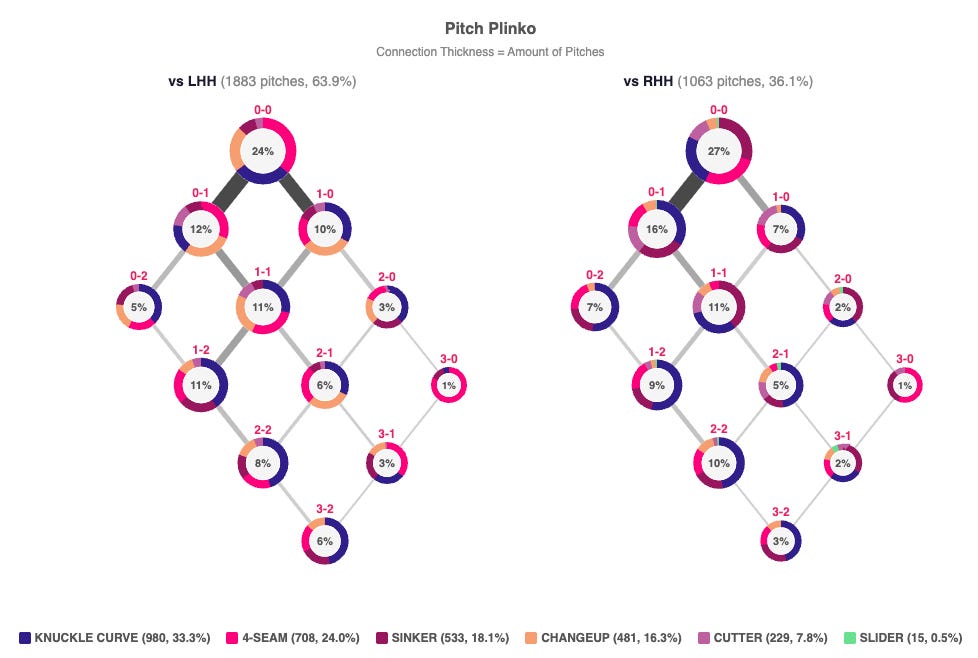
How to read a plinko chart: Each circle represents the usage of a pitcher’s arsenal in a given count (color key is on the bottom of the graphic). The thickness of the connecting lines reflects how often each count occurs, helping show how a pitcher navigates an at-bat.

Are you ready for retirement? Ford Stokes and Zac Blackerby are Braves fans who want to help you make sure you have income for life. Email Zac (zac@activewealth.com) or Ford (ford@activewealth.com) for your free Social Security roadmap today.
Braves Bullpen Status
(Reminder: these are all assumptions based on pitch count and recent usage)
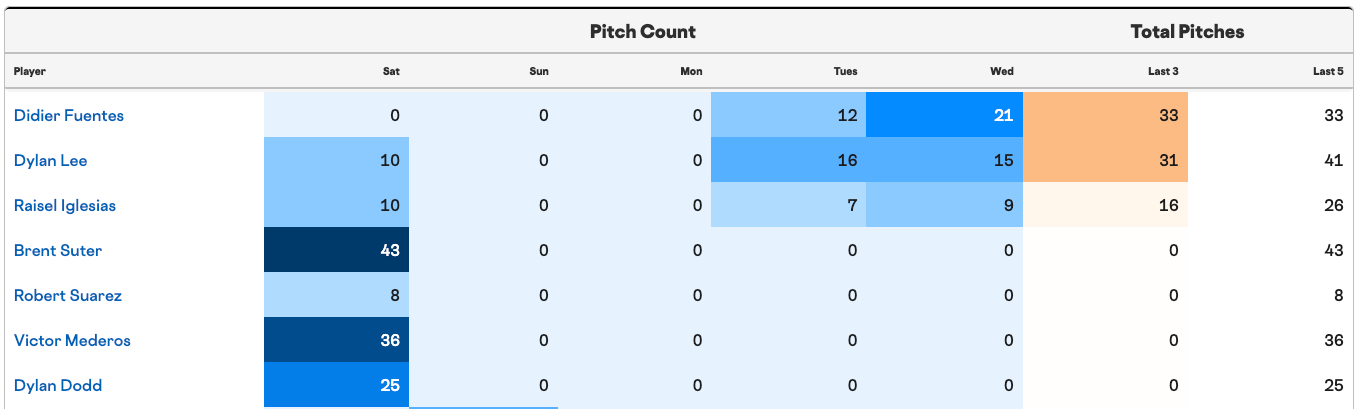
Likely available/potential limitations:
The trio of Didier Fuentes, Dylan Lee, and Raisel Iglesias have pitched in back-to-back days. Lee likely can’t/won’t pitch today, while Fuentes has never been asked to pitch on three straight days. Iglesias has just sixteen pitches and a history of pitching on three consecutive days, so it’s likely he pitches today.
Quick takeaway:
Fuentes getting into today’s game (and how effective he would be if he did) is the big question for game three.
Opponent Bullpen Status
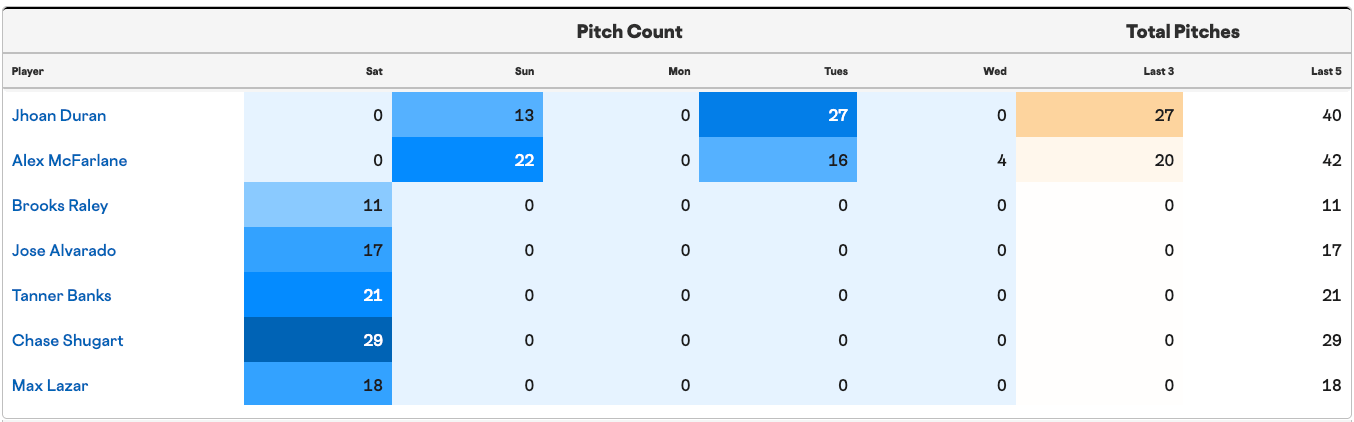
Likely Available/Potential Limitations:
Other than Cristopher Sánchez and Andrew Painter, I can’t imagine anyone is explicitly down today for Philadelphia. Maybe Jesús Luzardo, after 77 pitches on Tuesday.
Quick takeaway:
Does Philly go to Zack Wheeler out of the pen behind Nola to bridge to Jhoan Duran, or are they comfortable asking actual relievers to handle it?
Umpire information
Behind the plate: Mark Ripperger. UmpScorecards lists 31 plate games for him this season, with 94.80% called-pitch accuracy against 94.2% expected accuracy—a difference of 0.60 percentage points above expectation.
He’s typically considered one of the best umpires in the game, with BravesVision analyst CJ Nitkowski noting that his 96% Correct Call percentage is 2nd-best and he gets calls overturned via ABS 10% less often than league average.
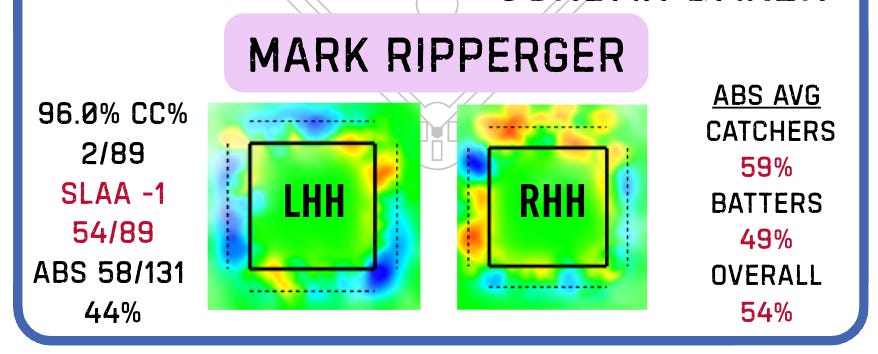
The useful live read is the bottom edge. Kerr’s curveball, Holmes’s slider and Nola’s curveball all create consequential takes there. Game 2 ended when Philadelphia successfully challenged an inside ball call for strike three; the ABS system can become part of a late-game decision again. Watch the zone Ripperger establishes, then whether either catcher challenges a high-value take.
Final Thought
The Braves are -110 on the moneyline to Philly’s -106, practically a toss-up (and these odds were flipped at 3PM), and FanDuel has set the over/under at 7.5 runs. The hinge point is When does the top of Philadelphia’s order get its next look at Holmes?
Kerr’s job is to interrupt the Turner–Schwarber–Harper opening sequence that produced two of yesterday’s decisive swings. Holmes’s slider can carry the middle innings, but his results deteriorated sharply the second time hitters saw him within a game. The critical moment may arrive before the seventh: Schwarber and Harper due up again, Holmes’s pitch count climbing, and Weiss deciding whether the matchup still favors the bulk arm.
For Atlanta’s hitters, the parallel task is to score on Nola’s hittable fastballs before his curveball controls the counts—and before Wheeler or Duran enters the game.
Let’s Talk About It
If you’d rather watch this, here’s the Braves Today live stream from this afternoon, after lineups were announced.
When you DH is batting 9th... You don't have a DH!