


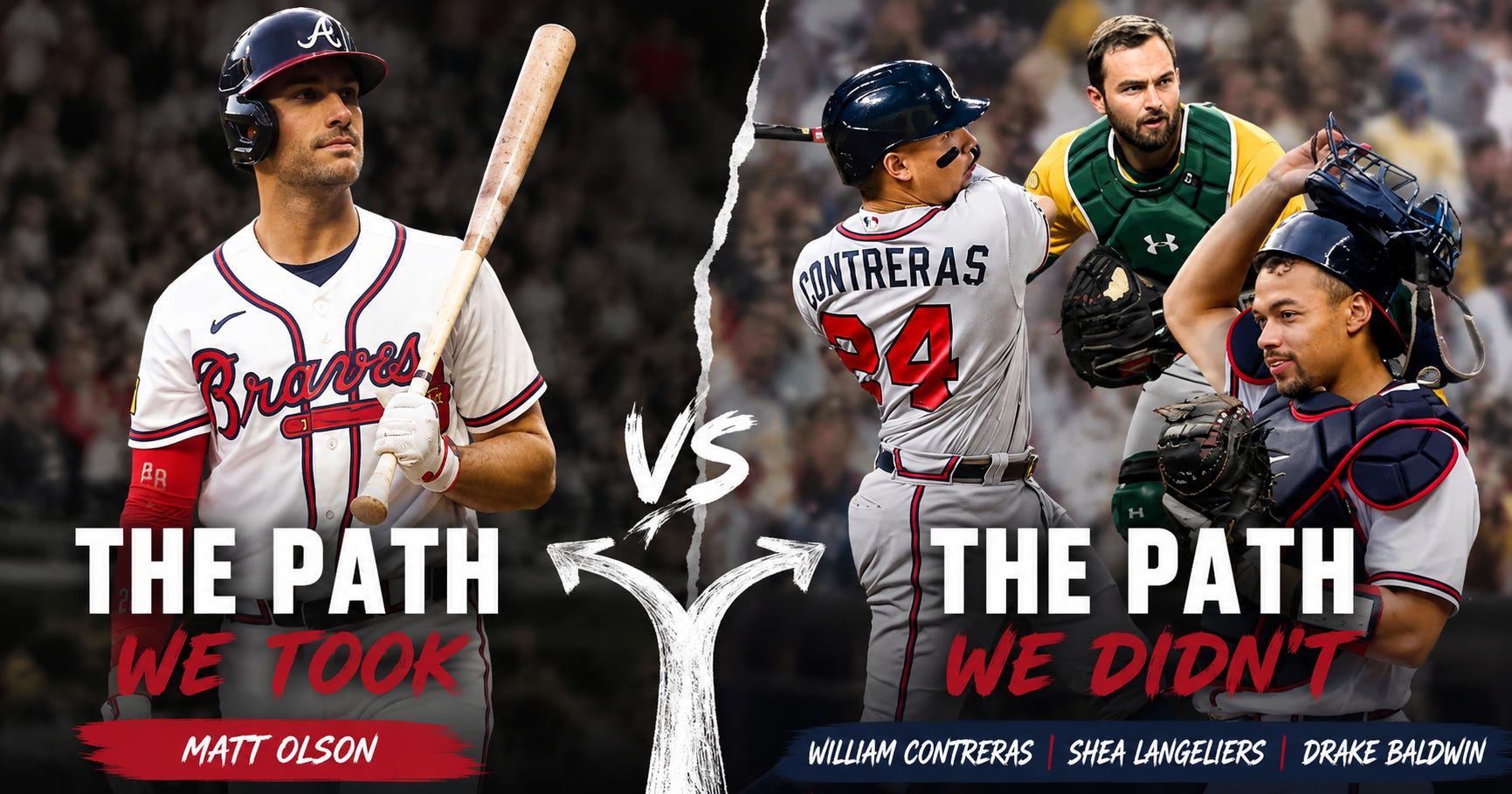
Baseball history is full of organizational fork-in-the-road moments.
The Red Sox selling Babe Ruth. The Expos trading Pedro Martínez. The Rangers choosing between Mark Teixeira and rebuilding. One decision changes payroll structure, prospect development, roster construction, and sometimes the trajectory of an entire franchise for years afterward.
For the Atlanta Braves, one of those moments came in March of 2022.
Franchise first baseman Freddie Freeman left for Los Angeles. Athletics first baseman Matt Olson, an Atlanta native who attended Parkview High School in Lilburn, Georgia, came home via trade and immediately signed an eight-year extension. And just like that, the Braves had their first baseman for the better part of the next decade.
The move worked. Olson has been durable, productive, and at times one of the best power hitters in baseball.
But what’s fascinating isn’t whether Atlanta made the right choice.
It’s what the alternative version of the organization might have looked like if they’d chosen a completely different direction.
Because recent reporting revealed that the Braves internally discussed much stranger solutions at first base than simply replacing Freeman with another star. Free agent Anthony Rizzo was an option. Outfielder Adam Duvall playing first base full-time was apparently an option.
And if Atlanta was willing to consider ideas like that, then another possibility starts becoming interesting to think about:
What if the Braves had simply kept William Contreras and Shea Langeliers, moved Contreras to first base, and built the next era of the roster around a completely different core?
Let’s talk about it.
The Original Fork in the Road
The Atlanta Braves originally extended Freddie Freeman in February of 2014, inking him to an eight-year contract at the age of 24. Valued at $135 million, it was at the time the longest contract in team history and went to a homegrown player.
But as that contract reached its end following Atlanta’s 2021 championship season, tension built around whether Freeman would return on a new deal. Dansby Swanson famously implored the team to re-sign Freddie during the World Series celebration at Truist Park. Hall of Famer Chipper Jones, who spent his entire career in Atlanta and served as a mentor to Freeman, spoke publicly about conversations with Freddie throughout the process.
Ultimately, Alex Anthopoulos and Freeman’s agent, Casey Close, weren’t able to reach a deal after the league’s lockout lifted in March of 2022. The Braves quickly pivoted to Olson, who was rumored to be available from cash-strapped Oakland with only two remaining years of arbitration before free agency.
Atlanta not only made the trade, sacrificing organizational top prospect Shea Langeliers as the centerpiece of the four-player package, but also quickly inked Olson to an eight-year extension just days later.
But what if they’d chosen one of the alternate options instead?
What if Anthony Rizzo or Adam Duvall had manned first base on Opening Day in 2022?
Both would have been short-term fixes. Rizzo, entering his age-32 season, ultimately rejected Atlanta’s one-year offer to sign a multi-year deal with the Yankees before retiring several seasons later. Duvall, meanwhile, was entering his age-33 season and had only one remaining year under contract.
The repercussions could have been significant.
First Base and Catcher Are Linked
The 2021 season was a nightmare for Alex Anthopoulos when it came to catching depth.
The Braves used seven different catchers to survive the regular season due to injuries behind the plate:
Travis d’Arnaud: 53 starts
William Contreras: 47 starts
Kevan Smith: 27 starts
Stephen Vogt: 22 starts
Alex Jackson: 7 starts
Jeff Mathis: 3 starts
Jonathan Lucroy: 2 starts
(Note: This adds up to 161 because the Braves had a late-season game rained out and never made up. Weirdly, “not playing the standard number of games” has become something of a trend for Atlanta championship teams. The Braves played only 144 games in 1995 due to the strike carrying over from 1994, and despite 154 game schedules being the standard, played 155 games in 1957 because of a tie and 158 games in 1914.)
Anthopoulos has jokingly mentioned being “scarred” by that 2021 season, which helps explain why Atlanta now constantly stockpiles veteran catching depth in Gwinnett.
Eventually, Anthopoulos decided to do something more permanent about it.
After already trading Shea Langeliers in the Olson deal, Atlanta moved William Contreras following the 2022 season, acquiring former Gold Glover Sean Murphy in return. Murphy had played 375 games over the previous three seasons with Oakland and immediately signed an extension after the trade.
The reason for the move centered around Contreras’ defense.
His ability to block balls in the dirt and control the running game rated among the worst in baseball in 2022. One veteran Braves starter reportedly refused to let Contreras catch his outings altogether. Anthopoulos openly admitted defense was the primary motivation for the trade, calling Murphy “a premium defensive player at a premium position.”
As a result of those defensive deficiencies, Atlanta gave Contreras more than 30 starts at designated hitter in 2022 and even briefly experimented with him in left field in an effort to keep his bat in the lineup.
Ironically, they never really explored moving Contreras to first base because Olson already occupied it.
That’s notable because moving catchers to first base is hardly unprecedented. Salvador Perez has split time between both spots. Joe Mauer eventually transitioned there permanently. Even Willson Contreras became a quality first baseman for St. Louis last season and was a desirable trade chip over the off-season, ending up in Boston this year.
What if Atlanta had done the same thing with William Contreras?
The William Contreras Experiment
The crux of the alternate timeline is simple:
If the Braves had never traded Shea Langeliers for Matt Olson, they would have had the luxury of moving Contreras elsewhere defensively.
The shift likely happens after the 2022 season.
In the original timeline, Langeliers debuted for Oakland in 2022 before taking over as the Athletics’ primary catcher the following season. In Alternate Atlanta, Langeliers, Contreras, and Travis d’Arnaud likely would have split catching and DH duties in 2022 while either Rizzo or Duvall handled first base for one season.
Then comes 2023.
Langeliers and d’Arnaud share time behind the plate while Contreras takes over at first.
And honestly, there are reasons to think the move could have worked.
The first is athleticism. Contreras never rated especially well defensively behind the plate, but he possessed solid sprint speed for a catcher, along with enough mobility that Atlanta briefly tried him in left field.
The second is that we now have an example within his own family.
Willson Contreras transitioned to first base with the Cardinals in 2025 and immediately rated positively at the position. His +4 Fielding Run Value in 2025 was followed by an even better +5 mark in 2026 with Boston, placing him near the top of MLB defensive leaderboards alongside Matt Olson himself.
William would have attempted the transition younger, lighter, and with considerably less mileage on his knees.
And we’ve seen lesser athletes make similar moves successfully. Kyle Schwarber has survived there at moments in his career. Michael Busch transitioned from third base. So did Vladimir Guerrero Jr., despite carrying far more physical mass than Contreras.
The offensive upside is obvious.
Contreras hit .289/.367/.457 in 2023 while still handling catching duties regularly. Removing some of the physical burden of the position may have unlocked even more offense. During his first season in Milwaukee, Contreras slugged roughly 20 points higher on days he served as a designated hitter instead of a catcher.
Yes, first base carries a much higher offensive bar than catcher. But there’s a very real possibility Contreras still clears it.
Everything Else Changes, Too
The fascinating part here isn’t simply pairing Langeliers and Contreras together.
It’s the downstream effects generated by avoiding both the Olson and Murphy trades altogether.
Here are the prospect packages that left the organization in those two deals:
Olson trade:
C Shea Langeliers
OF Cristian Pache
RHP Ryan Cusick
RHP Joey Estes
Murphy trade:
Veteran C Manny Peña
LHP Kyle Muller
RHP Freddy Tarnok
RHP Royber Salinas
C William Contreras
RHP Justin Yeager
While a lot of those prospects didn’t pan out in the majors, that’s a lot of trade chips for other upgrades.
From a financial perspective, Olson and Murphy combine for roughly $33.2 million annually under their extensions.
And this is where the alternate timeline gets interesting.
Contreras didn’t reach arbitration until 2025. Langeliers didn’t reach arbitration until 2026. Let’s conservatively estimate that the pair costs Alternate Atlanta roughly $2 million annually during the early years of this experiment.
What does an extra $31 million in payroll flexibility change?
Could Atlanta have added a more reliable starter at the 2023 deadline instead of giving innings to Yonny Chirinos, Allan Winans, Kolby Allard, and a 20-year-old AJ Smith-Shawver?
The Braves’ 2023 NLDS loss mostly fell on the offense scoring eight runs in four games. But maybe Game 3 looks different if someone other than Bryce Elder gets the ball.
Or what about 2024?
With Atlanta missing multiple lineup regulars for much of the season, additional payroll flexibility could have dramatically altered the outfield picture. Free agent Teoscar Hernández and his 33 homers certainly would’ve looked more appealing than attempting to rehabilitate Jarred Kelenic. Even a veteran utility player like Isiah Kiner-Falefa could have deepened the roster.
One deleted trade starts changing everything else connected to it.
Enter Baldwin
And then there’s Drake Baldwin.
The 2025 National League Rookie of the Year still likely debuts in this alternate timeline, although perhaps with less immediate opportunity behind Langeliers.
Travis d’Arnaud still probably departs after 2024. Baldwin still likely arrives as Atlanta’s next offensive force behind the plate.
And suddenly, the Braves would have developed three offensively impactful catchers within a remarkably short stretch of time.
At that point, Atlanta might legitimately be viewed as the premier catching factory in baseball.
Or perhaps Baldwin becomes trade capital himself.
If the Braves felt secure with Langeliers long-term, it’s entirely possible Baldwin gets moved in pursuit of a frontline starter. Anthopoulos famously pursued Garrett Crochet following the 2024 season, ultimately losing out to Boston’s package built around catcher Kyle Teel.
Maybe Baldwin becomes Atlanta’s version of Teel in this alternate universe.
That’s the thing about alternate histories in baseball: The changes rarely stop with one player.
The Matt Olson Argument
But here’s the thing.
Despite all the hypothetical flexibility this alternate version of Atlanta possesses, the Braves are probably still a better team with Matt Olson.
His durability alone is almost impossible to quantify. Atlanta literally hasn’t submitted a lineup card without Olson’s name in it since Opening Day of 2022.
His defense remains the standard for first basemen across Major League Baseball. And despite his outwardly quiet demeanor, Olson has become one of the stabilizing leaders of Atlanta’s clubhouse.
More importantly, he gave the Braves certainty.
The loss of Freeman carried the possibility of destabilizing a young roster. Freeman had been the face of the franchise for over a decade and the unquestioned clubhouse leader.
But Olson’s steady, everyday presence immediately gave Atlanta another foundation piece.
The team has slowly started resembling him in a lot of ways: quiet, fundamentally sound, durable, and relentlessly consistent. That’s difficult to quantify statistically. And it’s probably even harder to recreate through short-term free agents or ambitious position changes.
Sure, Alternate Atlanta may have been younger, more flexible, and perhaps even more explosive offensively.
But the version of the Braves we actually got has been more stable, more defensively sound, and more reliable.
And that’s what makes this alternate timeline so fascinating.
Not because it’s clearly better.
Not because the Braves made the wrong decision.
But because the Olson trade didn’t just replace Freddie Freeman. It quietly determined the identity of the next era of Braves baseball.
The Braves didn’t just choose Matt Olson.
They chose an entirely different future.
Thanks for an interesting analysis. A great reminder of how tough it is to be an MLB GM.
I never would have traded Contreras.
People like Contreras and Acuna help you recruit in Latin America and Caribbean.
He was younger, cheaper, and a better hitter.
One of A.A.'s WORST DEALS. Although he seems to have unlimited job security.
But he did a good job this Offseason adding Dubon, Yaz, Mateo and Saurez.
Lots of money coming off the books. Chance for him to make moves.