


Most MLB draft picks fail.
Historically, first-rounders have had a 73-81% chance of making the majors, and a second-rounder comes out to 50-63%. After that, it’s more likely than not that the player doesn’t make the majors, settling in close to 10% by the time you get to rounds 11-20.
And even if a player makes the majors, it’s no guarantee that they’ll make an impact. Roughly 9.8% of draftees, per a Baseball America study, eventually produce even 0.1 career WAR. So when you’re looking at one team’s 20-or-21-player draft class, proper perspective matters. Most of these guys aren’t going to make it.
But that’s no fun.
Because a month into their professional careers, a few members of Atlanta’s 2026 draft class are already doing some really interesting things. And somehow, one of the most intriguing performances of the bunch belongs to a guy Atlanta didn’t draft at all.
Let’s talk about it.
The “overdrafted” outfielder
Atlanta’s first pick at #9, Virginia outfielder AJ Gracia, won’t debut until next season after undergoing shoulder surgery shortly after the draft. The Braves signed him for roughly $4M against a $6.68M slot value, creating significant savings to deploy elsewhere in the class.
They also made significant savings with their second pick in the first round, taking Indiana State outfielder Carter Beck at pick #26. Beck was ranked as more of a second-round talent by several public outlets, making Atlanta's decision to take him at No. 26 one of the more criticized picks of the first night.
Seventeen professional games later, we’re obviously nowhere close to declaring Atlanta right.
Between Single-A Augusta (eleven games) and High-A Rome (six games), he’s hitting .354/.440/.446 with nine runs scored, ten walks to twelve strikeouts, and eight stolen bases. He’s reached base in all but one of his professional games to date, and his 170 wRC+ is 96th percentile in the minors (albeit in a small sample size).
The debut’s not been perfect - he’s been thrown out three times in nine stolen base attempts and he’s not yet been able to tap into his pull-side power (12th percentile Pull Air % of 7.9%), but the high floor is there. If more impact starts showing up in the profile, you can see Atlanta’s draft-day vision beginning to resolve with Beck.
The most productive $500 in baseball
Per Friend of Braves Today Jesús Cano of The Athletic, the Braves shocked some in the industry with their aggressive underslot deals to the players taken in rounds eight through ten of the most recent draft: Just $500.
The selections and aggressive discounting of three out-of-leverage college seniors allowed Atlanta to reserve $653,000 in assigned slot value for their high-upside prep draftees in rounds 2-4.
But unlike most $500 senior signees - players normally destined to fill out the organization’s minor league rosters - ninth-rounder Parker Brosius is already outplaying his bonus.
Coming out of nearby Georgia Tech after a breakout senior year, Brosius has been a revelation in his first taste of professional baseball. Stationed in Single-A Augusta, he’s hitting .286/.390/.469 with 10 stolen bases and 11 runs scored in just 15 games. Per reports, he’s been handling premium velocity while putting up his own stellar exit velocities.
It’s not all perfection at the moment. Brosius, who is nearly two years older than the average Single-A player, is showing an unusually patient approach (41.6% overall swing rate, and only 61.69% in the zone) and yet is still striking out 27.1% of the time - he’s not attacking enough strikes, yet is still striking out too much. His walk rate is also atypical for that level of patience, just 8.5%, low for the minors (25th percentile), meaning that his professional strikeout total (16 in 59 PAs) nearly equals his senior season’s total of 18 in 123 PAs.
But despite the plate discipline profile and the age-to-level working against him, he’s flashed more physical tools than you’d normally expect from a $500 senior sign and looks to potentially be one of the more intriguing senior signs in recent organizational history.
Speaking of budget acquisitions…
If getting that kind of production from a $500 draft pick qualifies as finding value, Atlanta did even better with Daniel Brooks.
They didn’t have to draft him at all.
Many modern undrafted free agents come with an obvious explanation for why nobody selected them. Sometimes it was injury, or they just had a terrible final college season.
And then sometimes, 30 organizations simply miss.
Daniel Brooks went undrafted out of College of Charleston in the 2025 draft, despite an ERA in the low 4s and averaging just under a strikeout per inning in his senior year. He then tore it up in a short stay in the MLB Draft League, striking out ten in just 5.2 innings with just two runs allowed.
He still went unselected, eventually signing a UDFA deal with Atlanta.
And then got to work.
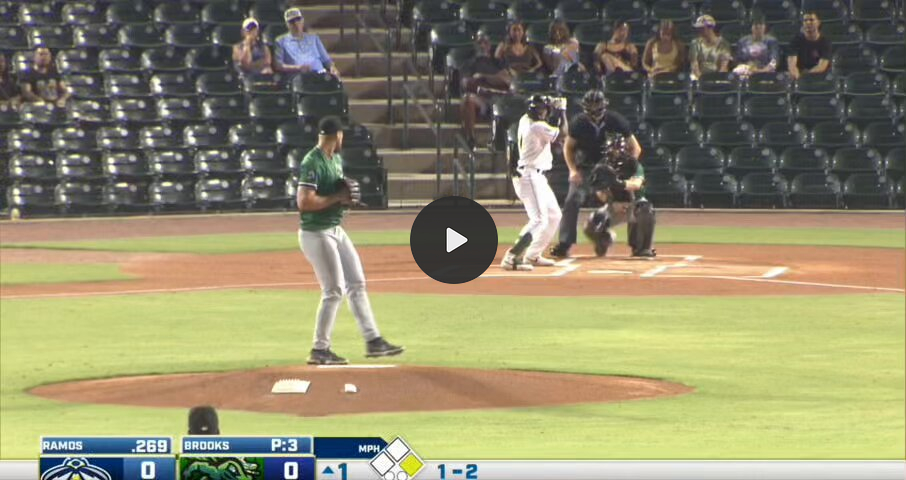
The 6’8, 250-pounder worked as a reliever in the complex league this year, posting a 6.17 ERA, but Atlanta still promoted him to Augusta in June. All he did for the GreenJackets was dominate, allowing just two earned runs in 27.2 innings with 46 strikeouts to only seven walks. The last of those outings was his first professional start, with ten punchies over five scoreless innings with just three hits and no walks.

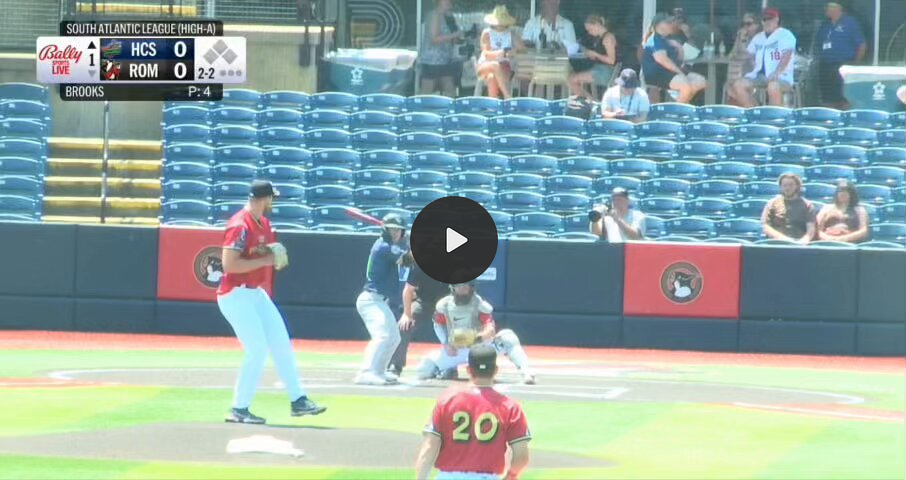
He then got bumped up to Rome and stuck into the Emperors’ rotation, where he struck out six with just one hit and one walk in his High-A debut last week.
It’s a limited package at the moment: a high-slot, low-90s fastball and a mid-80s slider, but a package that’s remarkably consistent thanks to smooth, easy mechanics that Brooks can easily repeat. Plagued by a long arm action early in his career that caused him to struggle to land his curveball and changeup effectively, he’s shortened his throwing motion and added a bit of deception to his delivery.
The next question is whether Atlanta can find another gear. A few more ticks of velocity would dramatically change Brooks’ profile, especially if he can develop a reliable third offering behind the fastball and slider. 93-94 isn’t much to speak of for a pitcher with that frame, Baseball America recently remarked that his velocity has been steadily improving throughout the season, and there is belief that more is coming,
That’s admittedly notable for an organization we’ve criticized for struggling to add velocity to its pitching prospects. If Brooks is one of the exceptions, the Braves may have stumbled into something much more interesting than organizational depth. These are the sort of rapid developmental leaps that could put him on organizational Top 30 lists as soon as next season.
At some point, you stop asking why nobody drafted him and start wondering what Atlanta found after everyone else went home.
Seventeen games don’t make Carter Beck a successful first-round pick. Fifteen games don’t make Parker Brosius the steal of the ninth round, and 33 dominant innings don’t guarantee Daniel Brooks ever throws a pitch in Atlanta.
That’s the point of those depressing draft probabilities at the top of this article.
But player development isn’t about making every pick work. It’s about finding enough wins throughout a class, and occasionally finding one somewhere nobody expected.
A first-round “reach.” A $500 senior sign. A guy nobody drafted.
It’s far too early to know what Atlanta has in any of them.
But that’s no fun.
Good work Linsay !!!
Very good Draft Analysis. Not sure about the Braves underslot/overslot draft strategy. First noticed it in 2022 when they overdrafted Owen Murphy.
Yankees and Dodgers don't use it. Gives me Pause. Not aware anyone else thinks it's a Winning strategy